
海通证券

Search documents
国泰海通|固收:长债供给放量,需要担忧资金收敛吗——一季度银行间资金和存单展望
国泰海通证券研究· 2026-01-13 13:20
Core Viewpoint - The article discusses the outlook for interbank funding and bond supply in the first quarter of 2026, emphasizing that concerns over long-term bond supply do not contradict the continuation of loose funding conditions, with the central bank likely maintaining low interest rates [1][2][3]. Group 1: Funding Conditions - The continuation of loose funding conditions and concerns over long-term bond supply are not contradictory; the current issue is not a lack of liquidity but rather insufficient demand for long-term bonds from institutions [1]. - The central bank's willingness to support interbank funding is crucial; despite seasonal factors and government bond issuance, the central bank's ability to smooth funding fluctuations is expected to remain strong [2][3]. Group 2: Monetary Policy Framework - Since the second half of 2024, the central bank has been iterating its monetary policy framework to enhance liquidity management, which is expected to lead to a stable and relatively loose funding environment in early 2026 [3]. - The central bank may employ various tools, such as large-scale MLF operations or adjustments in reserve requirements, to manage liquidity effectively [3]. Group 3: Deposit Rates and Market Reactions - The article predicts that the central bank's actions will lead to a decline in deposit rates, with a significant portion of fixed-term deposits maturing in the first quarter of 2026, which could further lower rates [3]. - The one-year deposit rate is expected to stabilize around 1.60-1.65%, with a downward trend anticipated as favorable factors emerge [3].



国泰海通研究 · 诚聘英才!
国泰海通证券研究· 2026-01-13 13:20
Group 1 - The article outlines the responsibilities of analysts in the research department, including tracking industry developments and conducting company research [2] - It emphasizes the importance of writing in-depth industry and company research reports to support clients [2] - The article highlights the need for analysts to participate in company investigations, institutional roadshows, and investor communication activities [2] Group 2 - The article specifies the qualifications required for the analyst position, including a master's degree in finance, economics, or related fields [2] - It mentions the necessity for strong logical analysis, data processing, and written communication skills [2] - The article indicates that candidates should have at least one year of relevant research experience and possess securities qualifications [2]

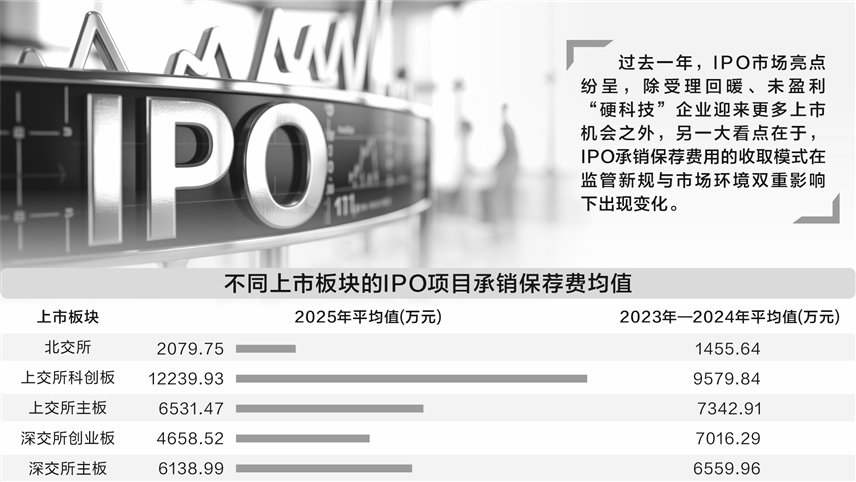
投行IPO承销“调价”大揭秘!新规一年,四大收费模式并存!科创板“最贵”,北交所“涨价”
券商中国· 2026-01-13 12:50
Core Viewpoint - The article discusses the significant changes in the IPO underwriting fee structure in the Chinese market following the implementation of new regulations in February 2025, which have led to a decline in the traditional tiered fee model and a shift towards more flexible pricing strategies [2][3]. Fee Structure Changes - The proportion of IPO cases using the tiered fee model based on fundraising amounts has drastically decreased from approximately 38% in 2023 to 6% in 2025, with most cases now adopting a "decreasing fee rate" standard [2][3]. - The mixed fee model, which combines a fixed rate with minimum or maximum fee clauses, has become the mainstream approach, accounting for 49% of cases [2][6]. Specific Fee Models - The traditional model of "actual fundraising × fixed rate" was used by 26 IPO companies, representing 33% of the market, with underwriting fees typically ranging from 5% to 9% [6]. - A significant number of companies (38) adopted the "fixed rate with limit conditions" model, which includes "minimum fees" or "maximum fees," marking an increase from 25% in 2023 [7]. - Examples of minimum fee structures include a case where the underwriting fee is calculated as "fundraising amount × 7.5%, with a minimum of 9.85 million yuan" [7]. Market Trends - The average underwriting fee for the Sci-Tech Innovation Board reached 122 million yuan in 2025, a notable increase from the previous average of approximately 95.8 million yuan [8]. - Conversely, the average underwriting fees for the main board and the ChiNext board have decreased, with the main board averaging 65.3 million yuan and the ChiNext board dropping over 30% to 46.6 million yuan [8][9]. Concentration of Revenue - The IPO underwriting market continues to exhibit a "head effect," with only 13 securities firms earning over 100 million yuan in underwriting fees in 2025 [10][11]. - CITIC Securities led the market with underwriting fees of 1.097 billion yuan, followed by other major firms like CICC and Guotai Junan, indicating a concentration of high-quality projects among top firms [11][12].

翱捷科技跌7.07% 2022年上市即巅峰超募42亿元
Zhong Guo Jing Ji Wang· 2026-01-13 09:39
Core Viewpoint - Aojie Technology (688220.SH) is currently experiencing a decline in stock price, with a closing price of 92.70 yuan and a drop of 7.07%, indicating a state of being below its initial public offering (IPO) price [1] Group 1: IPO Details - Aojie Technology was listed on the Shanghai Stock Exchange's Sci-Tech Innovation Board on January 14, 2022, with an issuance of 41.83 million shares at an initial price of 164.54 yuan per share [1] - On its first trading day, Aojie Technology's stock opened below the IPO price, reaching a maximum price of 130.11 yuan, which was the highest price since its listing [2] - The total funds raised from the IPO amounted to 6.883 billion yuan, with a net amount of 6.546 billion yuan after deducting issuance costs, exceeding the original plan by 4.166 billion yuan [2] Group 2: Fund Allocation - The funds raised are intended for several projects, including the design of new communication chips, smart IPC chip design, integrated solutions for various wireless protocols, high-precision navigation and positioning, research center construction, and working capital supplementation [2] - The total issuance costs for the IPO were 337 million yuan, with underwriting and sponsorship fees accounting for 310 million yuan [3]

国泰海通证券:中国航天发射创新高 军工市场迎发展新机遇
Xin Lang Cai Jing· 2026-01-13 08:58
Core Viewpoint - The military industry is poised for long-term growth due to recent global developments, including China's record space launches and the U.S. plans to significantly increase military spending, alongside the intensifying geopolitical competition among major powers [1][7]. Group 1: China's Aerospace Achievements - In 2025, China achieved a record of 92 space launches, sending over 300 satellites into orbit, marking a qualitative leap in both launch frequency and satellite deployment [2][8]. - Significant milestones include the Shenzhou 20 mission with a crew duration record of 204 days, the Shenzhou 21's rapid docking record of 3.5 hours, and the successful execution of a 16-day emergency launch protocol [2][8]. - Looking ahead to 2026, China plans to initiate various tests for its manned lunar landing project and the Chang'e 7 mission to search for water ice on the Moon [2][8]. Group 2: Global Military Dynamics - The U.S. military budget is proposed to increase from $1 trillion to $1.5 trillion for the fiscal year 2027, aimed at creating a "dream army" to address current global threats [3][9]. - The Pentagon plans to significantly boost the production of the "Patriot" missile system, increasing the annual output of the PAC-3 MSE missiles from approximately 600 to 2000 units [3][9]. - The U.S. Air Force has selected Northrop Grumman's new autonomous drone, "Reaper," as a leading candidate for collaborative combat aircraft projects [3][9]. Group 3: Military Sector Performance - The military sector showed strong performance in the week of January 5-9, 2026, with the defense and military index rising by 14.56%, outperforming the broader market by 10.74 percentage points [5][11]. - Notable stock performances include Galaxy Electronics (up 60.96%), Nanjing Panda (up 49.10%), and Zhenlei Technology (up 48.18%) [5][11]. - A significant breakthrough in domestic military technology was achieved with the successful first flight of the LQ-150 drone, which features a low-cost, multi-purpose flight control system [5][11]. Group 4: Investment Recommendations - The military sector is expected to accelerate its development during the 14th Five-Year Plan, with a focus on enhancing capabilities in aerospace and satellite internet [6][12]. - Key investment areas include assembly sectors like AVIC Shenyang Aircraft, component sectors like AVIC Optoelectronics, subsystem sectors like Aero Engine Corporation of China, and materials processing sectors like AVIC High-Tech [6][12].
工厂取消休假!光伏产品出口退税将全面取消,一波抢运潮来袭
Mei Ri Jing Ji Xin Wen· 2026-01-13 07:29
Core Viewpoint - The announcement to cancel the export VAT rebate for photovoltaic products starting April 1, 2026, will increase export costs for solar companies, prompting many to expedite shipments before the deadline [1]. Group 1: Policy Impact - The cancellation of the 9% export VAT rebate is expected to raise export costs for photovoltaic companies, leading to increased urgency in shipping products before the policy takes effect [1]. - The China Photovoltaic Industry Association noted that since 2024, the export prices of photovoltaic products have been declining, indicating a "volume increase, price decrease" trend [2]. - The adjustment in export VAT is seen as a long-term measure to stabilize export prices and reduce trade friction, although it is not the sole solution to the industry's challenges [2]. Group 2: Shipping and Logistics - A surge in shipping demand is anticipated as companies rush to export before the policy change, which may help alleviate seasonal declines in shipping rates [2]. - As of January 9, the Shanghai export container freight index was at 1647.39 points, down 0.5% from the previous period, with slight fluctuations in shipping rates across various routes [2]. - Despite the urgency from manufacturers, logistics companies indicate that the impact of the VAT policy change has not yet fully reached the logistics sector, and some companies have already developed contingency plans [2]. Group 3: Future Projections - Following the VAT policy adjustment, a significant drop in photovoltaic component export volumes is expected, with potential shipping volumes post-Chinese New Year estimated between 9,300 to 12,300 FEU per month [3][4]. - The main contract for the European shipping index (EC2604) experienced a notable increase, suggesting that the upcoming policy change may provide temporary support for shipping rates [3][4]. - Analysts predict that while there may be short-term benefits from increased shipping activity, the overall export volume of photovoltaic components will likely decline significantly in the future, putting pressure on long-term shipping rates [4].
工厂取消休假,召回员工加班!光伏产品出口退税将全面取消,有物流公司称“一波‘抢运潮’进入倒计时”
Mei Ri Jing Ji Xin Wen· 2026-01-13 07:03
Core Viewpoint - The announcement on January 9 regarding the adjustment of export tax rebate policy for photovoltaic products will lead to the cancellation of the 9% VAT export rebate starting from April 1, 2026, increasing export costs for solar companies [1]. Group 1: Export Tax Rebate Policy - The cancellation of the 9% VAT export rebate is expected to raise export costs for photovoltaic companies, prompting many factories to cancel worker vacations and increase production [1]. - The adjustment is seen as a measure to curb the rapid decline in export prices and reduce trade friction, although it is not the only solution to the industry's challenges [2]. Group 2: Market Reactions and Logistics - The China Photovoltaic Industry Association noted a "volume increase and price decrease" trend in export prices since 2024, with some companies passing the rebate loss to foreign buyers, leading to profit erosion [2]. - A surge in shipping demand is anticipated, although current booking volumes have not increased significantly, and logistics companies are preparing for this potential rush [2][3]. Group 3: Future Export Trends - Following the adjustment, a significant drop in photovoltaic component export volumes is expected, with potential shipping volumes post-Spring Festival estimated between 9,300 to 12,300 FEU per month [4]. - The main contract for the European shipping index EC2604 saw a notable increase, influenced by the expected rush in shipments due to the tax rebate policy change [4][5].

IPO承销保荐费格局生变
Jing Ji Wang· 2026-01-13 06:36
Core Insights - The IPO market is experiencing significant changes in underwriting and advisory fee structures due to new regulations and market conditions, with a notable shift from the previously dominant tiered fee model to a mixed fee model that includes fixed rates and minimum or maximum fee clauses [4][5] Fee Structures - The tiered fee model, which was prevalent in 2023 with 38% of cases, has drastically decreased to 6% by 2025, with most remaining cases adopting a decreasing fee percentage [3][4] - The traditional model of "actual fundraising amount × fixed rate" is now used by 33% of IPOs in 2025, with underwriting fees typically ranging from 5% to 9% [4] - A new model combining fixed rates with limit conditions has gained traction, with 49% of IPOs in 2025 utilizing this approach, up from 25% in 2023, primarily due to changing fundraising expectations [5] - The "one-price" fee model has been adopted by 12% of IPOs in 2025, focusing on direct pricing for online offerings [5] Market Trends - The average underwriting fee for the Sci-Tech Innovation Board reached 1.22 billion yuan in 2025, a significant increase from the previous average of 957.98 million yuan [7] - Conversely, the average underwriting fees for the main board and the ChiNext board have decreased, with the main board averaging 65.31 million yuan and the ChiNext board at 46.58 million yuan, reflecting a decline of over 30% for the ChiNext board compared to previous years [7][8] - The Beijing Stock Exchange has seen a notable increase in IPO fees, with an average of 20.80 million yuan in 2025, up 43% from the previous average of 14.56 million yuan [8] Market Concentration - The IPO underwriting market continues to exhibit a "head effect," with a small number of securities firms capturing the majority of market share, as only 13 firms generated over 100 million yuan in IPO revenue in the past year [9] - CITIC Securities leads the market with nearly 1.1 billion yuan in underwriting fees, followed by CITIC Construction Investment and Guotai Junan, indicating a concentration of high-quality projects among top firms [9]



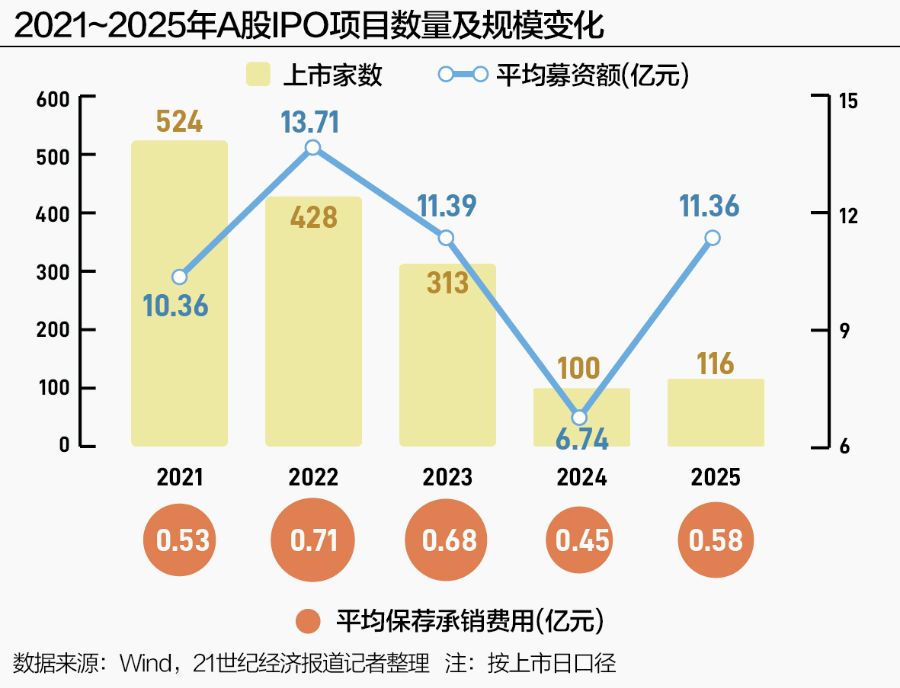
五年IPO变局 券商投行谁在潮头?
2 1 Shi Ji Jing Ji Bao Dao· 2026-01-13 05:55
Core Insights - The A-share and Hong Kong IPO markets have shown signs of recovery in 2025, leading to discussions about a potential "IPO boom" [1] - The last significant IPO year for both markets was in 2021, marking a peak in IPO numbers and fundraising [2] A-share Market Summary - In 2025, the number of new A-share listings increased to 116, with total fundraising reaching 131.8 billion yuan, nearly doubling year-on-year [3] - The average fundraising amount per IPO rose significantly to 11.36 million yuan, with average underwriting fees for brokers increasing to 0.58 million yuan [7] - The focus has shifted from quantity to quality, with a notable increase in the "value" of individual projects [7] - The largest IPOs in recent years have transitioned from traditional sectors to technology-driven companies, particularly in semiconductors and renewable energy [11] - Leading brokers like CICC and CITIC Securities have maintained their competitive edge, with CICC involved in three of the largest IPOs in the past five years [12][13] Broker Competition in A-share Market - The competition among brokers has evolved, with CITIC Securities and CICC dominating the top spots in underwriting [13][14] - In 2025, the merger of Haitong Securities and Guotai Junan created a new leader in underwriting volume, while the competition in the lower tiers has intensified [14] - CITIC Securities has consistently led in underwriting revenue, with significant contributions from high-quality projects [15][16] Hong Kong Market Summary - The Hong Kong IPO market has experienced a "V-shaped" recovery, with total fundraising in 2025 exceeding 285.8 billion HKD, reclaiming the top position globally [20] - The average fundraising amount per IPO surged to 24.43 million HKD in 2025, driven by large projects from leading companies [20][22] - The narrative of the Hong Kong IPO market has shifted from internet-driven stories to technology and manufacturing innovations [22] Broker Competition in Hong Kong Market - Foreign investment banks like Morgan Stanley and Goldman Sachs continue to hold key positions in large IPO projects, while Chinese brokers are increasing their participation [23][24] - The rise of Chinese brokers, particularly in joint underwriting roles, reflects their growing influence in the Hong Kong market [24][25] - Futu Securities has consistently led in the number of IPOs underwritten, while traditional bank-affiliated brokers are also making significant contributions [25][28] Future Outlook - The consensus indicates a more active IPO market in 2026, but challenges related to supply and market absorption capacity are anticipated [29] - The ability of brokers to price assets and manage project depth will be crucial for success in the upcoming years [29]
保险证券ETF(515630)涨超2%,基本面改善+估值修复进行时
Xin Lang Cai Jing· 2026-01-13 02:35
Group 1 - The Shanghai Municipal Government has issued measures to promote the quality and efficiency of the service industry and boost consumption, including encouraging health insurance products specifically for the elderly and supporting insurance products that provide care services for special groups [1] - Despite short-term fluctuations, the fundamental improvement logic of the insurance sector remains intact, with valuations expected to continue recovering towards 1x PEV due to factors such as stable interest rates, rising equity markets, and decreasing liability costs [1] - The insurance sector's performance in the first half of 2026 is anticipated to exceed expectations, supported by a low base in the first half of 2025, where some companies reported negative double-digit profit growth year-on-year [1] Group 2 - As of January 13, 2026, the CSI 800 Securities Insurance Index has risen by 1.99%, with significant gains in constituent stocks such as Hualin Securities (up 10.02%) and China Life (up 5.06%) [1] - The CSI 800 Securities Insurance Index is based on the CSI 800 Index and includes securities from the insurance sector, providing investors with diverse investment options [2] - The top ten weighted stocks in the CSI 800 Securities Insurance Index account for 64.71% of the index, including major companies like China Ping An and China Life [2]