
红旗连锁

Search documents
星巴克中国业务重新出发,成败几何?
日经中文网· 2025-11-05 02:54
Core Viewpoint - Starbucks is selling 60% of its Chinese business to local investment fund Boyu Capital amid increasing competition from domestic brands like Luckin Coffee, aiming to restructure its operations in China with a new joint venture valued at $4 billion [1][3]. Group 1: Starbucks' Market Position - Starbucks opened its first store in China in 1999, promoting coffee culture in a market where coffee was not yet popular [4][5]. - Starbucks was once the leading coffee chain in China but has now fallen to third place in terms of store count, with approximately 7,828 stores compared to Luckin Coffee's 26,117 and Koole's over 13,000 [6][8]. Group 2: Competitive Landscape - The rise of consumer price sensitivity has led to increased competition from local brands like Luckin Coffee, which offers lower prices (e.g., Starbucks' Americano starts at 27 yuan, while Luckin's can be as low as 14 yuan with coupons) [5][8]. - Consumers are increasingly viewing Starbucks as a luxury brand, leading to a shift towards more affordable local coffee chains [5][8]. Group 3: Future Plans and Strategies - Boyu Capital plans to leverage its experience to enhance Starbucks' brand image and expand into untapped markets, aiming to increase the number of stores in China from 8,000 to 20,000 [3]. - Starbucks has initiated strategies to attract customers, such as lowering prices on tea beverages and allowing students to use stores as study spaces, providing free power and water [10].



秀硬科技看“大家伙” 顶尖好物集体亮相 进博会国家展不仅有特色美食文化展品 还设置大量体验交互项目
Jie Fang Ri Bao· 2025-11-05 01:58
Core Points - The 8th China International Import Expo has officially opened, showcasing top products from 67 countries and international organizations [1] - The National Exhibition is a popular venue for countries to display their unique products and cultural heritage, with increased interactivity this year [1] Group 1: China's Technological Showcase - The China Pavilion features advanced technology elements, including humanoid robots and interactive experiences that highlight China's economic and social development achievements during the 14th Five-Year Plan [2] - China ranks 10th in the global innovation index and 1st in effective invention patents, with over 4 million patents [2] - Interactive zones allow visitors to experience high-speed trains and advanced technologies like 6G applications and brain-computer interfaces [2] Group 2: Guest Country Highlights - Six countries, including Sweden and the UAE, are guest countries this year, with Sweden showcasing a new high-end truck that saves up to 10% in fuel consumption [3] - Georgia uses a large LED screen to display its culture and features an open kitchen for traditional cooking demonstrations [3] - Thailand has created a display inspired by local architecture, featuring snacks, beauty products, and traditional massage experiences [3] Group 3: Culinary Experiences - Food tasting remains a popular attraction, with Serbia offering customized tasting experiences and Brazil featuring barbecue tastings in collaboration with local beverage brands [4] - Argentina will showcase its beef, wine, and traditional desserts, while Greece presents its traditional yogurt and salads [4] Group 4: Cultural and Economic Exchange - The Russian exhibition highlights the country's achievements in various fields and showcases handcrafted cultural artifacts [5] - The expo facilitates industry connections, with 14 countries participating in both national and enterprise exhibitions to promote their cultural and economic strengths [5]
星巴克中国“告别”西雅图
虎嗅APP· 2025-11-04 23:57
Core Viewpoint - Starbucks has decided to sell 60% of its Chinese business to Boyu Capital for $4 billion, marking a significant shift in its operational strategy in China [4][20]. Group 1: Transaction Details - The transaction is expected to be completed before the second quarter of Starbucks' fiscal year 2026, with Starbucks China continuing to report to Seattle until then [5]. - Boyu Capital will hold a maximum of 60% equity in the joint venture, while Starbucks retains 40% and continues to own the brand and intellectual property [20]. - The valuation of Starbucks' retail business in China is estimated at $13 billion, which includes the equity transferred to Boyu and the retained equity value [20]. Group 2: Management Changes - Liu Wenjuan will succeed Wang Jingying as CEO of Starbucks China after her retirement in January 2025, and will continue to report to Seattle [6][7]. - The decision to not continue the position of Chairman after Wang's retirement indicates a shift in the governance structure of Starbucks China [6]. - There is speculation that the influence of Seattle on Starbucks China has diminished, allowing for greater autonomy in decision-making [6][9]. Group 3: Performance Metrics - Starbucks China reported a revenue of $3.105 billion for the fiscal year 2025, reflecting a 5% year-over-year growth [7]. - The operating profit margin has remained in double digits for four consecutive quarters, indicating a positive trend in financial performance [7]. Group 4: Strategic Vision - Boyu Capital aims to expand Starbucks' store count in China to 20,000, significantly increasing from the current 8,011 stores by the end of fiscal year 2025 [9][22]. - Liu Wenjuan's strategy includes product innovation, dynamic pricing adjustments, and focusing on underperforming stores while targeting younger demographics [10][24]. Group 5: Market Context - The Chinese coffee market is experiencing intense competition, with brands like Luckin Coffee and others rapidly expanding their store networks [22][24]. - Starbucks is perceived to be in need of a transformation to maintain its premium image amidst rising competition and changing consumer preferences [25]. Group 6: Boyu Capital's Background - Boyu Capital has a strong track record in investments, with a historical internal rate of return (IRR) of over 25%, indicating its capability to drive Starbucks China's growth [15]. - The firm has previously invested in various successful projects, enhancing its credibility and potential to support Starbucks in navigating the Chinese market [15][19]. Group 7: Future Implications - The partnership with Boyu is expected to provide Starbucks China with the necessary resources for digital and store upgrades, addressing the need for significant investment in infrastructure [24]. - The collaboration may lead to a more localized decision-making process, allowing Starbucks to respond more effectively to market changes [21].

博裕投资将控股星巴克中国
Mei Ri Jing Ji Xin Wen· 2025-11-04 13:20
Core Viewpoint - Starbucks has entered a strategic partnership with Boyu Capital to establish a joint venture for its retail operations in China, marking a new chapter after 26 years in the market [1][3]. Group 1: Joint Venture Details - Boyu Capital will hold up to 60% equity in the joint venture, while Starbucks retains 40% and continues to own and license its brand and intellectual property [1]. - The enterprise value of the joint venture is approximately $4 billion, excluding cash and debt, which will determine Boyu Capital's corresponding equity [1]. Group 2: Market Potential and Growth Plans - Starbucks anticipates that the total value of its retail business in China will exceed $13 billion, comprising the equity transferred to Boyu Capital, retained equity, and future licensing revenue [3]. - The new joint venture will be headquartered in Shanghai and aims to expand Starbucks' store count in China from over 8,000 to 20,000 [4]. Group 3: Strategic Insights and Leadership - Starbucks' CEO Brian Niccol emphasized that Boyu Capital's local market expertise will accelerate Starbucks' expansion, particularly in smaller cities and emerging regions [4]. - Boyu Capital's partner Huang Yuzheng expressed a commitment to enhancing customer experiences through innovative and localized offerings [4]. Group 4: Historical Context and Comparisons - Boyu Capital, founded in 2011, has a diverse investment portfolio and has previously invested in notable projects such as Alibaba and NetEase Cloud Music [5][6]. - The partnership reflects a trend seen with other companies like Yum China and McDonald's, which have successfully accelerated growth in China by partnering with local investors [10][11].
星巴克迎中国合伙人 能否撑起下沉市场的盈利预期?
Jing Ji Guan Cha Wang· 2025-11-04 11:53
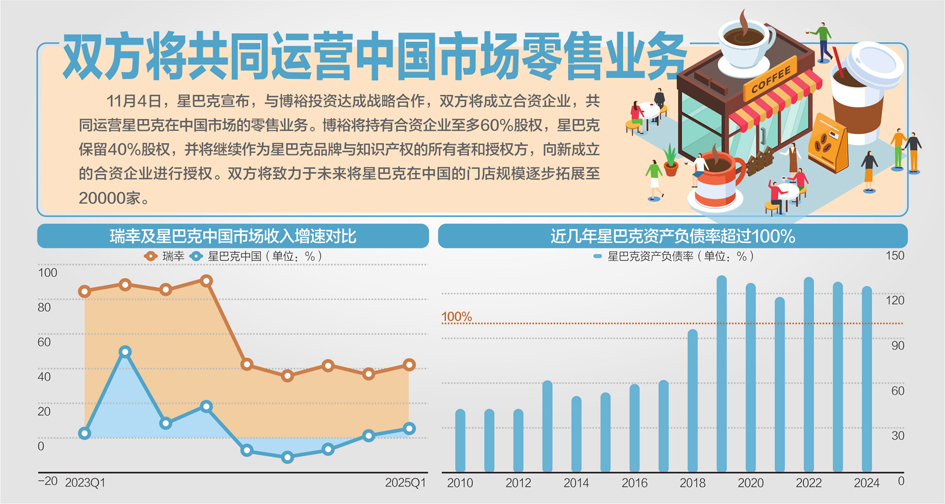
Core Insights - Starbucks has entered a strategic partnership with Boyu Capital to form a joint venture for its retail operations in China, with Boyu holding up to 60% equity and Starbucks retaining 40% [2] - The estimated enterprise value of Starbucks' retail business in China exceeds $13 billion, which includes the value from the joint venture and ongoing brand licensing fees [2] - The partnership indicates a shift in control of Starbucks' operations in China to a local entity, reflecting a broader trend of foreign brands seeking local partnerships to enhance competitiveness [5][8] Financial Performance - In fiscal year 2024, Starbucks China reported revenues of $2.958 billion, a decline of 1.4% year-on-year, while fiscal year 2025 is expected to show a slight recovery with revenues projected at $3.105 billion, representing a 5% increase [3] Boyu Capital Overview - Boyu Capital is recognized as a top private equity firm in China, co-founded by former executives from China Ping An Group and TPG Capital, focusing on sectors like technology, consumer retail, and healthcare [4] - The firm has a diverse investment portfolio, including notable companies such as NetEase Cloud Music and Perfect Diary, and is known for its strategic investments in emerging markets [4] Market Dynamics - The Chinese consumer market is characterized by intense competition, with local brands employing aggressive pricing strategies to capture market share, posing challenges for foreign brands like Starbucks [5] - The partnership with Boyu Capital is seen as a necessary evolution for Starbucks to adapt to local market conditions and optimize its operations in lower-tier cities [6][7] Future Expansion Plans - The newly formed joint venture aims to expand Starbucks' store count in China from 8,000 to 20,000, indicating a significant growth strategy in the Chinese market [6] - The operational headquarters will remain in Shanghai, and the joint venture will focus on adapting to the unique challenges of the lower-tier market [6] Strategic Shift - Starbucks is transitioning from a direct operator to a brand licensor, which reduces operational risks and allows for a more flexible approach to market expansion [6][7] - This shift mirrors similar strategies employed by other foreign brands, such as McDonald's, which have sought local partnerships to enhance their market presence in China [8]

产业互联网,新茶饮的下一个金矿
Sou Hu Cai Jing· 2025-11-04 10:44
Core Insights - The new tea beverage industry is transitioning from a growth phase to an industrial transformation phase, with players exploring various strategies such as international expansion, cross-industry collaboration, and supply chain optimization [2][3][4] - The focus is shifting from consumer-driven growth to industry-led development, indicating a significant change in the operational dynamics of the new tea beverage sector [2][4] Supply Side Developments - The supply side of the new tea beverage industry is releasing new potential, with players integrating and upgrading their supply chains to meet evolving consumer demands [3][4] - Players are investing in building their own supply chains, enhancing infrastructure from raw material sourcing to cold chain logistics, and upgrading equipment and digital capabilities in stores [3][4] Cost Efficiency and Upgrades - New tea beverage players are achieving cost reduction and efficiency improvements, amplifying scale effects and driving iterative upgrades within the industry [4] - This transformation is leading to a digital and industrialized supply side, which is expected to generate new growth opportunities and shift the focus from consumer demand to supply-side capabilities [4] New Imagination and Branding - The industry is witnessing innovative branding efforts, such as serialized novels on receipts and the creation of IPs and merchandise, exemplified by leading players like Mixue Ice City [5][6] - These initiatives reflect a broader trend of players seeking to redefine their brand identities and explore new avenues for growth [6][7] Demand Side Changes - The demand side is undergoing profound changes, with consumers increasingly seeking healthier options, such as sugar-free beverages, and showing interest in product derivatives [8][9] - This shift in consumer preferences is opening new market opportunities for players in the new tea beverage sector, necessitating a reevaluation of traditional supply models [8][9] Industry Internet as a Key Driver - The concept of industrial internet is emerging as a crucial factor for the new tea beverage industry, as players look to leverage it to meet new consumer demands and unlock growth potential [9] - The focus on industrial internet signifies a strategic pivot for players aiming to find new growth points and capitalize on the evolving landscape of the new tea beverage market [9]

星巴克中国易主,未来将再开1.2万家店
Hua Er Jie Jian Wen· 2025-11-04 10:35
Core Insights - Starbucks has announced a strategic partnership with Chinese alternative asset management firm Boyu Capital to establish a joint venture for its retail operations in China, marking the first time in 26 years that Starbucks has relinquished control of its Chinese business [2][6] - Boyu Capital will hold up to 60% of the joint venture, investing approximately $2.4 billion (about 173 billion RMB), while Starbucks retains 40% ownership and continues to own the brand and intellectual property [2][3] - The joint venture aims to expand Starbucks' store count in China from 8,000 to 20,000, with a current valuation of over $13 billion for Starbucks' retail business in China [3][5] Company Strategy - The partnership is seen as a strategic adjustment for Starbucks in response to increasing competition from local brands like Luckin Coffee and CoCo [6][10] - Starbucks' CEO Brian Niccol emphasized the need for a fundamental change in strategy to restore growth, particularly in the face of declining global comparable store sales [4][6] - The collaboration allows Starbucks to gain significant cash flow while still benefiting from future growth in the Chinese market through retained equity and ongoing licensing fees [6][10] Market Performance - Starbucks China reported a revenue of $831.6 million for Q4 of fiscal year 2025, a 6% year-over-year increase, marking four consecutive quarters of growth [5] - For the full fiscal year 2025, Starbucks China achieved a total revenue of $3.105 billion, reflecting a 5% increase, which is higher than the global average growth rate [5] - The joint venture comes at a time when Starbucks is experiencing a divergence in performance between its global and Chinese markets [4][5] Competitive Landscape - The deal attracted interest from over 20 capital firms and business giants, indicating a competitive environment for Starbucks' Chinese operations [7][8] - Boyu Capital's expertise in local market operations is expected to accelerate Starbucks' expansion, particularly in lower-tier cities [8][9] - The historical performance of Boyu Capital, with a net internal rate of return exceeding 25%, positions it as a strong partner for Starbucks in navigating the competitive landscape [9] Historical Context - This partnership is part of a broader trend where foreign brands in China seek local partnerships to enhance market penetration, similar to past collaborations like McDonald's with CITIC and Coca-Cola with COFCO [10] - The establishment of the joint venture signifies a new phase for Starbucks in China, referred to as the "2.0 era," aiming to unlock significant market potential [10]
在华零售业务“交权”,一个更本土的星巴克要来了:下沉战场成焦点
Sou Hu Cai Jing· 2025-11-04 10:11
Core Insights - Starbucks has entered a strategic partnership with alternative asset management firm Boyu Capital to establish a joint venture for its retail operations in China, marking a significant capital restructuring since its entry into the Chinese market 26 years ago [2][3] - The joint venture will allow Boyu to hold up to 60% equity, while Starbucks retains 40% and continues to own and license its brand and intellectual property [3] - The partnership aims to expand Starbucks' store count in China from approximately 8,000 to 20,000, reflecting a new strategic focus on deepening its market presence [3][6] Retail Business Control - The core of the transaction is the transfer of control over Starbucks' retail business in China to Boyu, which will manage the joint venture [3] - The estimated enterprise value of the retail business is around $4 billion, excluding cash and debt, with Starbucks' retail business in China valued at over $13 billion [3] - The joint venture will be headquartered in Shanghai and will manage Starbucks' existing stores while pursuing aggressive expansion [3][6] Market Competition - The Chinese coffee market is becoming increasingly competitive, with local brands like Luckin Coffee rapidly gaining market share through lower price points and faster expansion [4][7] - Starbucks aims to maintain its high-end brand positioning and avoid price wars that could dilute its brand value, emphasizing the importance of its "third space" experience [4][5] - The partnership with Boyu is seen as crucial for navigating the competitive landscape, particularly in lower-tier cities where local brands are expanding aggressively [6][8] Expansion Strategy - Starbucks has reported steady growth in its Chinese operations, with revenues reaching $3.105 billion in the fiscal year 2025, a 5% year-on-year increase [6] - The company opened 183 new stores in the fourth fiscal quarter and entered 47 new county-level markets, with a total of 415 new stores for the fiscal year [6] - The focus on lower-tier markets is expected to drive future growth, with a projected CAGR of 24.7% for coffee shops in third-tier cities and below from 2023 to 2028 [7][8] Operational Challenges - Starbucks faces challenges in balancing its high-end brand identity with the need to adapt to local market conditions, particularly in terms of operational costs in lower-tier cities [8] - Suggestions for overcoming these challenges include developing smaller, more cost-effective store formats and potentially launching independent brands to capture market share in lower-tier markets [8]
星巴克中国易主 博裕投资拿下60%股权
Xi Niu Cai Jing· 2025-11-04 06:52
Core Insights - Starbucks has entered a strategic partnership with Chinese alternative asset management firm Boyu Capital, marking the first time in 26 years that Starbucks has relinquished control of its business in China [1][3] - The joint venture will operate Starbucks' retail business in China, with Boyu Capital holding up to 60% equity and Starbucks retaining 40% while continuing to license its brand and intellectual property [1][3] Financial Overview - The transaction is based on an enterprise value of approximately $4 billion, excluding cash and debt, with Starbucks estimating the total value of its retail business in China to exceed $13 billion [3] - This valuation includes proceeds from the equity sale, the value of the remaining 40% stake, and expected licensing revenues over the next decade [3] Market Expansion Plans - The new joint venture will be headquartered in Shanghai and will manage the existing 8,000 stores, with plans to expand the store count to 20,000 [3] - The partnership aims to leverage local expertise to accelerate expansion into smaller cities and emerging regions in China [3] Competitive Landscape - Starbucks' performance in China is showing signs of recovery, with projected revenue of $3.105 billion for fiscal year 2025, reflecting a year-on-year increase of 5% [3] - However, the company faces significant competition from Luckin Coffee, which operates over 24,000 stores [3]
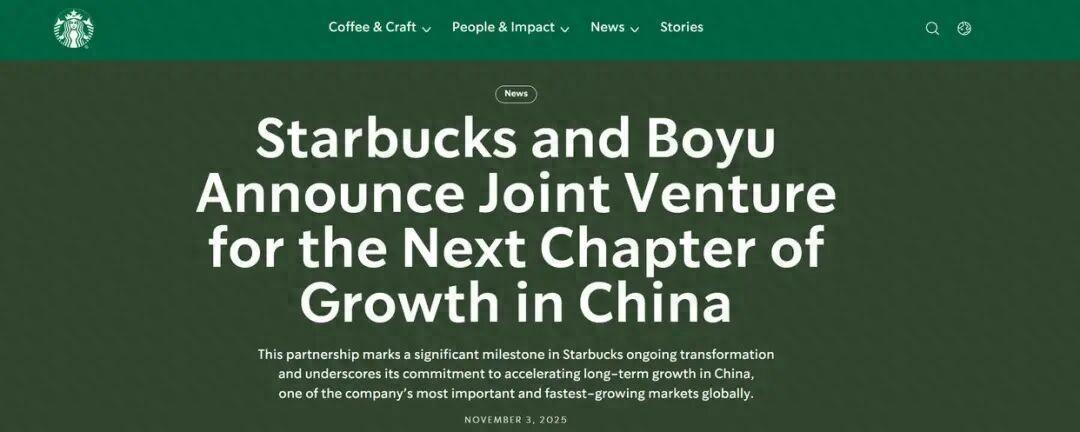
星巴克中国出售!博裕资本拿下60%股权,斥资40亿美元
Sou Hu Cai Jing· 2025-11-04 06:40
Core Insights - Starbucks has announced a joint venture with Chinese private equity firm Boyu Capital to operate its retail business in mainland China, marking the first time in 26 years that Starbucks has relinquished control of its Chinese operations [1][2] - Boyu Capital will hold up to 60% of the joint venture, while Starbucks retains 40% and continues to own and license its brand and intellectual property [1] - The enterprise value of the transaction is approximately $4 billion, excluding cash and debt, with Starbucks estimating the total value of its retail business in China to exceed $13 billion [2] Company Overview - The newly formed Starbucks China joint venture will be headquartered in Shanghai and will manage around 8,000 stores currently operated by Starbucks in mainland China [2] - Over 60% of Starbucks' stores are located in the U.S. and China, with China being its second-largest and fastest-growing market [3] - Starbucks CEO Brian Niccol emphasized that Boyu's local market expertise will significantly accelerate Starbucks' expansion in China, particularly in smaller cities and emerging regions [3] Investment Background - Boyu Capital, established in 2011, has become one of China's top local private equity firms, focusing on technology innovation, consumer retail, and healthcare [3] - Recent investments by Boyu include leading projects in the consumer and technology sectors, such as Mixue Ice Cream, Haitian Flavoring, and Perfect Diary [3] Financial Performance - For the fiscal year 2025, Starbucks reported revenue of $3.105 billion from the Chinese market, reflecting a 5% year-over-year growth [3] - By the end of fiscal year 2025, Starbucks had 8,011 stores in China, having entered 1,091 county-level markets, with 183 new stores opened in the fourth quarter alone [3]