
长江存储

Search documents
龙虎榜复盘 | 存储概念全线爆发,有色金属再度活跃
Xuan Gu Bao· 2025-09-12 12:41
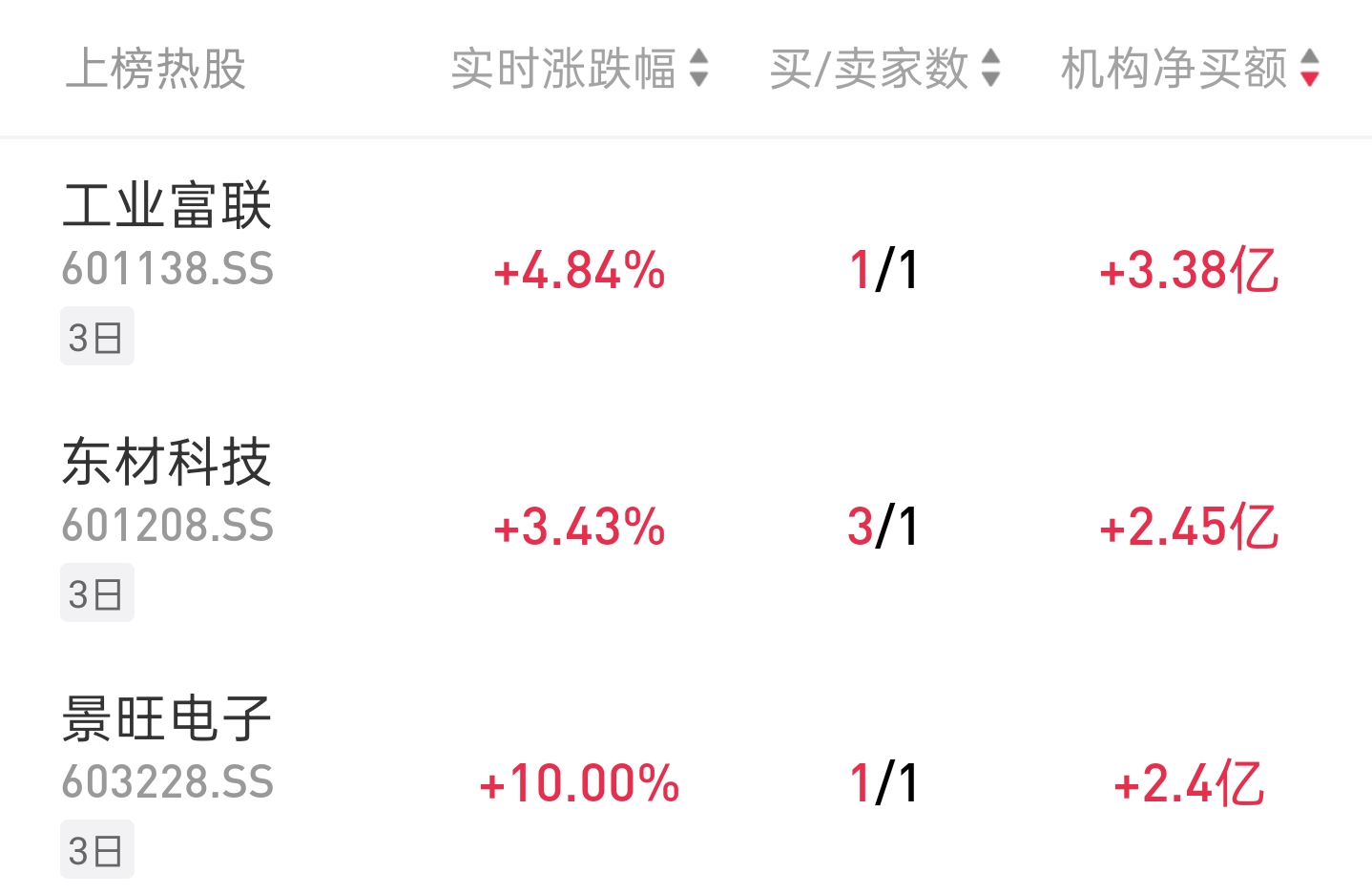
Group 1: Stock Market Activity - 32 stocks were listed on the institutional trading leaderboard today, with 17 seeing net purchases and 15 experiencing net sales [1] - The top three stocks with the highest net purchases by institutions were: Industrial Fulian (338 million), Dongcai Technology (245 million), and Jingwang Electronics (240 million) [1] Group 2: Semiconductor and Storage Industry - Jingwang Electronics had one institution net purchase of 240 million [2] - The company covers a few product types including RPCB, FPC, and MPCB [2] - The storage market is experiencing a price increase, with SanDisk announcing a 10% price hike across all channels and consumer products, indicating a potential new pricing cycle [3] - The demand for storage is driven by AI applications and strong needs in data centers, while supply is tightening due to production shifts and financial difficulties of some suppliers [3] - The establishment of Changchun's third phase project is significant for China's semiconductor industry, aiming to break the monopoly of Samsung and Hynix in the NAND market [3] Group 3: Non-Ferrous Metals - Yushen Co. is a leading third-party logistics service provider in the aluminum industry [4] - Hunan Silver focuses on silver smelting and processing, also recovering various valuable metals [4] - Market expectations indicate a high probability (89%) of the Federal Reserve lowering interest rates by 25 basis points in September, which could positively impact industrial metal prices [4] - Domestic manufacturing PMI showed a slight increase, indicating marginal improvement in economic conditions [4] - Industrial metal social inventory is expected to decrease, potentially driving prices higher [4]

“六个核桃”卖不动?前衡水首富转身走向半导体
2 1 Shi Ji Jing Ji Bao Dao· 2025-09-12 11:35
Core Viewpoint - The company Yango Beverage is experiencing a significant decline in revenue and profit, indicating a loss of market appeal for its flagship product, walnut milk, which previously generated nearly 10 billion yuan in sales [1][2]. Financial Performance - In the first half of 2025, the company reported revenue of 2.465 billion yuan, a year-on-year decline of 16.19%, and a net profit attributable to shareholders of 744 million yuan, down 27.76% [1]. - The company's revenue in the first quarter of 2025 fell by 19.7% to 1.86 billion yuan, marking a five-year low [2]. Sales Decline - Sales revenue across seven major regions, including Northeast, Northwest, East China, and North China, saw significant declines, with drops of 40.64%, 36.62%, 22.35%, and 19.63% respectively [2]. - The company's marketing expenses increased by 3.73% to 330 million yuan in the first half of 2025, but the sales expense ratio rose from 10.81% to 13.37%, indicating diminishing returns on marketing investments [2][3]. Investment Strategy - The company has shifted its focus towards diversified investments in sectors like artificial intelligence and semiconductors, attempting to find new growth avenues [5][6]. - Despite maintaining a high level of financial assets between 7 billion to 10.5 billion yuan from 2019 to 2022, the returns from conservative investments were low, with a yield of only 2.17% in 2022 [5][6]. - The company has made aggressive investments in various sectors, including 1 billion yuan in AI and 8 billion yuan in lithium battery companies, but these investments have often resulted in significant losses [6][7]. Strategic Challenges - The company's heavy reliance on marketing over research and development has raised concerns about its long-term competitiveness in a rapidly evolving beverage market [3]. - The ongoing decline in sales and the challenges of balancing core business development with cross-industry investments highlight the need for a strategic reassessment [7].

六个核桃卖不动了,前衡水首富转身搞起半导体
2 1 Shi Ji Jing Ji Bao Dao· 2025-09-12 11:06
Core Insights - The company Yango Beverage, known for its "Six Walnuts" product, is experiencing a significant decline in both revenue and profit, with a revenue of 2.465 billion yuan, down 16.19% year-on-year, and a net profit of 744 million yuan, down 27.76% year-on-year [1][2] - The once-popular walnut milk product is losing its appeal, leading to a search for new growth opportunities in sectors like semiconductors and AI [1][5] Revenue and Profit Decline - In the first half of 2025, the company reported a rare revenue decline of 19.7% in the first quarter, totaling 1.86 billion yuan, and a net profit drop of 26.95% to 642 million yuan, marking a five-year low [2][3] - Sales revenue across major regions, including Northeast, Northwest, East, and North China, saw significant declines, with drops of 40.64%, 36.62%, 22.35%, and 19.63% respectively [2] Marketing and R&D Strategy - The company increased its marketing expenses by 3.73% to 330 million yuan in the first half of 2025, but this led to a rise in the sales expense ratio from 10.81% to 13.37%, indicating diminishing returns on marketing investments [2][3] - In contrast, R&D expenses decreased by 11.2% to 18.36 million yuan, highlighting a strategic imbalance where marketing spending far exceeds R&D investment, with a ratio exceeding 20:1 from 2021 to 2024 [3] Diversification and Investment Strategy - To counteract declining sales, the company has diversified its investments into sectors like AI, new energy, and semiconductors, with significant cash reserves allocated to these areas [5][6] - The company has faced challenges with its investment returns, with a notable decline in investment income from 4.64 billion yuan in 2019 to just 219.61 million yuan in 2021, followed by consecutive losses in 2023 and 2024 [6][7] Market Reactions and Future Outlook - The company's cross-industry investment strategy has sparked discussions about the balance between core business development and diversification, especially as the beverage market faces shrinking demand [7] - The effectiveness of the company's approach to navigate its current challenges remains uncertain, as it seeks to balance traditional beverage operations with high-risk investments in unrelated sectors [7]
六个核桃卖不动了,前衡水首富转身搞起半导体
21世纪经济报道· 2025-09-12 11:01
Core Viewpoint - The company Yangyuan Beverage, known for its "Six Walnuts" product, is experiencing significant declines in both revenue and profit, indicating a loss of market appeal for its flagship product [1][3]. Group 1: Financial Performance - In the first half of 2025, Yangyuan Beverage reported revenue of 2.465 billion yuan, a year-on-year decline of 16.19%, and a net profit of 744 million yuan, down 27.76% [1]. - The company's sales revenue across seven major regions, including Northeast, Northwest, East, and North China, all saw declines, with the Northeast region experiencing a drop of 40.64% [3]. - The first quarter of 2025 marked a rare revenue decline of 19.7% to 1.86 billion yuan, with net profit falling 26.95% to 642 million yuan, reaching a five-year low [3]. Group 2: Marketing and R&D Strategy - Yangyuan Beverage increased its marketing expenses by 3.73% to 330 million yuan in the first half of 2025, marking the first significant advertising budget increase in recent years [3]. - Despite the increase in marketing spending, the sales expense ratio rose from 10.81% to 13.37%, indicating diminishing returns on marketing investments [3]. - The company has consistently allocated significantly more to marketing than to research and development, with a ratio exceeding 20:1 from 2021 to 2024, raising concerns about its strategic focus [4]. Group 3: Product Diversification and Investment Strategy - Yangyuan Beverage has attempted to diversify its product offerings with various new lines targeting different demographics, but the core business continues to face pressure [7]. - The company has shifted its investment strategy towards higher-risk sectors such as artificial intelligence and semiconductors, with significant cash reserves being allocated to these areas [7][8]. - Investments in sectors outside its core beverage business have raised questions about the effectiveness of this strategy, especially as the company faces declining sales in its primary product line [9].

东方证券:存储行情景气度持续 持续看好国产存储产业链
智通财经网· 2025-09-12 03:13
Core Viewpoint - The global DRAM market is expanding, driven by the rise of generative AI, leading to optimistic AI order expectations and benefiting the storage industry chain [1][3]. Group 1: Market Trends - The NAND price is expected to rise in Q3, with SanDisk announcing a price increase of over 10% for all channels, indicating the start of a new pricing cycle [1][2]. - The global DRAM market size increased by approximately 17% in Q2 2025, reaching $30.9 billion, primarily due to the demand from generative AI [3]. Group 2: Supply and Demand Dynamics - The supply-demand gap is expected to widen, with strong storage demand driven by AI applications and data centers, while supply is constrained due to production shifts and financial difficulties of some suppliers [2]. - The transition of NAND manufacturers to next-generation nodes is causing a shortage of low-density chips, further tightening supply [2]. Group 3: Domestic Industry Growth - Domestic advanced storage capacity is expanding, with companies like Zhaoyi Innovation and Changxin Storage maintaining close partnerships to benefit from the transition to DDR5/LPDDR5 [3]. - Changxin Storage is projected to capture about 30% of the domestic NAND market this year, with expectations to reach 15% of global NAND flash capacity by the end of 2026 [4].



【大涨解读】内存:海外大厂连续涨价,国产存储龙头或将跟进,英伟达最新GPU也转向GDDR内存
Xuan Gu Bao· 2025-09-12 02:46
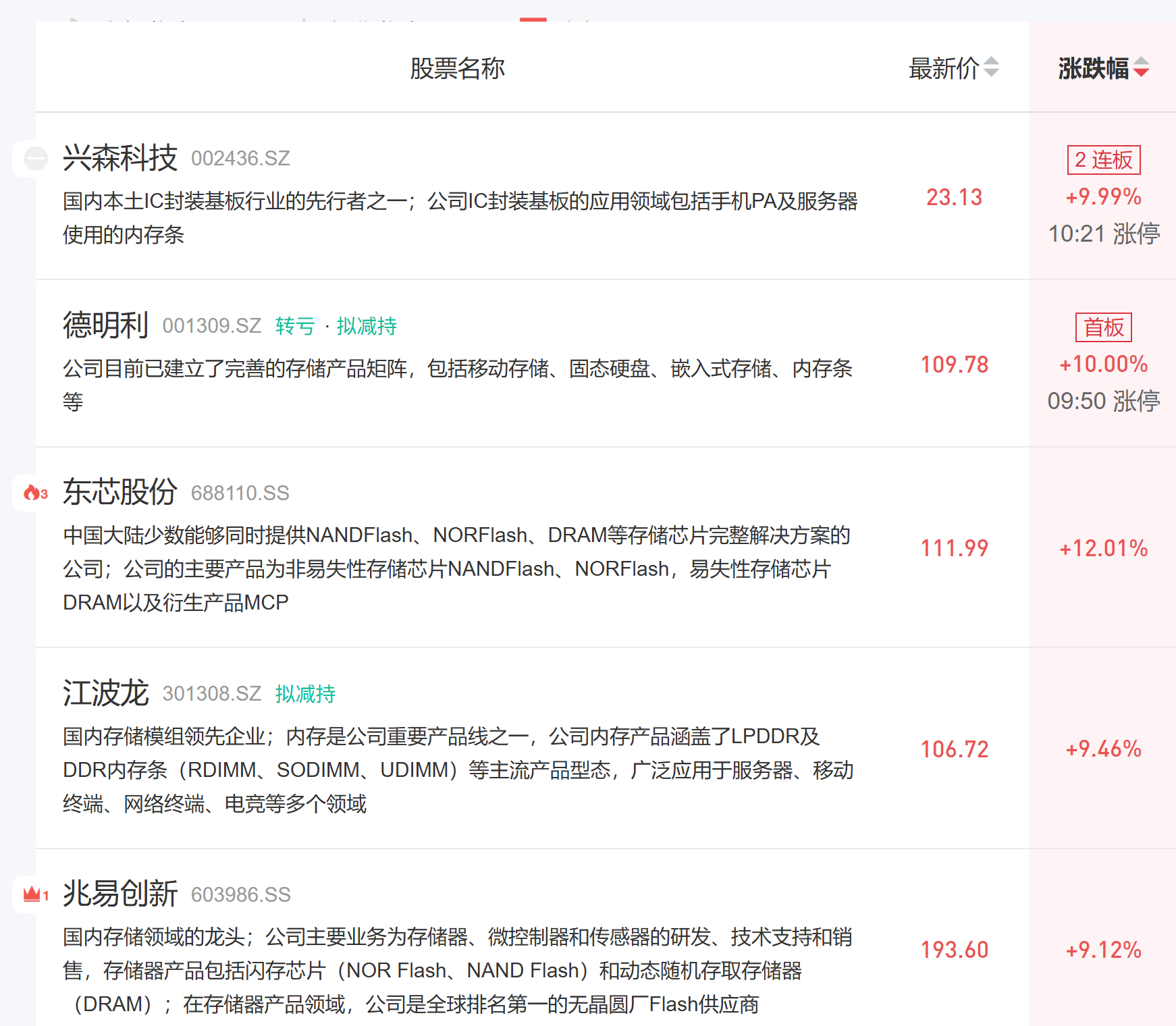
Market Overview - On September 12, the storage sector experienced a significant opening surge, with companies like Deminor hitting the daily limit, and others such as Dongxin Co., Jiangbolong, and others seeing substantial increases [1] Company Insights - **Xingsen Technology (002436.SZ)**: A pioneer in the domestic IC packaging substrate industry, with applications in mobile memory modules [3] - **Deminor (001309.SZ)**: Transitioning from losses and planning to reduce holdings; has established a comprehensive storage product matrix including mobile storage and solid-state drives [3] - **Dongxin Co. (688110.SS)**: One of the few companies in mainland China providing a full range of storage chips including NAND Flash, NOR Flash, and DRAM [3] - **Jiangbolong (301308.SZ)**: A leading domestic storage module company, with memory products covering mainstream types like LDDR memory modules [3] - **Beiyi Innovation (603986.SS)**: A leader in the storage field, focusing on the development and sales of memory chips and microcontrollers, ranking first globally in non-foundry Flash supply [3] Industry Trends - Major US storage leaders like Micron and SanDisk saw collective gains, with SanDisk announcing a 10% price increase across all channels for consumer products, indicating a potential new pricing cycle due to changing supply-demand dynamics [5][6] - The global DRAM market size increased approximately 17% quarter-on-quarter to $30.9 billion in Q2 2025, driven by the rise of generative AI and increasing demand for DRAM contracts and HBM shipments [6] - Nvidia's launch of the RubinCPX GPU aims to enhance speed in handling massive data, utilizing GDDR7 memory, which could lead to increased demand for DRAM [5][6] - The establishment of Changchun's third phase company marks a significant step in China's semiconductor industry, potentially breaking the monopoly of Samsung and SK Hynix in the NAND market [6]


全球存储大厂接连涨价,美股隔夜大涨,新一轮定价周期拉开帷幕
Xuan Gu Bao· 2025-09-12 00:48
需求端,AI应用推动及数据中心、客户端、移动领域存储需求强劲;供应端,行业面临供应紧缩,一 方面NAND生产商将产量转向下一代节点致低密度芯片供应紧缺,另一方面部分供应商因财务困境短期 难扩产。 此外,近日,长存三期(武汉)集成电路有限责任公司宣布成立,据此前媒体消息称,长江存储正积极 扩产,其NAND今年有望在国内市场占据约三成的份额,而到2026年底长江存储产能有望达到全球 NAND闪存的15%。我们认为,国产存储产业链成长有望加速。 隔夜美股存储公司集体大涨,闪迪涨超14%,美光科技涨7.55%。 近日闪迪宣布将面向所有渠道和消费者客户的产品价格上调10%以上,且考虑未来几个季度进一步调 整。东方证券认为此举或将标志着新一轮定价周期的拉开帷幕,预计竞争对手也有望效仿。此次提价源 于供需格局转变,供需缺口或持续扩大。 *免责声明:文章内容仅供参考,不构成投资建议 *风险提示:股市有风险,入市需谨慎 公司方面,据东方证券、互动平台等表示, 普冉股份、万润科技、朗科科技等为国内存储产业公司。 精测电子:长江存储以及长鑫存储均为公司客户。 ...
龙虎榜复盘 | AI全线爆发,国产芯片大幅反弹
Xuan Gu Bao· 2025-09-11 10:56
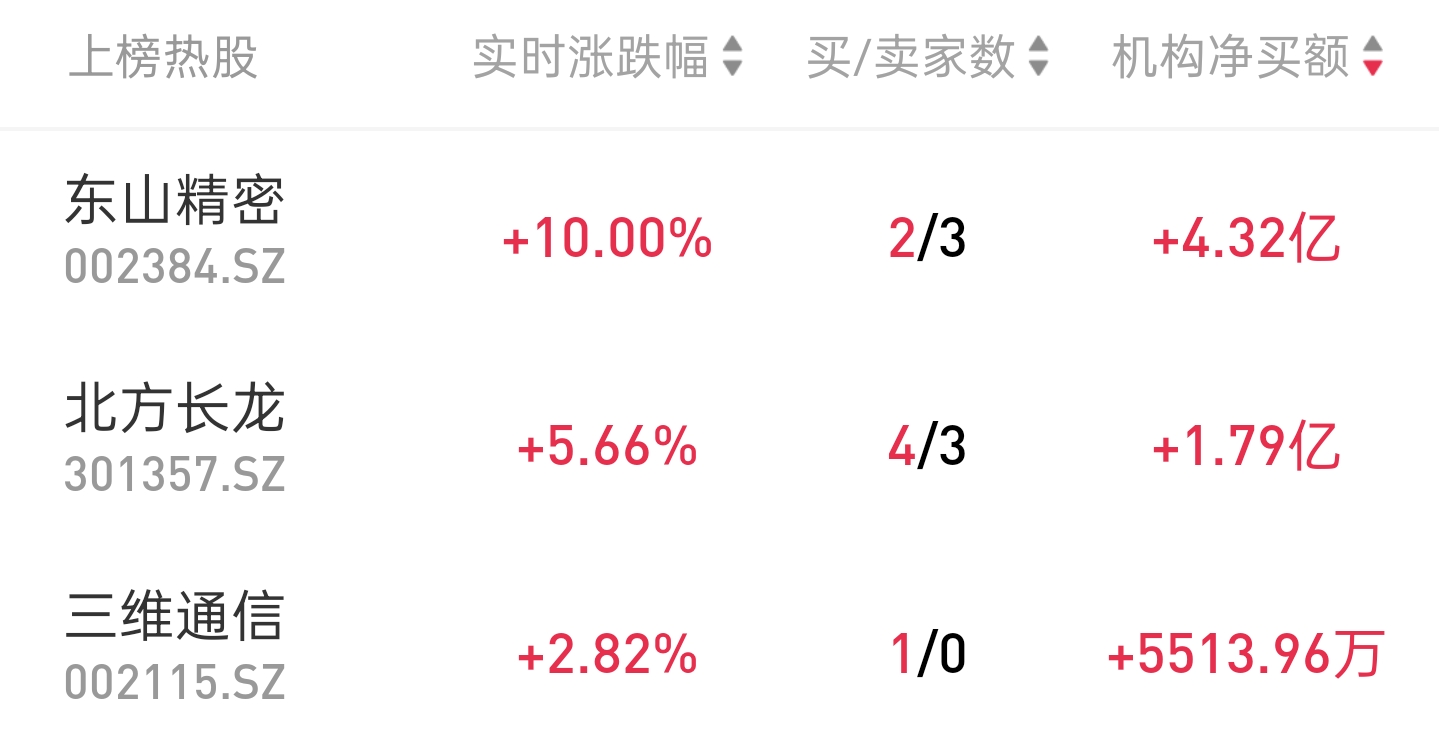
Group 1: Institutional Trading Insights - On the institutional trading leaderboard, 28 stocks were listed, with 12 experiencing net buying and 16 facing net selling [1] - The top three stocks with the highest net buying by institutions were Dongshan Precision (4.32 billion), Beifang Changlong (1.79 billion), and Sanwei Communication (1.74 billion) [1][2] Group 2: Stock Performance and Company Developments - Dongshan Precision saw a price increase of 10.00%, with 2 buyers and 3 sellers [2] - Beifang Changlong's stock rose by 5.66%, with 4 buyers and 3 sellers [2] - Sanwei Communication's stock increased by 2.82%, with 1 buyer and no sellers [2] - Dongshan Precision plans to acquire 100% of the shares of optical communication company Suosi Optoelectronics for no more than 59.35 billion, positioning its overall PCB business among the top four globally [2] Group 3: Semiconductor Industry Developments - NVIDIA announced the launch of the Rubin CPX GPU and Vera Rubin NVL144 CPX platform, with the Rubin CPX expected to be operational by the end of 2026 [3] - The Rubin CPX features a separated inference architecture, dividing AI computation into context and generation stages [3] - Oracle's stock surged by 36%, marking its largest single-day increase since 1992, with a market value increase of 244 billion following the announcement of an RPO amount of 455 billion, a 359% year-over-year increase [3] - The semiconductor market is projected to reach approximately 630.55 billion in sales in 2024, with logic circuit sales at about 215.77 billion and memory chip sales at around 165.52 billion [6]


搞垮日本芯片产业40年后,美国又盯上了韩国
商业洞察· 2025-09-10 09:26
Core Viewpoint - The article discusses the historical parallels between Japan and South Korea in the semiconductor industry, highlighting the challenges South Korea faces due to U.S. technology restrictions and the need for independent innovation to avoid becoming a pawn in geopolitical conflicts [5][88]. Group 1: Historical Context - In 1985, the Plaza Accord ended Japan's semiconductor dominance, leading to a significant decline in its market share [3][25]. - Japan's semiconductor industry, which once held over 48% of the global market, saw its share drop to less than half by 1995 due to U.S. trade measures [26]. - South Korea's semiconductor industry, initially supported by U.S. technology, grew rapidly, capturing over 30% of the global DRAM market by the mid-1990s [27][28]. Group 2: Current Challenges for South Korea - The U.S. plans to tighten regulations on South Korean companies, requiring individual licenses for each piece of American equipment imported, which could stifle innovation and growth [5][6]. - South Korea's semiconductor industry relies heavily on U.S. technology and equipment, with over 70% of the technology used in its factories coming from American firms [71][72]. - Despite holding approximately 14% of the global semiconductor market and dominating the DRAM and NAND flash sectors, South Korea risks losing its market position due to U.S. policy changes [69][70]. Group 3: Geopolitical Dynamics - The article emphasizes the interdependence between South Korea and China, noting that over 35% of South Korea's semiconductor exports go to China, which is crucial for its industry [73][74]. - South Korea's economic ties with China are significant, with bilateral trade reaching $328.08 billion in 2024, accounting for 21% of South Korea's total trade [77][78]. - The ongoing U.S.-China tech rivalry places South Korea in a precarious position, as it navigates between the two powers while trying to maintain its semiconductor industry [87][88]. Group 4: Future Outlook - The article suggests that South Korea must break free from its historical reliance on foreign technology and develop its own capabilities to ensure long-term sustainability in the semiconductor sector [60][94]. - It highlights the advancements made by China's semiconductor industry, which is rapidly catching up and could pose a significant challenge to South Korea's market position [90][92]. - The need for South Korea to adopt a strategy of independent innovation and avoid being a mere technology follower is emphasized as essential for its future in the global semiconductor landscape [96].

A股收评 | 三大指数缩量反弹 创业板指涨1.27% AI产业链再度活跃
智通财经网· 2025-09-10 07:28
Group 1: AI Industry Chain Activity - The AI industry chain showed renewed activity with significant gains in AI hardware concepts such as optical modules, PCBs, liquid cooling, and electronic fabrics, leading to multiple stocks hitting the daily limit up, including Yuan Dao Communication and Industrial Fulian [1][3] - IDC estimates that China's AI market is expected to reach 815.9 billion yuan by 2028, with a five-year CAGR of approximately 33%. The industry chain follows a gradient of "computing power first—model follow-up—application explosion" [2][3] - The AI sector is characterized by three main lines of development: upstream computing power supply, MaaS platformization, and industry-level AI Agent solutions, driven by technological breakthroughs, domestic and international demand, and capital expenditure [2][3] Group 2: Oil Service Sector Strength - The oil service sector experienced strong performance, with stocks like Zhongyuan Petroleum and Jun Oil hitting the daily limit up, driven by market reactions to geopolitical events [4] - Despite a recent explosion in Qatar, analysts believe it will not disrupt the global oil market significantly, although there are expectations of an oversupply due to slowing demand growth [4] Group 3: Satellite Internet Sector Activity - The satellite internet sector was active, with stocks such as Sanwei Communication and China Satellite seeing significant gains, supported by policy developments regarding satellite mobile communication business licenses [5][6] - The approval process for these licenses is expected to accelerate the commercialization and restructuring of the satellite internet industry in China [5][6] Group 4: Market Outlook - Analysts from Dongfang Securities suggest that recent market fluctuations and adjustments are not indicative of the end of the current bull market, but rather a consolidation phase for future upward movement, with potential for new highs within the year [6] - Guotai Junan Securities indicates that despite market adjustments, there is a positive outlook for continued upward movement in indices, with a likelihood of ongoing rotation in market hotspots [7] Group 5: Domestic Storage Chain Development - CITIC Securities reports that the third phase of Yangtze Memory Technologies has been registered with a capital of 20.72 billion yuan, which is expected to benefit the domestic storage chain significantly [8] - The company currently holds an 8.1% share of the global NAND market, with plans to increase this to 15% by the end of 2026, indicating strong growth potential for domestic equipment and materials [8]
