
博通

Search documents
电子行业周报:存储芯片进入新一轮周期,国产AI芯片大时代已经开启-20250929
Huaxin Securities· 2025-09-29 13:04
Investment Rating - The report maintains a "Buy" rating for several companies in the semiconductor and AI sectors, including 德明利 (De Ming Li), 通富微电 (Tongfu Microelectronics), 北京君正 (Beijing Junzheng), 海光信息 (Haiguang Information), and 中芯国际 (SMIC) [12][22]. Core Insights - The storage chip industry is entering a new cycle, driven by rising prices and a shift towards higher-end products like DDR5 and HBM, as major manufacturers like Samsung and SK Hynix reduce DDR4 production [5][7]. - The AI infrastructure boom is significantly impacting the demand for storage solutions, with major investments from companies like OpenAI, which plans to invest over $400 billion in AI data centers over the next three years [7][20]. - The report highlights the emergence of a new era for domestic AI chips, with advancements in AI models and infrastructure, particularly from companies like 阿里巴巴 (Alibaba) and 摩尔线程 (Moore Threads) [8][10]. Summary by Sections Industry Performance - The electronic sector saw a 3.51% increase from September 22 to September 26, ranking third among major industries, with a current P/E ratio of 72.55 [27][31]. - The semiconductor equipment segment experienced the highest growth at 15.56% during the same period [31]. Storage Market Dynamics - The first price surge in storage began in April 2025, with significant price increases announced by major players like SanDisk and Micron, with price hikes of 10% to 30% expected [5][18]. - The DRAM price index has risen approximately 72% over the past six months, indicating strong upward momentum in the NAND market [5][18]. AI Chip Developments - 阿里云 (Alibaba Cloud) has significantly upgraded its AI infrastructure, achieving over 5x growth in AI computing power and 4x in AI storage over the past year [20]. - 摩尔线程 (Moore Threads) has successfully passed its IPO review, showcasing advancements in GPU architecture that support a wide range of applications, including AI and high-performance computing [21][10]. Key Companies and Forecasts - The report recommends focusing on companies such as 兆易创新 (Zhaoyi Innovation), 江波龙 (Jiangbolong), and 北京君正 (Beijing Junzheng) for potential investment opportunities due to their expected growth in the AI and storage sectors [7][10][12].
申万宏源研究晨会报告-20250929
Shenwan Hongyuan Securities· 2025-09-29 00:12
Core Insights - The report highlights the significant advantages of ASIC over GPU in terms of cost-effectiveness and energy efficiency, marking a turning point for ASIC development [2][12] - The increasing penetration of AI is driving a surge in inference demand, expanding the market space for ASICs [3][12] - Domestic cloud providers are making strides in self-developed ASICs, indicating a strong demand in the Chinese AI cloud market [12][13] Summary by Sections ASIC vs. GPU - ASICs are specialized chips tightly coupled with downstream applications, focusing on specific needs like text and video inference, while GPUs are general-purpose chips covering a broader range of applications [2][12] - The energy efficiency of Google's TPU v5 is 1.46 times that of NVIDIA's H200, and Amazon's Trainium2 reduces training costs by 40% compared to GPU solutions [2][12] Market Growth and Demand - The global AI ASIC market is projected to reach $125 billion by 2028, with significant contributions from major clients [3][12] - The demand for inference computing is directly linked to throughput, with ChatGPT's weekly active users reaching 700 million by July 2025, driving the need for increased computational power [3][12] ASIC Design Services - ASIC design requires a high level of specialization, with major service providers like Broadcom and Marvell leading the market [3][12] - Broadcom's collaboration with Google on TPU has been pivotal, leveraging a comprehensive IP system and advanced packaging technologies [3][12] Domestic Developments - Leading Chinese cloud providers are achieving results in self-developed ASICs, with significant orders and advancements in technology [12][13] - The trends of PD separation and super nodes are emerging as key developments in the domestic ASIC landscape [12][13] Industry Outlook - The report anticipates a robust growth trajectory for the ASIC market, driven by increasing AI applications and domestic innovation [12][13]
芯片,重大突发!特朗普,传出大消息
Zheng Quan Shi Bao Wang· 2025-09-28 07:14
特朗普政府,又想出了新的征税方式? 针对上述消息,美国商务部没有立即回应。不过,当被问及相关细节时,白宫发言人库什·德赛回应 称,美国不能依赖外国进口来获取对国家和经济安全至关重要的半导体产品。"特朗普政府正采取细 致、多方面的策略,通过关税、减税、放松监管和充足能源供应,推动关键制造业回流美国本土。"库 什·德赛说道。 报道指出,若上述计划得以实施,将表明特朗普政府正寻求对从牙刷到笔记本电脑等各类消费品施加影 响。在努力扩大美国制造业规模的同时,这一举措可能会推高通货膨胀。 保守派智库、美国企业研究所的经济学家迈克尔·斯特莱恩表示:"目前美国正面临通胀问题,通胀率明 显高于美联储目标(通胀率2%)且仍在上升,而该计划可能会在此时推高消费品价格。" 他补充道,由于生产这些商品所需的关键投入品被征收新关税,即便美国本土生产的产品也可能变得更 加昂贵。 据环球网援引路透社报道,消息人士透露,为推动企业将制造业转移至美国,特朗普政府正在考虑根据 每台外国电子设备中的芯片数量征收关税。根据该计划,美国商务部将对产品芯片价值的估算部分按一 定比例征收关税。 特朗普8月份曾表示,美国将对进口半导体征收约100%的关税,但 ...
芯片重大突发!特朗普传出大消息!
天天基金网· 2025-09-28 01:27
Core Viewpoint - The Trump administration is considering imposing tariffs based on the number of chips in foreign electronic devices to encourage domestic manufacturing and reduce reliance on imports [3][4][5]. Group 1: Tariff Implementation - The proposed tariff plan would involve estimating the value of chips in products and applying tariffs accordingly [4][5]. - If implemented, this plan could affect a wide range of consumer goods, potentially increasing inflation as production costs rise due to new tariffs on essential inputs [5][6]. - The administration has previously indicated a willingness to impose significant tariffs on semiconductor imports, with rates potentially reaching 100% for certain products [6][7]. Group 2: Economic Implications - The plan aims to boost U.S. manufacturing while also posing risks of higher consumer prices, as the inflation rate is already above the Federal Reserve's target of 2% [5][6]. - The complexity of the proposed tariff system could create challenges for major tech companies like Apple and Dell, which rely on global supply chains [7][8]. - The administration's strategy includes a mix of tariffs, tax cuts, and regulatory relief to promote domestic production [4][5]. Group 3: Challenges and Considerations - Achieving a balance between domestic production and imports is expected to be difficult, as overseas products are often cheaper and supply chain adjustments take time [7][8]. - The actual implementation of tariffs based on chip counts raises questions about how these tariffs will be calculated and enforced [7][8]. - There are concerns that the proposed tariffs could complicate the already intricate U.S. tariff system, making compliance more challenging for companies [7][8].

芯片,重大突发!特朗普,传出大消息!
券商中国· 2025-09-27 12:43
Core Viewpoint - The Trump administration is considering imposing tariffs based on the number of chips in foreign electronic devices to encourage domestic manufacturing [1][2][5] Group 1: Tariff Implementation - The proposed plan involves estimating the value of chips in products and imposing tariffs accordingly [1][2] - Trump previously indicated a potential 100% tariff on imported semiconductors, with exemptions for companies manufacturing in the U.S. [1][5] - The administration is also contemplating a requirement for chip companies to maintain a 1:1 ratio of domestically produced chips to imported chips, with penalties for non-compliance [1][5][6] Group 2: Economic Implications - The implementation of these tariffs could lead to increased consumer prices, exacerbating existing inflation issues in the U.S. [2][5] - Economic experts warn that the tariffs may complicate the already intricate U.S. tariff system and could challenge major tech companies that rely on global supply chains [6] Group 3: Broader Tariff Measures - In addition to semiconductor tariffs, Trump announced new tariffs on various imported goods, including a 50% tariff on kitchen cabinets and a 30% tariff on furniture [3] - The administration's strategy includes a mix of tariffs, tax cuts, deregulation, and energy supply enhancements to boost domestic manufacturing [2][5]

ASIC系列研究之四:国产ASIC:PD分离和超节点
Shenwan Hongyuan Securities· 2025-09-26 12:46
Investment Rating - The report maintains a positive outlook on the ASIC industry, indicating a favorable investment rating for the sector [2]. Core Insights - The report highlights the significant cost-effectiveness and efficiency advantages of ASICs over GPUs, particularly in the context of AI model inference, with Google's TPU v5 demonstrating an energy efficiency ratio 1.46 times that of NVIDIA's H200 [3][19]. - The increasing penetration of AI applications is driving a surge in inference demand, expanding the market for ASICs, with projections indicating the global AI ASIC market could reach $125 billion by 2028 [3][32]. - The report emphasizes the complexity of ASIC design, underscoring the critical role of design service providers like Broadcom and Marvell, which are expected to benefit from the growing demand for custom ASIC solutions [4][44]. Summary by Sections 1. Demand Driven by Large Model Inference - The global AI chip market is projected to reach $500 billion by 2028-2030, with significant growth in AI infrastructure spending anticipated [13]. - ASICs are specialized chips that offer strong cost and efficiency advantages, particularly in specific applications like text and video inference [14][19]. - The report notes that the demand for ASICs is expected to rise sharply due to the increasing consumption of tokens in AI applications, exemplified by the rapid growth of ChatGPT's user engagement [25][31]. 2. High Complexity of ASIC Design and Value of Service Providers - ASIC design involves a complex supply chain, with cloud vendors often relying on specialized design service providers for chip architecture and optimization [41][44]. - Broadcom's ASIC revenue is projected to exceed $12 billion in 2024, driven by the success of its TPU designs for Google and other clients [60]. - The report identifies the importance of a complete IP system and design experience as key factors for service providers to secure new orders in the ASIC market [63]. 3. Domestic Developments: Not Just Following Trends - Leading Chinese cloud providers like Alibaba and Baidu are making significant strides in self-developed ASICs, indicating a robust domestic ecosystem [3][4]. - The report highlights the emergence of domestic design service providers such as Chipone and Aowei Technology, which are positioned to capitalize on the growing demand for ASICs [3][4]. - The trends of PD separation and supernodes are identified as critical developments in the domestic ASIC landscape, with companies like Huawei and Haiguang leading the way [4][44]. 4. Key Trends in Domestic ASIC Development - PD separation involves using different chips for prefill and decode tasks, enhancing efficiency in specific applications [4]. - Supernodes are being developed to create unified computing systems through high-bandwidth interconnections, with early implementations seen in domestic companies [4][44].




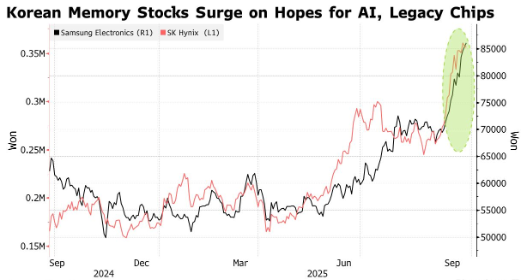
AI热潮从HBM蔓延至传统存储,韩国芯片股迎来“超级周期”?
智通财经网· 2025-09-26 03:36
Core Viewpoint - The stock prices of South Korea's major chip manufacturers have surged significantly, with a market capitalization increase of over $100 billion, driven by the AI boom and expected continued demand for HBM chips [1][3]. Group 1: Market Trends - Analysts have raised the target value of the Korean won by approximately 30% this quarter, anticipating a "super cycle" in the memory market due to supply-demand imbalances expected next year [1]. - Foreign investment in Korean chip stocks is expected to continue, supported by substantial capital expenditure announcements from major tech companies in the U.S. [1][3]. - The pessimism surrounding "old" DRAM and NAND chips is fading, with expectations of a supply shortage in these products by 2026 as manufacturers shift capacity to more profitable HBM products [3]. Group 2: Company Performance - SK Hynix has seen significant growth due to its leading position in the HBM chip sector, which is crucial for AI applications, while Samsung Electronics is also intensifying its efforts to catch up [1][3]. - Despite a 24% increase in Samsung's stock price this month, its price-to-earnings ratio remains at 14 times, while SK Hynix's P/E ratio is only 7 times, compared to approximately 26 times for major U.S. chip manufacturers [3][4]. - Analysts predict that Samsung's stock price will exceed its historical high of 91,000 won within the next 12 months, driven by strong demand for HBM products and its collaboration with Nvidia [4][7]. Group 3: Investment Sentiment - Foreign investors have significantly increased their inflow into these Korean memory manufacturers, marking the highest monthly inflow in over 13 years, although their market capitalization is still considered low [4]. - Analysts believe there is further room for growth in Samsung's foreign ownership ratio, which is currently 7 percentage points below its previous peak of 58% [4][7]. - The ongoing AI infrastructure development in the U.S. is expected to benefit Korean memory suppliers, as they are positioned to gain from increased capital expenditures by major cloud companies [7].
深夜!中概股大跌!美联储,大消息!
Zheng Quan Shi Bao· 2025-09-23 15:45
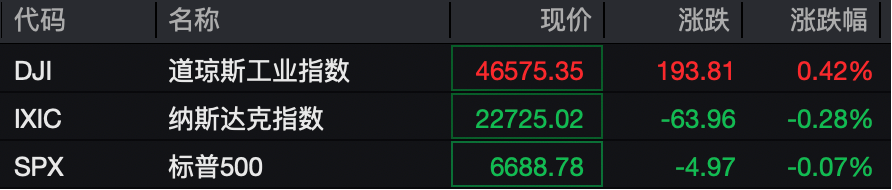
美联储官员密集发声。 当地时间9月23日,美股三大指数走势分化,截至发稿,道指涨0.42%,纳指跌0.28%,标普500指数跌0.07%。 | 代码 | 名称 | 现价 | 涨跌 | 涨跌幅 | | --- | --- | --- | --- | --- | | DJI | 道琼斯工业指数 | 46575.35 | 193.81 | 0.42% | | IXIC | 纳斯达克指数 | 22725.02 | -63.96 | -0.28% | | SPX | 标普500 | 6688.78 | -4.97 | -0.07% | 科技七巨头方面,截至发稿,仅脸书微涨,英伟达、亚马逊跌超2%。 | 代码 | 名称 | 现价 | 涨跌 | 涨跌幅▼ | 문 | | --- | --- | --- | --- | --- | --- | | META | 脸书(META PLATFORMS | 767.519 | 2.359 | 0.31% | | | GOOG | 谷歌(ALPHABET)-C | 251.992 | -0.889 | -0.35% | | | AAPL | 苹果(APPLE) | 255.187 | ...
深夜!中概股大跌!美联储,大消息!
证券时报· 2025-09-23 15:44
美联储官员密集发声。 | 代码 | 名称 | 现价 | 涨跌 | 涨跌幅 | | --- | --- | --- | --- | --- | | DJI | 道琼斯工业指数 | 46575.35 | 193.81 | 0.42% | | IXIC | 纳斯达克指数 | 22725.02 | -63.96 | -0.28% | | SPX | 标普500 | 6688.78 | -4.97 | -0.07% | 当地时间9月23日,美股三大指数走势分化,截至发稿,道指涨0.42%,纳指跌0.28%,标普500指数跌0.07%。 科技七巨头方面,截至发稿,仅脸书微涨,英伟达、亚马逊跌超2%。 | 代码 | 名称 | 现价 | 涨跌 | 涨跌幅 ▼ प | | --- | --- | --- | --- | --- | | META | 脸书(META PLATFORMS | 767.519 | 2.359 | 0.31% | | GOOG | 谷歌(ALPHABET)-C | 251.992 | -0.889 | -0.35% | | AAPL | 苹果(APPLE) | 255.187 | -0.893 | - ...

芯片迎来重大利好,巨头突掀涨价潮,台积电一度暴涨近5%
Zheng Quan Shi Bao Wang· 2025-09-23 15:16
Core Viewpoint - The recent price increase in the semiconductor industry, led by TSMC, reflects the deep impact of the AI wave on the semiconductor supply chain, with rising demand for data center construction driving up memory procurement and enhancing the bargaining power of chip suppliers [1][5]. Group 1: TSMC's Price Increase - TSMC plans to raise prices for its 3nm and 2nm process nodes, with the 2nm process expected to see a price increase of at least 50% compared to the 3nm process, significantly exceeding market expectations [2][3]. - The 2nm process is set to begin mass production this quarter, but TSMC has no plans for discounts or negotiation strategies due to the high capital expenditure associated with advanced processes [2][4]. Group 2: Impact on Other Chip Manufacturers - Other major chip manufacturers, including Samsung, Micron Technology, and SanDisk, have also announced price increases, with DRAM prices rising by up to 30% and NAND flash prices increasing by 5% to 10% due to supply constraints and surging demand from cloud enterprises [5][6]. - Micron Technology's storage chip prices have increased by 20% to 30%, and the company has paused accepting new orders [6]. Group 3: Market Reaction - Following the price increase announcements, TSMC's ADR surged nearly 5% at the market open, reaching a historical high, while other semiconductor stocks, including Intel and Micron Technology, also saw significant gains [2][7]. - In the Asian trading session, shares of storage chip giants like Samsung and SK Hynix rose, reflecting the overall positive sentiment in the semiconductor sector [7].
