
中简科技

Search documents
我国量产地表超强材料,单丝直径不到头发丝十分之一
Xuan Gu Bao· 2026-01-15 15:18
Group 1 - The domestic T1000-grade high-performance carbon fiber has been developed, featuring 12,000 filaments per strand, with a weight of only 0.5 grams per meter and tensile strength exceeding 6,600 MPa, making it 7 to 8 times stronger than steel [1] - This breakthrough signifies a leap from T300 to T1000 in domestic carbon fiber production, addressing the "bottleneck" issue in high-end materials and providing strong momentum for the upgrade of high-end manufacturing during the 14th Five-Year Plan [1] Group 2 - The high-performance carbon fiber industry in China is at a critical transformation point, shifting from meeting domestic demand to participating in global high-end competition, with a projected capacity exceeding 250,000 tons by 2030, accounting for over 50% of global demand [2] - The usage of carbon fiber in the new energy vehicle sector is expected to increase from 5% to 20%, with the demand in this sector projected to represent 45% of total demand by 2030, making it the largest single application area [2] - The low-altitude economy in China is expected to exceed 1 trillion yuan by 2026, leading to a surge in carbon fiber demand from core carriers like eVTOL and drones [2] Group 3 - Relevant A-share concept stocks include Zhongjian Technology and Guangwei Composites [3]
深度|商业航天新材料全景图:新材料企业的机遇与投资逻辑(附20+报告)
材料汇· 2026-01-14 14:18
Core Insights - The global commercial aerospace market is projected to reach a size of $75-125 billion in 2024, with an expected growth to $140 billion by 2025. In China, the market is anticipated to reach 2.3 trillion RMB in 2024, growing by 22.9% year-on-year, and is expected to exceed 2.8 trillion RMB in 2025. Material technology is becoming a core factor determining the competitiveness of commercial aerospace companies [1] - The demand for materials in commercial aerospace differs significantly from traditional aerospace, with a focus on lightweight materials, high-temperature resistance, and reliability to reduce costs. The cost savings of approximately 20,000-30,000 RMB per kilogram of payload make lightweight materials a priority [1] Overview of Key New Materials in Commercial Aerospace - A total of 128 new materials have been identified as critical for commercial aerospace applications, categorized into various types including aluminum-lithium alloys, titanium alloys, stainless steel, high-temperature alloys, copper alloys, and composite materials [3][4] - Aluminum-lithium alloys (e.g., 2195, 2099) are used in rocket storage tanks and main structures, offering a weight reduction of 10-15% compared to traditional aluminum alloys, with a strength increase of 20% [4] - Titanium alloys (e.g., Ti-6Al-4V) are utilized in engine components and satellite structures, with a density of 4.5 g/cm³ and high-temperature resistance up to 600°C [4] - Carbon fiber composites (e.g., T300, T700) are essential for rocket fairings and satellite shells, providing a strength-to-weight ratio significantly higher than steel [4][5] Application of Carbon Fiber Composites - Carbon fiber composites (CFRP) are crucial in commercial aerospace, accounting for 15-20% of the manufacturing cost of medium-sized reusable rockets, with values exceeding 20 million RMB per unit [10] - In satellite manufacturing, carbon fiber costs represent 12-15% of total costs for low Earth orbit satellites, with values ranging from 8-12 million RMB, and over 25% for high Earth orbit satellites, exceeding 15 million RMB [10][11] - The T700 grade carbon fiber has a tensile strength of ≥4.9 GPa and is used in less critical components, while T800 and T1100 grades are used in more demanding applications, with T1100 achieving a tensile strength of 7.0 GPa [11] High-Temperature Materials and Refractory Metals - Ultra-high temperature materials are critical for rocket engine technology, with combustion chamber temperatures exceeding 3000°C and nozzle throat temperatures above 1650°C [15] - Ceramic matrix composites (C/C) and high-temperature alloys (e.g., nickel-based alloys) are essential for engine components, with domestic production rates for high-temperature alloys exceeding 95% [19][20] - Refractory metals (e.g., tungsten, molybdenum) are key materials for extreme temperature environments, with applications in rocket engine nozzles and fuel storage systems [23][24] Emerging and Sustainable Materials - Emerging materials such as self-healing composites and biodegradable polymers are being explored for their potential in reducing environmental impact and enhancing the longevity of aerospace components [8] - The use of recycled carbon fiber composites is being piloted, offering a cost reduction of 50% while maintaining 90% of the original strength [8]


借力商业航天,材料迎来新机遇
Huajin Securities· 2026-01-14 08:03
Investment Rating - The industry investment rating is maintained as "Outperform the Market" [4] Core Insights - The commercial aerospace industry is entering a period of explosive growth, with significant improvements in low-orbit satellite constellation construction and launch capabilities. China plans to launch 12,992 commercial satellites to create a global internet satellite constellation [1] - The demand for liquid rocket engines is increasing due to the trend towards large-capacity and reusable rockets in commercial aerospace, leading to a substantial rise in the demand for liquid propellants [2] - The market for electronic specialty gases is projected to reach $6.023 billion globally by 2025, with a CAGR of 6.39% from 2022 to 2025 [2] - The carbon fiber industry is experiencing structural differentiation, with high-performance carbon fiber demand rising in aerospace, while the mid-to-low-end market faces oversupply and price wars [9] - Advanced structural ceramics and composite materials are critical for high-end equipment in aerospace and other key sectors, with ongoing technological advancements in China [9] Summary by Sections Commercial Aerospace Development - The commercial aerospace sector is witnessing rapid advancements, with the establishment of launch sites and the development of new rocket technologies [1] - The government is promoting the safe and healthy development of emerging industries, including commercial aerospace, through various action plans [1] Market Demand and Growth - The demand for liquid propellants and specialty gases is expected to grow significantly, driven by advancements in rocket technology and increased satellite production [2] - The electronic specialty gas market in China is projected to reach 23 billion yuan by 2024, with a CAGR of 10.31% from 2022 to 2024 [2] Material Applications - High-performance materials such as carbon fiber, advanced ceramics, and quartz glass fibers are increasingly used in commercial aerospace applications [9][11] - Companies like Jiufeng Energy and Guangwei Composites are leading in the domestic market for specialty gases and carbon fibers, respectively, with ongoing projects to meet the growing demand [2][9] Investment Recommendations - The report suggests focusing on companies involved in rocket fuel and satellite production, as well as those producing specialty fibers and advanced materials for aerospace applications [11]





中简科技:以ZT10等为代表的更高性能碳纤维研制进展顺利
Zheng Quan Ri Bao Wang· 2026-01-14 03:51
Core Viewpoint - The company Zhongjian Technology (300777) is making significant progress in the development of higher-performance carbon fibers, such as ZT10, and is expanding its product applications based on diverse user needs [1] Group 1 - The company is utilizing both dry spray wet method and wet method processes to enhance its product matrix [1] - The company is continuously expanding its product application scenarios to meet the specific demands of different users [1]
中简科技1月13日获融资买入2.59亿元,融资余额12.25亿元
Xin Lang Zheng Quan· 2026-01-14 01:32
Group 1 - The core viewpoint of the news is that Zhongjian Technology experienced a significant drop in stock price, with a 7.80% decline on January 13, resulting in a trading volume of 1.641 billion yuan [1] - On January 13, Zhongjian Technology had a financing buy-in amount of 259 million yuan and a financing repayment of 215 million yuan, leading to a net financing buy of 44.1868 million yuan [1] - As of January 13, the total balance of margin trading for Zhongjian Technology was 1.228 billion yuan, with the financing balance accounting for 6.77% of the circulating market value, indicating a high level compared to the past year [1] Group 2 - As of January 9, the number of shareholders for Zhongjian Technology was 47,600, a decrease of 5.17% from the previous period, while the average circulating shares per person increased by 5.45% to 8,899 shares [2] - For the period from January to September 2025, Zhongjian Technology achieved an operating income of 684 million yuan, representing a year-on-year growth of 28.46%, and a net profit attributable to the parent company of 290 million yuan, up 25.45% year-on-year [2] - Since its A-share listing, Zhongjian Technology has distributed a total of 365 million yuan in dividends, with 259 million yuan distributed over the past three years [2]
中简科技(300777.SZ):公司高性能碳纤维产品主要应用于航空航天领域
Ge Long Hui· 2026-01-13 15:50
Group 1 - The core viewpoint of the article is that Zhongjian Technology (300777.SZ) focuses on high-performance carbon fiber products primarily for the aerospace sector [1] Group 2 - The company's high-performance carbon fiber products are specifically applied in the aerospace industry [1]
200亿+,30万吨!碳纤维产能潮来袭
DT新材料· 2026-01-12 16:06
Core Viewpoint - The carbon fiber industry is expected to experience significant growth in 2025, driven by increased demand from aerospace and wind energy sectors, leading to a notable recovery in market performance and a shift from price wars to price increases among major players [4][5][6]. Market Performance - In 2025, China's apparent consumption of carbon fiber is projected to reach 91,900 tons, a year-on-year increase of 52.48%, while actual consumption is expected to be 96,400 tons, reflecting a staggering growth of 71.89% [4]. - The demand surge is primarily attributed to the aerospace sector and wind energy, with the latter's demand for carbon fiber reaching 48,900 tons, surpassing the global demand levels of 2024 [4]. Price Trends - Major carbon fiber manufacturers are initiating price hikes after nearly three years of price competition, with Toray announcing price increases of 10%-20% for its TORAYCA™ carbon fiber and related products [4][6]. - Jilin Chemical Fiber plans to raise prices for its wet-process carbon fibers by 5,000 yuan per ton and 10,000 yuan per ton, respectively, starting January 1, 2026, marking its second price increase in 2025 [4]. Industry Developments - The carbon fiber industry is witnessing a transition from "scale expansion" to "performance upgrade," driven by emerging fields such as commercial aerospace and humanoid robotics, which are increasing the demand for high-performance carbon fibers [5]. - A total investment exceeding 20 billion yuan is being directed towards carbon fiber-related projects, with over 300,000 tons of products involved in the carbon fiber industry chain [6]. Project Highlights - Jilin Province is initiating a carbon fiber high-tech industrial park project with a planned annual production capacity of 9,000 tons of T1000 carbon fiber and 50,000 hydrogen bottles [7]. - Wehai Guangwei Composite Materials is developing a project for high-performance carbon fiber additives with an investment of 31.5 million yuan, aiming for an annual production capacity of 5,700 tons [8]. - The Shaoxing Keqiao Baowan carbon fiber project is set to produce 120,000 tons of PAN-based carbon fiber raw silk, with a total investment of 3.198 billion yuan [10]. - China Petrochemical Shanghai Petrochemical is investing approximately 3.196 billion yuan to establish a 30,000-ton large tow carbon fiber project in Inner Mongolia [11]. Future Prospects - The carbon fiber industry is expected to continue its upward trajectory, supported by increasing demand, price recovery, and application expansion, which are the core driving forces behind its growth [6].

中简科技最新股东户数环比下降5.17%
Zheng Quan Shi Bao Wang· 2026-01-12 15:01
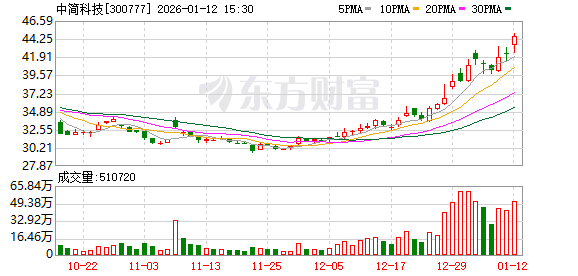
Core Viewpoint - The company, Zhongjian Technology, reported a decrease in the number of shareholders and a significant increase in stock price, indicating a concentration of shares and positive market sentiment [2] Group 1: Shareholder Information - As of January 10, 2026, the number of shareholders for Zhongjian Technology was 47,598, a decrease of 2,593 from the previous period, representing a decline of 5.17% [2] Group 2: Stock Performance - The closing price of Zhongjian Technology was 44.60 yuan, reflecting an increase of 5.54%, with a cumulative increase of 9.31% since the concentration of shares began [2] - The stock experienced four days of increases and two days of decreases during the reporting period [2] Group 3: Financing Data - As of January 9, the margin trading balance for the stock was 1.024 billion yuan, with a financing balance of 1.020 billion yuan, showing an increase of 12.4576 million yuan, or 1.24%, since the concentration of shares began [2] Group 4: Financial Performance - For the first three quarters, Zhongjian Technology achieved operating revenue of 684 million yuan, a year-on-year increase of 28.46%, and a net profit of 290 million yuan, a year-on-year increase of 25.45% [2] - The basic earnings per share were 0.6613 yuan, with a weighted average return on equity of 6.44% [2]
震荡整理蓄势待发!化工ETF天弘(159133)连续8日净流入,近20日“吸金”近2亿元,盘中实时净申购3600万份
Sou Hu Cai Jing· 2026-01-12 07:03
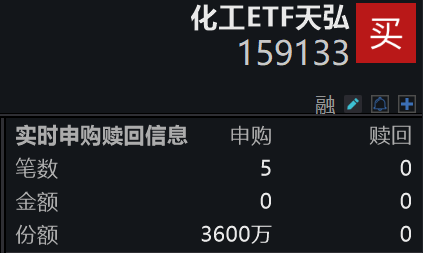
Core Viewpoint - The chemical ETF Tianhong (159133) has shown significant trading activity and net inflows, indicating strong investor interest in the chemical sector, particularly in light of recent developments in advanced manufacturing and semiconductor materials [1][2][3]. Group 1: ETF Performance - As of January 12, 2026, the chemical ETF Tianhong (159133) recorded a turnover of 3.04% with a transaction volume of 23.46 million yuan [1]. - The ETF has seen a net subscription of 36 million shares during the trading session [1]. - The latest scale of the chemical ETF Tianhong reached 776 million yuan, with a total of 678 million shares, both hitting record highs since its inception [2]. Group 2: Market Trends - The chemical ETF Tianhong has experienced continuous net inflows over the past eight days, totaling 168 million yuan, and nearly 200 million yuan over the last 20 days [2]. - The ETF tracks an index that includes 50 major stocks in the chemical industry, characterized by large market capitalization and high liquidity, with over 93% of its composition in basic chemicals, petroleum and petrochemicals, and electric equipment [2]. Group 3: Industry Developments - Shanghai has released a three-year action plan to support the transformation and upgrading of advanced manufacturing, focusing on key and emerging industries such as new-generation electronic information, intelligent connected vehicles, and advanced materials [2]. - The plan aims to foster the development of competitive enterprises in sectors like integrated circuits and low-altitude economy, which may benefit the chemical industry indirectly through increased demand for materials [2][3]. Group 4: Institutional Insights - Guohai Securities suggests that the ongoing tensions in international relations may accelerate the domestic substitution process for semiconductor materials, particularly in critical areas such as photoresists and electronic chemicals, presenting significant growth opportunities for domestic companies [3]. - The "anti-involution" policy is expected to optimize the supply side of the chemical industry, with certain segments like chromium salts experiencing a revaluation due to rising demand from AI data centers and aerospace engines [3].
“反内卷”政策引导下化工行业景气度或将止跌回升,化工ETF嘉实(159129)有望持续受益
Xin Lang Cai Jing· 2026-01-12 05:51
Group 1 - The chemical sector experienced a reversal in early trading on January 12, 2026, with the CSI Chemical Industry Theme Index (000813) down by 0.63% as of 11:25 AM [1] - Key stocks in the sector showed mixed performance, with Guangwei Composite leading gains at 8.12%, followed by Bluestar Technology at 4.77% and Zhongjian Technology at 4.52%. Hebang Bio led the declines, with Sanmei Co. and Juhua Co. also falling [1] - The Ministry of Industry and Information Technology emphasized four key areas for 2026: "stability," "expansion," "innovation," and "growth," focusing on stabilizing growth in key industries such as steel, non-ferrous metals, and petrochemicals [1] Group 2 - CITIC Construction pointed out that despite rising short-term technical correction risks in the chemical sector, investment opportunities still exist. The outlook remains positive for the cross-year market, focusing on future industry hotspots, AI, semiconductors, and the resource price increase chain [1] - Guohai Securities noted that under the "anti-involution" policy, supply-side expansion in China's chemical industry is expected to slow significantly, potentially leading to a recovery in industry prosperity. The curtailment of disorderly capacity expansion may benefit leading companies with cost and efficiency advantages, marking a long-term upward trend in performance [1] - As of December 31, 2025, the top ten weighted stocks in the CSI Chemical Industry Theme Index included Wanhua Chemical, Salt Lake Industry, and Cangge Mining, accounting for a total of 45.31% of the index [2] Group 3 - Investors can also explore investment opportunities in the chemical sector through the Chemical ETF Link Fund (013527) [3]