毕马威会计师事务所

Search documents
万城控股(02892)拟委任立信德豪为核数师
智通财经网· 2025-08-04 11:50
智通财经APP讯,万城控股(02892)发布公告,由于公司与毕马威会计师事务所未能就截至2025年12月31 日止财政年度的审计费用达成共识,毕马威会计师事务所已辞任公司核数师,自2025年8月1日起生效。 经审计委员会推荐,董事会进一步宣布,已议决委任香港立信德豪会计师事务所有限公司(立信德豪)为 公司核数师,自2025年8月4日起生效。此项委任旨在填补辞任后的临时空缺,并将持续有效直至公司下 届股东周年大会结束为止。 ...
万城控股(02892.HK)委任香港立信德豪为核数师
Ge Long Hui· 2025-08-04 11:45
格隆汇8月4日丨万城控股(02892.HK)公告,由于公司与毕马威会计师事务所未能就截至2025年12月31日 止财政年度的审计费用达成共识,毕马威会计师事务所已辞任公司核数师,自2025年8月1日起生效。 经审计委员会推荐,董事会进一步宣布,已议决委任香港立信德豪会计师事务所有限公司为公司核数 师,自2025年8月4日起生效。此项委任旨在填补辞任后的临时空缺,并将持续有效直至公司下届股东周 年大会结束为止。 ...
京能清洁能源(00579)建议委任毕马威会计师事务所为国际审计师
智通财经网· 2025-08-01 13:41
Core Viewpoint - The company, Jingneng Clean Energy (00579), has announced the recommendation to appoint KPMG as the international auditor for the fiscal year 2025, pending approval from shareholders at an upcoming extraordinary general meeting [1] Group 1 - The board of directors has resolved to recommend the appointment of KPMG after the results of the tender process and the recommendation from the audit committee [1] - The term of KPMG will commence upon the conclusion of the extraordinary general meeting and will last until the end of the next annual general meeting, subject to shareholder approval [1] - An extraordinary general meeting will be convened for shareholders to consider and approve the proposed appointment of KPMG as the international auditor for 2025 [1]
西部证券电新行业联席首席胡琎心离职
Xin Lang Zheng Quan· 2025-07-31 07:38
西部电新团队 | | 主流与风光设备 /青英分析师 | | | --- | --- | --- | | 名次 | 机构 | 姓名 | | | | 朱玥、许琳、任佳玮、王吉 | | 1 | 中信建投证券 | 颖、陈思同、雷云泽、胡颖、 | | | | 郑博元、屈文敏 | | | | 朱碧野 (核心成员)、李孝 | | 2 | 民生证券 | 鹏、王一如、李佳、赵丹、林 | | | | 誉韬、席子屹 | | | | 庞钧文、周奥铮、牟俊宇、马 | | 3 | 国泰君安 | 铭宏、朱攀、周淼顺、孙炫 | | | | 浩、任再威 | | 4 | 华创证券 | 黄麟、盛炜、何家金、吴含、 | | | | 苏干叶、梁旭、代昌祺 | | 5 | 国海证券 | 李航、邱迪、王刚、李铭全 | | | | 胡碰心、刘小龙、章启耀、侯 | | 6 | 西部证券 | 立森、重正奇 | 值得注意的是,电新板块人员暗流涌动。6月,中泰证券研究所电力与新能源行业助理研究员周寒阳辞 职,转行投身高中科创教培,一度刷屏社交媒体;5月,财通证券原电新首席张一弛离职;同期,原天 风证券家电首席孙谦转投财通证券,出任业务所长兼首席经济学家。去年12月 ...



“大而美”法案搅动全球能源格局
Zhong Guo Hua Gong Bao· 2025-07-14 02:02
Core Viewpoint - The "Big and Beautiful" tax and spending bill signed by President Trump significantly alters U.S. energy policy, potentially disrupting the global energy structure and hindering the transition to renewable energy sources [1][2]. Group 1: Impact on Renewable Energy - The bill repeals several tax incentives for clean energy projects, particularly affecting wind and solar energy, which could severely hinder the renewable energy industry [1][2]. - Energy Innovation reports that over 80% of new electricity capacity in the U.S. last year came from solar and battery projects, primarily in "red states" like Texas, Oklahoma, and Kansas [1]. - The U.S. solar industry warns of nearly 300,000 job losses due to the premature termination of green subsidies, with the industry facing an increased burden of $4 billion to $7 billion [2][3]. Group 2: Changes in Tax Incentives - New regulations require clean energy projects to be operational by 2027 or start construction within 12 months of the bill's enactment to qualify for remaining tax credits [2]. - The bill extends the tax credit for hydrogen projects by two years, allowing projects to qualify if they start by January 1, 2028, which is a positive development for the hydrogen sector [3]. Group 3: Fossil Fuel Industry Benefits - The bill retains provisions favorable to fossil fuel companies, including billions in subsidies and new lease auctions for oil and gas in federal waters, which has been positively received by the oil and gas industry [3][4]. - The reintroduction of lower royalty rates for new oil and gas lease auctions is seen as a significant boost for the U.S. oil and gas sector [4]. Group 4: Global Energy Market Implications - The U.S. is currently in a state of oversupply in the global oil and gas market, and excessive production could lead to a decline in global oil prices, which may not align with U.S. interests [4]. - The implementation of the "Big and Beautiful" bill is expected to initiate a transformation period in the global energy industry, creating challenges and opportunities for foreign renewable energy companies [4].
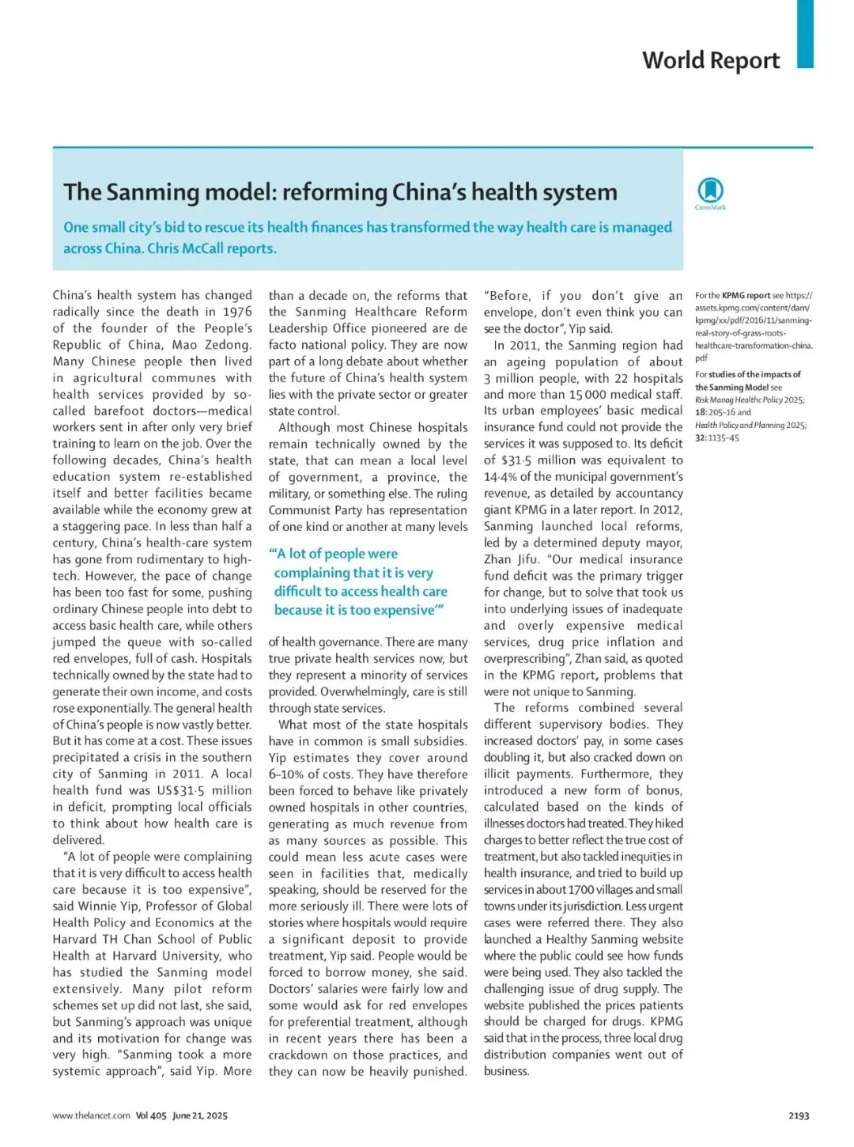
柳叶刀:三明模式正在引领中国卫生体系改革进程
Di Yi Cai Jing· 2025-07-11 00:35
Core Insights - The Sanming model serves as a successful example of healthcare reform in China, emphasizing transparency, restructuring the drug supply chain, and reforming the health insurance distribution mechanism, thus providing a "Chinese solution" for global healthcare reform [1][3][24] Healthcare System Background - China's healthcare system has evolved significantly since 1976, transitioning from rudimentary services to advanced healthcare, but rapid changes have led to increased costs and accessibility issues for ordinary citizens [4][6] - In 2011, Sanming faced a healthcare crisis with a local health fund deficit of $31.5 million, equivalent to 14.4% of the municipal government's revenue, prompting urgent reforms [10][21] Sanming Model Reforms - The Sanming reforms, initiated in 2012, aimed to address the healthcare fund deficit and underlying issues such as high medical costs and drug price inflation, leading to a systemic approach to healthcare delivery [10][11][22] - Key reforms included increasing doctors' salaries, implementing a new bonus system based on treated illnesses, and enhancing transparency through the "Healthy Sanming" website, which disclosed fund usage [11][24] Financial Outcomes - By 2015, the Sanming healthcare fund had turned from a deficit into a surplus of $19.5 million, demonstrating the effectiveness of the reforms [13][24] - The Chinese government has since recognized the Sanming model, encouraging other regions to adopt similar policies, particularly in health insurance innovation [13][24] Drug Supply Chain Transformation - The Sanming model introduced a two-invoice system for drug procurement, significantly reducing drug costs and eliminating excessive mark-ups in the supply chain, which has been replicated nationwide [15][25] - Between 2018 and 2022, the prices of 294 key drugs in China decreased by an average of 53% due to these reforms, while their quality improved [16][25] Broader Implications and Challenges - While the Sanming model has shown success in controlling costs and improving healthcare access, its applicability in larger cities like Shanghai and Beijing remains limited due to different healthcare dynamics [18][26] - Experts suggest that while some elements of the Sanming model can be adapted for densely populated areas, the overall model may not be easily transferable to all regions of China [19][20][26]
关联互通,创见不同:全球银行业可持续披露观察(上)
Sou Hu Cai Jing· 2025-07-03 06:12
Core Insights - The importance of providing interconnected and focused statements in sustainable disclosures is increasing as banks expand their sustainability-related disclosures [3][5][29] - Understanding and comparing banks' ESG performance is becoming a challenge due to the richness of disclosed sustainable information [3][5] - The study covers 33 major global banks and analyzes their climate and sustainability-related disclosures for the 2024 reporting cycle [1][5] Disclosure Timeliness - 73% of major global banks published their annual and sustainability reports simultaneously in 2023, up from 43% in the previous year [6] - All 20 domestic systemically important banks in China have achieved synchronized publication of sustainability-related reports with their annual reports [6] Disclosure Content - Banks are focusing their disclosures on climate change, customer, and employee-related themes, which have clearer requirements and more complete data [3][6] - There is a lack of detailed disclosures on biodiversity and other themes, often due to limited data availability or perceived lower importance [3][6][26] Reporting Standards and Frameworks - Many global banks are adopting various reporting standards and frameworks, with 23% referencing the TNFD framework for nature-related disclosures in 2024 [15][18] - Domestic banks are widely referencing the sustainable disclosure guidelines from major Chinese stock exchanges and the GRI standards [15][18] Importance and Information Reiteration - 27% of global banks reference the EU's Corporate Sustainability Reporting Directive for double materiality analysis, while 55% of domestic banks have conducted such analyses [18][20] - 61% of global banks have restated their previous year's financing emissions data, indicating evolving methodologies [20] Areas for Improvement - Banks need to enhance disclosures on water and marine resources, biodiversity, and tax transparency, as current disclosures are often limited [26][29] - There is a call for banks to actively manage their operations and value chains while aligning business and social value through meaningful sustainability practices [26][29] Future Research Directions - KPMG plans to further analyze eight key sustainable themes under the environmental, social, and governance pillars, including sustainable financing and social impact assessment [27]

三重“凉意”席卷美国,这剂“药”失效了
Zhong Guo Xin Wen Wang· 2025-06-17 01:39
"我们将向其他国家加征关税,让美国人富起来!" 2025年1月,美国总统特朗普在就职演讲中,曾如是声言。 从年初到入夏,美国政府一直试图向选民兑现竞选承诺。但事与愿违,这个夏天,美国经济恐怕要"凉 凉"了。 毕马威会计师事务所最近发布的一份消费者调查显示,受关税影响,50%的美国消费者正在削减购买 量,49%的消费者正在积极寻找优惠和折扣。许多美国人表示,这个夏天他们虽然还会选择旅行,但在 其他方面已经削减了个人支出。 第三"凉",凉在信心。 第一"凉",凉在旅游业。 英国牛津经济研究院下属的旅游经济学公司发布数据显示,受美国政府"对等关税"等政策影响,2025年 美国国际入境旅客数量将下降8.7%,国际旅客今年在美国花销将比去年少85亿美元。旅游分析机构的 最新报告显示,这是自2013年以来,美国面临的最严重的夏季旅游低谷。 旅游不仅是一张门票,餐饮、交通、住宿,还有周边产品背后的制造业,都与旅游息息相关。《财富》 杂志认为,外国游客赴美人数下滑,或将使大量工作岗位和重要税收收入面临风险。 美国政府的边境管控和滥施关税的举动早已招致大量贸易伙伴的不满,美国的国际形象受损严重,外国 游客将美国从海外旅行目的地 ...
【环球财经】英国零售商5月销售额仅小幅增长
Xin Hua Cai Jing· 2025-06-10 07:43
新华财经北京6月10日电(王姝睿) 周二公布的对英国零售商和消费者的调查显示,由于家庭对个人财 务状况和消费能力的信心下降,英国消费者支出在前一个月反弹之后,于5月失去了增长势头。 Omnis Investments高级投资策略师Patrick O'Donnell认为,英国4月通胀强于预期,引发了人们对通胀压 力的担忧,并降低了英国央行6月降息的可能性。这一数据应该让人怀疑,在8月的后续会议上是否会降 息。 贝伦贝格银行经济学家安德鲁表示,英国央行可能在2025年剩余时间内将利率维持在4.25%。安德鲁 称,从4月开始,企业国民保险缴款的增加和工资增长的上升增加了企业成本,很可能转化为更高的通 胀。 毕马威会计师事务所英国消费者、零售和休闲部门负责人Linda Ellett表示,虽然天气依旧晴好,但5月 英国零售额的增速并没有加快。提早进行季节性采购可能是一个因素,另外随着家庭面对近期一系列基 本支出的上涨,一些消费欲望也受到了抑制。 英国GfK消费者信心指数从4月的-23升至5月的-20,仍远低于该调查的长期平均值-11。 上个月的官方数据显示,英国4月零售销售增幅远超预期,部分原因是比往年更晴朗的天气促进 ...
产业金融发展新模式:以产业带动消费,以消费促进产业
Sou Hu Cai Jing· 2025-05-26 03:02
Core Viewpoint - The article emphasizes the importance of financial innovation in bridging the value chain between the industrial and consumer sectors to drive high-quality economic development in China, especially during the current phase of economic transformation and structural adjustment [2][23]. Group 1: Current Economic Challenges - China's economy is facing multiple pressures, including the need for industrial transformation, structural employment issues, and insufficient consumer confidence, which are hindering the release of domestic consumption potential [2][3]. - Enterprises are under significant operational pressure due to rising costs and weak market demand, leading to declining profit margins, particularly in traditional manufacturing sectors [3]. - The employment market is experiencing structural challenges, with traditional jobs disappearing faster than new opportunities in emerging industries can be created, resulting in a mismatch in labor supply and demand [3]. Group 2: Consumer Income and Confidence - There is a noticeable downward pressure on household income, with wage growth slowing significantly, particularly for frontline employees in manufacturing and services [4]. - Fluctuations in financial markets have adversely affected property income, leading to a substantial impact on overall disposable income and consumer purchasing power [4]. - Consumer confidence remains low due to uncertainties in economic expectations and employment prospects, resulting in a tendency towards risk-averse savings and a decline in consumption willingness [4]. Group 3: Role of Commercial Banks - Commercial banks are encouraged to develop a collaborative mechanism between industrial finance and consumer finance to support the transformation of the real economy and stimulate market demand [5]. - By providing financial support to advanced manufacturing and strategic emerging industries, banks can enhance supply quality and create a virtuous cycle of "industrial upgrading creating supply—employment stability ensuring income—consumer finance releasing demand" [5][7]. - The integration of financial services into consumption scenarios and the provision of robust wealth management services are essential for stabilizing employment and increasing residents' income [5][8]. Group 4: Value of Industrial Finance - The value of industrial finance in expanding domestic demand and boosting consumption is multi-faceted, impacting supply-side optimization, demand-side enhancement, employment stability, and income growth [7]. - Supporting technological upgrades and product innovation through industrial finance can significantly improve the quality and efficiency of the supply system, thereby meeting the demands of consumption upgrades [7][10]. - Financial support for private enterprises, which are key to job creation, directly influences income levels and consumer capacity, enhancing overall consumption willingness [8]. Group 5: Practical Measures for Banks - Banks should focus on strategic emerging industries and advanced manufacturing by offering specialized loans and innovative financing products to support the development of products aligned with consumption upgrade trends [13][16]. - By designing differentiated financial products that cater to consumer scenarios and small business growth, banks can stimulate terminal consumption markets and create a positive cycle from "employment increase" to "consumption stimulation" [17][19]. - Wealth management services should be integrated with consumer finance to enhance residents' financial income and optimize consumption rights, thereby fostering a positive cycle from "income growth" to "consumption upgrade" [20][22].