环旭电子

Search documents
——金融工程市场跟踪周报20260208:静待市场情绪提振-20260208
EBSCN· 2026-02-08 05:49
Quantitative Models and Factors Summary Quantitative Models and Construction Methods Model Name: Volume Timing Model - **Model Construction Idea**: The model uses volume signals to determine market timing[12] - **Model Construction Process**: - The model evaluates the volume timing signals for major indices as of February 6, 2026, and maintains a cautious view[24] - **Model Evaluation**: The model is currently signaling a cautious outlook for all major indices[24] Model Name: Momentum Sentiment Indicator - **Model Construction Idea**: The model uses the number of stocks with positive returns within an index to gauge market sentiment[24] - **Model Construction Process**: - Calculate the proportion of stocks in the CSI 300 index with positive returns over the past N days - The formula is: $ \text{CSI 300 Index N-day Upward Stock Proportion} = \frac{\text{Number of stocks with positive returns in the past N days}}{\text{Total number of stocks in the index}} $[24] - **Model Evaluation**: The indicator can quickly capture upward opportunities but may miss out on gains during sustained market exuberance and has limitations in predicting downturns[25] Model Name: Moving Average Sentiment Indicator - **Model Construction Idea**: The model uses the eight moving average system to determine the trend state of the CSI 300 index[32] - **Model Construction Process**: - Calculate the eight moving average values for the CSI 300 index closing prices with parameters 8, 13, 21, 34, 55, 89, 144, 233 - Assign values to the moving average indicator based on the moving average interval values - The formula is: $ \text{Indicator Value} = \begin{cases} -1 & \text{if interval value is 1/2/3} \\ 0 & \text{if interval value is 4/5/6} \\ 1 & \text{if interval value is 7/8/9} \end{cases} $[32] - **Model Evaluation**: The recent CSI 300 index is in a non-prosperous sentiment interval[32] Model Backtesting Results Volume Timing Model - **Signal**: Cautious for all major indices[24] Momentum Sentiment Indicator - **Current Value**: The indicator is above 60%, indicating high market sentiment[25] Moving Average Sentiment Indicator - **Current Value**: The CSI 300 index is in a non-prosperous sentiment interval[32] Quantitative Factors and Construction Methods Factor Name: Cross-sectional Volatility - **Factor Construction Idea**: The factor measures the cross-sectional volatility of index constituent stocks to assess the Alpha environment[36] - **Factor Construction Process**: - Calculate the cross-sectional volatility for the CSI 300, CSI 500, and CSI 1000 index constituent stocks - The formula is: $ \text{Cross-sectional Volatility} = \sqrt{\frac{1}{N-1} \sum_{i=1}^{N} (R_i - \bar{R})^2} $ where $ R_i $ is the return of stock i, and $ \bar{R} $ is the average return[37] - **Factor Evaluation**: The short-term Alpha environment has deteriorated, but the quarterly view shows a good Alpha environment for the CSI 300 and CSI 1000 indices[36] Factor Name: Time-series Volatility - **Factor Construction Idea**: The factor measures the time-series volatility of index constituent stocks to assess the Alpha environment[37] - **Factor Construction Process**: - Calculate the time-series volatility for the CSI 300, CSI 500, and CSI 1000 index constituent stocks - The formula is: $ \text{Time-series Volatility} = \sqrt{\frac{1}{T-1} \sum_{t=1}^{T} (R_t - \bar{R})^2} $ where $ R_t $ is the return at time t, and $ \bar{R} $ is the average return[40] - **Factor Evaluation**: The recent week shows an improvement in the Alpha environment for all indices[37] Factor Backtesting Results Cross-sectional Volatility - **CSI 300**: - Last quarter average: 2.17% - Last quarter percentile (2 years): 70.99% - Last quarter percentile (1 year): 74.07% - Last quarter percentile (6 months): 65.64%[37] - **CSI 500**: - Last quarter average: 2.48% - Last quarter percentile (2 years): 48.41% - Last quarter percentile (1 year): 53.97% - Last quarter percentile (6 months): 56.35%[37] - **CSI 1000**: - Last quarter average: 2.63% - Last quarter percentile (2 years): 66.53% - Last quarter percentile (1 year): 68.92% - Last quarter percentile (6 months): 66.14%[37] Time-series Volatility - **CSI 300**: - Last quarter average: 0.96% - Last quarter percentile (2 years): 58.02% - Last quarter percentile (1 year): 60.91% - Last quarter percentile (6 months): 47.94%[40] - **CSI 500**: - Last quarter average: 1.27% - Last quarter percentile (2 years): 50.00% - Last quarter percentile (1 year): 57.94% - Last quarter percentile (6 months): 60.32%[40] - **CSI 1000**: - Last quarter average: 1.22% - Last quarter percentile (2 years): 63.35% - Last quarter percentile (1 year): 71.31% - Last quarter percentile (6 months): 66.93%[40]
300818,突然终止投资海外铜金银矿项目!超100家机构现身调研!
证券时报· 2026-02-08 04:31
Core Viewpoint - The article discusses the recent trends in institutional investor research and highlights specific companies that have garnered attention due to their stock performance and strategic decisions [3][5][11]. Group 1: Institutional Research Trends - As of February 6, 113 A-share listed companies disclosed institutional investor research records, with 50% of these companies experiencing stock price increases [3]. - Notable stock performers include Zerun New Energy with a 70.84% weekly increase, followed by Olay New Materials at 32.25%, and Triangle Defense at 19.14% [3]. Group 2: Nep Mining Machine - Nep Mining Machine announced the termination of its investment in overseas mining projects, specifically the acquisition of Swiss Veridat Resources and the Colombian Alacran copper-gold-silver mine project, due to significant changes in equity transfer conditions and increased risks [5]. - The total investment amount was $146 million (approximately 1.02 billion RMB), representing 56% of the company's net assets [5]. - The company plans to continue its dual development strategy, focusing on strengthening its core business while exploring investment opportunities in stable regions like Central Asia and Southeast Asia [5]. Group 3: Huanxu Electronics - Huanxu Electronics also received attention from 113 institutional investors, with a focus on its 2025 Q4 performance and the impact of storage price increases on its business [8]. - The company reported a 5.3% quarter-over-quarter decline and a 6.8% year-over-year decline in Q4 2025 revenue, totaling 15.55 billion RMB [8]. - Huanxu Electronics anticipates growth in AI server motherboard business and is optimistic about new cooperation opportunities in smart glasses and other areas [9]. Group 4: Dajin Heavy Industry - Dajin Heavy Industry hosted 109 institutional investors to discuss its offshore engineering base, which aims to become a world-class factory for large-scale offshore wind foundations [11]. - The base covers over 1,300 acres with an annual design capacity of 500,000 tons, focusing on producing large foundations suitable for 15MW to 25MW wind turbines [11]. - The company is enhancing its local assembly capabilities in Europe to improve project delivery and profitability [12].




算力需求强劲,关注CPO等新技术演进
Orient Securities· 2026-02-07 09:53
Investment Rating - The report maintains a "Positive" investment rating for the electronic industry, indicating an expectation of returns stronger than the market benchmark by over 5% [5]. Core Insights - Strong demand for computing power driven by AI applications is expected to continue, with significant investments from major cloud providers [8]. - The hardware supply-demand imbalance is spreading across various sectors, leading to price increases [8]. - New technologies such as CPO (Co-Packaged Optics) are anticipated to create additional demand [8]. Summary by Sections Investment Recommendations and Targets - Key investment targets include: - Semiconductor manufacturing: SMIC (688981, Buy), Hua Hong Semiconductor (01347, Buy) - Testing and packaging: Changdian Technology (600584, Buy), Tongfu Microelectronics (002156, Buy), and others [9]. - Server storage: Lianqi Technology (688008, Buy) - CPUs: Haiguang Information (688041, Buy), Longxin Technology (688047, Not Rated), and others [9]. - Passive components: Sanhua Group (300408, Buy), Fenghua Advanced Technology (000636, Not Rated) [9]. - Server manufacturing: Industrial Fulian (601138, Buy), Huaqin Technology (603296, Buy) [9]. - Analog and power chips: Naxin Micro (688052, Buy), Sierui Technology (688536, Not Rated), and others [9]. - Semiconductor equipment: Zhongwei Company (688012, Buy), Northern Huachuang (002371, Buy), and others [9]. - Optical devices/chips: Zhishang Technology (301486, Not Rated), Tianfu Communication (300394, Not Rated), and others [9]. AI Applications and Edge Computing - Key targets in edge AI applications include: - AI main control chips: Amlogic (688099, Buy), Hengxuan Technology (688608, Buy) - Edge storage: Zhaoyi Innovation (603986, Buy), Bawei Storage (688525, Buy) [10]. - Terminal manufacturers: Hikvision (002415, Buy), Luxshare Precision (002475, Buy), BYD Electronics (00285, Not Rated), and others [10]. - Core components for AI edge: Huanxu Electronics (601231, Buy), Sunny Optical Technology (02382, Buy), and others [10].





超百家机构 盯上2家公司
Zhong Guo Zheng Quan Bao· 2026-02-07 04:58
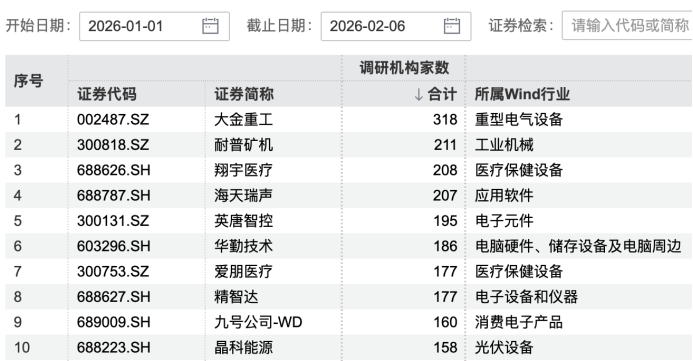
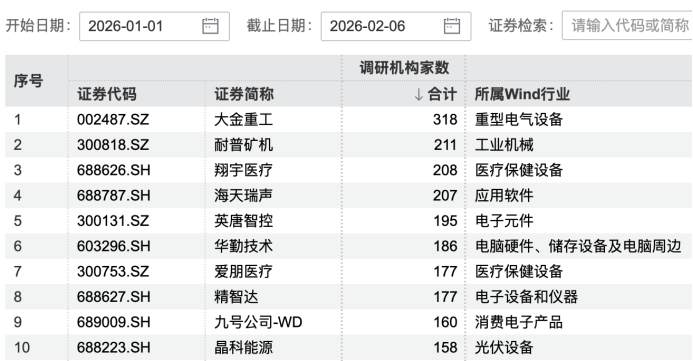
Group 1 - The enthusiasm for institutional research on listed companies remains high, particularly in the machinery, electronics, power equipment, and basic chemicals sectors [1] - Over 700 companies have been researched by institutions this year, with Daikin Heavy Industries receiving the highest number of institutional inquiries at 318 [2][4] - This week, both Naipu Mining and Huanxu Electronics were the most researched companies, each receiving inquiries from 113 institutions [2][6] Group 2 - The top ten A-share listed companies by the number of institutional inquiries this year include Daikin Heavy Industries, Naipu Mining, and Xiangyu Medical, with 318, 211, and 208 inquiries respectively [4] - Naipu Mining's research focused on its competitive barriers in forged composite liners and future investments in mineral resources, indicating a dual development strategy [7] - Huanxu Electronics received significant attention from multiple fund companies, with 113 institutional inquiries, including 33 from securities firms and 32 from fund companies [11][12] Group 3 - Huanxu Electronics is focusing on three business lines: computing power boards, optical communication, and server power supply, which align with its parent company's future advanced packaging technology layout [14] - The company aims to enhance its service to top clients in the computing power board sector by integrating with its parent company's chip packaging [14] - In the optical communication sector, Huanxu Electronics is targeting business opportunities in optical components, while also considering partnerships for server power supply to better serve North American clients [14][15]
超百家机构,盯上2家公司
Zhong Guo Zheng Quan Bao - Zhong Zheng Wang· 2026-02-07 04:52
Core Viewpoint - Institutional interest in listed companies remains high, particularly in the machinery, electronics, power equipment, and basic chemicals sectors, with notable frequency of research in the electronics and power equipment industries [1]. Group 1: Institutional Research Activity - Over 700 companies have been researched by institutions this year, with Daikin Heavy Industries receiving the highest number of institutional inquiries at 318 [3]. - This week, both Naipu Mining and Huanxu Electronics were the most researched companies, each receiving 113 institutional inquiries [2][4]. Group 2: Top Companies by Institutional Research - The top ten A-share companies by the number of institutional inquiries this week include: 1. Naipu Mining (113 inquiries) - Industrial Machinery 2. Huanxu Electronics (113 inquiries) - Electronic Manufacturing Services 3. Daikin Heavy Industries (109 inquiries) - Heavy Electrical Equipment 4. Aobi Zhongguang (76 inquiries) - Electronic Equipment and Instruments 5. BGI Genomics (73 inquiries) - Life Science Tools and Services 6. Guoneng Rixin (72 inquiries) - Application Software 7. Ruiming Technology (67 inquiries) - Electronic Equipment and Instruments 8. Huatong Cable (48 inquiries) - Electrical Components and Equipment 9. Hebei Steel Resources (41 inquiries) - Non-metallic Metals 10. Huarui Precision (39 inquiries) - Industrial Machinery [4]. Group 3: Focus Areas of Institutional Research - During the research on Naipu Mining, institutions showed interest in the competitive barriers of the company's forged composite liners, future investments in mineral resources, and the reasons for terminating the investment in the Colombian mining project [5]. - For Huanxu Electronics, institutions focused on the company's future business synergies and how the group plans to build core competitiveness, as well as which businesses Huanxu Electronics and its subsidiary Guangchuang will focus on [6][8]. Group 4: Business Strategies and Developments - Huanxu Electronics is focusing on three business lines in the AIDC sector: computing power boards, optical communication, and server power supply, all of which are related to the parent company’s future layout in advanced packaging technology [8]. - The company aims to leverage its computing power board business to better serve top clients by aligning with the parent company's plans for computing chip packaging [8]. - In the optical communication sector, Huanxu Electronics is starting with optical modules and aims to explore business opportunities in optical components within optical-electrical co-packaging [8][9].
机构最新调研路线图出炉 耐普矿机、环旭电子最受关注
Di Yi Cai Jing· 2026-02-06 16:15
Group 1 - A total of 129 listed companies were investigated by institutions from February 2 to February 6, with Nepean Mining and Huanxu Electronics receiving the most attention, involving 113 institutions [1] - Dajin Heavy Industry, Obi Photonics-UW, and BGI Genomics were investigated by 109, 76, and 73 institutions respectively [1] - Weichai Heavy Machinery and Jereh Group received 4 institutional investigations, while Hai'an Group and COFCO Technology were investigated 3 times [1] Group 2 - Institutions continue to focus on sectors such as industrial machinery, electrical components and equipment, and integrated circuits [1]
利好来了!刚刚,工信部重磅发布!
券商中国· 2026-02-06 11:49
Core Viewpoint - The Ministry of Industry and Information Technology (MIIT) has announced the construction of a national computing power interconnection node system, which is expected to enhance the efficiency and service level of public computing resources and promote high-quality development in the computing power industry [2][3]. Group 1: National Computing Power Interconnection Node System - The MIIT's notification outlines a "1+M+N" system for national computing power interconnection nodes, aiming to standardize and facilitate the efficient flow of computing resources across different regions and sectors [2][3]. - The construction goals include establishing a supply-demand matching system for computing power in regions and key industries, enhancing overall computing power levels [2][3]. - Regional nodes will provide a unified service platform for interconnection, including services such as resource aggregation, selection, and monitoring [2][3]. Group 2: Industry Trends and Demand - The domestic computing power demand is expected to accelerate, driven by rapid iterations of domestic AI models and the evolving interaction methods that are shaping the demand for inference-side computing power [4][5]. - Major AI models from companies like Alibaba and Baidu are being released, which will further drive the commercialization of these models and increase the demand for computing power [5][6]. - The infrastructure for AI computing power is undergoing systematic upgrades to support the explosive demand for training and inference, transitioning from vertical scaling to distributed cluster expansion and cross-domain collaboration [6][7]. Group 3: Hardware Innovations - Key hardware components such as optical modules and switches are innovating around high speed, low power consumption, and low cost, with a focus on co-packaged optics (CPO) and linear drive pluggable optics (LPO) [7]. - Domestic optical module manufacturers are gaining a leading position in the global market, which positions them to benefit significantly from the expansion of AI computing infrastructure [7].





热点追踪周报:由创新高个股看市场投资热点(第 230 期)-20260206
Guoxin Securities· 2026-02-06 09:34
========= - Model Name: 250-Day New High Distance; Model Construction Idea: The model aims to track the market trend by monitoring stocks that hit new highs, based on the effectiveness of momentum and trend-following strategies[11]; Model Construction Process: The 250-day new high distance is calculated as follows: $ 250 \text{ Day New High Distance} = 1 - \frac{Closet}{ts\_max(Close, 250)} $ where Closet is the latest closing price, and ts_max(Close, 250) is the maximum closing price over the past 250 trading days[11]; Model Evaluation: The model is effective in identifying market trends and hotspots[11] - Factor Name: Stable New High Stocks; Factor Construction Idea: The factor focuses on stocks that have hit new highs and exhibit stable price paths, leveraging the "boiling frog" effect and smooth price paths for stronger momentum effects[25]; Factor Construction Process: Stocks are selected based on analyst attention, relative strength, price path stability, and new high continuity. Specific conditions include: - Analyst attention: At least 5 buy or hold ratings in the past 3 months - Relative strength: Top 20% in market performance over the past 250 days - Price stability: Evaluated using the sum of absolute daily returns over the past 120 days and the ratio of price path length to displacement - New high continuity: Average 250-day new high distance over the past 120 days - Trend continuity: Average 250-day new high distance over the past 5 days[27] Model Backtest Results: - 250-Day New High Distance Model, 250-Day New High Distance for major indices as of February 6, 2026: Shanghai Composite Index 2.39%, Shenzhen Component Index 3.69%, CSI 300 Index 3.07%, CSI 500 Index 5.29%, CSI 1000 Index 4.95%, CSI 2000 Index 3.67%, ChiNext Index 4.48%, STAR 50 Index 8.58%[12][13][15] Factor Backtest Results: - Stable New High Stocks Factor, Number of stocks hitting new highs in the past 20 trading days: 1641; Highest number of new high stocks by industry: Machinery 238, Electronics 196, Basic Chemicals 176; Highest proportion of new high stocks by industry: Nonferrous Metals 69.92%, Defense & Military 63.11%, Petroleum & Petrochemicals 60.78%[19][20] - Stable New High Stocks Factor, Number of stable new high stocks selected this week: 50; Highest number of stable new high stocks by sector: Manufacturing 18, Technology 16[28] =========
热点追踪周报:由创新高个股看市场投资热点(第230期)-20260206
Guoxin Securities· 2026-02-06 09:19
========= - The report tracks the market trend by monitoring stocks, industries, and sectors that have reached new highs, emphasizing the effectiveness of momentum and trend-following strategies[11] - The 250-day new high distance is calculated as $ 1 - \frac{Closet}{ts\_max(Close, 250)} $ where Closet is the latest closing price and ts_max(Close, 250) is the maximum closing price over the past 250 trading days[11] - As of February 6, 2026, the 250-day new high distances for major indices such as the Shanghai Composite Index, Shenzhen Component Index, CSI 300, CSI 500, CSI 1000, CSI 2000, ChiNext Index, and STAR 50 Index are 2.39%, 3.69%, 3.07%, 5.29%, 4.95%, 3.67%, 4.48%, and 8.58% respectively[12][13][15] - The report identifies 1641 stocks that reached a 250-day new high in the past 20 trading days, with the highest numbers in the machinery, electronics, and basic chemicals industries[19] - The highest proportions of new high stocks are in the non-ferrous metals, defense and military, and petroleum and petrochemical industries[19] - By sector, the manufacturing and technology sectors have the most new high stocks this week, with 523 and 513 stocks respectively[20] - The report also tracks "stable new high" stocks based on analyst attention, relative stock strength, trend continuity, price path stability, and new high sustainability[25][27] - The screening criteria include the absolute value of the past 120-day price change, the sum of the absolute values of the past 120-day daily price changes, and the number of buy or overweight ratings in the past three months[27] - This week, 50 stable new high stocks were selected, including Mingyang Smart Energy, Universal Scientific Industrial, and Hengtong Optic-Electric, with the most in the manufacturing and technology sectors[28][31] - The 250-day new high distances for major indices are: Shanghai Composite Index 2.39%, Shenzhen Component Index 3.69%, CSI 300 3.07%, CSI 500 5.29%, CSI 1000 4.95%, CSI 2000 3.67%, ChiNext Index 4.48%, STAR 50 Index 8.58%[12][13][15] - The highest proportions of new high stocks by index are: CSI 2000 30.10%, CSI 1000 35.00%, CSI 500 41.80%, CSI 300 27.33%, ChiNext Index 34.00%, STAR 50 Index 44.00%[20][23][24] - The highest proportions of new high stocks by industry are: non-ferrous metals 69.92%, defense and military 63.11%, petroleum and petrochemical 60.78%[19][22][24] =========


由创新高个股看市场投资热点
量化藏经阁· 2026-02-06 09:13
Group 1 - The report tracks stocks, industries, and sectors reaching new highs, indicating market trends and hotspots, with a focus on the effectiveness of momentum and trend-following strategies [1][4][13] - As of February 6, 2026, the distance to the 250-day new high for major indices is as follows: Shanghai Composite Index at 2.39%, Shenzhen Component Index at 3.69%, CSI 300 at 3.07%, CSI 500 at 5.29%, CSI 1000 at 4.95%, CSI 2000 at 3.67%, ChiNext Index at 4.48%, and STAR 50 Index at 8.58% [6][26] - Among the CITIC first-level industry indices, textiles and apparel, petroleum and petrochemicals, building materials, light industry manufacturing, and machinery are closest to their 250-day new highs, while banking, comprehensive finance, pharmaceuticals, food and beverage, and agriculture are further away [9][27] Group 2 - A total of 1,641 stocks reached a 250-day new high in the past 20 trading days, with the highest number of new highs in the machinery, electronics, and basic chemicals sectors [2][14][27] - The highest proportion of new high stocks is found in non-ferrous metals, defense and military, and petroleum and petrochemicals, with respective proportions of 69.92%, 63.11%, and 60.78% [14][27] - The manufacturing and technology sectors had the most new high stocks this week, with 523 and 513 stocks respectively, while the proportion of new high stocks in the indices is as follows: CSI 2000 at 30.10%, CSI 1000 at 35.00%, CSI 500 at 41.80%, CSI 300 at 27.33%, ChiNext at 34.00%, and STAR 50 at 44.00% [17][27] Group 3 - The report identifies 50 stocks with stable new highs, including Mingyang Smart Energy, Huanxu Electronics, and Hengtong Optic-Electric, primarily from the manufacturing and technology sectors [3][22][27] - The manufacturing sector had the most new high stocks, particularly in the machinery industry, while the technology sector's highest new highs were in the electronics industry [22][27]