
翰森制药

Search documents
大华继显:AI创新及国策推动内地互联网医疗领域 看好阿里健康(00241)及平安好医生(01833)
Zhi Tong Cai Jing· 2026-02-16 01:25
Group 1 - The mainland internet healthcare sector is entering a new phase driven by tech giants accelerating AI innovation and government policy support, such as the online initial diagnosis pilot program launched in Beijing [1] - Despite challenges in profitability, leading companies are leveraging AI ecosystems and innovative strategies for long-term sustainable growth [1] - Alibaba Health (00241) is favored with a "Buy" rating and a target price of HKD 7.8, with expected revenue and adjusted net profit CAGR of 13% and 24% from FY2026 to FY2028, driven by innovative drugs, healthcare product growth, and deepening synergies with Alibaba [1] Group 2 - Ping An Good Doctor (01833) is also favored with a "Buy" rating and a target price of HKD 20, with expected revenue and adjusted net profit CAGR of 16% and 56% from FY2025 to FY2027, supported by synergies with Ping An (02318) and ongoing AI empowerment [1] - The firm maintains an "Overweight" rating on the mainland healthcare sector, preferring leading innovative pharmaceutical companies and contract research, development, and manufacturing organizations (CRDMOs) [2] - Companies that effectively utilize real-world data to optimize AI algorithms and enhance service quality in internet healthcare are also favored, with preferred stocks including BeiGene (06160), Innovent Biologics (01801), Hansoh Pharmaceutical (03692), China Biologic Products (01177), Hutchison China MediTech (00013), WuXi Biologics (02269), WuXi AppTec (02359), and Alibaba Health [2]

港股通创新药ETF工银(159217)跌0.30%,成交额2.32亿元
Xin Lang Cai Jing· 2026-02-13 07:14
Core Viewpoint - The Hong Kong Stock Connect Innovative Drug ETF (工银, 159217) has shown a slight decline of 0.30% in its closing price, with a trading volume of 2.32 billion yuan on February 13, 2025. The fund has experienced growth in both its share count and total assets since the beginning of the year [1]. Fund Overview - The Hong Kong Stock Connect Innovative Drug ETF (工银, 159217) was established on March 26, 2025, with an annual management fee of 0.40% and a custody fee of 0.07%. Its performance benchmark is the adjusted return of the National Index for Hong Kong Stock Connect Innovative Drugs [1]. - As of February 12, 2025, the fund's latest share count is 3.935 billion shares, with a total asset size of 5.214 billion yuan. Compared to December 31, 2025, the fund's shares have increased by 4.57% and its total assets by 9.73% [1]. Liquidity - Over the last 20 trading days, the cumulative trading amount for the Hong Kong Stock Connect Innovative Drug ETF (工银, 159217) reached 7.823 billion yuan, with an average daily trading amount of 391 million yuan [1]. Fund Management - The current fund managers are Liu Weilin and Jiao Wendong. Liu has managed the fund since March 26, 2025, achieving a return of 31.76%, while Jiao has been managing it since April 10, 2025, with a return of 50.17% [2]. Top Holdings - The fund's top holdings include: - CSPC Pharmaceutical Group (石药集团) - 10.65% of the portfolio, valued at 506 million yuan - BeiGene (百济神州) - 10.10%, valued at 480 million yuan - CanSino Biologics (康方生物) - 9.91%, valued at 471 million yuan - China National Pharmaceutical Group (中国生物制药) - 9.85%, valued at 468 million yuan - Innovent Biologics (信达生物) - 9.72%, valued at 462 million yuan - 3SBio (三生制药) - 7.08%, valued at 337 million yuan - Hansoh Pharmaceutical (翰森制药) - 7.07%, valued at 336 million yuan - Kelun Pharmaceutical (科伦博泰生物-B) - 3.54%, valued at 168 million yuan - Kangzhe Pharmaceutical (康哲药业) - 2.60%, valued at 124 million yuan [3].
大健康风向标〡跨越千亿美元门槛:中国分子站在全球化起点
Jing Ji Guan Cha Wang· 2026-02-13 07:06
Core Viewpoint - The keyword for the stock market in 2025 is expected to be "innovative drugs," with significant stock price increases driven by the potential of in-development innovative drugs and BD (business development) transactions rather than traditional revenue from already marketed drugs [1] Group 1: BD Transactions - In 2025, China's innovative drug BD transaction total exceeded $100 billion, with notable orders reaching $10 billion, and upfront payments from multinational pharmaceutical companies reaching a new high of $1.25 billion [1] - Landmark transactions include a $13 billion collaboration between Qihuang Dejian and Biohaven/AimedBio in January, marking a milestone for China's ADC technology [2] - In May, 3SBio's deal with Pfizer exceeded $6 billion, setting a record for upfront payments in China at $1.25 billion, highlighting the value of both first-in-class and fast-follow drugs [2] - In July, a $12 billion strategic partnership between Hengrui Medicine and GlaxoSmithKline showcased the depth of early-stage pipelines in leading Chinese pharmaceutical companies [2] - In October, Innovent Biologics and Takeda's collaboration worth $11.4 billion included a cost-sharing model for global R&D, enhancing operational capabilities for future international ventures [2] Group 2: Milestone Payments and Emerging Fields - Several past BD transactions reached milestone payments in 2025, including a $300 million payment to China National Pharmaceutical's subsidiary from Merck and a $250 million payment to Bairui Tianheng from Bristol-Myers Squibb [3] - The focus of BD transactions is shifting from oncology to other therapeutic areas, with autoimmune diseases, metabolism, and central nervous system disorders emerging as new hot fields [3] - Notable deals include the global rights licensing of BTK inhibitor Orelabrutinib for multiple sclerosis by Nocera Biopharma, with a potential total transaction value exceeding $2 billion [3] - The metabolic field is gaining traction, driven by global weight loss trends, with several companies entering into licensing agreements for GLP-1 targeted drugs [3] Group 3: Independent Clinical Trials and Regulatory Approvals - Numerous innovative drug companies in China are advancing their own overseas clinical trials, achieving significant progress [4] - In early 2025, Dize Pharmaceutical's lung cancer targeted drug received priority review from the FDA and was approved in July, becoming the first globally innovative drug independently developed in China to gain approval in the U.S. [4] - Other advancements include breakthrough therapy designations for CS0159 by Kexi Kedi and a Phase III trial approval for a recombinant human albumin injection by Heyuan Biopharma [4] - These developments indicate that the Chinese innovative drug industry is becoming a significant force in global innovation, transitioning from fast-following to original innovation and integrating deeply into the global value chain [4]



医药行业周报:1-8批国采平稳接续扰动有限,机构加仓创新,持续看好低估创新标的
BOCOM International· 2026-02-12 12:24
Industry Rating - The report rates the pharmaceutical industry as "Leading" [1] Core Insights - The report highlights that the recent national procurement has been stable, with limited disruptions, and institutions are increasing their positions in innovative companies, maintaining a positive outlook on undervalued innovative targets [1][4] - The overall market sentiment has improved, driven by significant business development transactions, and the pharmaceutical sector is expected to continue its steady growth in 2026, despite potential short-term volatility [4][5] Summary by Sections Market Performance - The Hang Seng Index rose by 1.3% and the Hang Seng Healthcare Index increased by 5.0%, ranking second among 12 industry indices [4][6] - Sub-sectors such as biopharmaceuticals and CXO both saw a growth of 7.4% [6] Institutional Holdings - Since Q4 2025, the proportion of domestic capital holding pharmaceutical stocks through Hong Kong Stock Connect has slightly decreased, while foreign capital holdings have increased [32] - As of February 10, 2026, domestic holdings were at 22.2%, down 0.2 percentage points, while foreign holdings rose to 39.7%, up 0.9 percentage points [32] Sales Performance - In 2025, China's pharmaceutical market sales decreased by 1% year-on-year, with public hospitals accounting for the largest market share at 10,977 billion RMB, down 2.1% [5] - Retail pharmacy sales reached 5,878 billion RMB, growing by 2.4%, with online pharmacies seeing a significant increase of 13.6% [5] National Procurement - The recent national procurement round had a high selection rate of 93%, with 1,020 products from 1,091 participating companies expected to be implemented by the end of March 2026 [5] - The procurement process has seen increased participation and a diverse range of selected products, ensuring stability in clinical demand [5] Investment Recommendations - The report recommends focusing on innovative drugs, particularly companies like Sanofi and Hengrui Medicine, which have rich catalysts and clear long-term growth logic [4] - It also suggests looking into CXO companies benefiting from high downstream demand and improving financing conditions, such as WuXi AppTec [4]
医药行业周报:1-8批国采平稳接续扰动有限,机构加仓创新,持续看好低估创新标的-20260212
BOCOM International· 2026-02-12 11:21
Industry Rating - The report rates the pharmaceutical industry as "Leading" [1] Core Insights - The report highlights that the recent national procurement has been stable, with a high selection rate of 93%, indicating a positive outlook for innovative companies in the sector [4][5] - The market sentiment has improved, driven by significant business development (BD) transactions, suggesting a continuation of the positive trend in 2026 despite potential short-term volatility [4] - The report emphasizes the importance of focusing on fundamentals and valuations when selecting stocks, particularly undervalued innovative companies that have been overlooked during market fluctuations [4] Summary by Sections Market Performance - The Hang Seng Index rose by 1.3% and the Hang Seng Healthcare Index increased by 5.0%, outperforming the broader market [4][6] - Sub-sectors such as biopharmaceuticals and CXO both saw a growth of 7.4% [6] Institutional Holdings - As of February 10, 2026, domestic institutional holdings through Hong Kong Stock Connect slightly decreased to 22.2%, while foreign holdings increased to 39.7%, indicating a shift towards more positive sentiment among foreign investors [32] - Key increases in holdings were noted in leading CXO companies benefiting from demand recovery, such as Tigermed and WuXi AppTec [37][38] Valuation Overview - The report provides a valuation summary for various companies, with notable buy ratings for AstraZeneca, BeiGene, and others, indicating strong growth potential [3] - The average price-to-earnings (P/E) ratio for the healthcare sector is reported at 28.4 times, with specific segments like biopharmaceuticals at 13.1 times [16] Sales Trends - The report notes a 1% year-on-year decline in China's pharmaceutical market sales for 2025, with significant variations across different sales channels [5] - Public hospitals accounted for the largest market share but experienced a 2.1% decline, while retail pharmacies saw a 2.4% increase, driven by online sales growth [5] Procurement Insights - The recent national procurement round involved 316 commonly used drugs, with a high participation rate and diverse product offerings, ensuring stable clinical supply [5] - The procurement process has been refined to enhance quality and reliability, with stricter requirements for participating companies [5]
港股午评:恒指跌0.89% AI应用概念走强 智谱涨近25%
2 1 Shi Ji Jing Ji Bao Dao· 2026-02-12 04:57
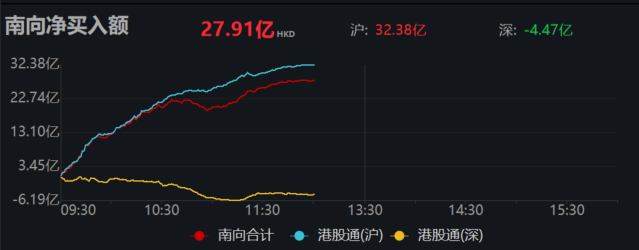
Market Overview - The Hong Kong stock market experienced a downward trend in the morning session, with the Hang Seng Index falling by 0.89% and the Hang Seng Tech Index declining by 1.68% [1] Sector Performance - The AI application sector showed strong performance, with notable gains: Zhiyun surged nearly 25%, MINIMAX-WP increased over 14%, and Kingsoft Cloud rose more than 4% [1] - The electric equipment sector continued its upward momentum, highlighted by Dongfang Electric rising over 11%, Harbin Electric increasing more than 7%, and Flat Glass Group gaining over 2% [1] - The optical communication sector was active, with Yangtze Optical Fiber and Cable rising over 11%, Huiju Technology increasing more than 7%, and Cambridge Technology gaining over 2% [1] - The pharmaceutical sector exhibited mixed results, with Reborn Bio rising by 13.65%, WuXi Biologics increasing by 4.83%, and Baidu's biotech unit rising by 3.88%, while three other companies saw declines [1] Capital Flow - Southbound capital saw a net inflow of nearly 2.8 billion HKD in the morning session [1]

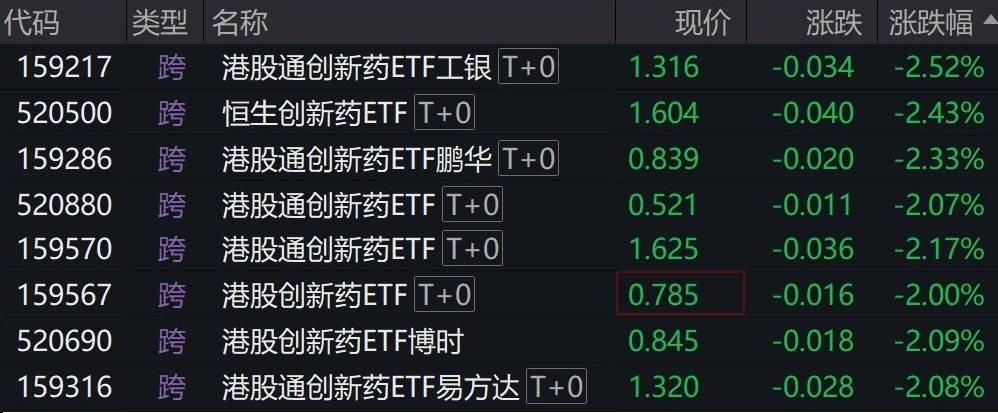
港股创新药概念股走低,相关ETF跌超2%
Sou Hu Cai Jing· 2026-02-12 03:16
Group 1 - The Hong Kong innovative drug concept stocks have declined, with companies such as 3SBio, Kelun-Botai Biopharmaceuticals falling over 3%, and CSPC Pharmaceutical Group, China Biologic Products, and Hansoh Pharmaceutical dropping over 2% [1] - The Hong Kong innovative drug-related ETFs have also seen a decline of over 2% [1] Group 2 - Current analysis indicates that the healthcare sector presents multiple investment opportunities, with the CXO industry experiencing sustained improvement due to a recovery in overseas orders and domestic capacity reduction, while still having room for valuation recovery [2] - The medical device sector is benefiting from domestic equipment upgrade policies and overseas market expansion, with continuous catalysts in cutting-edge areas such as brain-computer interfaces and AI imaging [2] - Internet healthcare is seeing improved operational efficiency in the context of deepening medical insurance payment reforms, leading to a clearer profit growth trajectory [2]

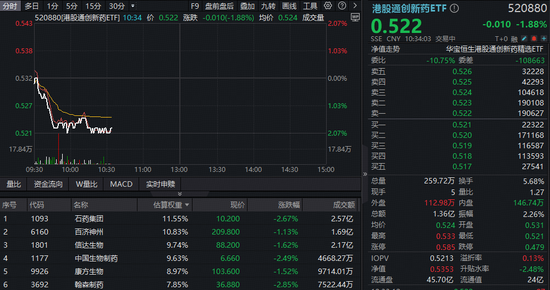
龙头齐跌,港股通创新药ETF(520880)下探2%,吸筹良机?港股春节或迎独立行情
Xin Lang Ji Jin· 2026-02-12 02:57
Group 1 - The Hong Kong stock market for innovative drugs experienced a decline, with the Hong Kong Stock Connect Innovative Drug ETF (520880) dropping by 2%, and major stocks like CSPC Pharmaceutical, China Biologic Products, and Hansoh Pharmaceutical falling over 2% [1] - The market is expected to see a traditional surge during the Chinese New Year holiday, with an average increase of 2% since 2021 [1] - CICC highlights four key sectors in the A-share market: dividends, internet, innovative drugs, and new consumption, which are considered to have long-term investment value [1] Group 2 - Chinese innovative drugs continue to gain traction internationally, with significant business development (BD) deals, including a partnership between Innovent Biologics and Eli Lilly worth up to $8.85 billion [2] - In January, CSPC Pharmaceutical announced a partnership with AstraZeneca valued at up to $18.5 billion, showcasing the global competitiveness of Chinese innovative drugs [2] Group 3 - The Chinese innovative drug sector is entering a commercialization phase, with over 70% of innovative drug companies reporting revenue growth, and companies like BeiGene achieving revenues exceeding 36 billion yuan [3] - Leading companies are starting to achieve profitability, with firms like Innovent Biologics and Rongchang Biologics reaching annual breakeven, and Elysium achieving over 2 billion yuan in net profit [3] - Open Source Securities expresses optimism about the innovative drug sector and its supply chain, as well as emerging industries like AI and biomanufacturing [3] Group 4 - The Hong Kong pharmaceutical sector has adjusted for nearly two quarters, presenting an attractive investment opportunity, particularly through ETFs for efficient capital allocation [3] - The Hong Kong Stock Connect Innovative Drug ETF (520880) focuses on innovative drug R&D companies, with the top ten holdings accounting for over 73% of the portfolio [3]
创新药2026年策略深度报告-中国药企加速融入全球新药市场-26年多赛道管线进展可期
2026-02-11 15:40
Summary of Key Points from Conference Call Records Industry Overview - **Industry**: Innovative Pharmaceuticals - **Global Drug Approvals**: In 2025, a total of 46 new drugs were approved globally, which is a decrease from the previous two years but still above the historical average of 36 since 1993 [1][2] - **Trends**: The approval landscape is shifting towards precision medicine and unmet medical needs, particularly in oncology, where 16 drugs were approved, representing approximately 15% of total approvals, higher than the past five-year average [4] Core Insights and Arguments - **FDA Performance**: Despite personnel turnover and regulatory challenges, the FDA maintained high output efficiency, approving 46 new drugs in 2025, including 34 new molecular entities and 12 biologics [2] - **Emerging Technologies**: The FDA is advancing platforms such as Antibody-Drug Conjugates (ADC) and bispecific antibodies, with ADC becoming a cornerstone in oncology [5][29] - **China's Global Integration**: In 2025, China saw a significant increase in license-out transactions, with 154 deals worth $14.19 billion, marking a 46.7% and 150% year-over-year increase, respectively [6][31] - **Clinical Trial Quality**: China's clinical trial quality has improved significantly, with compliance rates surpassing those of Europe and the U.S., addressing international concerns about data reliability [10] Company-Specific Developments - **Innovative Drug Companies**: - **Kangfang Biotech**: Achieved significant progress with its EVSTAN antibody, showing superior progression-free survival (PFS) and overall survival (OS) benefits [11] - **Hanyu Pharmaceutical**: Reported impressive results for its independent monoclonal antibody for ESCC, with a two-year overall survival rate of 88.3% [12] - **Hengrui Medicine**: Advanced in ADC technology, evolving to XDC, and has multiple ADC drugs in late-stage clinical trials [14] - **Rongchang Biotech**: Plans to expand indications for its core product, with several key clinical data expected in 2027 [15] - **Kelong Botai**: Entered the global registration phase for its lung cancer drug, FKB267, with significant data disclosures [16] - **Baiyi Shenzhou**: Made strides in hematology with multiple important data readouts [17][18] Additional Important Insights - **Market Positioning**: China's position in the global transaction market has significantly improved, with 339 transactions recorded in 2025, accounting for 24.5% of the global market [7][8] - **Regulatory Environment**: The FDA's stable policies and efficiency improvements are expected to facilitate the entry of innovative products from China into overseas markets [31] - **Emerging Drug Classes**: ADCs and similar conjugates are identified as the most certain and highest pricing power segments in the global innovative drug market [29][30] This summary encapsulates the key points from the conference call records, highlighting the innovative pharmaceutical industry's dynamics, regulatory environment, and specific company advancements.
速递|默沙东入局小分子GLP-1:减重竞赛进入口服与BD新阶段
GLP1减重宝典· 2026-02-09 11:16
整理 | GLP1减重宝典内容团队 2026年2月5日,默沙东在 ClinicalTrials.gov 上注册了其小分子GLP-1受体激动剂MK-4082的全球一期临床试验,标志着这家在DPP-4时代占据 统治地位的跨国药企,正式加入新一轮GLP-1减重药物的技术竞赛。 根据注册信息,该一期临床计划入组120例健康受试者,主要评估安全性、耐受性及药代动力学特征,预计将于2026年8月完成。这一时间表显 示,默沙东当前对该项目的定位仍处于"快速验证可行性"的早期阶段,但在GLP-1赛道整体高度拥挤的背景下,其战略信号意义远大于临床阶 段本身。 ▍ GLP-1热潮之下,MNC走向分化布局 过去数年,GLP-1类药物在减重领域掀起的热潮,几乎吸引了所有主流跨国药企(MNC)入场,但不同公司的切入路径已出现明显分化。作为 该领域的先驱,礼来 与 诺和诺德 选择了"全维度覆盖"的策略,从注射型到口服制剂、从GLP-1单靶点到双靶点及多靶点激动剂,力图构建系 统性护城河。 而后进入者则更多采取差异化切口。罗氏 通过收购Carmot获得GLP-1/GIP及小分子GLP-1资产,同时引进Zealand Pharma的Amyl ...

