
辉瑞

Search documents
跨国药企扫货中国创新药 谁是首席买家
经济观察报· 2026-01-25 06:30
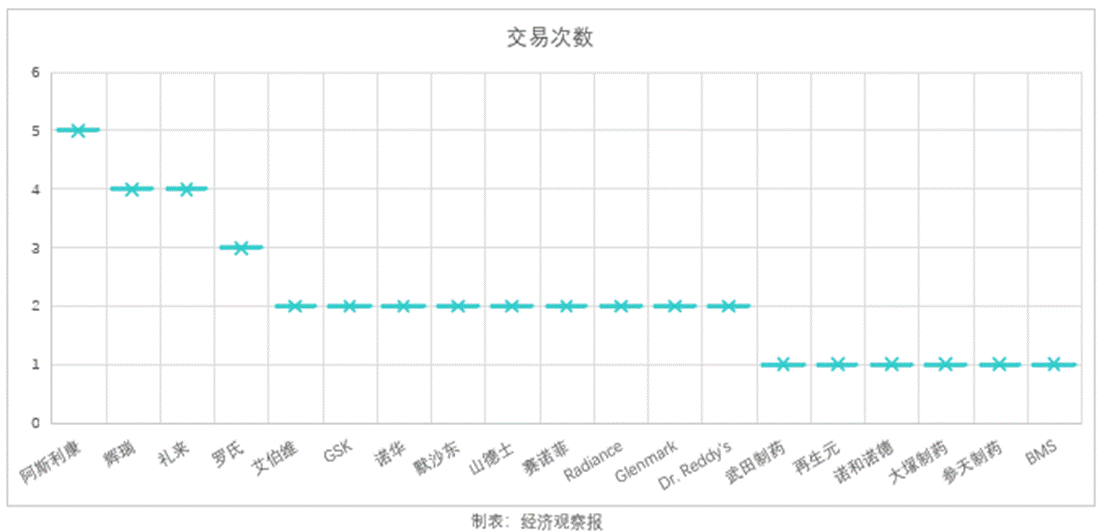
在这一年的交易热潮中,跨国巨头们的采购风格各有不同。谁出手频次最高?谁手笔最大?经济观 察报分析了全年150多笔交易,复盘跨国药企的投资画像与交易特色。 多位受访者对经济观察报表示,其所在药企与潜在合作方达成了进一步沟通意向,他们判断2026 年中国创新药对外授权交易热仍会持续。 2025年爆发式增长的对外授权交易验证了中国创新药资产的价值,该年对外授权总交易额超1300 亿美元,交易数超150笔(约占全球40%),创下历史新高。 阿斯利康最活跃 在交易频次上,阿斯利康是最活跃的跨国药企,2025年一共出手了5次。 合作方包括石药集团(01093.HK)、和铂医药(02142.HK)、加科思药业(01167.HK)、元 思生肽等。其中,在2025年6月与石药集团达成的潜在总交易额超53亿美元的合作,可排进年度 交易额前四。在资产选择上,阿斯利康主要集中在临床早期管线,以及技术平台合作。 在交易频次上,阿斯利康是最活跃的跨国药企,2025年一共 出手了5次。从立即兑现的首付款看,辉瑞与武田制药出手最 阔绰。 作者:张英 封图:图虫创意 作为中国市场销售额最高的外资药企,在经历2024年的公司治理风暴后,阿斯利康 ...


跨国药企扫货中国创新药 谁是首席买家
Jing Ji Guan Cha Wang· 2026-01-25 02:25
Core Insights - The 2026 JPMorgan Healthcare Conference highlighted significant interest from multinational companies in Chinese assets, particularly in the innovative drug sector [1][2] Group 1: Market Trends - The trend of foreign licensing deals for Chinese innovative drugs is expected to continue in 2026, following a record-breaking year in 2025 where the total licensing deal value exceeded $130 billion, accounting for approximately 40% of global transactions [3] - The surge in licensing deals in 2025 validated the value of Chinese innovative drug assets, with over 150 transactions recorded [3] Group 2: Key Players - AstraZeneca emerged as the most active multinational company in 2025, engaging in five transactions, including a notable deal with CSPC Pharmaceutical Group valued at over $5.3 billion [4] - Pfizer and Eli Lilly each conducted four transactions, with Pfizer's deal with 3SBio setting a record for upfront payments in Chinese innovative drugs at $1.25 billion [5] - GSK's collaboration with Heng Rui Medicine reached a potential total of $12.5 billion, marking the highest deal value for Chinese innovative drugs [13] Group 3: Emerging Markets - Interest in Chinese innovative drugs is not limited to Western companies; firms from India, Latin America, and the Middle East are also engaging in licensing deals [7] - Indian companies Glenmark and Dr. Reddy's each completed two business development transactions in 2025, with Glenmark's deals totaling over $2 billion [8][9] Group 4: Financial Highlights - Three companies, AstraZeneca, GSK, and Takeda, signed contracts exceeding $10 billion, while Pfizer and Novartis secured contracts over $5 billion [10] - The largest single transaction was GSK's deal with Heng Rui Medicine, which included rights to one core drug and options for 11 additional projects [13] Group 5: Future Outlook - Executives at the 2026 JPM conference expressed that Chinese assets are an effective way to supplement pipelines, indicating a shift towards acquiring entire biotechnology platforms rather than just single products [14]
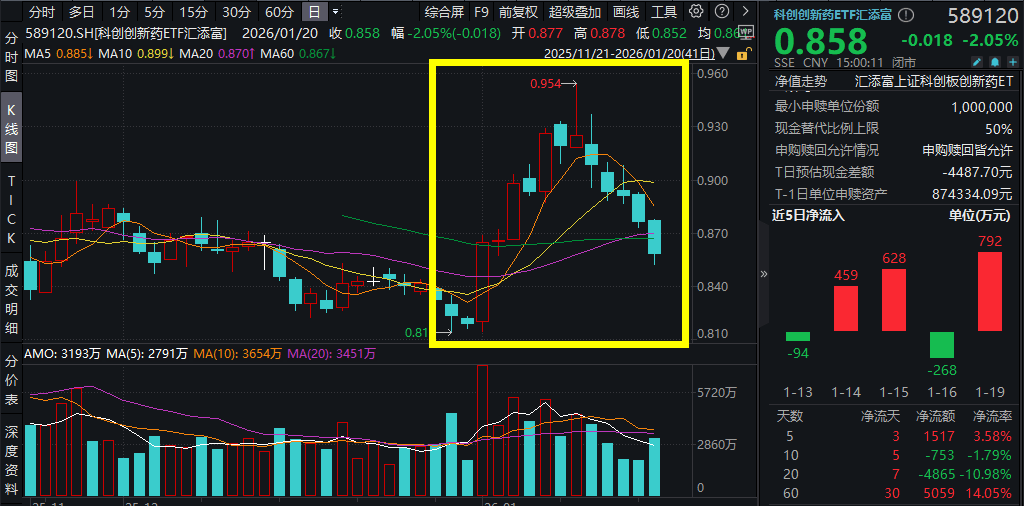
创新药板块承压,益方生物等跌超3%,科创创新药ETF汇添富(589120)跌超2%,资金逆势涌入!"全球创新药春晚"JPM召开,中国创新药闪耀全球
Sou Hu Cai Jing· 2026-01-20 11:33
Core Viewpoint - The A-share market is experiencing fluctuations, particularly affecting the innovative drug sector, with the ETF Huatai Innovation Drug (589120) declining by 2.05% and facing a five-day losing streak, despite attracting over 7.9 million yuan in funds [1][3]. Group 1: Market Performance - The Huatai Innovation Drug ETF (589120) has seen a decline in its constituent stocks, with major players like I-Mab and Junshi Biosciences dropping over 3%, and others like BeiGene and Zai Lab falling more than 2% [3]. - The top ten constituent stocks of the ETF show a negative trend, with BeiGene-U down by 2.38% and Junshi Biosciences-U down by 3.42%, indicating a general downturn in the sector [3]. Group 2: Long-term Outlook - Despite the short-term market pressure, the long-term outlook for the innovative drug sector remains positive, with expectations of a clear beta market driven by liquidity recovery at the beginning of the year [4]. - The JPM conference highlighted the achievements of over 20 Chinese pharmaceutical companies, with projections for significant revenue growth in innovative drugs, such as a 25% increase for Heng Rui in 2026 [4]. Group 3: Business Development (BD) Trends - The BD activities in the sector are at a peak, with 17 transactions occurring since January, totaling approximately 10.15 billion USD in upfront payments, significantly exceeding market expectations [5]. - The ongoing trend of foreign companies expanding in China and the increasing flow of funds into the innovative drug sector suggest a favorable environment for growth and investment [5]. Group 4: Investment Strategy - The innovative drug sector is recommended for increased allocation, particularly in Hong Kong stocks, as the market is currently at a relative bottom, with potential for new historical highs [5]. - The ETF focuses on leading innovative drug companies, providing a high degree of exposure to the opportunities presented by the rise of Chinese innovative drugs [5].


JPM亮点归纳,年报预告陆续披露,积极把握超预期机会
ZHONGTAI SECURITIES· 2026-01-19 04:40
Investment Rating - The report maintains an "Overweight" rating for the pharmaceutical and biotechnology industry [2]. Core Insights - The report highlights the ongoing performance of the pharmaceutical sector, with a focus on the upcoming annual earnings forecasts and the potential for exceeding expectations. The sector has shown a return of 7.08% since the beginning of 2026, outperforming the CSI 300 index by 4.88% [8][12]. - Key catalysts in the industry include significant partnerships and acquisitions, such as AbbVie’s $6.5 billion upfront payment for RC148 and a $1 billion collaboration between Eli Lilly and NVIDIA to accelerate AI drug development [4][10]. - The report emphasizes the importance of innovative drug chains and the AI+ theme, suggesting that these areas will continue to attract investment and yield positive results [4][5]. Summary by Sections Industry Overview - The pharmaceutical sector's total market capitalization is approximately 74,744.70 billion yuan, with a circulating market value of 68,522.64 billion yuan [2]. - The report notes that the pharmaceutical sector is currently valued at 23.4 times PE based on 2026 earnings forecasts, which is a premium of 13.7% compared to the overall A-share market [15]. Market Dynamics - The report indicates that the pharmaceutical sector has experienced a mixed performance, with medical services up by 3.29% while other segments like medical devices and traditional Chinese medicine have seen declines [8][12]. - The report also mentions that the market is transitioning to a more rational and steady growth phase, moving away from the initial volatility seen at the start of the year [4]. Key Company Performances - Notable companies such as WuXi Biologics, Sangamo Therapeutics, and Tigermed have been highlighted for their strong performance, with WuXi Biologics showing a significant increase of 26.53% in January [24]. - The report suggests continued monitoring of companies involved in AI and small nucleic acid technologies, as they are expected to lead future growth in the sector [5][9]. Investment Recommendations - The report recommends focusing on companies that are well-positioned within the innovative drug chain and AI+ sectors, as these are anticipated to provide substantial returns [4][5]. - Specific stocks recommended include WuXi Biologics, Sangamo Therapeutics, and Tigermed, which have shown promising growth trajectories [24].



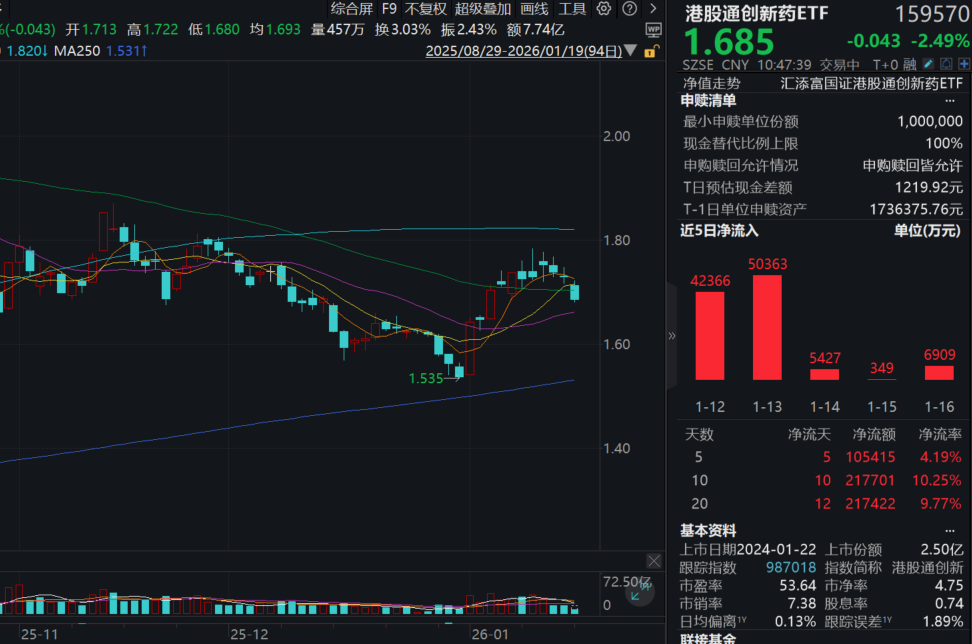
JPM大会落幕,中国创新药再成全球焦点!港股通创新药ETF(159570)深度回调2.5%,资金快速涌入,近5日狂揽超10亿元!
Xin Lang Cai Jing· 2026-01-19 03:13
Group 1 - The Hong Kong Innovation Drug ETF (159570) has experienced a 2.5% decline for three consecutive days, with a trading volume exceeding 800 million yuan, and has attracted over 1 billion yuan in the last five days [1][3] - As of January 16, the latest scale of the Hong Kong Innovation Drug ETF (159570) has surpassed 26.2 billion yuan, leading its peers in the same category [1] - The majority of the weighted stocks in the ETF's index have shown negative performance, with notable declines including Kelun-Bio down over 5%, Innovent Biologics and Hansoh Pharmaceutical down over 4%, and others down over 3% [3][4] Group 2 - The 44th JPMorgan Healthcare Conference took place from January 12 to 15, featuring several Chinese innovative pharmaceutical companies, including WuXi AppTec and BeiGene, among others [5] - Huatai Securities noted that the JPM conference and the upcoming annual report cycle in February could serve as catalysts for the market, which is currently at a relative bottom, with expectations for new highs in the innovative drug sector [5] - Zhongtai Securities highlighted multiple catalysts in the pharmaceutical sector, including significant data disclosures from multinational corporations and various business development deals, indicating a positive outlook for the innovative drug industry [5][6] Group 3 - The 2026 JPMorgan Conference is expected to showcase Chinese innovative drugs as a global highlight, with over 20 Chinese pharmaceutical companies participating [7] - Companies like HengRui are projected to see a 25%+ growth in innovative drug revenue by 2026, with several key drugs and indications expected to be approved in the next two years [7] - Notable developments include RC148's licensing deal worth up to 5.6 billion USD between Rongchang Bio and AbbVie, and various clinical trial advancements from companies like Summit Therapeutics and Eifang Bio [8]
跨国药企“必备”肿瘤药中国药企还有机会卖
Jing Ji Guan Cha Wang· 2026-01-16 16:20
Core Viewpoint - The recent exclusive licensing agreement between Rongchang Biologics and AbbVie for the dual-specific antibody drug RC148, targeting PD-1/VEGF, highlights the competitive landscape in the oncology drug market, with significant financial implications for both companies [1][5]. Group 1: Licensing Agreement Details - Rongchang Biologics has entered into an exclusive licensing agreement with AbbVie for RC148, which is currently in Phase II clinical trials [1]. - The deal includes an upfront payment of $650 million and potential milestone payments up to $4.95 billion, along with tiered royalties on net sales, bringing the total potential value of the agreement to $5.5 billion [1]. - Following the announcement, Rongchang Biologics' stock surged, with a 20% increase in A-shares and a 7.87% increase in Hong Kong shares [1]. Group 2: Market Context and Comparisons - The PD-1/VEGF target has seen multiple drugs developed, with over five similar drugs already in the market, leading to skepticism about the market share for later entrants [1][4]. - Other Chinese biotech firms have also engaged in significant licensing deals for PD-1/VEGF drugs, with notable transactions including a $500 million upfront payment from Summit to Kanyos Biologics and a $1.25 billion upfront payment from a partnership involving 3SBio and Pfizer [4]. - Despite being ranked lower in the market, Rongchang Biologics' deal value is comparable to that of Kanyos Biologics, raising questions about the valuation of later-stage products [5]. Group 3: Future Prospects and Trends - There is an expectation for continued licensing transactions in the PD-1/VEGF space, driven by efficacy, different indications, and combination therapies [8]. - Companies with PD-1/VEGF candidates that have not yet been licensed are actively seeking opportunities, with the potential for significant deals depending on product data and market conditions [8]. - Major multinational pharmaceutical companies, including Eli Lilly, Novartis, and AstraZeneca, have not yet announced new PD-1/VEGF acquisitions, indicating potential future market activity [9].

跨国药企“必备”肿瘤药,中国药企还有机会卖
经济观察报· 2026-01-15 05:55
Core Viewpoint - The article discusses the potential for PD-1/VEGF drugs to generate external licensing deals, highlighting recent significant transactions in this sector and the competitive landscape among pharmaceutical companies [1][3]. Group 1: Recent Transactions - Rongchang Biopharma announced an exclusive licensing agreement with AbbVie for its dual-specific antibody drug RC148, targeting PD-1/VEGF, currently in Phase II clinical trials. The deal includes an upfront payment of $650 million and potential milestone payments up to $4.95 billion, with a total deal value of $5.5 billion [2][6]. - Other notable transactions include: - Canfite BioPharma licensed its PD-1/VEGF dual antibody to Summit Therapeutics for an upfront payment of $500 million, with a total deal value exceeding $5 billion [5][6]. - Three other companies have also secured deals for PD-1/VEGF drugs, with upfront payments ranging from $50 million to $1.25 billion and total deal values reaching up to $6.05 billion [5][6]. Group 2: Market Dynamics - The PD-(L)1/VEGF target is considered one of the most promising in oncology, combining immunotherapy and targeted therapy, with expectations of significant therapeutic benefits [5][9]. - Despite the presence of multiple drugs targeting the same pathway, there is still potential for new licensing agreements based on efficacy, different indications, and combination therapies [11][12]. - The competitive landscape is characterized by a trend where companies are looking to acquire PD-1/VEGF assets to strengthen their oncology portfolios, especially those that missed earlier opportunities in the PD-1 market [8][12]. Group 3: Future Outlook - There is an expectation for continued licensing transactions in the PD-1/VEGF space, as companies seek to leverage unique data and therapeutic advantages of their products [10][11]. - Companies like Zai Lab, Junshi Biosciences, and others are in various stages of developing PD-(L)1/VEGF pipelines, indicating ongoing interest and investment in this therapeutic area [11][12].

研判2026年!全球T细胞衔接器药物行业产业链、发展历程、市场规模、临床数量、已获批上市数量及发展趋势分析:免疫疾病临床试验增长强劲[图]
Chan Ye Xin Xi Wang· 2026-01-15 01:53
Core Insights - T-cell engagers (TCEs) are a focus in precision immunotherapy, showing rapid market growth and clinical advancements in cancer and autoimmune disease treatments [1][4] Market Overview - The global TCE market is projected to reach $5.6 billion by 2025 and $9.5 billion by 2026, with China's market expected to grow to $300 million and $600 million respectively [1][4] - Since 2024, the TCE sector has seen significant transaction activity, with 28 transactions recorded in 2024 and a total of 179 transactions from 2013 to 2024 [4][5] Clinical Trials - In 2024, there were 175 TCE clinical trials initiated globally, with 115 focused on hematological cancers, representing 65% of the market share [4] - The number of clinical trials for autoimmune diseases is expected to grow significantly, matching the 32 trials for solid tumors initiated in 2024 [4] Industry Definition and Classification - TCEs are a subgroup of immunotherapy that utilize bispecific antibodies to direct T-cells to kill tumor cells, classified into three main types: IgG-like TCEs, Fv-based TCEs, and combination-based TCEs [2][3] Industry Development - The development of TCEs has evolved over 40 years, from the initial concept in 1961 to clinical applications, with significant milestones in 1985 and 2008 marking key advancements [5][6] Competitive Landscape - Over ten TCEs have been approved globally, with a surge in approvals since 2022, particularly in the hematological cancer space [7] - Key companies involved in TCE development include Amgen, Roche, Johnson & Johnson, and several domestic firms in China such as Guangdong Fipeng Pharmaceutical and Aimi Biotechnology [7][8] Future Trends - TCEs are increasingly being explored for various diseases beyond hematological cancers, including autoimmune diseases, and are becoming a significant area of research in the biopharmaceutical sector [8][9]


重药控股:参投企业润生药业国产吸入制剂首获FDA批准
Zheng Quan Shi Bao Wang· 2026-01-14 12:35
重药控股(000950)官微发布消息称,近日,公司参与投资企业润生药业有限公司(以下简称"润生药 业")传来喜讯,其申报的核心产品"沙美特罗替卡松吸入粉雾剂"(英文通用名:Fluticasone Propionate and Salmeterol Inhalation Powder USP,药品申请号:ANDA 214464)正式获得美国食品药品监督管理局 (FDA)批准上市,实现国际化里程碑突破。 据悉,这是FDA首次批准中国药企自主研发的吸入粉雾剂(Dry Powder Inhaler,DPI),标志着中国高 端复杂制剂成功叩开国际主流市场大门。该产品以联合用药形式(支气管扩张剂与吸入糖皮质激素), 用于可逆的气道阻塞性疾病的规律治疗,包括成人和儿童哮喘。润生药业成立于2014年10月,重药控股 下属参股基金公司和亚化医基金在润生药业成立初期投资进入。 此前,重药控股参股子公司重庆药友制药有限责任公司与上海复星医药产业发展有限公司及辉瑞共同签 订许可协议,就口服小分子胰高血糖素样肽-1 受体(GLP-1R)激动剂(包括YP05002)及含有该活性 成分的产品授予辉瑞于许可区域(即全球范围)及领域(即人类、 ...

“双抗”56亿美元“出海” 荣昌生物资金压力缓解
Bei Jing Shang Bao· 2026-01-13 15:42
Core Viewpoint - Rongchang Biologics has signed an exclusive licensing agreement with AbbVie for the dual-specific antibody drug RC148, valued at approximately $5.6 billion (about 39.06 billion RMB), marking a significant milestone in the company's business development efforts [1][3]. Group 1: Business Development Transactions - The agreement with AbbVie includes an upfront payment of $650 million (about 4.53 billion RMB) and potential milestone payments of up to $4.95 billion (about 34.53 billion RMB) based on development, regulatory, and commercialization achievements [3]. - This transaction is noted as the highest upfront payment recorded in the innovative drug sector for business development (BD) transactions at the start of the year [3]. - Since 2025, Rongchang Biologics has completed three BD transactions, including the recent agreement with AbbVie, indicating a strategic push for international expansion [5][6]. Group 2: Financial Performance - For the first three quarters of 2025, Rongchang Biologics reported revenue of approximately 1.72 billion RMB, a year-on-year increase of 42.27%, while the net loss narrowed to 551 million RMB [7]. - The company’s cash reserves reached 1.07 billion RMB by the end of Q3 2025, an increase from 743 million RMB and 763 million RMB at the end of 2023 and 2024, respectively [7]. - Despite the increase in cash reserves, the company still faces a high debt ratio of 61.18% as of Q3 2025, indicating ongoing financial pressure [7]. Group 3: Market Reaction - On January 13, following the announcement of the AbbVie deal, Rongchang Biologics' A-shares hit the daily limit, closing at a 20% increase, with a total trading volume of 2.369 billion RMB [2]. - The H-shares also experienced a significant rise, closing up 7.87% [2]. - The market's positive response reflects investor confidence in the potential of the RC148 drug and the strategic partnership with AbbVie [6][8].