
滨江集团

Search documents
中指研究院:1-10月TOP100房企拿地总额同比增长26.4%
Zhi Tong Cai Jing· 2025-11-01 00:37
Core Insights - The total land acquisition amount by the top 100 real estate companies in China reached 783.8 billion yuan from January to October 2025, marking a year-on-year increase of 26.4%, although the growth rate has significantly narrowed compared to the previous months due to large-scale land acquisitions in September [1][2] Group 1: Land Acquisition Trends - The top 100 companies' land acquisition continues to be dominated by state-owned enterprises, with 8 out of the top 10 companies being state-owned [2] - China Overseas Land & Investment, China Merchants Shekou, and Greentown China ranked as the top three companies in terms of new land value, with 187 billion yuan, 180.7 billion yuan, and 120.9 billion yuan respectively [2] - The total new land value for the top 10 companies reached 1,044.9 billion yuan, accounting for 48.1% of the total new land value of the top 100 companies [2] Group 2: Joint Acquisition Strategies - Many land acquisitions in October were conducted in joint ventures, primarily in first and second-tier cities such as Shanghai and Beijing, to share risks associated with market uncertainties [3] - The joint acquisition model often involves a combination of state-owned enterprises and local state-owned assets, as well as partnerships between real estate companies and financial investors [3] - Some projects are being developed through a construction agency model, where the agency is involved early in the project to secure development rights [3] Group 3: Regional Land Acquisition - The Yangtze River Delta region led the four major city clusters in land acquisition, with the top 10 companies acquiring 261.7 billion yuan worth of land [4] - In key cities, state-owned and local state-owned enterprises remain the primary players, while private enterprises are supplementing land reserves in specific areas [4] - Companies like China Merchants Shekou and Jianfa have made significant land acquisitions in cities like Beijing, Shanghai, and Chengdu, focusing on core urban areas [4] Group 4: High-Value Land Transactions - In October, high-value land transactions were concentrated in Shanghai and Beijing, with Shanghai accounting for 4 of the top 10 highest total price land parcels [5] - The highest transaction was for two underground space parcels in Shanghai's Jing'an District, totaling 7.7 billion yuan [5] - Joint ventures were involved in 4 of the top land parcels acquired [5]

房企“银十”成绩单:48家企业销售额环比上涨
Di Yi Cai Jing· 2025-10-31 14:27
Core Insights - The total sales of the top 100 real estate companies in China for the first ten months of 2025 reached 289.67 billion yuan, representing a year-on-year decline of 16.3%, with the decline rate widening by 4.1 percentage points compared to the first nine months of the year [1] - The sales performance in October showed a slight month-on-month recovery, with a total sales amount of 253 billion yuan, reflecting a 0.1% increase from the previous month [6] Group 1: Sales Performance by Company Tier - The average sales for the top 10 real estate companies was 143.09 billion yuan, down 15.0% year-on-year [4] - The average sales for companies ranked 11 to 30 was 35.51 billion yuan, down 17.8% year-on-year [4] - The average sales for companies ranked 31 to 50 was 17.21 billion yuan, down 16.6% year-on-year [4] Group 2: Company Breakdown - There are 7 companies in the 100 billion yuan and above tier, with sales figures of 222.7 billion yuan, 201.1 billion yuan, 189.1 billion yuan, 169.6 billion yuan, 156.0 billion yuan, 114.6 billion yuan, and 106.5 billion yuan respectively [4] - The second tier (500-1000 billion yuan) has 7 companies, down 2 from the previous year, with sales figures of 92.6 billion yuan, 92.1 billion yuan, 86.3 billion yuan, 68.7 billion yuan, 62.1 billion yuan, 55.7 billion yuan, and 55.3 billion yuan respectively [4] - The third tier (300-500 billion yuan) has 6 companies, down 3 from the previous year, with sales figures of 43.8 billion yuan, 43.5 billion yuan, 41.5 billion yuan, 33.9 billion yuan, and 32.7 billion yuan respectively [4] Group 3: Market Trends - In October, first-tier cities recorded a total transaction volume of 1.68 million square meters, remaining flat month-on-month but down 41% year-on-year [6] - The total transaction volume in 26 second and third-tier cities was 7.91 million square meters, with a slight month-on-month increase of 1% but a year-on-year decline of 35% [6] - The city of Chengdu led in monthly transactions with 800,000 square meters, followed by Qingdao, Wuhan, and Xi'an [6] Group 4: Policy Implications - The recent "14th Five-Year Plan" emphasizes boosting consumption and may lead to the relaxation of housing purchase restrictions in major cities [7] - The industry anticipates that as year-end performance targets approach, supply in key cities may improve, providing some support to the market [7] - A more comprehensive approach from the central government is needed to stabilize the industry and break the negative cycle [7]





41家A股上市房企亏掉872亿
Di Yi Cai Jing· 2025-10-31 12:54
Core Insights - The performance of A-share listed real estate companies in the first three quarters of 2025 shows a significant decline, with 41 out of 77 companies reporting net losses totaling -872.16 billion yuan [2][3][5] - The ongoing losses in the real estate sector since 2022 are attributed to low-profit project settlements and impairment provisions during market adjustments, although there is potential for recovery if the housing market gradually improves [2][9] Financial Performance Overview - A total of 77 A-share listed real estate companies disclosed their Q3 reports, with a combined revenue of 973.3 billion yuan [2][3] - 41 companies reported net losses, accounting for over 50% of the total, with the overall net loss for the sector reaching -674.89 billion yuan [5][9] Major Losses - Vanke reported a net loss of 28.02 billion yuan in the first three quarters, with a revenue of 161.39 billion yuan, primarily due to declining settlement scales and low gross margins [3][4] - *ST Jinke experienced a significant loss of 10.78 billion yuan, with total revenue dropping by 73.57% to 5.699 billion yuan [3][4] - Huaxia Happiness reported a net loss of 9.829 billion yuan, with revenue down 72.09% to 3.882 billion yuan [4] Other Notable Losses - Greenland Holdings and Xinda Real Estate reported losses exceeding 5 billion yuan, with Greenland's revenue down 20.16% to 127.697 billion yuan [4][5] - Jin Di Group and Huashang City A reported losses around 4 billion yuan, with Jin Di's revenue down 41.48% to 23.994 billion yuan [5] Companies with Positive Performance - Only 36 companies reported positive net profits, with notable performers including China Communications Real Estate, which achieved a net profit of 4.827 billion yuan after restructuring [6][8] - Other profitable companies include China Merchants Shekou, Nanjing High-Tech, and Binjiang Group, with net profits of 2.497 billion yuan, 2.438 billion yuan, and 2.395 billion yuan respectively [8] Market Outlook - The real estate sector has faced continuous losses since 2022, with challenges including low-profit project settlements and increased interest expenses [9] - Despite the ongoing difficulties, there are signs of potential recovery in core cities, with companies focusing on higher-margin projects to improve their financial performance [9]



地产三季报出炉,41家A股上市房企亏掉872亿
Di Yi Cai Jing· 2025-10-31 11:57
Core Insights - The performance of A-share listed real estate companies continues to be under pressure, with 41 out of 77 companies reporting net losses in the first three quarters of 2025, totaling a loss of 872.16 billion yuan [1][5][9] - The ongoing losses in the real estate sector are attributed to low-profit project settlements, impairment provisions during market adjustments, and increased interest expenses [9][10] - Despite the challenging environment, there are indications that some companies may recover if the housing market gradually improves [1][9] Financial Performance - The total operating revenue for the 77 listed real estate companies reached 973.3 billion yuan, with a significant portion of companies reporting substantial losses [1][5] - Vanke reported an operating revenue of 161.39 billion yuan with a net loss of 28.02 billion yuan, primarily due to declining settlement scales and low gross margins [2][3] - *ST Jinke experienced a 73.57% decline in total revenue to 5.699 billion yuan, resulting in a net loss of 10.778 billion yuan, exacerbated by liquidity issues [2][3] - Huaxia Happiness reported a revenue of 3.882 billion yuan, down 72.09%, with a net loss of 9.829 billion yuan [3] - Greenland Holdings and Xinda Real Estate also reported significant losses, with net losses exceeding 6.69 billion yuan and 5.31 billion yuan, respectively [3][4] Company Restructuring and Recovery - A few companies, such as *ST Zhongdi, managed to turn a profit due to significant asset restructuring, reporting a net profit of 4.827 billion yuan [6][7] - The restructuring involved transferring real estate development assets to its parent company, which resulted in a profit boost from asset disposals [7] - Companies like China Merchants Shekou, Nanjing High-Tech, and Binjiang Group reported net profits exceeding 2 billion yuan, indicating some resilience in the sector [8] Market Outlook - The real estate sector has faced continuous losses since 2022, with sales expected to decline further until 2024, impacting revenue recognition and gross margins [9] - Despite the challenges, there are signs of potential recovery in core cities, where companies are focusing on higher-margin projects to improve profitability [9][10] - The decline in land and financing costs, along with improved sales performance, may lead to a reversal in fortunes for some companies, although most will prioritize cash flow management [10]
非限购周期楼市新图景!2025房地产行业年度报告重磅发布:“好城市+好房子”蕴含结构性机会
Mei Ri Jing Ji Xin Wen· 2025-10-31 11:49
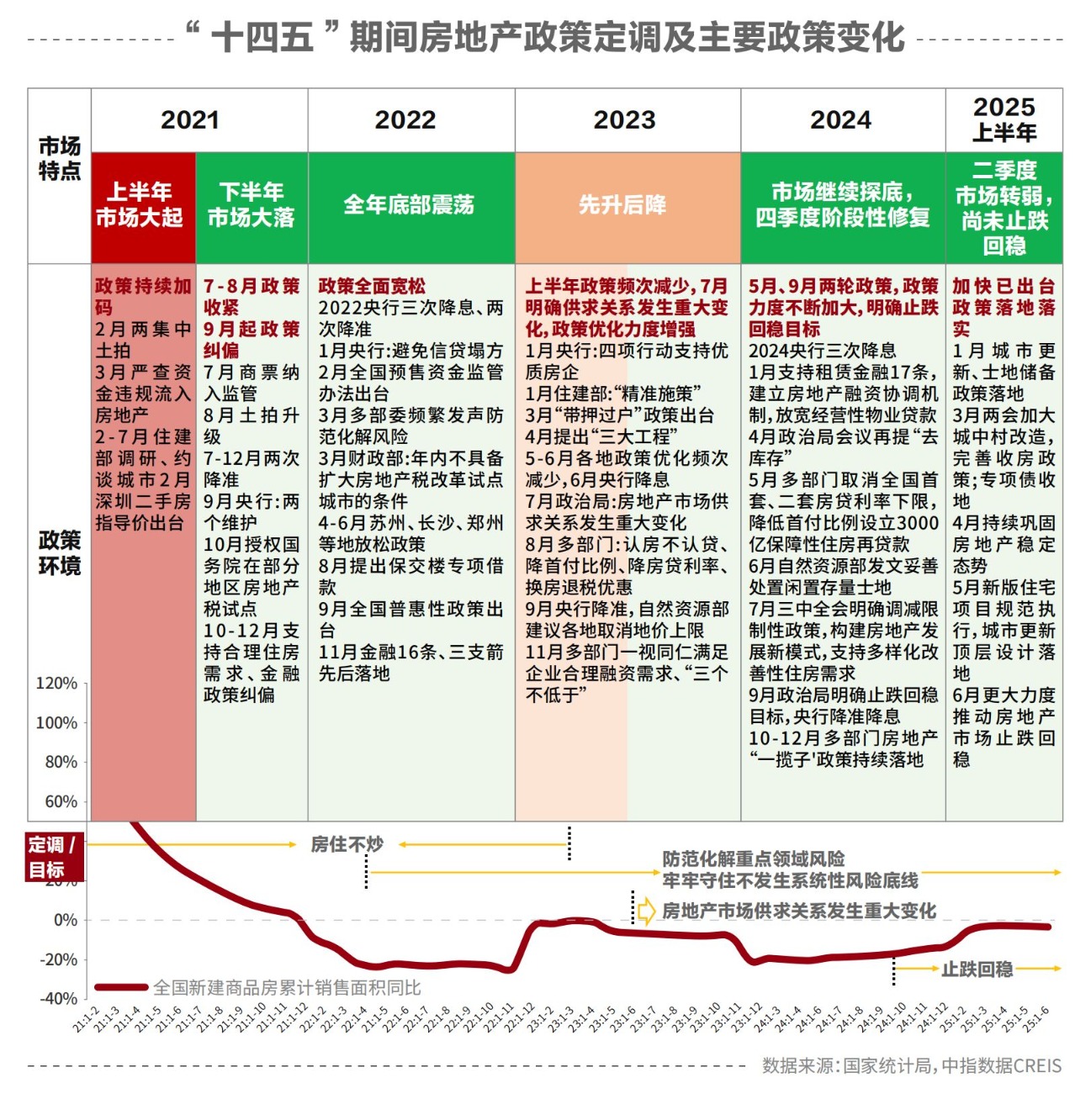
Core Insights - The real estate industry is crucial for stabilizing domestic demand, linking consumption and investment, and is expected to play a significant role in the "14th Five-Year Plan" and the upcoming "15th Five-Year Plan" [1] Market Overview - The real estate market, valued in trillions, is undergoing a transformation to regain stability, with ongoing discussions about whether risks have been fully cleared and what future trends may emerge [2] - The report presented at the 15th China Value Real Estate Annual Conference indicates that there is still room for development in the real estate market, with the top 20 cities in terms of development investment accounting for 35% of national GDP and 21% of the population [2][10] Policy Environment - Since the second half of 2021, the policy tone has shifted from "housing is for living, not for speculation" to "stabilizing and stopping the decline," with increased frequency and support for policies from central to local governments [2][3] - Approximately 3,000 optimization policies have been introduced across various regions since 2022, including significant financial support measures for real estate companies [3] Market Trends - The current policy environment is at its historically most lenient stage, with mortgage rates, transaction taxes, and down payment ratios at their lowest levels [5] - Despite a temporary market recovery, the report indicates a decline in new home sales area by 6% year-on-year for the first nine months of 2025, with a notable weakening in market performance in the second and third quarters [5][9] Inventory and Supply - As of September 2025, the available residential inventory in 50 representative cities is 310 million square meters, a decrease of 2.9% from the end of 2024, with a clearance cycle of 19.9 months [9] - The market is entering a de-inventory phase, but risks have not been fully resolved, indicating that the market is still some distance from a complete stabilization [9] Structural Opportunities - The report emphasizes focusing on "good cities + good houses" to capture structural opportunities, as the dynamics of housing demand are changing due to population and urbanization trends [10][11] - There is a notable divergence in market performance among cities, with first-tier cities like Guangzhou and Shenzhen experiencing population growth, while Beijing and Shanghai see declines [10] Investment Trends - Major real estate companies are increasingly focusing on core cities for land acquisition, with significant proportions of their land purchases concentrated in cities like Shanghai, Beijing, and Shenzhen [16][19] - The land transfer revenue in 300 cities has increased by 13% year-on-year, with first and second-tier cities showing substantial growth, while third and fourth-tier cities continue to struggle [19]
房地产及建材行业双周报(2025/10/17-2025/10/30):地产销售仍低迷,建材“反内卷”带动企业盈利改善-20251031
Dongguan Securities· 2025-10-31 11:31
Investment Rating - The report maintains a "Neutral" rating for both the real estate and building materials sectors [1][3]. Core Insights - Real estate sales remain sluggish, with a cumulative year-on-year decline of 5.5% in sales area and 7.9% in sales revenue for the first three quarters of 2025. The decline has widened compared to the end of August [3][26]. - The report highlights a shift in the real estate sector towards "quality, service, and sustainability," moving away from high leverage and high turnover models. It emphasizes the importance of urban renewal to unlock potential in existing stock [3][27]. - The building materials sector is expected to see a steady recovery in profitability, with a target of exceeding 300 billion yuan in revenue from green building materials by 2026 [3][51]. Summary by Sections Real Estate Sector Overview - As of October 30, 2025, the Shenwan Real Estate Index has increased by 0.31% over the past two weeks, underperforming the CSI 300 Index by 4.03 percentage points [13]. - In September 2025, new residential prices in first-tier cities fell by 0.3% month-on-month, while second-tier cities saw a 0.4% decline [24][26]. - The report identifies key companies to watch, including Poly Developments, Binjiang Group, and China Merchants Shekou, which are expected to perform well in the current market environment [3][27]. Building Materials Sector Overview - The Shenwan Building Materials Index rose by 2.19% over the past two weeks, ranking 16th among 31 sectors [28]. - The report notes a significant decline in national cement production, down 5.2% year-on-year to 1.259 billion tons, marking the lowest level since 2010 [48][52]. - Companies such as Conch Cement, Taipai Group, and Huaxin Cement are highlighted for their strong fundamentals and high dividend yields [52]. Specific Material Insights - The glass and fiberglass sectors are facing pressure with low prices, but the report anticipates a long-term improvement in competition due to supply constraints [5][52]. - The report suggests that the photovoltaic glass industry is transitioning towards a model driven by technology and sustainability, which is expected to enhance profitability [5][52]. - Consumer building materials are seeing improved margins due to price increases and demand from urban renewal projects, with companies like North New Materials and Rabbit Baby recommended for attention [53].
滨江集团(002244):公司信息更新报告:三季度业绩稳健增长,拿地聚焦杭州大本营
KAIYUAN SECURITIES· 2025-10-31 03:51
Investment Rating - The investment rating for the company is "Buy" (maintained) [1] Core Views - The company has shown robust revenue and profit growth in the first three quarters of 2025, driven by an increase in delivery scale. The sales ranking remains in the top ten, with a strong focus on land acquisition in Hangzhou [5][6] - The company is expected to maintain its profit forecasts, with projected net profits for 2025-2027 at 2.94 billion, 3.27 billion, and 3.42 billion yuan, respectively. The current stock price corresponds to a PE ratio of 11.8, 10.5, and 10.1 times for the respective years [5][6] Financial Performance - In the first three quarters of 2025, the company achieved operating revenue of 65.51 billion yuan, a year-on-year increase of 60.6%. The net profit attributable to the parent company was 2.39 billion yuan, up 46.6% year-on-year [6] - The gross profit margin and net profit margin were 12.44% and 6.21%, respectively, reflecting increases of 2.01 percentage points and 1.86 percentage points year-on-year. The expense ratio decreased to 2.2%, down 1.4 percentage points year-on-year [6] - The company reported a negative operating cash flow of 7.95 billion yuan [6] Sales and Land Acquisition - The company recorded sales of 78.63 billion yuan from January to September 2025, a decrease of 1.9% year-on-year, maintaining the tenth position in industry sales rankings and first among private enterprises. The sales area increased by 17.8% year-on-year [7] - In Hangzhou, the company achieved a total sales amount of 44.6 billion yuan, maintaining the highest market share. The company acquired 18 plots of land in Hangzhou and Jinhua, with a total land payment of 36.64 billion yuan, of which 35.96 billion yuan was in Hangzhou [7] Financing and Cost - The company has a smooth financing channel, with 3 billion yuan in bond financing at a coupon rate not exceeding 3.8%. The comprehensive financing cost has decreased to 3.1%, down 30 basis points from the beginning of the year [8]
滨江集团(002244):业绩大增,拿地积极
Shenwan Hongyuan Securities· 2025-10-31 03:22
Investment Rating - The investment rating for the company is "Buy" (maintained) [1] Core Insights - The company reported a significant increase in performance, with a 60.6% year-on-year growth in revenue for Q3 2025, reaching 65.5 billion yuan, and a 46.6% increase in net profit attributable to shareholders, amounting to 2.39 billion yuan [6] - The company has a strong land acquisition strategy, with a total land acquisition amount of 36.6 billion yuan in Q3 2025, representing a 34.2% year-on-year increase, and a land acquisition intensity of 47% [6] - The company maintains a healthy financial position with a net debt ratio of 6.6% and a cash-to-short-term debt ratio of 4.3 times, indicating strong liquidity [6] Financial Data and Profit Forecast - Total revenue for 2024 is projected at 69.15 billion yuan, with an expected increase to 76.04 billion yuan in 2025, reflecting a 10% year-on-year growth [2] - The net profit attributable to shareholders is forecasted to be 2.94 billion yuan in 2025, with a growth rate of 15.4% [2] - The earnings per share (EPS) is expected to rise to 0.94 yuan in 2025, up from 0.77 yuan in 2024 [2] Market Data - As of October 30, 2025, the closing price of the company's stock is 11.10 yuan, with a market capitalization of 29.81 billion yuan [3] - The company has a price-to-earnings (P/E) ratio of 14 for 2024, which is expected to decrease to 12 in 2025 and further to 11 in 2026 [2][3] Sales Performance - The company achieved sales of 78.6 billion yuan in Q3 2025, with a slight year-on-year decrease of 1.9%, while maintaining a high average selling price of 39,000 yuan per square meter [6] - The company aims for a sales target of approximately 100 billion yuan in 2025, despite a projected decrease of 10% year-on-year [6] Land Acquisition Strategy - The company focuses on land acquisition in the Hangzhou area, with 97% of the total land acquisition in Q3 2025 occurring in this region [6] - The average land acquisition price was 30,000 yuan per square meter, reflecting a 15.8% year-on-year increase [6]
滨江集团(002244.SZ):2025年三季报净利润为23.95亿元
Xin Lang Cai Jing· 2025-10-31 01:37
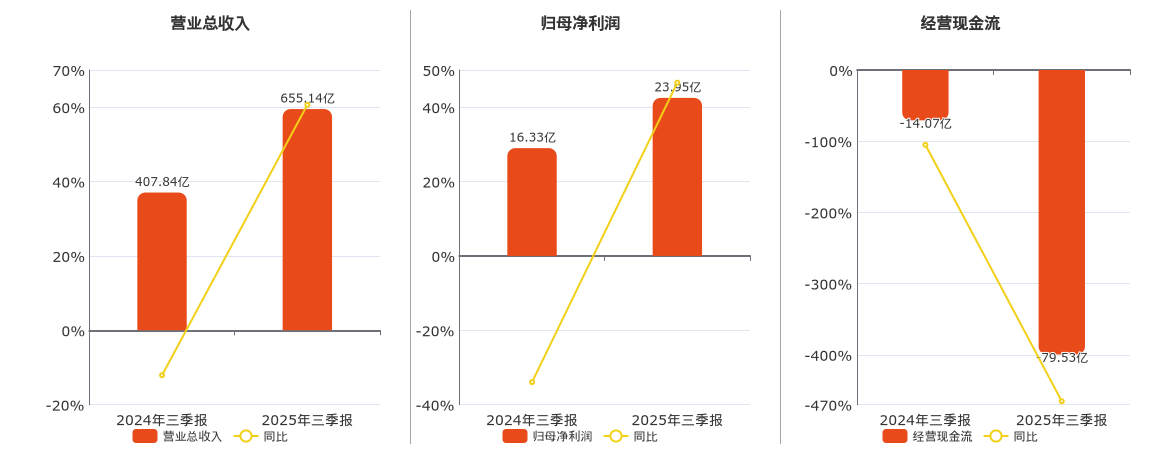
Core Insights - The company reported a total operating revenue of 65.514 billion yuan and a net profit attributable to shareholders of 2.395 billion yuan for Q3 2025 [1] - The net cash inflow from operating activities was -7.953 billion yuan, a decrease of 6.546 billion yuan compared to the same period last year, ranking 89th among disclosed peers [1] Financial Metrics - The latest debt-to-asset ratio is 76.43%, ranking 62nd among disclosed peers [3] - The latest gross profit margin is 12.44%, ranking 63rd among disclosed peers [3] - The latest return on equity (ROE) is 8.06% [3] - The diluted earnings per share (EPS) is 0.77 yuan [3] - The latest total asset turnover ratio is 0.27 times [3] - The latest inventory turnover ratio is 0.41 times [3] Shareholder Information - The number of shareholders is 27,500, with the top ten shareholders holding 2.201 billion shares, accounting for 70.73% of the total share capital [3] - The largest shareholder is Hangzhou Binjiang Investment Holding Co., Ltd., holding 4.54 billion shares [3] - Other notable shareholders include Xian Jin Xing with 1.19 billion shares and Xia Jian Sheng with 322 million shares [3]
滨江集团:10月30日召开董事会会议
Mei Ri Jing Ji Xin Wen· 2025-10-30 23:05
Group 1 - The core point of the article is that Binhai Group (SZ 002244) held its third meeting of the seventh board of directors on October 30, 2025, via telecommunication, where it reviewed the proposal for reappointing the auditing firm for the fiscal year 2025 [1] - For the first half of 2025, Binhai Group's revenue composition was as follows: real estate accounted for 99.71%, hotel industry 0.27%, and other businesses 0.02% [1]