
大秦铁路

Search documents
红利方向持续表现,300红利低波ETF(515300)红盘上扬,最新资金净流入1.43亿元
Sou Hu Cai Jing· 2025-07-10 02:56
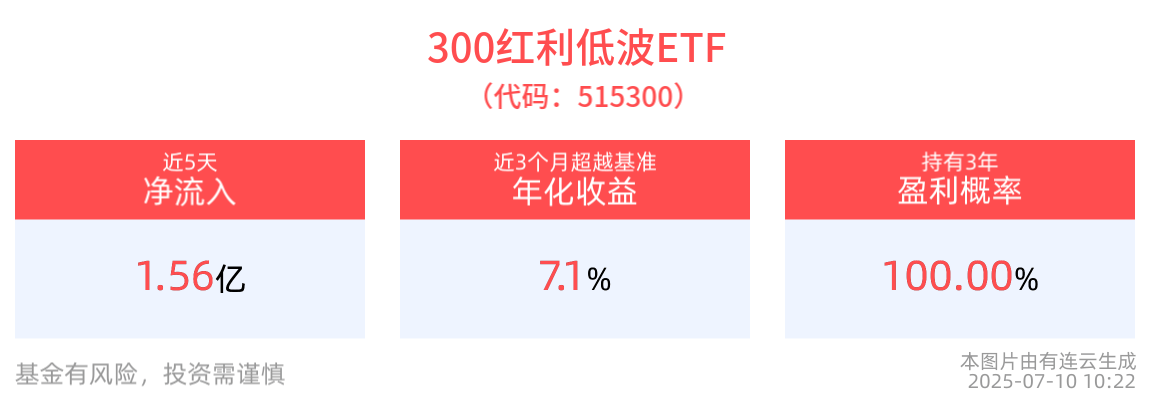
Group 1: ETF Performance and Liquidity - The 300 Dividend Low Volatility ETF recorded an intraday transaction of 32.3471 million yuan, with an average daily transaction of 1.56 billion yuan over the past week as of July 9 [3] - The latest scale of the 300 Dividend Low Volatility ETF reached 5.739 billion yuan, with a net inflow of 143 million yuan recently [3] - Over the past five trading days, there were three days of net inflow totaling 156 million yuan [3] Group 2: Historical Returns and Rankings - As of July 9, the 300 Dividend Low Volatility ETF has seen a net value increase of 61.15% over the past five years, ranking 43rd out of 995 index equity funds, placing it in the top 4.32% [3] - The highest monthly return since inception was 13.89%, with the longest consecutive monthly gain being five months and a maximum increase of 14.56% [3] - The average return during the rising months was 3.66%, and the ETF outperformed the benchmark with an annualized return of 7.10% over the last three months [3] Group 3: Top Holdings - As of June 30, 2025, the top ten weighted stocks in the CSI 300 Dividend Low Volatility Index include China Shenhua, Gree Electric, Sinopec, Daqin Railway, Shuanghui Development, Midea Group, China State Construction, China Mobile, China Merchants Jinling, and Huayu Automotive, collectively accounting for 35.21% of the index [3] Group 4: Market Insights - CITIC Securities indicated that the market will enter the earnings disclosure period in July, with recent performance in the dividend sector suggesting that funds may focus on uncovering investment opportunities around earnings [6] - Investors without stock accounts can access investment opportunities through the corresponding CSI 300 Dividend Low Volatility ETF linked fund (007606) [6]

A股,新信号!
天天基金网· 2025-07-09 05:05
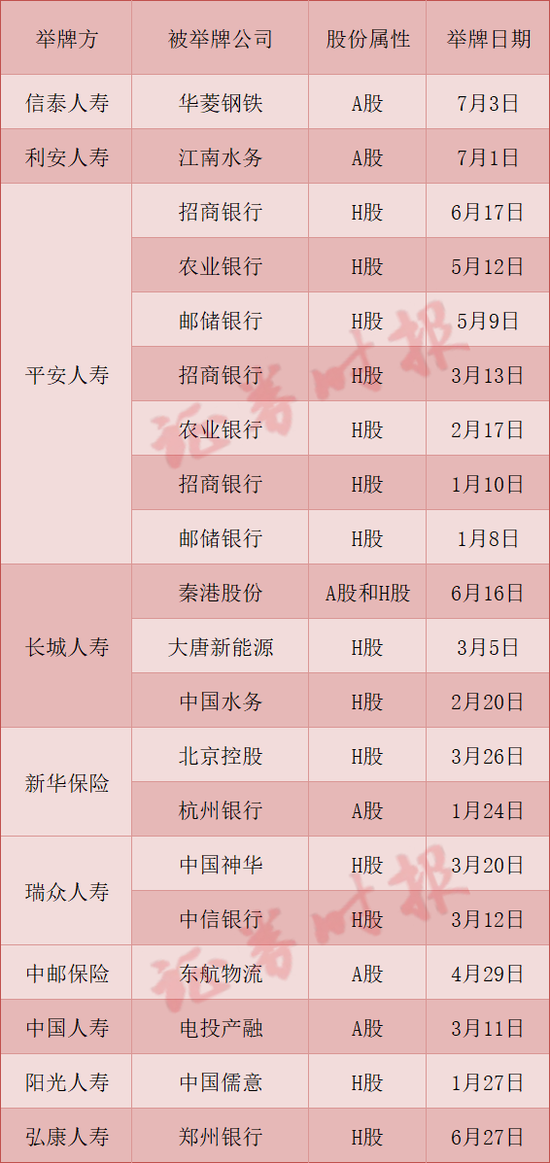
Core Viewpoint - Insurance capital has become a significant force in the capital market, actively acquiring shares in A-share and Hong Kong-listed companies, particularly in stable dividend-paying sectors like banking and public utilities [2][3][7]. Group 1: Insurance Capital Activity - Insurance capital has made at least 20 acquisitions of listed companies this year, focusing on sectors with stable cash flows and dividends [3][4]. - Notable acquisitions include Li'an Life increasing its stake in Jiangnan Waterworks by 46.99 million shares (5.03%) and Xintai Life acquiring 343 million shares (5.00%) of Hualing Steel [3][4]. - Hongkang Life increased its stake in Zhengzhou Bank to 6.68% after multiple acquisitions, highlighting the trend of insurance capital in the market [3][4]. Group 2: Market Environment and Strategy - The current low-interest-rate environment has led to an "asset shortage," prompting insurance capital to seek high-dividend equities to enhance returns [7][8]. - Regulatory changes, such as adjustments to the equity asset ratio for insurance funds, have facilitated greater participation of insurance capital in equity investments [7][8]. - The focus on high-dividend assets, particularly those yielding over 5%, is seen as a strategy to mitigate the impact of low fixed-income returns [7][8]. Group 3: Broader Market Implications - The increase in acquisitions by financial and industrial capital, as well as private equity, reflects a positive outlook on the long-term development of the capital market [10]. - The rise in acquisition activities serves as a market confidence booster, potentially attracting more capital and fostering a healthier market cycle [10][11]. - There is a need for insurance capital to balance the pursuit of returns with risk management, especially given the concentration in banking stocks which may amplify systemic risks [10][11].

交通运输行业周报第43期:25H1地缘政治扰动运价,OPEC+增产有望提振油运景气-20250709
EBSCN· 2025-07-09 03:14
Investment Rating - The report maintains an "Overweight" rating for the transportation sector [5] Core Views - Geopolitical events have caused significant fluctuations in oil shipping rates in H1 2025, with a notable increase in rates due to sanctions and geopolitical tensions [1] - OPEC+ is expected to boost oil shipping demand in H2 2025 through increased production, despite weak global oil consumption growth [2] - The transportation sector is experiencing mixed performance, with shipping and port sub-sectors showing positive trends while aviation and express delivery face challenges [3] Summary by Sections 1. Industry Overview - In H1 2025, geopolitical events led to a sharp rise in oil shipping rates, particularly in January due to U.S. sanctions on Russian oil tankers, followed by a high demand for compliant oil transport [1] - The BDTI index reached 984 points by June 30, 2025, up 15.4% year-to-date, while the BDTI TD3C-TCE reported a daily rate of $29,300, an increase of 37.0% [1] 2. Oil Shipping - OPEC+ plans to increase production by 548,000 barrels per day in August 2025, which is expected to support oil shipping demand despite a downward revision in global oil consumption growth forecasts [2] - The IEA predicts a global oil supply increase of 1.8 million barrels per day in 2025, with non-OPEC+ countries contributing 1.4 million barrels and OPEC+ 400,000 barrels [2] 3. Sector Performance - The transportation sector's performance over the past five trading days showed the Shanghai Composite Index up by 1.40%, while the transportation sector index fell by 0.3% [3] - The shipping sub-sector led gains with a 1.91% increase, while aviation faced a decline of 2.74% [3] 4. Investment Recommendations - The report suggests focusing on state-owned enterprises in the transportation sector, particularly in highways, railways, and ports, due to their high dividend yields and value [4] - It also highlights the potential for recovery in oil shipping and container shipping, recommending companies like COSCO Shipping and China Merchants Energy [4] 5. Key Company Earnings Forecasts - The report includes earnings forecasts and valuations for key companies in the transportation sector, indicating a positive outlook for those involved in oil and container shipping [78]
A股,新信号!
Zheng Quan Shi Bao· 2025-07-08 11:39
Group 1 - Insurance capital has become a significant force in the capital market, with at least 20 instances of shareholding increases in A-shares and H-shares this year, primarily targeting stable dividend-paying assets like banks and public utilities [1][2] - Recent announcements indicate that Li'an Life and Xintai Life have increased their holdings in Jiangnan Water and Hualing Steel, respectively, with Li'an Life acquiring 46.99 million shares (5.03% of total shares) and Xintai Life acquiring 343 million shares (5.00% of total shares) [2][3] - The trend of insurance capital actively participating in shareholding increases is attributed to a low interest rate environment, leading to a search for stable cash flow and strong performance companies [1][6] Group 2 - The increase in shareholding by insurance capital is seen as a response to "asset scarcity," with a focus on high-dividend equities to enhance returns and offset the pressure from low fixed-income asset yields [6][7] - Regulatory changes, such as adjustments to the equity asset ratio for insurance funds, have facilitated greater participation of insurance capital in the equity market, creating favorable conditions for shareholding increases [6][7] - The rise in shareholding activities is viewed as a positive signal for the long-term development of the capital market, potentially enhancing investor confidence and attracting more capital [7][8] Group 3 - The participation of various capital types, including financial capital, industrial capital, and private equity, in shareholding increases reflects a positive outlook on the long-term performance of the companies involved [7][8] - The concentration of insurance capital in high-dividend sectors, particularly banks, raises concerns about potential systemic risks due to high industry concentration [7][8] - Future strategies for insurance capital may involve diversifying into less cyclical and more diversified high-dividend sectors to balance returns and risks [8]



A股,新信号!
证券时报· 2025-07-08 11:28
Core Viewpoint - Insurance capital has become a significant force in the capital market, actively acquiring shares in A-share and H-share listed companies, particularly in stable dividend-paying sectors like banking and public utilities [1][5][12]. Group 1: Insurance Capital Activity - Insurance capital has made at least 20 acquisitions of listed companies this year, focusing on stable cash flow and dividend-yielding assets [1][5]. - Recent notable acquisitions include Li'an Life increasing its stake in Jiangnan Waterworks by 46.99 million shares (5.03%) and Xintai Life acquiring 343 million shares (5.00%) of Hualing Steel [4][5]. - Hongkang Life has also increased its stake in Zhengzhou Bank, reaching 6.68% after multiple acquisitions [4]. Group 2: Market Environment and Strategy - The current low-interest-rate environment has led funds to seek companies with stable cash flows and strong performance as optimal investment choices [2][14]. - The "asset shortage" phenomenon has intensified, pushing insurance capital to invest in high-dividend equities to enhance returns and offset the pressure from fixed-income assets [14][20]. - Regulatory changes, such as adjustments to insurance capital investment ratios, have facilitated greater participation of insurance funds in equity markets [13][12]. Group 3: Broader Participation - Besides insurance capital, other entities like Asset Management Companies (AMCs) and private equity firms have also engaged in share acquisitions [7][8][9]. - The involvement of various capital types, including financial and industrial capital, reflects a positive outlook on the long-term development of the capital market [17]. Group 4: Market Impact and Future Outlook - Increased share acquisitions serve as a market confidence booster, attracting more capital and promoting a virtuous cycle in the market [19]. - The concentration of insurance capital in specific sectors, particularly banking, raises concerns about potential systemic risks due to high industry concentration [20][21]. - Future strategies may involve diversifying investments into less cyclical and higher-dividend sectors to balance risk and return [21].

上证红利指数下跌0.19%,前十大权重包含大秦铁路等
Jin Rong Jie· 2025-07-08 07:33
Group 1 - The Shanghai Dividend Index (000015) experienced a slight decline of 0.19%, closing at 3126.99 points, with a trading volume of 20.687 billion [1] - Over the past month, the Shanghai Dividend Index has increased by 1.56%, and by 7.59% over the last three months, but has decreased by 2.16% year-to-date [1] - The index comprises 50 securities listed on the Shanghai Stock Exchange, selected based on high cash dividend yields, stable dividends, and certain scale and liquidity [1] Group 2 - The top ten weighted stocks in the Shanghai Dividend Index include COSCO Shipping Holdings (4.52%), CITIC Bank (2.9%), and Haier Smart Home (2.8%) among others [1] - The index is fully composed of stocks from the Shanghai Stock Exchange, with a 100% representation [1] Group 3 - The industry composition of the index shows that finance accounts for 36.91%, energy for 20.99%, and industrials for 20.66%, with smaller allocations to consumer discretionary, materials, communication services, utilities, and consumer staples [2] - The index samples are adjusted annually, with the next adjustment scheduled for the trading day following the second Friday of December [3] - Criteria for sample inclusion include a cash dividend yield greater than 0.5%, ranking within the top 90% of average total market capitalization and trading volume, and a three-year average payout ratio between 0 and 1 [3]

7月7日晚间重要公告一览
Xi Niu Cai Jing· 2025-07-07 10:10
Group 1: Company Performance - Wanwei High-tech expects a net profit of 235 million to 265 million yuan for the first half of 2025, representing a year-on-year increase of 81.34% to 104.48% [1] - Jin Guan Electric has won bids for projects from Southern Power Grid and Guangxi Power Grid, with a total bid amount of approximately 42.81 million yuan, accounting for 5.76% of the company's 2024 revenue [2] - Ankai Bus reported a June vehicle sales increase of 37.88% year-on-year, with a total production of 814 vehicles, a 52.23% increase [4] - Daqin Railway's June cargo transport volume increased by 5.29% year-on-year, totaling 32.42 million tons [5] - Xianggang Technology anticipates a net profit of 75 million to 85 million yuan for the first half of 2025, a year-on-year increase of 410% to 478% [9] - Longxin General expects a net profit of 1.005 billion to 1.12 billion yuan for the first half of 2025, a year-on-year increase of 70.52% to 90.03% [10] - Le Xin Technology forecasts a net profit of 250 million to 270 million yuan for the first half of 2025, a year-on-year increase of 65% to 78% [11] - I-Le Furniture expects a net profit of 80 million to 99 million yuan for the first half of 2025, a year-on-year increase of 76.08% to 117.90% [13] - Shennong Group sold 219,000 pigs in June, generating sales revenue of 385 million yuan [14] - Guohuo Airlines anticipates a net profit of 1.187 billion to 1.267 billion yuan for the first half of 2025, a year-on-year increase of 78.13% to 90.14% [45] Group 2: Industry Developments - The electric power equipment industry is seeing increased project bids, as evidenced by Jin Guan Electric's recent contracts [2] - The automotive industry is experiencing growth, with Ankai Bus reporting significant increases in both production and sales [4] - The railway transportation sector is showing resilience with Daqin Railway's cargo transport volume growth [5] - The pharmaceutical industry is advancing with clinical trial approvals, such as Wanbang's WP107 oral solution for treating myasthenia gravis [6] - The packaging and printing industry is witnessing substantial profit growth, as indicated by Xianggang Technology's performance forecast [9] - The agricultural sector, particularly in pig farming, is maintaining steady sales figures, as shown by Shennong Group's sales data [14]


交通运输2025年中期策略报告:“确定性”多点开花,业绩估值各有看点-20250707
Xinda Securities· 2025-07-07 09:23
Group 1: Express Delivery Sector - The express delivery sector shows a divergence in certainty, with direct express delivery focusing on performance and e-commerce express delivery focusing on valuation [22] - SF Holding's business volume has been consistently exceeding expectations, with a year-on-year growth of 31.76% in May 2025, significantly outpacing the industry growth rate [23][24] - The company's profit margin has steadily improved, with a net profit margin of approximately 3.20% in Q1 2025, reflecting a year-on-year increase of 0.27 percentage points [24][34] - The e-commerce express delivery sector faces intensified price competition, which may lead to performance fluctuations, while the overall industry volume grew by 20.1% year-on-year from January to May 2025 [3][42] Group 2: Aviation Sector - The aviation sector is experiencing improved supply-demand certainty, with strong demand for civil aviation travel during holidays, leading to a year-on-year increase in passenger load factor to 84.1% from January to May 2025 [4][5] - Supply constraints are evident, with limited capacity for new aircraft deliveries and high utilization rates of existing fleets, indicating a strong likelihood of supply contraction [5][6] - Ticket prices are expected to stabilize and potentially rise during peak travel seasons, driven by improved supply-demand dynamics and a downward trend in oil prices [6][4] Group 3: Port Performance - The container throughput in ports remains resilient, with a year-on-year growth of 7.7% from January to May 2025, supported by strong export performance [7][8] - Dry bulk cargo throughput has shown signs of recovery, particularly in iron ore and coal, despite some short-term pressures [8][7] - Liquid bulk cargo, particularly crude oil, has faced demand pressures, leading to fluctuations in throughput [8] Group 4: Shipping and Chemical Products - The oil transportation sector is expected to see long-term supply increases, but demand remains uncertain, leading to potential fluctuations in freight rates [9] - Container shipping supply is gradually increasing, but short-term freight rates are expected to remain volatile due to changing tariff policies [10] Group 5: Bulk Supply Chain - The bulk supply chain is anticipated to stabilize, with leading companies expected to recover their operating volumes, despite short-term declines [11][12] - Profit margins for major supply chain companies are projected to improve, with significant increases in gross margins for key products [12][13] Group 6: Road and Rail Transport - The highway sector is gradually recovering from a low base, with a year-on-year increase of 5.0% in freight volume from January to April 2025 [14] - The railway sector faces challenges due to weak coal demand, with a year-on-year decline of 3.6% in freight volume on the Daqin Line [14]

大秦铁路(601006) - 大秦铁路2025年6月大秦线生产经营数据简报
2025-07-07 08:15
股票代码:601006 股票简称:大秦铁路 公告编号:【临2025-050】 12025年7月8日 本公司董事会及全体董事保证本公告内容不存在任何虚假记载、误导性陈述或者重大遗 漏,并对其内容的真实性、准确性和完整性承担个别及连带责任。 2025年6月,公司核心经营资产大秦线完成货物运输量3242万吨,同比 增长5.29%。日均运量108.07万吨。大秦线日均开行重车72.1列,其中:日均 开行2万吨列车50.9列。2025年1-6月,大秦线累计完成货物运输量18873万吨, 同比减少2.17%。 以上主要运营数据来自本公司内部统计。运营数据可能在月度之间存在 一定差异,其影响因素包括但不限于市场环境、设备检修和接卸能力等。 大秦铁路股份有限公司 董 事 会 大秦铁路股份有限公司 2025 年 6 月大秦线生产经营数据简报 ...
大秦铁路:6月大秦线货物运输量3242万吨,同比增长5.29%
news flash· 2025-07-07 07:55
Core Insights - The company announced that the core operating asset, the Daqin Line, achieved a cargo transportation volume of 32.42 million tons in June 2025, representing a year-on-year increase of 5.29% with an average daily volume of 1.08 million tons [1] - For the first half of 2025, the cumulative cargo transportation volume of the Daqin Line reached 189 million tons, showing a year-on-year decrease of 2.17% [1]