
陕西煤业

Search documents
煤炭开采板块11月20日跌2.08%,大有能源领跌,主力资金净流出5.64亿元
Zheng Xing Xing Ye Ri Bao· 2025-11-20 09:16
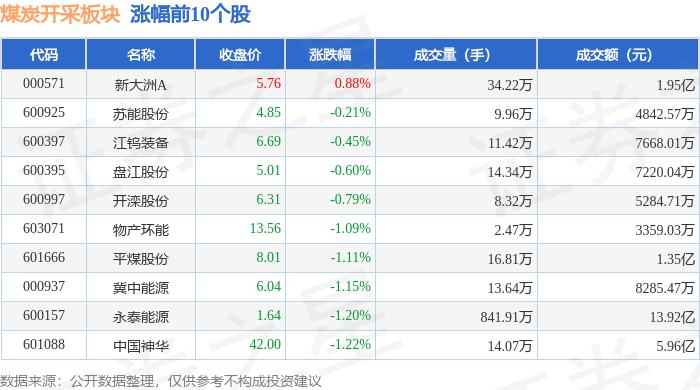
Market Overview - The coal mining sector experienced a decline of 2.08% on November 20, with Dayou Energy leading the drop [1] - The Shanghai Composite Index closed at 3931.05, down 0.4%, while the Shenzhen Component Index closed at 12980.82, down 0.76% [1] Individual Stock Performance - Notable stock performances include: - Xindazhou A (000571) increased by 0.88% to close at 5.76, with a trading volume of 342,200 shares and a turnover of 195 million yuan [1] - Dayou Energy (600403) fell by 9.97% to 8.31, with a trading volume of 1,108,400 shares and a turnover of 95.26 million yuan [2] - China Shenhua (601088) decreased by 1.22% to 42.00, with a trading volume of 140,700 shares and a turnover of 596 million yuan [1] Capital Flow Analysis - The coal mining sector saw a net outflow of 564 million yuan from major funds, while retail investors contributed a net inflow of 580 million yuan [2] - The capital flow for individual stocks indicates: - Huai Bei Mining (600985) had a net outflow of 35.39 million yuan from major funds [3] - Electric Power Investment Energy (002128) recorded a net inflow of 22.42 million yuan from major funds [3] - New Dazhou A (000571) experienced a net inflow of 18.34 million yuan from major funds [3]




6.75亿元资金今日流出煤炭股
Zheng Quan Shi Bao Wang· 2025-11-20 09:06
Market Overview - The Shanghai Composite Index fell by 0.40% on November 20, with 7 industries experiencing gains, led by construction materials and comprehensive sectors, which rose by 1.40% and 0.87% respectively [1] - The coal industry saw a decline of 2.10%, ranking second in terms of the largest drop [1] Capital Flow - The main capital outflow from both markets totaled 47.655 billion yuan, with only 4 industries seeing net inflows [1] - The banking sector led the net inflow with 2.188 billion yuan, followed by the communication sector with a net inflow of 1 billion yuan [1] Coal Industry Analysis - The coal industry experienced a net outflow of 675 million yuan, with 37 stocks in the sector; only 2 stocks rose while 35 fell, including 1 stock hitting the daily limit down [2] - The top three stocks with the highest net outflow in the coal sector were Shaanxi Coal and Chemical Industry (987.269 million yuan), Yongtai Energy (881.709 million yuan), and Meijin Energy (826.157 million yuan) [2][3] - The stock with the highest net inflow was Huaibei Mining, with an inflow of 30.667 million yuan [2]


强调3个观点:产地扰动仍存,进口煤同环比下滑-20251120
GOLDEN SUN SECURITIES· 2025-11-20 08:33
Investment Rating - The report maintains a rating of "Buy" for the coal mining sector [5] Core Views - The report emphasizes three key viewpoints regarding the coal market dynamics and investment strategies [4][9] - It highlights that the recent price adjustments are a normal digestion of previous rapid increases, and the core logic of rising coal prices due to supply constraints remains unchanged [4] - The report anticipates that as demand (whether speculative or real) activates, coal prices will rise, with expectations for prices to peak at the end of the year, potentially exceeding market expectations [4] Summary by Sections Production - In October, the raw coal production decreased by 2.3% year-on-year, with an output of 410 million tons, maintaining the same level as September [15][8] - For the first ten months of 2025, the cumulative production reached 3.97 billion tons, reflecting a growth of 1.5% year-on-year [15] - The forecast for 2025 suggests that the total thermal coal production may reach approximately 3.88 billion tons, with a growth rate narrowing to around 1.4% [15] Imports - In October, coal imports fell by 9.75% year-on-year, totaling 41.73 million tons, which is a decrease of 4.51 million tons compared to the same month last year [21][8] - For the first ten months of 2025, total coal imports amounted to 38.76 million tons, down 11% year-on-year [21] - The report predicts that the annual thermal coal import level may decline to around 38 million tons, a decrease of 6.4% year-on-year [21] Demand - In October, the industrial power generation increased by 7.9% year-on-year, with a total of 800.2 billion kWh generated [24][8] - The industrial thermal power generation saw a year-on-year increase of 7.3%, reversing a decline of 5.4% in September [24] - Conversely, crude steel production in October dropped by 12.07% year-on-year, amounting to 72 million tons, with the decline accelerating compared to September [37][8] Investment Recommendations - The report recommends focusing on high-performing stocks, particularly in the coal sector, including China Shenhua, China Coal Energy, and Yancoal [45][9] - It suggests a shift towards second-tier stocks as coal prices continue to rise, emphasizing the importance of selecting stocks based on performance and valuation [9]


国泰海通:煤价迎来短期见顶 后续静待冬季需求
智通财经网· 2025-11-20 06:48
Group 1: Coal Price Trends - Coal prices have continued to rise, exceeding 830 CNY/ton, but a short-term peak may be reached [1] - The core reason for the recent coal price increase is a fundamental shift in the supply-demand dynamics since May [1] - The coal production for October was 410 million tons, a year-on-year decrease of 2.3%, but month-on-month stable [1] Group 2: Supply and Demand Analysis - The coal supply has contracted significantly due to government intervention against "involution," with production from July to October showing a continuous decline [1] - The total electricity consumption in August and September increased by 4.6%, a significant recovery from the 2.5% growth in Q1, indicating strong demand [1] - Despite entering the typical demand off-season, demand has remained unexpectedly high, particularly in East China [1] Group 3: Market Insights - As of November 14, 2025, the price of Q5500 coal at Huanghua Port was 837 CNY/ton, reflecting a 2.3% increase from the previous week [2] - The focus on domestic supply stability and reduced imports is expected to maintain a steady decline in total supply for the year [2] - The operating rate of major coking enterprises was reported at 79.18%, indicating a slight increase [2] Group 4: Recommended Stocks - The report recommends stocks in the coal sector, including China Shenhua Energy, Shaanxi Coal and Chemical Industry, and China Coal Energy [3] - Other recommended companies include Yanzhou Coal Mining and Jincheng Anthracite Mining [3]

港股异动 | 煤炭股延续跌势 中煤能源(01898)跌超4% 机构称短期煤价超预期上涨或告一段落
智通财经网· 2025-11-20 06:45
Core Viewpoint - Coal stocks continue to decline, with notable drops in major companies such as China Coal Energy, Yanzhou Coal Mining, and China Shenhua Energy, indicating a bearish trend in the coal sector [1] Group 1: Market Performance - As of the latest report, China Coal Energy (01898) fell by 4.48% to HKD 10.87, Yanzhou Coal Mining (01171) decreased by 3.71% to HKD 10.63, China Shenhua Energy (01088) dropped by 1.56% to HKD 40.36, and Yancoal Australia (03668) declined by 0.87% to HKD 27.22 [1] Group 2: Coal Price Trends - Coal prices have risen above RMB 830 per ton, but a short-term peak in coal prices may have been reached. In October, the output of industrial raw coal was 410 million tons, a year-on-year decrease of 2.3%, but month-on-month stable [1] - The fundamental shift in the supply-demand dynamics of the coal industry since May is identified as the core reason for the recent price increases, suggesting a long-term upward trend in coal prices remains intact [1] Group 3: Future Outlook - According to Dongwu Securities, coal companies are expected to see their earnings bottom out starting from the third quarter, with coal prices projected to stabilize as they are anticipated to reach a low point in Q2 2025. This stability is expected to benefit leading companies, ensuring consistent profitability [1] - The expected decline in insurance capital costs may lead to a decrease in dividend yields for major players like China Shenhua and Shaanxi Coal from approximately 4.5% in 2025 to around 3.5% by mid-2026 [1]

煤炭股延续跌势 中煤能源跌超4% 机构称短期煤价超预期上涨或告一段落
Zhi Tong Cai Jing· 2025-11-20 06:42
Group 1 - Coal stocks continue to decline, with China Coal Energy (601898) down 4.48% to HKD 10.87, Yanzhou Coal Mining (600188) down 3.71% to HKD 10.63, China Shenhua Energy (601088) down 1.56% to HKD 40.36, and Yancoal Australia (03668) down 0.87% to HKD 27.22 [1] - According to Guotai Junan Securities, coal prices have risen above CNY 830 per ton, but the short-term surge may be coming to an end. In October, the output of industrial raw coal was 410 million tons, a year-on-year decrease of 2.3%, but month-on-month stable [1] - The fundamental shift in the supply-demand dynamics of the coal industry since May is identified as the core reason for the current price increase, indicating that the medium-term upward trend in coal prices will remain unchanged [1] Group 2 - Dongwu Securities suggests that high dividend logic indicates coal prices are expected to bottom out in Q2 2025, with coal companies' performance starting to recover from Q3. Future stability in coal prices is anticipated to support sustained profitability for leading companies [1] - It is projected that as insurance capital costs continue to decline, high dividend stocks like China Shenhua and Shaanxi Coal and Chemical Industry (601225) may see their dividend yield decrease from approximately 4.5% in 2025 to around 3.5% by mid-2026 [1]
2026年电煤中长期合同点评:符合预期,港口基准价维持不变
Shanxi Securities· 2025-11-20 06:00
Investment Rating - The report maintains an investment rating of "Leading the Market - A" for the coal industry [1][13]. Core Viewpoints - The 2026 medium- and long-term coal supply contract plan aligns with expectations, with a slight relaxation in performance requirements. The plan continues the mechanism established in the 2022 contracts, which was a significant adjustment from the previous five-year mechanism [1][2]. - The pricing mechanism for coal contracts has been adjusted to include a monthly price adjustment mechanism for production area contracts, while the port benchmark price remains unchanged at 675 RMB/ton [3][10]. - The report suggests that with the implementation of "anti-involution" policies, the expected increase in domestic coal supply is limited, leading to a recovery in coal prices and improved performance in long-term contracts [3][6]. Summary by Sections Contract Signing Requirements - For power companies, the signing demand should not be less than 80% of the required amount, with 80% of these contracts under key regulatory oversight. For coal companies, the task volume should not be less than 75% of their own resource volume [2][10]. Pricing Mechanism - The production area contracts will now have a monthly price adjustment mechanism, with the benchmark price set based on the reasonable price range for coal production in Shanxi, Shaanxi, and Inner Mongolia. The floating price will be determined by various indices [3][10]. Performance Supervision - The contract performance requirements have been relaxed, with monthly performance rates required to be no less than 80%, and quarterly and annual rates should generally not be less than 90%. There is an emphasis on increasing performance during peak seasons [3][10]. Investment Recommendations - The report highlights several companies with significant recovery potential, including Jin控煤业, 华阳股份, 山煤国际, 兖矿能源, 陕西煤业, 中煤能源, and 中国神华 [6].


自由现金流ETF中证全指(561080)涨0.32%,半日成交额269.76万元





Xin Lang Cai Jing· 2025-11-20 05:27
Core Viewpoint - The Freedom Cash Flow ETF CSI All Share (561080) has shown a positive performance with a 0.32% increase, indicating investor interest and potential growth in the underlying assets [1] Group 1: ETF Performance - The Freedom Cash Flow ETF CSI All Share (561080) closed at 1.239 yuan with a trading volume of 2.6976 million yuan [1] - Since its inception on April 23, 2025, the fund has achieved a return of 23.72%, with a monthly return of 5.52% [1] Group 2: Top Holdings Performance - Major holdings in the ETF include: - China National Offshore Oil Corporation (CNOOC) up by 0.34% - Midea Group up by 1.83% - Gree Electric Appliances up by 1.07% - Wuliangye Yibin up by 1.00% - COSCO Shipping Holdings up by 0.20% - Luoyang Molybdenum down by 0.19% - TCL Technology up by 0.48% - China Aluminum Corporation up by 1.09% - SF Holding up by 0.28% - Shaanxi Coal and Chemical Industry down by 0.42% [1]
煤炭行业周报:10月煤炭产量同环比双降,印尼拟削减26年产量目标-20251120
East Money Securities· 2025-11-20 05:15
Investment Rating - The report maintains an investment rating of "Outperform the Market" for the coal industry, indicating a projected increase in stock prices relative to the benchmark index [2]. Core Insights - In October, coal production in China saw a decline both year-on-year and month-on-month, with a total output of 407 million tons, representing a decrease of 2.3% year-on-year and 1.2% month-on-month. Cumulatively, from January to October, coal production reached 3.973 billion tons, reflecting a year-on-year increase of 1.5% [1]. - The demand for electricity, pig iron, and cement in October showed mixed results, with electricity production increasing by 7.3% year-on-year, while pig iron and cement production decreased by 7.9% and 15.8%, respectively. Cumulatively, from January to October, electricity and pig iron production saw slight declines of 0.4% and 1.8%, while cement production fell by 6.7% [1]. - The National Development and Reform Commission (NDRC) has emphasized the need to stabilize energy production and supply, particularly during peak demand periods, and to ensure the safety of energy supply during adverse weather conditions [1]. - The China Coal Industry Association forecasts that Indonesia's coal production will decrease to 750 million tons in 2025, a 10.3% year-on-year decline, with a target reduction for 2026 set below 700 million tons. This is expected to tighten the supply further, especially as domestic production faces limitations due to regulatory measures [1]. - The report anticipates that coal prices will remain volatile but generally upward due to tight supply and strong winter demand, with the Qinhuangdao coal price reported at 827 RMB per ton as of November 14, reflecting a 2.4% increase month-on-month [1]. Summary by Sections Production and Demand - October coal production in China was 407 million tons, down 2.3% year-on-year and 1.2% month-on-month. Cumulative production from January to October was 3.973 billion tons, up 1.5% year-on-year [1]. - Demand for electricity rose by 7.3% year-on-year in October, while pig iron and cement production fell by 7.9% and 15.8%, respectively [1]. Regulatory Environment - The NDRC has called for measures to ensure stable energy supply and safety during peak demand periods, particularly in winter [1]. Price Trends - Coal prices are expected to remain under upward pressure due to tight supply conditions, with the Qinhuangdao coal price at 827 RMB per ton as of mid-November [1].
中行、工行再创历史新高,银行ETF基金涨1.85%,自由现金流ETF上演9连“吸金”14.95亿
Ge Long Hui A P P· 2025-11-20 03:36
Core Viewpoint - The A-share banking sector is experiencing significant gains, with notable increases in stock prices and market capitalization, indicating a shift in investor preference towards stability as year-end approaches [1][2] Group 1: Banking Sector Performance - China Bank A-shares rose over 4%, reaching a historic high with a market capitalization exceeding 2 trillion [1] - Industrial and Commercial Bank of China (ICBC) increased by 1%, also hitting a historic high, surpassing Agricultural Bank of China to reclaim the top position in market capitalization [1] - The banking ETF fund rose by 1.85%, reflecting strong investor interest in the sector [1] Group 2: Market Trends and Investor Behavior - The technology sector experienced a pullback, while banking stocks continued to rise, indicating a preference for stability and securing annual returns as year-end approaches [1] - The probability of a Federal Reserve rate cut in December has decreased to 30%, alongside prevalent discussions about an AI bubble in the U.S. stock market, leading to a decline in market risk appetite [1] - Weakening domestic credit and retail sales data in October have increased focus on public utilities, banking, and dividend-paying sectors [1] Group 3: Related Products and Fund Flows - The banking ETF fund (515020) saw a net inflow of 183 million over the past 20 days, including major state-owned and joint-stock banks [2] - The Free Cash Flow ETF (159201) reported a slight decline of 0.08%, with a total size of 6.999 billion, and a net inflow of 2.422 billion from October 14 to November 19 [2] - The Free Cash Flow ETF has the lowest fee rate in the market at 0.2%, making it an attractive option for investors [2]

