
湘财股份

Search documents
湘财股份(600095) - 湘财股份2025年第一次临时股东会决议公告
2025-09-15 11:30
证券代码:600095 证券简称:湘财股份 公告编号:临 2025-057 湘财股份有限公司 2025年第一次临时股东会决议公告 本公司董事会及全体董事保证本公告内容不存在任何虚假记载、误导性陈述 或者重大遗漏,并对其内容的真实性、准确性和完整性承担法律责任。 重要内容提示: 本次会议是否有否决议案:无 一、 会议召开和出席情况 (一)股东会召开的时间:2025 年 9 月 15 日 (二)股东会召开的地点:杭州市西湖区西溪路 128 号新湖商务大厦 7 楼湘财股份 有限公司会议室 (三)出席会议的普通股股东和恢复表决权的优先股股东及其持有股份情况: | 1、出席会议的股东和代理人人数 | 812 | | --- | --- | | 2、出席会议的股东所持有表决权的股份总数(股) | 1,992,847,591 | | 3、出席会议的股东所持有表决权股份数占公司有表决权股 | | | 份总数的比例(%) | 69.9759 | (四)表决方式是否符合《公司法》及《公司章程》的规定,股东会主持情况等。 本次会议由董事会召集,由董事长史建明先生主持。本次会议的召集程序、 表决方式、决议内容,均符合《公司法》等相关 ...

A股并购重组活跃,诞生多只新“巨无霸”企业
Xin Lang Cai Jing· 2025-09-15 05:20
Group 1 - Capital market reforms have intensified since last year, with a series of policies supporting mergers and acquisitions (M&A) to inject strong momentum into the high-quality development of listed companies [1][2] - As of September 11, 2025, over 220 A-share listed companies have disclosed M&A events and related progress, indicating sustained activity in asset restructuring [1][2] - The strategic direction of M&A among listed companies is evident, focusing on either cross-industry acquisitions for transformation or expanding a "second growth curve" based on core businesses [1][2] Group 2 - Transformational M&A has become a crucial option for companies facing performance pressure, exemplified by Jinpu Titanium's plan to exit the loss-making titanium dioxide business and acquire a 100% stake in a rubber products manufacturer [2][3] - Expansion-oriented M&A reflects companies' strategies to deepen their industry chains, as seen in Guotou Zhonglu's plan to acquire a 100% stake in a state-owned electronic engineering firm, marking a shift from consumer goods to high-end industrial services [2][3] Group 3 - The semiconductor industry is a focal point for A-share asset restructuring in 2025, with significant cases like SMIC's acquisition of a 49% stake in its subsidiary, enhancing its control over advanced production capacity [3][4] - Chip design firm Chipone's planned acquisition of a semiconductor company aims to strengthen its position in the RISC-V ecosystem, potentially reshaping the semiconductor IP landscape [3][4] Group 4 - The computing power industry is also witnessing major consolidations, such as Dongyangguang's planned acquisition of Qinhuai Data for 28 billion yuan, which will enhance regional layout and technological synergy [4][5] - The merger between Haiguang Information and Zhongke Shuguang is set to create the largest scale in the domestic computing power industry, combining strengths in chips and data center infrastructure [5][6] Group 5 - Several "mega" asset restructuring cases have emerged in 2025, including the merger of Guotai Junan and Haitong Securities, and China Shenhua's acquisition of subsidiaries from its controlling shareholder, with total assets reaching 258.36 billion yuan [5][6] - The predominant transaction method remains a combination of issuing shares and cash, accounting for approximately 60% of deals, which alleviates short-term funding pressure while aligning interests [5][6] Group 6 - The trend of share-swap mergers is increasing, with notable cases like the merger of Haiguang Information and Zhongke Shuguang, and the merger of China Shipbuilding and China Shipbuilding Heavy Industry [6][7] - These mergers are significant for eliminating competition among firms, enhancing governance efficiency, and improving collaboration across the industry chain [6][7] Group 7 - Currently, about 10% of restructuring cases are in the intention stage, while 30% have board and shareholder approvals, indicating that most projects have moved into substantive progress [6][7] - Approximately 14% of cases have been completed, while around 17% have been canceled or terminated due to market changes or unmet transaction conditions, reflecting a cautious market attitude amid stricter regulations [6][7]


券商板块估值修复机遇获看好
Xin Lang Cai Jing· 2025-09-14 23:16
Core Viewpoint - The brokerage sector is experiencing a valuation recovery phase, supported by strong performance and favorable market conditions, with analysts optimistic about continued growth in the sector [1][2][3]. Market Performance - The A-share market has shown a positive trend this year, with the Shanghai Composite Index up 15.48%, the Shenzhen Component Index up 24.1%, and the ChiNext Index up 41.04% as of September 14 [2]. - The average daily trading volume in the A-share market reached 1.6 trillion yuan, more than doubling year-on-year [2]. Brokerage Sector Performance - In the first half of the year, 42 A-share listed brokerages reported a total operating income of 251.87 billion yuan, a year-on-year increase of 11.37%, and a net profit attributable to shareholders of 104.02 billion yuan, up 65.08% [2]. - The brokerage sector index has risen 11.58% year-to-date, with 43 out of 50 stocks in the sector showing gains, and 17 stocks increasing by over 10% [3]. Valuation Recovery and Investor Returns - Ten brokerage firms have conducted share buybacks totaling 221 million shares, with a total buyback amount of 2.34 billion yuan, a 158.34% increase from the previous year [4]. - A total of 28 listed brokerages have announced semi-annual dividend plans, proposing a total dividend of 18.80 billion yuan, significantly higher than last year's total of 13.84 billion yuan [4]. - Analysts believe that these actions enhance shareholder returns and market confidence, contributing to the valuation recovery of the sector [4]. Future Outlook - Analysts expect the brokerage sector to continue its upward trajectory, with improved operating environments and sustainable performance enhancing growth prospects [4][5]. - The sentiment in the brokerage sector is anticipated to remain positive, with potential for further market performance if new capital flows into the market [5].
市场向好叠加主动市值管理 券商板块估值修复机遇获看好
Zheng Quan Ri Bao Zhi Sheng· 2025-09-14 16:08
Core Viewpoint - The brokerage sector is experiencing a valuation recovery phase, supported by strong performance and favorable market conditions, leading to optimistic expectations for continued growth in the sector [1][2][3]. Industry Performance - The A-share market has shown a positive trend this year, with the Shanghai Composite Index up 15.48%, the Shenzhen Component Index up 24.1%, and the ChiNext Index up 41.04% as of September 14 [2]. - The average daily trading volume in the A-share market reached 1.6 trillion yuan, more than doubling year-on-year [2]. - In the first half of the year, 42 listed brokerages achieved a total operating income of 251.87 billion yuan, a year-on-year increase of 11.37%, and a net profit attributable to shareholders of 104.02 billion yuan, up 65.08% year-on-year [2]. Stock Performance - The brokerage sector (Shenwan Secondary) has risen 11.58% year-to-date, with 43 out of 50 stocks in the sector showing gains, and 17 stocks increasing by over 10% [3]. - Notable performers include Xiangcai Securities with a 58.89% increase, Guosheng Financial Holdings at 47.98%, and others like Changcheng Securities and Bank of China Securities with increases of 42.53% and 39.41%, respectively [3]. Valuation Recovery Opportunities - Brokerages are actively engaging in share buybacks and dividend distributions, signaling positive market sentiment and enhancing investment value [3][4]. - As of September 14, 10 brokerage firms have repurchased a total of 221 million shares for 2.34 billion yuan, a 158.34% increase from the previous year [4]. - A total of 28 listed brokerages have announced semi-annual dividend plans amounting to 18.80 billion yuan, significantly exceeding last year's total of 13.84 billion yuan [4]. Future Outlook - Analysts expect the brokerage sector to continue its upward trajectory, with improved operating environments and sustainable performance enhancing growth prospects [4]. - The sentiment in the brokerage sector is seen as a reflection of capital inflow, with expectations for continued market activity and performance improvements in brokerage services [4].
十大机构看后市:继续聚焦景气赛道,关注通胀改善,短期延续震荡,科技和周期继续占优
Sou Hu Cai Jing· 2025-09-14 09:24
Group 1 - The three major indices in China saw significant gains, with the Shanghai Composite Index rising by 1.52%, the Shenzhen Component Index increasing by 2.65%, and the ChiNext Index up by 2.10% [1] - Citic Securities emphasizes the importance of focusing on sectors with growth potential and the need for a turnaround in deflationary trends to attract foreign investment in Chinese assets [1] - China Merchants Securities highlights the introduction of new energy storage construction plans and anticipates upcoming discussions between China and the U.S. in Spain regarding various topics, including TikTok [1] Group 2 - Huajin Securities notes ongoing market volatility and discussions about asset allocation strategies, indicating a preference for technology and cyclical sectors [2] - China Galaxy Securities reports a global rise in risk appetite due to expectations of U.S. Federal Reserve interest rate cuts, which are expected to lower capital costs and enhance corporate profit forecasts [2] - Dongwu Securities discusses the need for market volume to increase for a sustained upward trend, indicating that structural shifts may occur during periods of market consolidation [3] Group 3 - Pacific Securities anticipates sector rotation and is waiting for new highs in the market [4] - The bond market is expected to continue its downward trend, with predictions of new lows for government bond futures [5] - Xiangcai Securities reports a rebound in macro short-cycle composite indices and an upward trend in A-share indices, driven by strong performance in technology sectors [6] Group 4 - Kaisheng Securities highlights the "spindle strategy" focusing on sectors with growth potential and valuation recovery, particularly in Hong Kong and the ChiNext market [6] - Yongxing Securities notes a divergence in the market with an increase in margin trading balances, while overall turnover rates have declined [7] - The current investment environment in A-shares is characterized by high investment value, with the dividend yield of the CSI 300 index at 2.62% compared to a 10-year government bond yield of 1.90% [7]
证券业核心“心脏”大升级!数字化必答题,谁拿了高分?
2 1 Shi Ji Jing Ji Bao Dao· 2025-09-13 06:10
Group 1 - The securities industry is undergoing a critical transformation, with business models upgrading and technology deeply integrating with operations [1] - Wealth management is shifting towards buyer advisory, institutional services are evolving from trading to comprehensive services, and asset management is focusing on proactive management capabilities [1][2] - The launch of UF3.0, a new core business system by Hengsheng Electronics, aims to address the limitations of traditional centralized systems and enhance flexibility and scalability [2][3] Group 2 - UF3.0 has been successfully implemented in multiple securities firms, with notable cases including Dongfang Securities and招商证券, which have transitioned to a customer value creation engine and completed a full-scale switch for millions of clients, respectively [3][4] - The system features a "stable + agile" dual architecture, ensuring risk-free operation while allowing for rapid iteration based on demand and innovation [3][4] - The application of AI technology is seen as a key driver for small and medium-sized securities firms to innovate in wealth management, enabling efficient client analysis and personalized service offerings [5][6][7] Group 3 - Different types of firms have distinct technology strategies, with leading firms focusing on ecosystem building and deep industry application, while smaller firms face challenges in technology investment [6] - Small and medium-sized firms are encouraged to focus on application and customer layers rather than blindly investing in foundational technology development [6][7] - The wealth management sector presents significant growth potential for smaller firms, especially with the integration of AI technology to streamline operations and reduce costs [7]

年内券商境内发债募资同比增超66%,券商ETF(512000)调整蓄势,盘中成交超9亿
Sou Hu Cai Jing· 2025-09-12 06:47
Core Viewpoint - The securities industry is experiencing a mixed performance, with the broker ETF showing significant inflows and growth in net asset value, driven by favorable market conditions and increased demand for financing among brokerages [1][2][3]. Group 1: Market Performance - As of September 12, 2025, the CSI All Share Securities Company Index has decreased by 0.89%, with mixed performance among constituent stocks [1]. - The broker ETF has seen a recent increase in trading volume, with a turnover of 2.93% and a total transaction value of 984 million yuan [1]. - The broker ETF's net asset value has increased by 58.74% over the past year, reaching a new high of 33.631 billion yuan [2]. Group 2: Financing and Growth - Brokerages have raised 1.12 trillion yuan through bond issuance in the domestic market this year, marking a 66.18% year-on-year increase [2]. - The primary driver for this bond issuance is the need for capital to support business expansion amid a favorable A-share market [2]. - The broker ETF has experienced continuous net inflows over the past 11 days, totaling 3.777 billion yuan, with a peak single-day inflow of 768 million yuan [1][2]. Group 3: Industry Outlook - Analysts believe that the recent V-shaped recovery in the A-share market indicates a robust medium to long-term trend, supported by a strong liquidity environment [3]. - The demand for digital transformation among brokerages is accelerating, with expectations of increased activity in the capital markets [3]. - Long-term investment value in the securities technology and brokerage IT sectors is expected to rise due to a stable macroeconomic environment and deepening capital market reforms [3].
沪指又新高,“旗手”回调接人,机构:高景气券商攻守兼备!顶流券商ETF(512000)连续11日揽金37亿元
Xin Lang Ji Jin· 2025-09-12 05:33
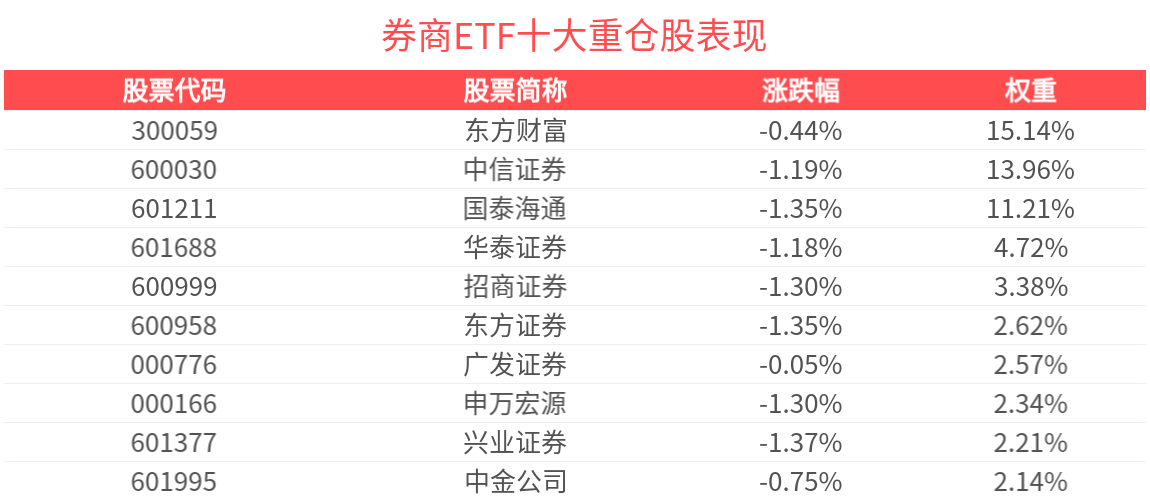
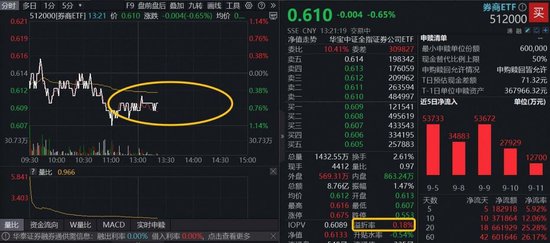
Core Viewpoint - The A-share market is experiencing fluctuations, with the brokerage sector showing mixed performance, but overall, there are positive indicators for the sector's growth potential due to increased trading activity and favorable policies [1][3]. Group 1: Market Performance - On September 12, the A-share market showed volatility, with the Shanghai Composite Index reaching a new high during the session [1]. - The brokerage sector, which had a strong performance previously, saw a slight pullback, with individual stocks like China Merchants Securities rising by 2.76% [1]. - The brokerage ETF (512000) experienced a price drop of over 1% at one point but showed resilience with a real-time transaction volume of 8.76 billion yuan [1]. Group 2: Sector Analysis - Analysts suggest that the brokerage sector may benefit from a combination of favorable capital, policy, and fundamental factors, leading to potential performance improvements [3]. - Open-source Securities highlighted that the brokerage sector's valuation remains low, with institutional holdings being relatively low, indicating potential for growth driven by trading volume and policy catalysts [3]. - Dongwu Securities noted that the non-bank financial sector has a low average valuation, providing a safety margin, and the transformation within the brokerage industry could lead to new growth opportunities [3]. Group 3: ETF Insights - The brokerage ETF (512000) has surpassed 33.6 billion yuan in size, setting a new historical high, with an average daily trading volume of 9.57 billion yuan this year [5]. - The ETF passively tracks the CSI All Share Securities Company Index, encompassing 49 listed brokerage stocks, with nearly 60% of its holdings concentrated in the top ten leading brokerages [5]. - The ETF serves as an efficient investment tool, balancing investments in leading brokerages while also considering the high growth potential of smaller brokerages [5].





同花顺身家660亿董事长“不卖了”,是认怂了吗?
凤凰网财经· 2025-09-11 12:30
Core Viewpoint - The article discusses the recent actions of Tonghuashun's chairman, Yi Zheng, who initially announced a share reduction plan but quickly reversed the decision, leading to significant market reactions and raising questions about the company's stability and future prospects [3][6][10]. Group 1: Share Reduction and Market Reaction - On September 6, Yi Zheng announced a plan to reduce shares worth nearly 500 million yuan, which led to a sharp decline in the company's stock price, dropping over 6% on September 8 [3][5]. - Following the announcement, the stock price rebounded after Yi Zheng declared he would not sell any shares, resulting in a 4.56% increase on September 11 [6][8]. - The market's immediate reaction to Yi Zheng's initial announcement was significant, with a loss of nearly 100 billion yuan in market capitalization [5]. Group 2: Historical Context of Share Reductions - Tonghuashun has a history of announcing share reduction plans that often do not materialize, leading to a perception of the company as frequently engaging in "wolf-crying" tactics [11][13]. - Previous announcements included plans to reduce up to 3% of total shares, but actual reductions were minimal, indicating a pattern of market manipulation [11][12]. Group 3: Company Performance and Valuation - Despite a significant increase in stock price, the company's financial performance does not align with its high valuation, with a static PE ratio exceeding 100, indicating overvaluation compared to peers [15][16]. - The company reported a revenue of 1.779 billion yuan and a net profit of 501 million yuan for the first half of the year, showing growth but not sufficient to justify its market cap [15][16]. - The company's business model relies heavily on data services and advertising, with a notable lack of a comprehensive financial ecosystem compared to competitors like Dongfang Caifu [19][20]. Group 4: Competitive Landscape - In the financial information service sector, Tonghuashun is often compared to Dongfang Caifu and Dazhihui, with the former currently dominating the market [19][22]. - Dongfang Caifu's acquisition of a securities license has allowed it to create a closed-loop business model, which Tonghuashun has struggled to replicate [19][20]. - The emergence of Dazhihui as a competitor, especially after its merger with Xiangcai Securities, poses a significant threat to Tonghuashun's market position [21][22].

公募费改持续推进,券商五篇大文章评价试行
Shanxi Securities· 2025-09-11 09:47
Investment Rating - The report maintains an investment rating of "Leading the Market - A" for the non-bank financial industry [1]. Core Insights - The non-bank financial industry has shown significant performance improvements, particularly in brokerage firms, which have reported substantial earnings growth. The report emphasizes the importance of focusing on the investment value of the sector [3]. - Recent regulatory changes, including the ongoing reform of public fund sales fees, aim to reduce investor costs and shift the focus from "scale" to "service" in the public fund industry [4][12]. - The introduction of a new evaluation system for securities firms, focusing on their contributions to key financial areas, is expected to enhance service quality and align with national economic development goals [6][13]. Summary by Sections Investment Recommendations - The report highlights the ongoing reform of public fund sales fees, which includes lowering subscription and service fees, encouraging long-term holding, and establishing a direct sales service platform for institutional investors [12][25]. Market Review - The major indices showed mixed performance, with the Shanghai Composite Index down 1.18% and the Shenzhen 300 Index down 0.81%, while the ChiNext Index increased by 2.35%. The non-bank financial index fell by 4.96%, ranking 29th among 31 sectors [14][19]. Key Industry Data Tracking 1) Market Performance and Scale: The total A-share trading volume was 13.02 trillion yuan, with a daily average of 2.60 trillion yuan, reflecting a 12.74% decrease [14][19]. 2) Credit Business: As of September 5, the market had 3,023.32 million pledged shares, accounting for 3.70% of total equity, with a margin balance of 2.29 trillion yuan, up 1.14% [19][21]. 3) Fund Issuance: In August 2025, new fund issuance reached 1,020.22 billion units, with a 6.62% increase from the previous month [19][22]. 4) Investment Banking: The equity underwriting scale in August 2025 was 234.77 billion yuan, with IPOs amounting to 40.93 billion yuan [19]. 5) Bond Market: The total price index of bonds fell by 1.57% since the beginning of the year, with the 10-year government bond yield at 1.83%, up 21.83 basis points [19][27]. Regulatory Policies and Industry Dynamics - The China Securities Regulatory Commission (CSRC) has solicited opinions on the draft regulations for public fund sales fees, aiming to optimize fee structures and enhance investor protection [25][28]. The CSRC has also approved the launch of a direct sales service platform to improve operational efficiency in the public fund industry [28].