药明生物

Search documents
政策暖风+产业创新突破双重驱动 恒生生物科技ETF富国12月1日蓄势待发!
Quan Jing Wang· 2025-11-28 01:40
Core Viewpoint - The Hong Kong pharmaceutical sector has attracted significant market attention this year, with southbound funds net buying over 160 billion yuan in healthcare, ranking third among 12 Hang Seng primary industries [1] Group 1: Policy and Industry Dynamics - The surge in southbound funds in the Hong Kong pharmaceutical sector is driven by a combination of policy support, industry advancements, and capital influx, creating new opportunities for the biopharmaceutical industry [2] - Recent policies, including measures to support high-quality development of innovative drugs and the introduction of a fast-track listing process for unprofitable biotech companies, have provided strong momentum for industry innovation [2] - As of Q3, there are over 100 biopharmaceutical companies listed on the Hong Kong Stock Exchange, with a total market capitalization accounting for approximately 15% of the Hong Kong stock market [2] - China's innovative drug research and development capabilities are steadily improving, with the number of innovative drug pipelines expected to reach 4,804 by 2024, second only to the United States [2] - The license-out transaction value for Chinese innovative drugs has seen a compound annual growth rate of 125% from 2019 to 2024, with nearly 50 billion USD in overseas transactions expected in the first half of 2025 [2] Group 2: Financial Environment - The liquidity in the Hong Kong pharmaceutical sector is expected to improve, supported by the Federal Reserve's interest rate cuts and a more accommodative domestic monetary policy [3] - From January to August this year, the financing amount for domestic innovative drugs increased by over 40% year-on-year, indicating a rapid recovery in financing vitality within the sector [3] Group 3: Investment Opportunities - The upcoming launch of the Fuguo Hang Seng Biotechnology ETF (Fund Code: 159132) on December 1 aims to provide investors with an efficient tool to invest in leading biotech companies listed in Hong Kong [1][4] - The Hang Seng Biotechnology Index, which the ETF tracks, includes 30 leading biotech, pharmaceutical, and medical device companies, focusing on high-growth sectors such as innovative drugs and CXO services, with nearly 90% combined weight [4] - The index has shown a cumulative increase of 58.9% since its inception, significantly outperforming the Hang Seng Healthcare Index and the Hang Seng Index [5] - The introduction of futures for the Hang Seng Biotechnology Index on November 28 is expected to enhance market liquidity and attract more institutional investors [5]
港交所重磅期指上新,港股医药板块首个期指来了!恒生医药ETF(159892)流动性优势进一步放大
Ge Long Hui· 2025-11-28 01:24
Group 1 - The Hong Kong Stock Exchange launched the "Hang Seng Biotechnology Index Futures" on November 28, marking an important expansion of the Hong Kong stock derivatives system and providing a dedicated risk management tool for the biotechnology sector [1] - The biotechnology industry is characterized by high volatility and high growth, with the annualized volatility of the Hang Seng Biotechnology Index reaching 39.4% as of October 31, 2025 [1] - The introduction of index futures aims to provide institutions with a "risk management foundation," allowing them to hedge volatility while capturing growth through ETFs [1] Group 2 - The Hang Seng Medical ETF focuses on two high-growth sectors: "innovative drugs + CXO," and underwent its largest-ever adjustment in September, reducing its constituent stocks from 50 to 30, thereby enhancing the purity of core assets [2] - The latest weighted stocks in the ETF include globally competitive innovative drug and R&D service companies such as BeiGene, WuXi Biologics, Innovent Biologics, and CanSino Biologics, with the top ten constituent stocks accounting for 70% of the total weight [2] - Historically, the Hang Seng Biotechnology Index saw a peak increase of 112% this year, and as of November 27, it recorded a year-to-date increase of 83.36%, significantly outperforming the broader market [2]
11月28日正式交易!恒生医药板块唯一期指来了
Zhong Guo Jing Ji Wang· 2025-11-28 00:18
Core Viewpoint - The launch of the Hang Seng Biotechnology Index futures on November 28, 2025, marks a significant enhancement in the investment landscape of the biotechnology sector in Hong Kong, indicating the industry's growing importance in thematic investments [1][2]. Group 1: Index Futures Launch - The Hang Seng Biotechnology Index futures will officially trade starting November 28, 2025, with the underlying asset being the Hang Seng Medicine ETF (159892) [1]. - This product is the first new index futures in Hong Kong's stock market in five years, reflecting the increasing prominence of the pharmaceutical industry [1]. - The introduction of this futures product enriches the range of derivative products in the Hang Seng Index series and strengthens the risk management and capital allocation capabilities of the biotechnology sector [1][3]. Group 2: Investment Value in Biotechnology - The Hang Seng Biotechnology Index focuses on 30 leading biotechnology companies listed in Hong Kong, capturing the core development trends of the industry [2]. - As of November 25, 2025, the index has seen an annual increase of over 80%, significantly outperforming the Hang Seng Composite Index [2]. - The biotechnology sector is supported by long-term trends such as an aging population and increasing medical demands, which continue to open up growth opportunities [2]. Group 3: Derivative Tools and Market Dynamics - The introduction of the Hang Seng Biotechnology Index futures serves as a crucial risk management tool for the high-growth and high-volatility characteristics of the biotechnology sector [3]. - Similar index derivatives have shown strong market vitality, with the Hang Seng Technology Index futures experiencing a 31% increase in average daily trading volume in the first three quarters of 2025 compared to the previous year [3]. - The collaboration between index futures and ETFs is expected to optimize the capital ecosystem of the biotechnology industry, attracting institutional investors and enhancing liquidity and pricing efficiency [4]. Group 4: Future Prospects - The launch of the Hang Seng Biotechnology Index futures is anticipated to promote the deep integration of innovative resources and capital markets in the biotechnology field, supporting long-term healthy development of the industry [4].
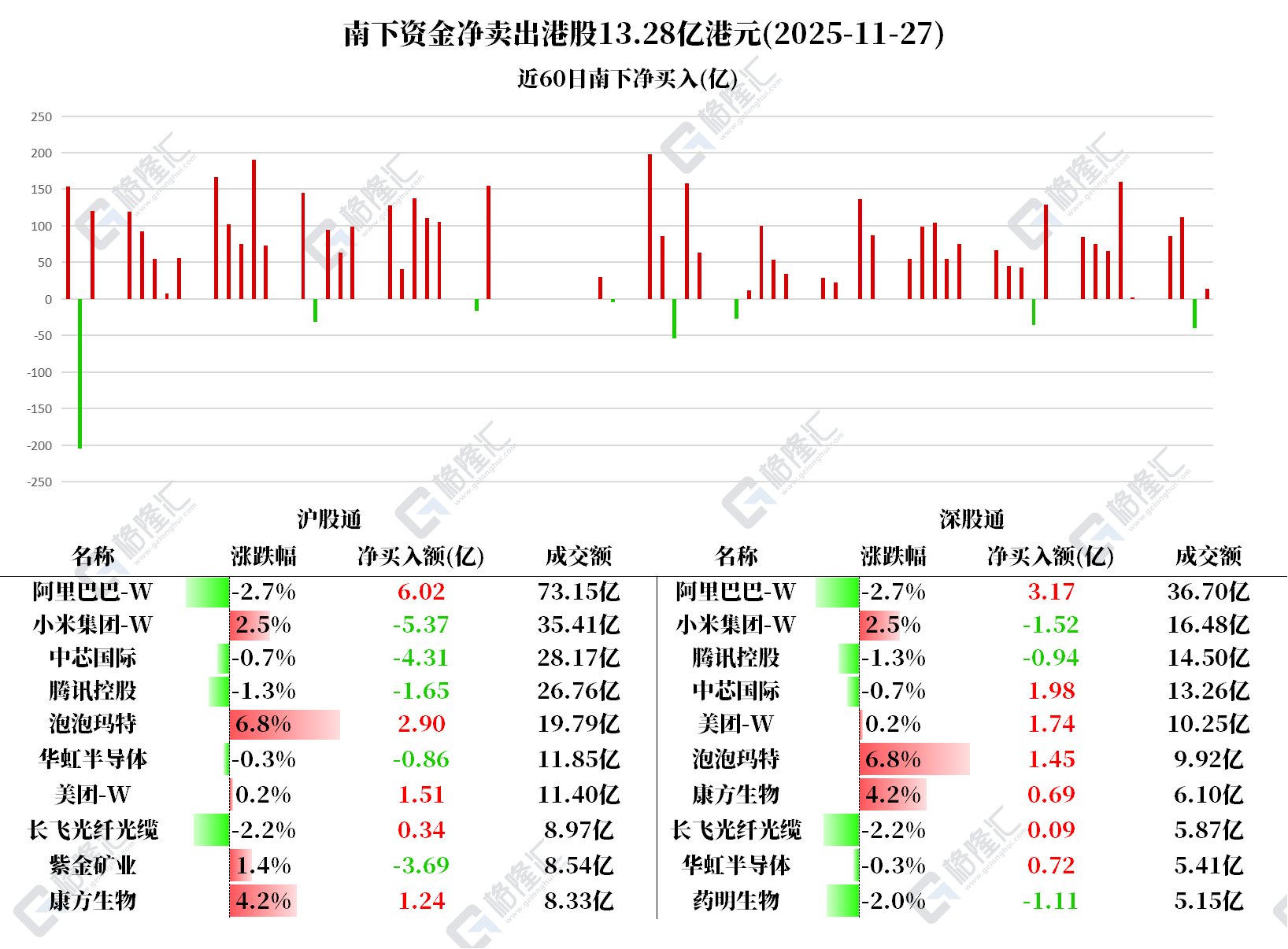
南向资金今日净买入13.28亿港元,阿里巴巴-W净买入9.19亿港元
Zheng Quan Shi Bao Wang· 2025-11-27 15:13
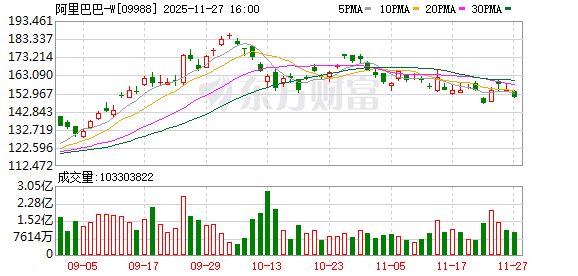
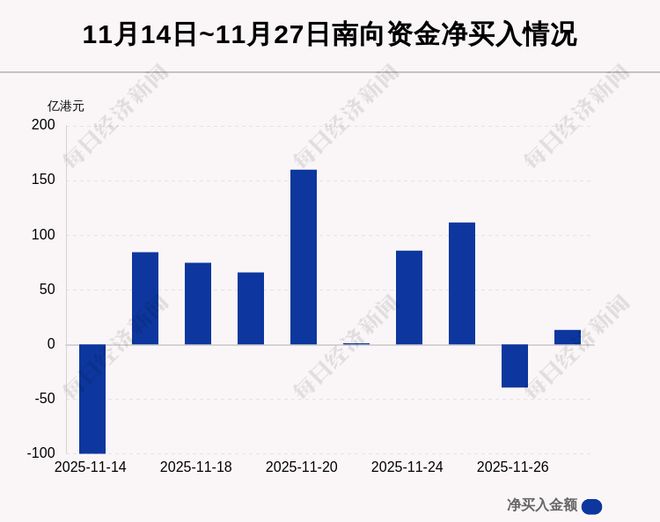
Market Overview - The Hang Seng Index rose by 0.07% on November 27, with total southbound trading amounting to HKD 86.624 billion, including HKD 43.976 billion in buying and HKD 42.648 billion in selling, resulting in a net buying amount of HKD 1.328 billion [2][3]. Southbound Trading Details - Southbound trading through the Shenzhen Stock Connect totaled HKD 31.299 billion, with buying at HKD 15.996 billion and selling at HKD 15.303 billion, leading to a net buying of HKD 0.693 billion [2]. - The Shanghai Stock Connect saw a total trading amount of HKD 55.325 billion, with buying at HKD 27.980 billion and selling at HKD 27.345 billion, resulting in a net buying of HKD 0.635 billion [2]. Active Stocks - Alibaba-W had the highest trading volume among southbound stocks, with a total trading amount of HKD 109.85 billion and a net buying of HKD 9.19 billion, despite a closing price drop of 2.71% [2][3]. - Other notable stocks included Xiaomi Group-W with a trading amount of HKD 51.88 billion and a net selling of HKD 6.89 billion, and SMIC with a trading amount of HKD 41.43 billion [2][3]. Continuous Net Buying and Selling - Alibaba-W has been continuously net bought for 11 days, with a total net buying amount of HKD 25.449 billion during this period [3]. - Two stocks, SMIC and Tencent Holdings, experienced continuous net selling, with net selling amounts of HKD 1.893 billion and HKD 1.528 billion, respectively [3].


港股通(深)净买入6.93亿港元
Zheng Quan Shi Bao Wang· 2025-11-27 15:09
Core Points - The Hang Seng Index rose by 0.07% to close at 25,945.93 points on November 27, with a net inflow of HKD 1.328 billion through the southbound trading channel [1] - The total trading volume for the southbound trading was HKD 86.624 billion, with a net buy of HKD 1.328 billion [1] - In the Shanghai-Hong Kong Stock Connect, the trading volume was HKD 55.325 billion with a net buy of HKD 0.635 billion, while in the Shenzhen-Hong Kong Stock Connect, the trading volume was HKD 31.299 billion with a net buy of HKD 0.693 billion [1] Trading Activity - Alibaba-W was the most actively traded stock in the Shanghai-Hong Kong Stock Connect with a trading volume of HKD 73.15 billion and a net buy of HKD 6.02 billion, despite a closing price drop of 2.71% [1][2] - Xiaomi Group-W followed with a trading volume of HKD 35.41 billion and a net sell of HKD 5.37 billion, closing up by 2.49% [1][2] - In the Shenzhen-Hong Kong Stock Connect, Alibaba-W also led with a trading volume of HKD 36.70 billion and a net buy of HKD 3.17 billion, while Xiaomi Group-W had a net sell of HKD 1.52 billion [2] Summary of Active Stocks - The top ten actively traded stocks included Alibaba-W, Xiaomi Group-W, and Tencent Holdings, with respective trading volumes of HKD 73.15 billion, HKD 35.41 billion, and HKD 28.17 billion [1][2] - The net buy and sell amounts for these stocks indicated a strong interest in Alibaba-W, while Xiaomi Group-W faced significant selling pressure [1][2]




智通港股通活跃成交|11月27日
智通财经网· 2025-11-27 11:04
Core Insights - On November 27, 2025, Alibaba-W (09988), Xiaomi Group-W (01810), and SMIC (00981) were the top three companies by trading volume in the southbound trading of the Stock Connect, with trading amounts of 7.315 billion, 3.541 billion, and 2.817 billion respectively [1] - In the Shenzhen-Hong Kong Stock Connect, Alibaba-W (09988), Xiaomi Group-W (01810), and Tencent Holdings (00700) also ranked as the top three, with trading amounts of 3.670 billion, 1.648 billion, and 1.450 billion respectively [1] Southbound Trading Highlights - **Top Active Companies in Southbound Trading (Shanghai-Hong Kong)** - Alibaba-W (09988): Trading amount of 7.315 billion, net buying of +0.602 billion [2] - Xiaomi Group-W (01810): Trading amount of 3.541 billion, net selling of -0.537 billion [2] - SMIC (00981): Trading amount of 2.817 billion, net selling of -0.431 billion [2] - Tencent Holdings (00700): Trading amount of 2.676 billion, net selling of -0.165 billion [2] - Pop Mart (09992): Trading amount of 1.979 billion, net buying of +0.290 billion [2] - **Top Active Companies in Southbound Trading (Shenzhen-Hong Kong)** - Alibaba-W (09988): Trading amount of 3.670 billion, net buying of +0.317 billion [2] - Xiaomi Group-W (01810): Trading amount of 1.648 billion, net selling of -0.152 billion [2] - Tencent Holdings (00700): Trading amount of 1.450 billion, net selling of -0.094 billion [2] - SMIC (00981): Trading amount of 1.326 billion, net buying of +0.198 billion [2] - Meituan-W (03690): Trading amount of 1.025 billion, net buying of +0.174 billion [2]


最新出炉!11月27日港股通净流入13.28亿港元,其中9.194亿港元都买了它
Mei Ri Jing Ji Xin Wen· 2025-11-27 10:39
Group 1 - The most actively traded stock with net buying is Alibaba-W (9988.HK) with a net purchase amount of 919.4 million HKD and a closing price of 150.6 HKD [2][4] - The stock with the highest net selling is Xiaomi Group-W (1810.HK) with a net selling amount of 689.2 million HKD and a closing price of 41.1 HKD [2][4] - A total of five stocks experienced net buying, while six stocks faced net selling in the southbound trading activity [2][3] Group 2 - Other notable stocks with net buying include Pop Mart (9992.HK) with 435 million HKD, Meituan-W (3690.HK) with 325 million HKD, and Kangfang Biotech (9926.HK) with 192 million HKD [4] - Stocks with net selling include Semiconductor Manufacturing International Corporation (0981.HK) with a net selling of 232 million HKD and Tencent Holdings (0700.HK) with a net selling of 259 million HKD [4] - The overall trading activity reflects a mixed sentiment among investors in the Hong Kong market [2][3]
图解丨南下资金入阿里、泡泡玛特,出小米
Ge Long Hui A P P· 2025-11-27 09:53
Group 1 - Southbound funds net bought Hong Kong stocks worth 1.328 billion HKD today, with notable purchases including Alibaba-W (919 million HKD), Pop Mart (434 million HKD), Meituan-W (325 million HKD), and Kangfang Biotech (192 million HKD) [1] - Continuous net buying of Alibaba has reached 25.45042 billion HKD over 11 days, while SMIC has seen a continuous net selling totaling 1.89276 billion HKD over 6 days [1] - Tencent has experienced net selling for 3 consecutive days, amounting to 1.52864 billion HKD [1] Group 2 - Alibaba-W's stock price decreased by 2.7% with a net buying amount of 6.02 billion HKD and a trading volume of 73.15 billion HKD [3] - Xiaomi Group-W's stock price increased by 2.5% but faced a net selling of 5.37 billion HKD with a trading volume of 35.41 billion HKD [3] - Pop Mart's stock price rose by 6.8% with a net buying of 2.90 billion HKD and a trading volume of 19.79 billion HKD [3] - Meituan-W's stock price increased by 0.2% with a net buying of 1.51 billion HKD and a trading volume of 11.40 billion HKD [3] - Kangfang Biotech's stock price rose by 4.2% with a net buying of 1.24 billion HKD and a trading volume of 8.33 billion HKD [3]


海通国际:海外创新药产业链已呈结构性复苏趋势
智通财经网· 2025-11-27 06:05
Core Viewpoint - The overseas CXO industry has shown resilience under macroeconomic pressure, with overall sentiment stabilizing after hitting a bottom, suggesting a recovery in the domestic CXO sector as macro indicators like interest rates and financing improve [1] Group 1: Industry Overview - The overseas CXO industry has confirmed its bottom and is showing a structural recovery trend, with significant differentiation in recovery across sectors [2] - Clinical CROs, represented by companies like IQVIA and Medpace, are leading the recovery due to strong orders and forward guidance [2] - CDMOs, exemplified by Lonza, demonstrate resilience through long-term contracts, while preclinical CROs and research services are still in a bottoming phase [2] Group 2: Clinical CRO Insights - IQVIA shows positive data with a net book-to-bill ratio of 1.15 and a 20% year-on-year increase in RFP flow, with cancellations returning to a normalized $2.2 billion from over $3 billion [3] - Medpace exhibits the strongest performance with a net book-to-bill ratio of 1.20 and a pre-backlog exceeding $3 billion, indicating high revenue visibility for 2026 [3] - ICON is experiencing demand recovery, but short-term performance is affected by project execution volatility, with a net book-to-bill ratio of 1.02 due to $900 million in project cancellations [3] Group 3: CDMO Insights - Lonza maintains stable performance with strategic long-term contracts and a structure that provides immunity to biotech financing fluctuations [4] - Samsung Biologics keeps its revenue growth guidance unchanged at approximately 25%-30%, with total contract amounts exceeding $20 billion, showcasing strong order reserves [4] - Syngene faces short-term profitability pressure but is entering a critical phase of capacity upgrades and order increases with new global clinical orders [4] Group 4: Investment Recommendations - Companies with global competitive advantages in the CXO sector include WuXi AppTec, WuXi Biologics, and others [4] - Focus on innovative drug industry chain companies with improving profitability, such as Haoyuan Pharmaceutical [4] - Attention is also recommended for companies primarily generating domestic revenue, expected to recover as innovative drugs expand internationally, like Tigermed [4]
港股科技ETF(159751)涨近1%,多重利好催化港股科技
Sou Hu Cai Jing· 2025-11-27 02:38
Core Viewpoint - The Hong Kong technology sector is experiencing a strong rally, driven by multiple favorable factors including increased expectations for Federal Reserve interest rate cuts and improved market liquidity, alongside significant revenue growth in Alibaba's cloud business and a resurgence in AI focus [1]. Group 1: Market Performance - As of November 27, 2025, the CSI Hong Kong Stock Connect Technology Index (931573) has seen a strong increase, with notable gains in constituent stocks such as Huahong Semiconductor (up 5.36%), Kangfang Biotech (up 4.89%), and Li Auto (up 3.87%) [1]. - The Hong Kong Technology ETF (159751) has risen by 0.73%, marking its fourth consecutive increase, with the latest price reported at 1.1 HKD [1]. Group 2: Influencing Factors - The recent rally in the Hong Kong technology sector is attributed to the anticipated easing of monetary policy by the Federal Reserve, which is expected to enhance liquidity in the market [1]. - The combination of the Federal Reserve's halt on balance sheet reduction and the relaxation of SLR regulations is expected to limit liquidity pressure in the medium term [1]. Group 3: Index Composition - The CSI Hong Kong Stock Connect Technology Index comprises 50 large-cap technology companies with high R&D investment and revenue growth, reflecting the overall performance of leading technology stocks within the Hong Kong Stock Connect [1]. - As of October 31, 2025, the top ten weighted stocks in the index include Alibaba-W, Tencent Holdings, and SMIC, collectively accounting for 66.81% of the index [2].