长安汽车

Search documents
马自达电动化计划再推迟两年 中小车企的稳健转型困局
Zhong Guo Qi Che Bao Wang· 2026-01-21 08:38
Core Viewpoint - Mazda's electric vehicle (EV) transformation has faced significant delays, with the launch of its first self-developed electric platform model pushed from 2027 to at least 2028, and possibly to 2029, marking the second major delay since the plan was announced in 2021. This reflects the unique challenges faced by smaller automakers in the transition to new energy vehicles [1] Group 1: Internal Factors - The rapid evolution of technology and the complexity of research and development are the main internal reasons for the delay. Mazda's European R&D Vice President, Christian Schultze, stated that pure electric technology is still in a phase of rapid iteration, leading to increased project difficulties due to new breakthroughs and requirements [2] - Unlike established platforms from larger groups like Volkswagen and Volvo, Mazda lacks sufficient technical accumulation and collaborative resources, requiring it to build its scalable electric platform from scratch. This includes independent breakthroughs in battery integration, electric drive systems, and vehicle architecture [2] - Frequent updates in technical standards, particularly in key areas like 800V high-voltage architecture and cylindrical cell applications, have forced Mazda to repeatedly adjust its R&D plans to avoid launching outdated products [2] Group 2: Resource Constraints - Mazda's limited R&D budget, especially compared to the hundreds of billions of euros invested by giants like Toyota and Volkswagen, restricts its ability to focus resources on developing a pure electric platform while also maintaining profitability in its internal combustion engine (ICE) business [3] - The global scarcity of specialized talent in the pure electric field puts Mazda at a disadvantage in competing with larger groups for skilled personnel, leading to slow formation and expansion of its core technology team, which directly impacts R&D efficiency [3] - Mazda has chosen to prioritize the iteration of its core competencies in ICE and hybrid technologies rather than blindly following the trend of pure electric expansion, reflecting its commitment to its brand identity [3] Group 3: External Factors - Policy fluctuations and demand changes in the European and American markets have further complicated Mazda's original plans. The cancellation of federal tax credits for electric vehicles in the U.S. led to a 49% drop in new electric vehicle registrations in November 2025, significantly shrinking market demand [3] - The U.S. market, being Mazda's core market, has seen its original product launch schedule disrupted by policy shifts, including tariffs imposed by the Trump administration that affected Mazda's plans to export self-developed electric vehicles from Japan to the U.S. [3] - Adjustments in subsidies and emission regulations in the European market have also increased market uncertainty, prompting Mazda to reassess its product launch timing [3] Group 4: Strategic Adjustments - Mazda's pragmatic transition strategy is key to balancing short-term survival with long-term transformation. While the development of its self-developed platform is on hold, Mazda is leveraging partnerships to fill market gaps, notably its deep collaboration with Changan Automobile [4] - The currently available EZ-6 and EZ-60 electric models are built on Changan's EPA1 platform, utilizing Changan's supply chain for core battery and electric drive systems, which reduces R&D and manufacturing costs [4] - Mazda is shifting its strategic focus towards hybrid models, planning to introduce a hybrid version of its globally popular CX-50 crossover SUV by 2027 to meet strong hybrid demand in the U.S. market, thereby generating funds for the development of its electric platform [4] Group 5: Market Position and Future Outlook - The delay in launching electric vehicles also implies a passive downward adjustment of Mazda's electric vehicle goals, with the target for electric models to account for 25%-40% of global sales by 2030 now likely to fall below 25% [5] - Compared to its Japanese peers like Toyota and Honda, which have adjusted their pace but still have faster electric vehicle rollout, Mazda's lag may result in missed market opportunities, especially as Chinese brands accelerate their presence in the global electric vehicle market [5] - However, Mazda's cautious strategy may help it avoid the pitfalls of aggressive transformation, allowing it to maintain a differentiated competitive space with future models based on its self-developed platform, which will continue to embody its "Kodo design" and driving dynamics [5] - Mazda's transformation challenges reflect the broader struggles of small to medium-sized automakers in the global shift to electric vehicles, highlighting the need for either partnerships with larger firms for resource access or a more measured approach to market engagement [5][6] - The next two years will test Mazda's patience and technical resilience as it navigates the electric vehicle wave, focusing on building technical barriers and maintaining market share without being marginalized in the industry [6]

长安福特年销量跌破10万辆红线
第一财经· 2026-01-21 05:58
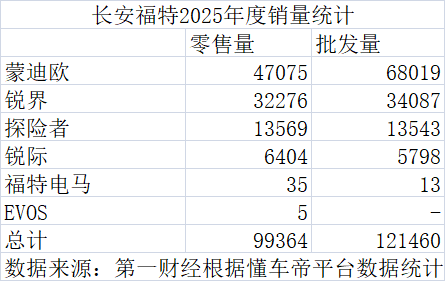
2026.01. 21 本文字数:918,阅读时长大约1.54分钟 作者 | 第一财经 葛慧 10万辆/年,在业内通常被认为是汽车销量规模的关键临界点,跌破10万辆意味着研发制造成本和产 能利用率拉响警报。 曾经一年卖出近百万辆的合资品牌长安福特,今年已跌破上述生存红线。 据懂车帝援引的乘联会数据统计,长安福特2025年1~12月在华批发销量12.15万辆,零售销量9.94 万辆。这两个数据相比该品牌2024年24.7万辆的销量,均明显腰斩。 一般而言,由于批发销量存在向经销商压库等因素,零售数据更能体现终端市场的真实情况。这也意 味着,若按零售销量,长安福特多年来首次跌破10万辆/年的生存红线。 零售销量来看,最多的蒙迪欧一年买了4.7万辆,在所有车型销量中占到半数比重。作为福特电动化 开山之作,福特电马只卖了35辆,且销售数据自8月开始无记录。 | | 长安福特2025年度销量统计 | | | --- | --- | --- | | | 琴售量 | 批发量 | | 蒙迪欧 | 47075 | 68019 | | 锐界 | 32276 | 34087 | | 探险者 | 13569 | 13543 | | ...


长安福特年销量跌破10万辆红线
Di Yi Cai Jing· 2026-01-21 04:52
Core Insights - Changan Ford's sales have significantly declined, falling below the critical threshold of 100,000 units per year, which raises concerns about manufacturing costs and capacity utilization [1][3] - In 2025, Changan Ford's wholesale sales in China were reported at 121,460 units, while retail sales were only 99,364 units, indicating a substantial drop compared to 2024's sales of 247,000 units [1][2] - The retail sales data suggests that Changan Ford has experienced its first drop below the 100,000 units per year survival line, with the Mondeo model accounting for a significant portion of sales [1][2] Sales Performance - In 2025, the retail sales breakdown shows the Mondeo sold 47,075 units, the Edge sold 32,276 units, and the Explorer sold 13,569 units, while the Ford Mustang Mach-E only sold 35 units [2] - Changan Ford's sales have been on a downward trend since reaching a peak of 957,000 units in 2016, with sales dropping to 184,000 units in 2019 and further declining to 233,000 units in 2023 [3] - The company saw a brief recovery in 2021 with sales reaching 304,700 units, but this was followed by consecutive declines in 2022 and 2023 [3] Market Position - Changan Ford's parent company, Changan Automobile, reported that in 2025, its total sales reached 2.913 million units, with 2.468 million units coming from its own brands, representing 85% of total sales [3] - The decline in Changan Ford's sales has led to a shift in focus towards its own brands, as indicated by the lack of official sales announcements from Changan Ford's shareholders [3]
【掘金行业龙头】电机+灵巧手+人形机器人,公司完成灵巧手全产业生态闭环,发布接近人手自由度的灵巧手
财联社· 2026-01-21 04:27
电机+灵巧手+人形机器人,完成灵巧手全产业生态闭环,发布接近人手自由度的灵巧手,电机已用于医 疗、人形机器人等领域,这家公司汽车领域与博世、比亚迪、理想、长安达成合作。 前言 《电报解读》是一款主打时效性和专业性的即时资讯解读产品。侧重于挖掘重要事件的投资价值、分析 产业链公司以及解读重磅政策的要点。即时为用户提供快讯信息对市场影响的投资参考,将信息的价值 用专业的视角、朴素的语言、图文并茂的方式呈现给用户。 ...

富特科技:预告2025净利增长超121%,车载电源领军者驶入增长快车道
Quan Jing Wang· 2026-01-21 03:29
Core Viewpoint - The company, Zhejiang Fute Technology Co., Ltd., forecasts a significant increase in net profit for 2025, driven by the booming global electric vehicle (EV) market, with expected net profit growth of 121.98% to 164.26% compared to the previous year [1][4]. Group 1: Financial Performance - The company anticipates a net profit of between 210 million to 250 million yuan for 2025, compared to 94.6052 million yuan in the previous year [1]. - The projected annual revenue is expected to exceed 4 billion yuan, reflecting a growth of over 106.83% year-on-year [1]. - In Q3 2025, the company achieved a revenue of 1.085 billion yuan, marking a year-on-year increase of 108.27% [1]. - For the first three quarters of 2025, the company reported a revenue of 2.559 billion yuan, up 116.31% year-on-year, and a net profit of 137 million yuan, an increase of 65.94% [1]. Group 2: Industry Growth - The rapid development of the EV industry is a primary driver of the company's explosive growth, with China's EV production and sales in the first half of 2025 reaching 6.968 million and 6.937 million units, respectively, representing year-on-year growth of 41.4% and 40.3% [2]. - The domestic EV market is projected to see sales of 16.49 million units in 2025, a year-on-year increase of 28.2%, while European sales are expected to reach approximately 2.94 million units, growing by 33% [1]. Group 3: Research and Development - The company has increased its R&D investment, with R&D expenses reaching 121 million yuan in the first half of 2025, a year-on-year increase of 56.8% [2]. - The R&D team has expanded to 910 members, accounting for 39.57% of the total workforce, providing strong support for technological innovation [2]. Group 4: Technological Advancements - The company has made significant breakthroughs in integrated technology, developing a 4-in-1 integrated smart power distribution unit that supports various charging scenarios [3]. - The company is at the forefront of applying third-generation semiconductor materials, including silicon carbide and gallium nitride, enhancing its product offerings [3]. Group 5: International Expansion - The company has been actively pursuing internationalization, with overseas revenue reaching 132 million yuan in 2024, a staggering year-on-year increase of 5815.39% [4]. - By the first half of 2025, overseas business revenue accounted for over 17% of total revenue, indicating successful international strategy implementation [4]. Group 6: Market Position and Future Outlook - The company is positioned as a leading supplier in the domestic vehicle power market, with its market share in the domestic on-board charger (OBC) market increasing from 5.6% in 2024 to 8.3% in the first half of 2025 [4]. - The company’s performance in 2025 reflects strong momentum in the core EV sector, with expectations for continued growth driven by efficient R&D capabilities and expanding market share [4][5].
中国汽车_海外电动汽车机遇及潜在风险-China Automobiles_ The overseas EV opportunities & the risks that may ensue
2026-01-21 02:58
Summary of Key Points from the Conference Call Industry Overview - **Industry**: China Electric Vehicles (EV) and New Energy Vehicles (NEV) - **Market Growth**: The overseas market is expected to be a significant growth area for China EV sales in 2026, with a projected **35% year-over-year (yoy) volume growth** [1][15]. Core Insights - **Price Competition Framework**: A framework was developed to assess potential price cuts in overseas markets based on three parameters: 1. Is the auto market in contraction? 2. Do Chinese OEMs have high penetration? 3. Is there excess production capacity? - Thailand is currently the only market exhibiting all three parameters, making it an exception rather than the norm for price competition [1][16][24]. - **Profitability in Overseas Markets**: Chinese OEMs, particularly BYD, are achieving significantly higher Average Selling Prices (ASP), gross margins, and unit profits in overseas markets compared to domestic sales. For instance, BYD's ASP is **50%-120% higher**, with gross margins **5-10% higher**, and unit profits **43%-420% higher** for the same models sold outside China [3][49]. - **NEV Market Penetration**: As China's NEV penetration reaches **60%** with a slowdown to **11% yoy growth** by 2026, overseas markets are entering a mass-adoption phase. The overseas NEV sales are expected to reach **7.4 million units** in 2026, with Chinese brands fulfilling **55%** of this volume [4][62][65]. Market Dynamics - **Thailand as a Case Study**: Thailand is highlighted as a key market for Chinese OEMs due to favorable local policies and cultural proximity. The market is projected to see **141,000 NEV sales** in 2025, with a **26% market share** for Chinese brands [17][18]. - **Price Cuts and Market Concerns**: Two rounds of price cuts in Thailand have raised concerns about a potential price war similar to that in China. The price cuts were driven by market contraction, high penetration of Chinese OEMs, and excess production capacity [31][39]. - **Future Risks**: If other overseas markets begin to exhibit similar conditions as Thailand, there could be a **16%-19% downside** to cash margins at 0% [2][12][44]. Investment Recommendations - **Recommended Stocks**: BYD and XPeng are identified as well-positioned for overseas growth due to their higher exposure to international markets and expanding sales networks [4][62]. Additional Insights - **Cyclical Nature of the Auto Industry**: The cyclical nature of the auto industry and potential changes in local production requirements could impact future pricing strategies and market dynamics [2][44][46]. - **Local Production Capacity**: Chinese OEMs are building localized production capacity to meet overseas demand, with expectations of **0.9 million** and **1.7 million** NEV production capacity overseas by the end of 2025 and 2026, respectively [4][62]. - **Competitive Landscape**: Chinese brands are gaining market share in various overseas markets, with significant growth in developed markets such as the UK, Spain, and Australia, where they achieved double-digit market share gains [75][76]. This summary encapsulates the key points discussed in the conference call, focusing on the dynamics of the Chinese EV market, particularly in relation to overseas expansion and competitive strategies.


重磅利好,中国电车能领德国补贴了,两国为新能源出海开政策绿灯
3 6 Ke· 2026-01-21 01:39
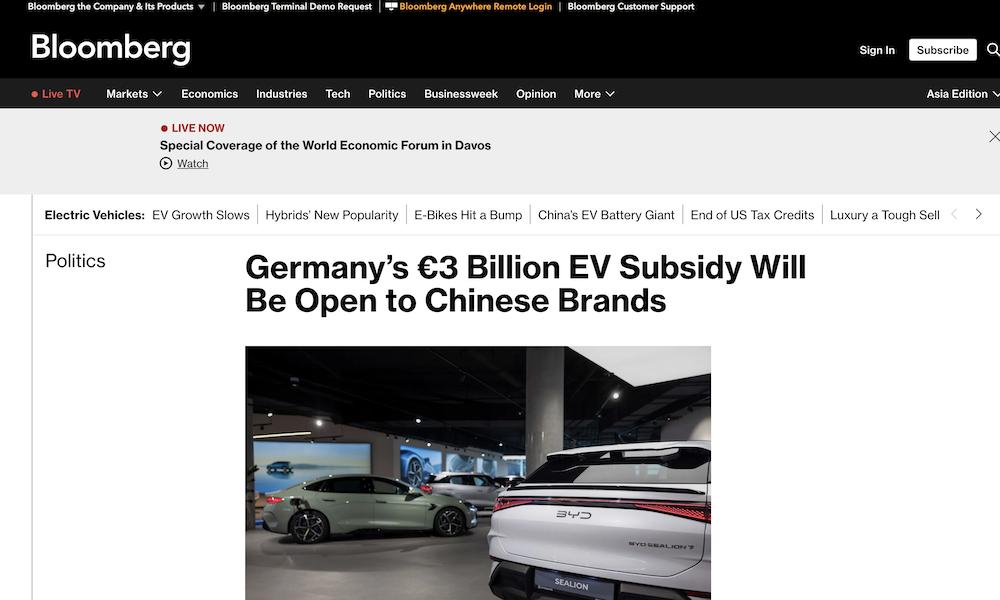
Core Viewpoint - Recent policy changes in Germany and Canada are creating favorable conditions for Chinese electric vehicle manufacturers to expand internationally, particularly in the European and North American markets [1][2][5]. Group 1: Germany's Policy Changes - The German government has announced a €3 billion (approximately ¥24.5 billion) subsidy plan for electric vehicles, providing up to €6,000 (approximately ¥49,000) for households purchasing new electric cars, which is open to all manufacturers, including Chinese brands [1][2]. - This subsidy aims to boost electric vehicle sales and support the automotive industry after a significant drop in demand following the end of previous subsidy programs [5]. - The German Federal Environment Minister emphasized the need to embrace competition rather than impose restrictions, indicating a welcoming stance towards Chinese automotive manufacturers [5]. Group 2: Canada's Policy Adjustments - Canadian Prime Minister Justin Trudeau announced the cancellation of a 100% tariff on Chinese electric vehicles and introduced an annual quota of 49,000 vehicles that will benefit from a 6.1% most-favored-nation tariff rate [1][8]. - This quota corresponds to the export volume from China to Canada before the imposition of additional tariffs, with expectations for gradual increases over the years [10]. - Trudeau highlighted China's undeniable advantages in the electric vehicle sector, aiming to learn from innovative partners to enhance Canada's competitive automotive industry [10]. Group 3: Export Growth of Chinese Automakers - In 2025, China's total automobile exports are projected to reach 8.32 million units, marking a 30% year-on-year increase, continuing a five-year growth trend [11]. - The export value is expected to grow from $34.5 billion (approximately ¥240.1 billion) in 2021 to $142.4 billion (approximately ¥991 billion) in 2025, reflecting a 21% increase [11]. - Notably, the export volume of new energy vehicles is anticipated to double, reaching 2.615 million units in 2025, with significant contributions from major automakers like BYD and Chery [11][16]. Group 4: Performance of Major Chinese Automakers - Chery is expected to lead in export volume in 2025, with 1.34 million units, while BYD's exports are projected to reach 1.05 million units, a 144% increase from the previous year [16][18]. - SAIC Group is also set to export 950,000 units, leveraging its joint ventures and brand portfolio [18]. - New entrants like Leap Motor and Xpeng are showing remarkable growth, with exports increasing by 600% and 150%, respectively, indicating a strong competitive presence in the international market [19][20]. Group 5: Industry Implications - The evolving international landscape for Chinese automakers signifies a historic shift from "bringing in" to "going out," enhancing the global influence of Chinese automotive brands [21]. - The advancements in technology, such as smart cabins and battery innovations, are contributing to the transformation of the global automotive industry [21]. - The current complex international environment and restructuring of the global automotive landscape suggest that Chinese automotive exports are likely to maintain a robust trajectory, becoming a key driving force in global mobility transformation [21].


华创证券:中国电动汽车出口有望迎来更安全、更稳定的发展机遇
Zheng Quan Shi Bao Wang· 2026-01-21 00:55
Core Insights - A new agreement on electric vehicle imports was reached between China and Europe, while Canada announced the restoration of the most-favored-nation tax rate for Chinese electric vehicles within quotas, indicating a more secure and stable development opportunity for China's electric vehicle exports [1] Industry Summary - China's automobile export market shows significant potential with rapid growth and high return on equity (ROE), serving as crucial support for the valuation and growth of the automotive sector [1] Company Recommendations - Companies recommended for investment include BYD (002594), Geely Automobile, and Great Wall Motors (601633) [1] - Additional companies to watch include Leap Motor, Changan Automobile, SAIC Motor (600104), and Chery Automobile [1]

国产汽车电子“领头羊”过会!
是说芯语· 2026-01-20 23:39
Core Viewpoint - E-Tech has transformed from a follower to a leader in the automotive electronics sector in China, establishing itself as a key player in providing standardized solutions across various automotive domains [2][7]. Group 1: Market Position and Product Matrix - Since its establishment in 2002, E-Tech has developed a comprehensive product matrix covering body control, intelligent cockpit, power domain, and intelligent driving, which provides a solid foundation for one-stop electronic system services for automakers [2]. - In the Chinese market for pre-installed body controllers in passenger vehicles, E-Tech holds a 25.50% market share, maintaining the top position for three consecutive years [3]. - E-Tech also leads in the market for pre-installed remote physical keys with a 13.83% share, and ranks among the top three in the cockpit domain and display assembly market for domestic brands [3]. Group 2: Partnerships and Global Reach - E-Tech has built a strong network of partnerships with major domestic automakers such as Changan, Great Wall, SAIC, and Geely, as well as new energy vehicle companies like Li Auto, Xpeng, and Leap Motor [3]. - Internationally, E-Tech provides automotive electronic EMS services to renowned suppliers like Bosch, with products being used in luxury brands such as Volvo and Audi, showcasing its capability to meet international quality standards [3]. Group 3: Technological Advancements and Future Prospects - The automotive industry is undergoing significant transformation towards electrification, intelligence, and connectivity, creating a favorable environment for explosive growth in automotive electronics [4]. - E-Tech has established a complete intellectual property system with 182 authorized patents and has achieved ASPICE CL2 certification, actively participating in industry standard formulation [4]. - The company is poised for further breakthroughs in smart cockpit and intelligent driving areas, supported by its recent entry into the capital market, which will provide necessary funding for technological innovation and capacity expansion [4][7].

【读财报】上市车企12月销量:整车销量超222万辆 江淮汽车、赛力斯、江铃汽车等销量增速加快
Xin Lang Cai Jing· 2026-01-20 23:35
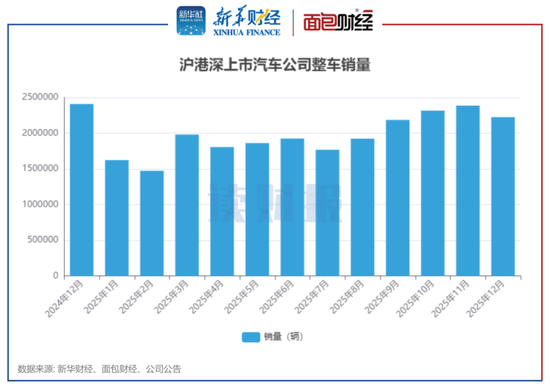
Core Insights - The overall vehicle sales for 20 A and H-share listed automotive manufacturers in December 2025 totaled 2.2255 million units, representing a year-on-year decline of 7.64% and a month-on-month decrease of 6.77% [10][11] - In December 2025, 16 companies reported sales of approximately 1.2532 million new energy vehicles (NEVs), marking a year-on-year increase of 1.99% and a penetration rate of about 58% [10][11] Group 1: Overall Vehicle Sales - The total vehicle sales for the 20 listed companies in December 2025 were 2.2255 million units, down 7.64% year-on-year and down 6.77% month-on-month [10][11] - For the entire year of 2025, these companies sold over 23.5 million vehicles, reflecting a year-on-year growth of 8.86% [11] - Companies such as Jianghuai Automobile, Seres, and Jiangling Automobile saw an acceleration in sales growth in December compared to November, while companies like Shuguang and Zhongtong Bus experienced a slowdown [10][11] Group 2: New Energy Vehicle Sales - In December 2025, the total sales of NEVs reached approximately 1.2532 million units, with a year-on-year increase of 1.99% and a month-on-month decrease of 8.93% [5][15] - The NEV penetration rate for December was about 57.96%, a decrease of 0.85 percentage points from November [15] - BYD, SAIC Group, and Geely were the top three companies in NEV sales for December, with significant growth observed in companies like BAIC Blue Valley and Jianghuai Automobile, which reported growth rates exceeding 70% [7][17] Group 3: Company-Specific Performance - BYD led the sales in December with 420,398 units sold, although this represented an 18.34% decline year-on-year [4][14] - SAIC Group and Changan Automobile followed with sales of 399,449 units and 254,843 units, respectively, with Changan showing a slight year-on-year increase of 1.66% [4][14] - Geely's December sales increased by 12.74% year-on-year, totaling 236,817 units, while GAC Group experienced a significant decline of 33.82% in sales [4][15]