天合光能

Search documents
晶澳率先预告全年“成绩单”!光伏龙头的突围难题
Bei Jing Shang Bao· 2026-01-13 13:03
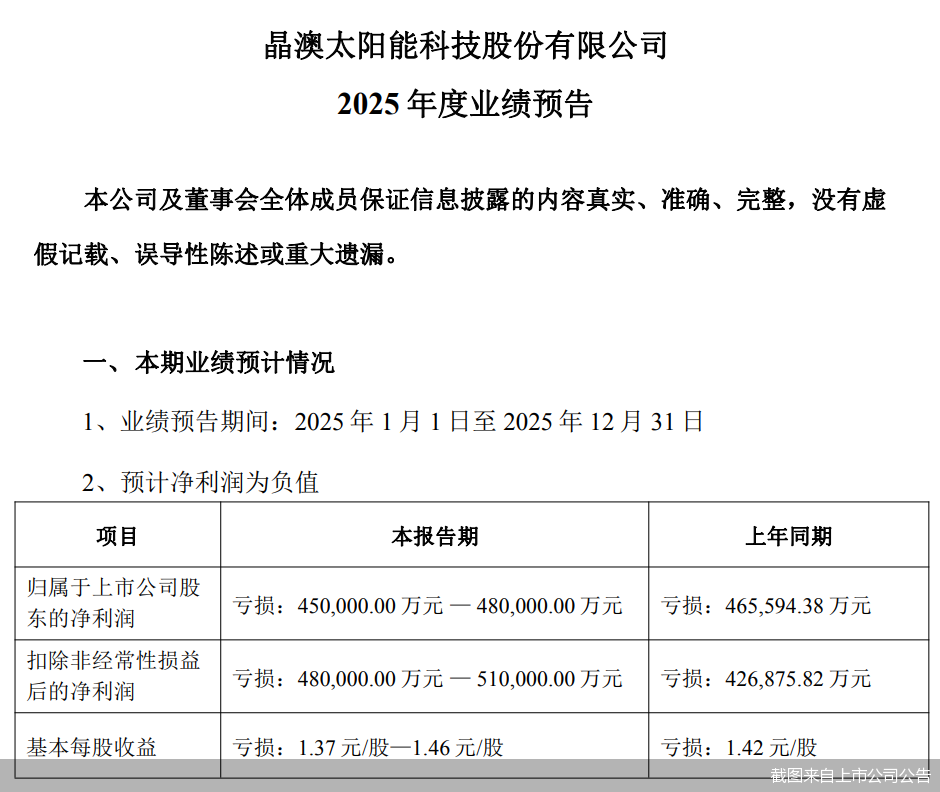
Core Viewpoint - JA Solar Technology (晶澳科技) has forecasted a net loss of 45 billion to 48 billion yuan for 2025, indicating that the company's performance is expected to remain similar to the previous year's loss, reflecting the ongoing challenges in the photovoltaic industry during a period of adjustment [1][4]. Financial Performance - The projected net loss for 2025 is between 45 billion and 48 billion yuan, compared to a loss of approximately 46.56 billion yuan in 2024 [4]. - The expected net loss after excluding non-recurring gains and losses is between 48 billion and 51 billion yuan, compared to a loss of about 42.69 billion yuan in the previous year [4]. - Basic earnings per share are projected to be a loss of 1.37 to 1.46 yuan per share, compared to a loss of 1.42 yuan per share in the previous year [3][4]. - Revenue figures for JA Solar from 2022 to 2025 show a decline, with revenues of approximately 729.89 billion yuan in 2022, 815.56 billion yuan in 2023, 701.21 billion yuan in 2024, and 368.09 billion yuan in the first three quarters of 2025 [4]. Market Dynamics - The photovoltaic industry is experiencing a "cold winter," characterized by significant losses among leading companies due to oversupply and intensified competition [1][4]. - The cancellation of export tax rebates for photovoltaic products, effective April 1, 2025, is expected to increase export costs and compress profit margins for companies [8][9]. - JA Solar's market capitalization has decreased from a peak of 190 billion yuan in June 2022 to approximately 40 billion yuan currently [5]. Industry Trends - The integration of solar and storage solutions is becoming a significant trend, with JA Solar launching various energy storage products [6]. - The company is also preparing for an IPO in Hong Kong, aiming for an "A+H" listing [6]. - The overall financial performance of the photovoltaic sector remains weak, with major companies like Trina Solar, JinkoSolar, and LONGi Green Energy also reporting substantial losses [7].


太空光伏万亿前景,激光巨头能搭上快车吗?
Xin Lang Cai Jing· 2026-01-13 11:33
Core Viewpoint - The concept of "space photovoltaics" is gaining traction among major solar companies, with a focus on perovskite tandem solar cells as a potential game-changer in the space energy sector [1][3][11] Group 1: Industry Developments - HaiMoxing claims to be a core supplier of laser equipment for JinkoSolar and Trina Solar, actively collaborating on the development of perovskite tandem solar cells [1][13] - JinkoSolar's chairman, Li Xiande, emphasized the need to explore market opportunities in space photovoltaics, while Trina Solar's chairman, Gao Jifan, announced plans to accelerate the commercialization of perovskite technology [3][11] - The Starship rocket is theoretically capable of deploying 300-500 GW per year, with plans to launch 1 million tons of satellites annually, each providing 100 kW of AI computing power, potentially adding 100 GW of computing capacity each year [1][3] Group 2: Technical Advantages of Perovskite - Perovskite solar cells are lightweight, with a weight reduction of over 90% compared to gallium arsenide and 92% compared to crystalline silicon, allowing for significant cost savings in satellite launches [4][12] - The energy output of perovskite cells can reach 10-30 W/g, compared to 3.8 W/g for gallium arsenide and 0.38 W/g for crystalline silicon, making them a more efficient option for space applications [4][12] - Perovskite cells are less affected by environmental factors in space, which could enhance their stability and longevity compared to traditional materials [4][12] Group 3: Collaborations and Industry Alliances - HaiMoxing is deeply involved in R&D partnerships with leading solar companies, positioning itself to capture future market opportunities in perovskite technology [14] - Other companies, such as Junda Co. and Aerospace Hongtu, are forming strategic alliances to develop perovskite applications for space energy solutions [14] - A growing number of laser equipment manufacturers, including Dier Laser and Qinghong Laser, are making advancements in perovskite technology, indicating a competitive landscape in this emerging field [6][14] Group 4: Challenges Ahead - Despite the promising outlook, the large-scale application of perovskite technology in space photovoltaics faces significant challenges, including the need for extensive in-orbit data validation and the development of consistent packaging and aerospace-grade standards [9][18] - The path to achieving substantial orders and revenue contributions remains long for laser equipment manufacturers involved in this sector [18]



“太空光伏”狂欢:万亿叙事焦虑与泡沫预警
2 1 Shi Ji Jing Ji Bao Dao· 2026-01-13 11:22
Core Insights - Tesla CEO Elon Musk has ambitious plans for "space solar power," aiming to launch solar AI satellites to maximize solar energy utilization from space, with projections of 8,000 launches per year for deployment [1][2] - The concept of "space solar power" has gained significant attention in the Chinese A-share market, with predictions of a trillion-dollar market, despite the technology still facing commercialization challenges [2][3] Concept Clarification - "Space solar power" refers to two levels: narrowly, it involves solar components on spacecraft for self-power; broadly, it includes deploying large solar arrays in space to transmit energy to Earth [3][4] - The core advantage of space solar power is its ability to generate energy continuously without atmospheric interference, achieving 5-10 times the sunlight intensity compared to ground-based solar [4][5] Market Dynamics - The surge in interest is driven by the explosive growth of commercial space and the energy demands of AI computing centers, creating a rigid energy demand for low Earth orbit satellites [6][7] - The global market for space solar power is projected to reach approximately 29.5 billion RMB by 2030, ten times the current size, driven by the deployment of low Earth orbit satellites [6][7] Competitive Landscape - The space solar power sector is characterized by a competitive landscape where state-owned enterprises lead core space missions, while private companies target commercial applications [8][9] - Major Chinese solar companies like Trina Solar and LONGi Green Energy are advancing from technology development to engineering validation, with significant investments in various solar technologies [9][10] Technological Challenges - The current technology competition in space solar power revolves around three main routes: gallium arsenide, crystalline silicon, and perovskite, each with its advantages and limitations [12][13] - Gallium arsenide batteries are efficient but costly, while crystalline silicon is cheaper but less effective in space; perovskite is seen as a potential long-term solution but faces stability issues [12][13] Investment Sentiment - The capital market's enthusiasm for space solar power is fueled by narratives of vast market potential, with predictions suggesting a market size reaching trillions by 2030 [14][18] - However, the current excitement may be speculative, as many companies lack substantial revenue from space solar power, indicating a potential disconnect between stock prices and fundamental performance [18]
中银晨会聚焦-20260113
Bank of China Securities· 2026-01-13 09:07
Core Insights - The report highlights a significant increase in the current account surplus, reaching a historical high in Q3 2025, with a GDP ratio of 4.0%, indicating a robust trade surplus environment [4] - The AI industry is transitioning from a focus on computational power to practical applications, marking a new phase in the market where AI applications are expected to drive growth [6] - The commercial space sector is opening new growth opportunities for photovoltaic (PV) technology, particularly in space applications, which are expected to have unique requirements and market dynamics [7][10] Macroeconomic Overview - The current account surplus has expanded year-on-year, maintaining a reasonable GDP ratio, but the rising surplus raises concerns about increasing trade protectionism [4] - There has been a notable acceleration in domestic capital outflows, with foreign investment shifting from net inflows to slight outflows, particularly in Q3 2025 [4] - The increase in domestic capital outflows is attributed to rising foreign debt and equity investments, alongside a significant net outflow of foreign capital [4] AI Industry Insights - The AI sector is moving towards application-driven growth, with recent market entries indicating a maturation of business models within the industry [6] - The report suggests that the AI application market remains a high-value investment area, with potential for significant returns as the industry evolves [6] Photovoltaic Technology in Space - The report discusses the potential of space-based photovoltaic technology, which is still in its early stages, with limited manufacturers capable of meeting the unique demands of space environments [7][10] - The need for PV technology to withstand extreme conditions in space is expected to create a divide among companies in the industry, favoring those with strong supply channels and technological capabilities [9][10] - The cost sensitivity in space applications is low, allowing leading companies to capitalize on high-margin opportunities as they develop space PV solutions [9][10]
天合储能1.7GWh亚太项目交付
鑫椤储能· 2026-01-13 06:37
关注公众号,点击公众号主页右上角" ··· ",设置星标 "⭐" ,关注 鑫椤储能 资讯~ 近日,天合储能顺利完成向亚太地区 1.7GWh 储能项目的发货交付。该项目为公司目前 规模最大的海外储能项目出货 ,标志着天合储能在超大 规模储能项目交付能力上的又一次突破,也进一步彰显了公司在海外储能市场的持续拓展与全球项目交付能力的领先优势。 本次交付项目采用天合储能 Elementa 2 储能系统。该系统搭载天合自研电芯,并配备 AI 仿生液冷技术,可将系统内部电芯温差精准控制在 2.5℃ 以内,在 –30°C 至 55°C 的宽温区间内保持稳定运行,充分适应高温、高负荷等复杂工况,为超大规模储能项目的长期安全与可靠运行 提供坚实保障。 鑫椤报告预售: 2025-2029年全球储能市场运行趋势及竞争策略研究报告 预订电话:18964001371(微信同) 凭借高可靠性与快速部署优势, Elementa 系列储能产品正持续服务于不同区域、不同应用场景的能源需求,在效率、灵活性与系统稳定性之间 实现良好平衡,满足海外市场对储能系统 规模化、工程化、可复制落地 的实际需求。 截至 2025 年底,天合储能全球储能系统累 ...
天合光能分布式光伏组件最新报价上调3分/W
Bei Jing Shang Bao· 2026-01-13 06:29
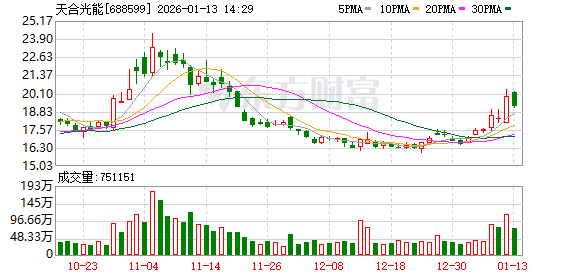
Core Insights - Trina Solar (688599) announced its distributed market guidance price through its WeChat account "Trina Solar Distributed" on January 13, with the lowest component price reaching 0.85 CNY/W, an increase of 0.03 CNY/W compared to the price on January 1 [2] - The Ministry of Finance and the State Administration of Taxation released an announcement on January 9 regarding adjustments to the export tax rebate policy for photovoltaic products, stating that the VAT export rebate for photovoltaic products will be canceled starting April 1 [2] Company Summary - Trina Solar's component pricing reflects a positive trend, with a notable increase in the lowest price per watt [2] - The company's pricing strategy may be influenced by recent policy changes regarding export tax rebates [2] Industry Summary - The cancellation of VAT export rebates for photovoltaic products could impact the overall market dynamics and pricing strategies within the solar industry [2] - The adjustment in export tax policy may lead to increased costs for manufacturers, potentially affecting their competitiveness in international markets [2]
今亮点!天合光能成立光伏技术公司
Zheng Quan Shi Bao Wang· 2026-01-13 04:57
(相关资料图) 人民财讯1月13日电,企查查APP显示,近日,淮安群创光伏技术有限公司成立,法定代表人为陈奕 峰,注册资本为1000万元,经营范围包含:工业设计服务;新材料技术研发;新材料技术推广服务;机 械设备研发;光伏设备及元器件销售等。企查查股权穿透显示,该公司由天合光能旗下江苏群创光伏技 术有限公司全资持股。 ...

为星网二期配套产品 陕西华达“20cm”涨停
Shang Hai Zheng Quan Bao· 2026-01-13 04:57
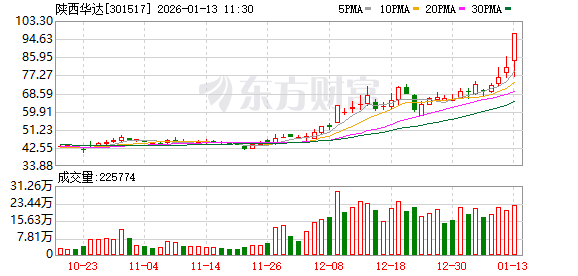
Core Viewpoint - Shaanxi Huada is actively participating in major aerospace projects, including the Starlink (State Grid Star Constellation) and Qianfan, and is expanding its product offerings in commercial aerospace, focusing on various connectors and components [2][9]. Group 1: Company Developments - Shaanxi Huada has updated its investors about its involvement in the Starlink project, stating that it is supplying products for the second phase and is committed to meeting customer demands [2]. - The company reported a stock price increase, reaching a limit up of 97.08 CNY per share on January 13 [2]. - Shaanxi Huada is enhancing its production capacity in response to the growing demand in the commercial aerospace sector, focusing on automation and new processes to improve efficiency [9]. Group 2: Strategic Transactions - The company is progressing with a related transaction to acquire 100% of Shaanxi Huajing Microelectronics, which will become a wholly-owned subsidiary, enhancing its product range and competitive edge [9][11]. - The acquisition is expected to create synergies in product categories, technology development, customer resources, and sales channels, thereby strengthening the company's business landscape [11]. Group 3: Industry Collaborations - Other companies, such as Zhimin Da, Trina Solar, and Alliance Electronics, have also disclosed collaborations related to the Starlink project, indicating a broader industry engagement in commercial aerospace [7][12]. - Zhimin Da is providing embedded computing modules for satellite systems, while Trina Solar is advancing high-efficiency technology for satellite applications [14]. - Alliance Electronics has successfully entered the bidding for low-orbit satellite communication products, further demonstrating the competitive landscape in the commercial aerospace sector [14].
重组入列:最新443家全国重点实验室名单
仪器信息网· 2026-01-13 03:56
Core Viewpoint - By December 2025, over 500 national key laboratories have completed restructuring into a new sequence, with nearly 110 "Double First-Class" universities participating in about 80% (nearly 400) of the national key laboratories [1][2]. Group 1: National Key Laboratories Overview - National key laboratories are scientific research and development institutions planned by the state to support the national laboratory system, focusing on major technological innovation areas related to national security and socio-economic development [2]. - The restructuring of the national key laboratory system was first proposed at the Central Economic Work Conference in 2018 and established as a component of national strategic scientific and technological forces in the revised "Science and Technology Progress Law" in 2021 [2]. Group 2: Participation of Universities - The leading or co-building universities for the laboratories are primarily "Double First-Class" universities, indicating a strong involvement of top-tier educational institutions in the research initiatives [1][2]. - Nearly 110 "Double First-Class" universities are involved in the establishment and support of approximately 400 national key laboratories [1][2]. Group 3: List of Key Laboratories - A variety of national key laboratories have been established across different fields, including: - Dark Matter Physics National Key Laboratory led by Shanghai Jiao Tong University [3] - Explosive Science and Safety Protection National Key Laboratory led by Beijing Institute of Technology [3] - Materials Chemistry Engineering National Key Laboratory led by Nanjing University of Technology [3] - The list includes laboratories focusing on diverse areas such as intelligent transportation, infectious disease research, and advanced manufacturing technologies [3][4][5].

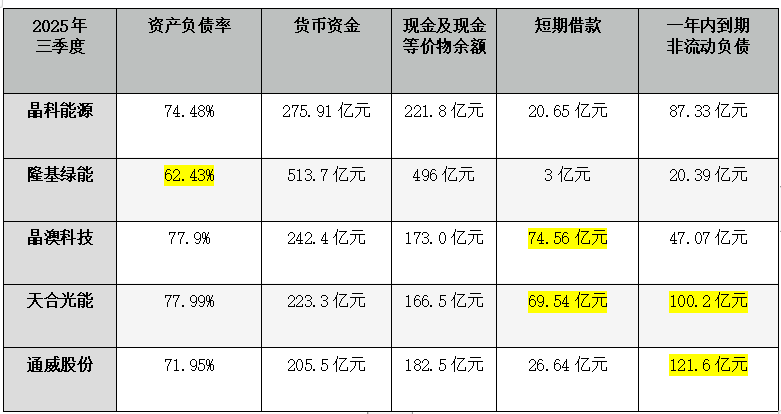
取消退税谁突围 谁出清?A股光伏龙头企业核心财务数据拆解
Nan Fang Du Shi Bao· 2026-01-13 03:37
Core Viewpoint - The Ministry of Finance announced the cancellation of export VAT rebates for photovoltaic products starting April 1, 2026, affecting 249 products, which may accelerate the exit of weaker companies and optimize industry capacity structure [1] Group 1: Market Reaction - The A-share "photovoltaic equipment" sector surged by 2.72% following the announcement, with notable increases in stock prices for major companies such as JinkoSolar (3.56%), LONGi Green Energy (4.57%), JA Solar (3.4%), Trina Solar (8.62%), and Tongwei Co. (2.11%) [1] Group 2: Financial Health of Leading Companies - Leading photovoltaic companies exhibit high asset-liability ratios, with JinkoSolar, JA Solar, Trina Solar, and Tongwei Co. all exceeding 70%, and JA Solar and Trina Solar nearing 78% [2] - As of Q3 2025, JinkoSolar reported an asset-liability ratio of 74.48%, LONGi Green Energy at 62.43%, JA Solar at 77.9%, Trina Solar at 77.99%, and Tongwei Co. at 71.95% [3] - JinkoSolar had cash and cash equivalents of 22.18 billion, with 5 billion restricted for guarantees, while LONGi Green Energy maintained a lower short-term borrowing of 300 million [5] Group 3: Accounts Receivable and Payable - The five leading companies collectively had accounts payable nearing 200 billion, with accounts receivable totaling approximately 72.3 billion, resulting in a significant payment demand [8] - The accounts receivable turnover days increased for several companies, with LONGi Green Energy at 69.31 days, JA Solar at 67.02 days, and Trina Solar at 82.38 days [7] Group 4: Profitability Challenges - All leading companies faced significant losses in the first three quarters of 2025, with JinkoSolar, LONGi Green Energy, JA Solar, Trina Solar, and Tongwei Co. reporting net losses of 4.543 billion, 4.454 billion, 3.453 billion, 4.315 billion, and 5.471 billion respectively [10] - The gross profit margins varied, with Trina Solar at 5.09% and JA Solar at -2.6%, indicating a wide disparity in profitability [11] Group 5: Debt Structure and Financing - Tongwei Co. had a notably high long-term debt of 53.78 billion, while JinkoSolar's financial expenses were relatively low due to favorable foreign exchange gains [12] - The actual controllers of LONGi Green Energy and Tongwei Co. had some share pledges, with LONGi at 14.62% and Tongwei at 28.36%, indicating potential financial constraints [14]