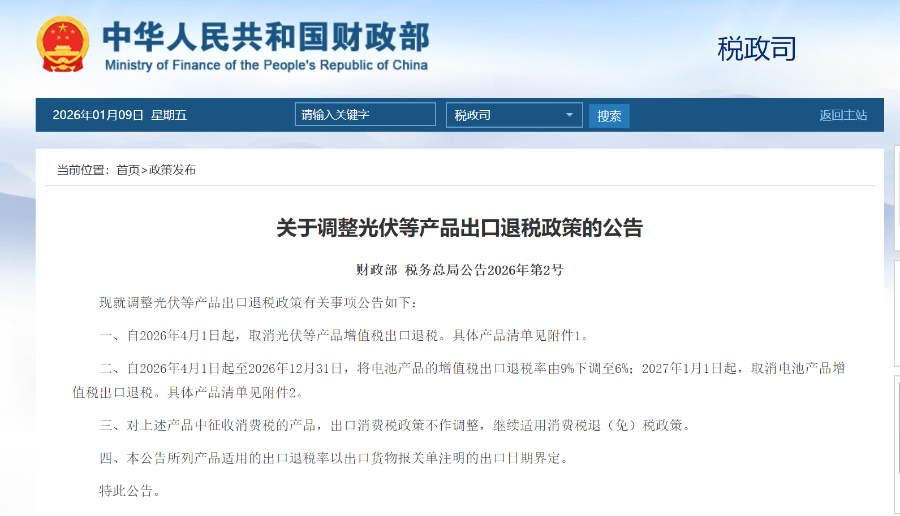
光伏产品出口退税政策调整

Search documents
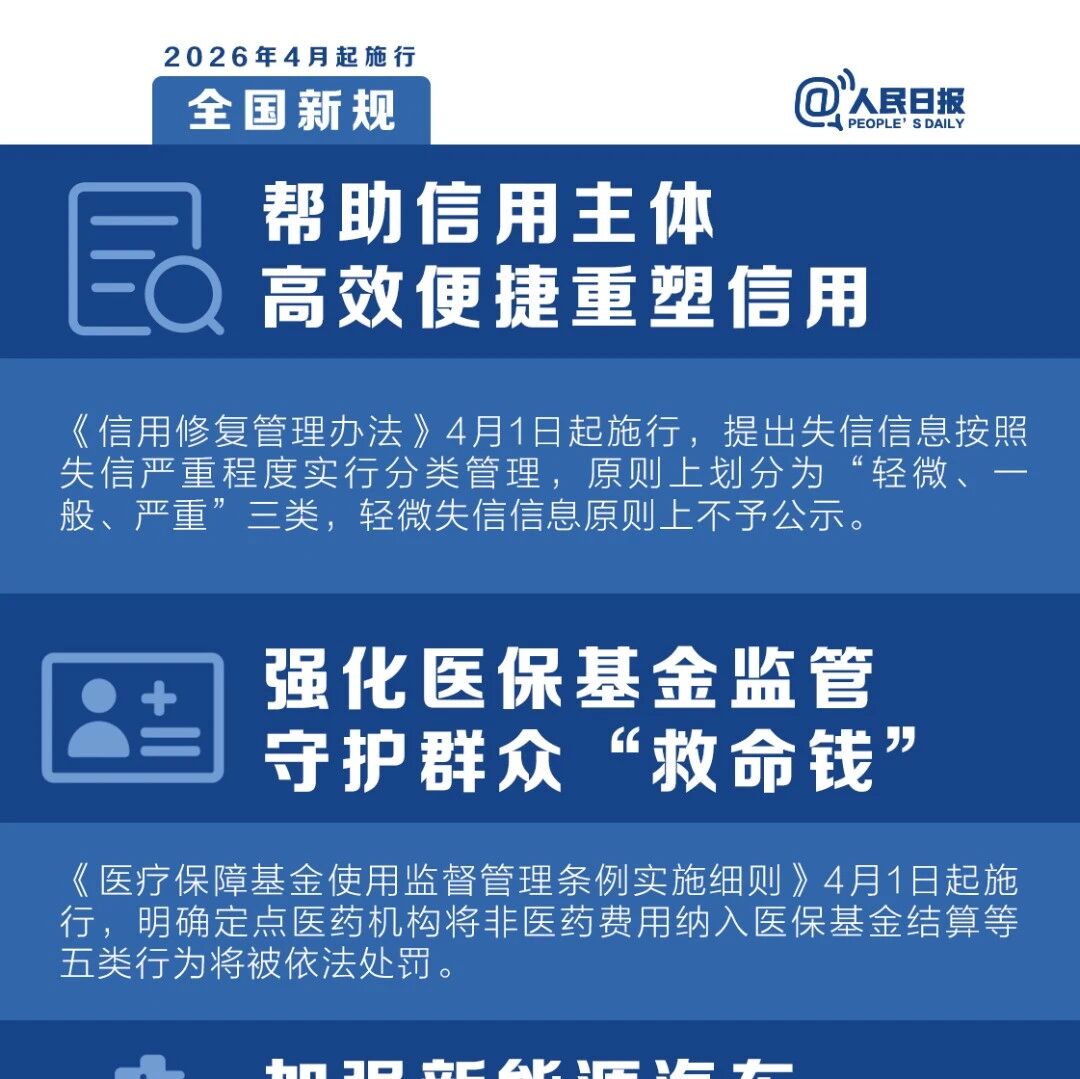
明天起,这些新规将影响你的生活
证券时报· 2026-03-31 02:10
Core Points - The article discusses various new regulations and standards that will take effect on April 1, 2026, aimed at improving different sectors including credit management, healthcare, and environmental sustainability. Group 1: Credit Management - The "Credit Repair Management Measures" will categorize dishonest information based on severity, with minor infractions generally not being publicly disclosed [1]. Group 2: Healthcare - The "Implementation Rules for the Supervision and Management of Medical Security Fund Usage" will impose penalties on designated medical institutions for including non-medical expenses in medical fund settlements [2]. Group 3: Environmental Management - The "Interim Measures for the Recycling and Comprehensive Utilization of Waste Power Batteries from New Energy Vehicles" mandates that battery manufacturers are responsible for the recycling of batteries sold and used within the country [3]. Group 4: E-commerce - A new customs announcement allows cross-border e-commerce companies to handle returns flexibly, without the requirement to return goods to the original export customs [4]. Group 5: Traditional Medicine - The "National Standard for the Classification and Determination of Traditional Chinese Medicine Constitution" will be implemented, providing a basis for various health-related sectors [5]. Group 6: Elderly Care - The "Basic Standards for Life Care Services in Elderly Care Institutions" will enhance the safety and comfort of elderly residents by outlining service requirements and processes [6]. Group 7: Child Welfare - The revised "Management Measures for Child Welfare Institutions" allows qualified institutions to provide services for children with rehabilitation needs [7]. Group 8: Tax Policy - The Ministry of Finance and the State Administration of Taxation announced the cancellation of VAT export rebates for photovoltaic products and a reduction in the rebate rate for battery products from 9% to 6% [8]. Group 9: Infectious Disease Management - The National Health Commission will classify Chikungunya fever and fever with thrombocytopenia syndrome as Category B infectious diseases, implementing corresponding prevention and control measures [9]. Group 10: Local Regulations - Various local regulations will also take effect, including the "Beijing Housing Safety Regulations" which hold property owners responsible for safety [12], and the "Tianjin Electronic Administrative Law Enforcement Certificate" for enhancing transparency in inspections [14].

德业股份股价突破60日线,储能业务与港股上市计划受关注
Jing Ji Guan Cha Wang· 2026-02-11 09:37
Performance Overview - The stock price of the company has shown strong performance, closing at 96.60 yuan on February 11, 2026, with a daily increase of 1.45% and a cumulative increase of 6.92% over the past five trading days, surpassing the 60-day moving average of 86.32 yuan [1] Financial Performance - For the first three quarters of 2025, the company reported revenue of 8.846 billion yuan, representing a year-on-year growth of 10.36%, and a net profit attributable to shareholders of 2.347 billion yuan, up 4.79% year-on-year [1] - The revenue contribution from energy storage inverters reached 41.8%, while energy storage battery packs accounted for 27.5%, indicating an increase in high-margin business contributions [1] Strategic Initiatives - In early 2026, the company submitted a listing application to the Hong Kong Stock Exchange, aiming to raise funds to enhance global production capacity and R&D investment, which is seen as a strategic move to address increasing overseas competition and expand international capital channels [2] Industry Policy and Environment - Starting from April 2026, the export tax rebate policy for photovoltaic products will be gradually phased out, with the current rebate rate of approximately 9% being a significant component of profits. The market is focused on whether the company can mitigate the impact of this policy through cost control or product premium [3] - The growth in household storage demand in markets like Australia, supported by subsidy policies, is expected to bolster the battery pack business [3] Market and Technical Analysis - The stock price has recently broken through the upper Bollinger Band at 96.55 yuan, and the MACD indicator shows a bullish crossover, indicating enhanced short-term momentum [4] - There has been a net inflow of main funds on certain trading days, such as a net inflow of 1.588 million yuan on February 3, with an increase in turnover rate [4]

建信期货多晶硅日报-20260116
Jian Xin Qi Huo· 2026-01-16 01:14
Report Information - Date: January 16, 2026 [2] Industry Investment Rating - Not provided Core View - The policy direction has shifted from anti - involution to anti - monopoly, breaking the strong cost support logic. The adjustment of the export tax - rebate policy for photovoltaic products is negative, and the exchange's risk control remains strict. Although the spot price of polysilicon is high, the fundamentals are weak. With high expected production in January and downstream in the cycle of production cuts, terminal demand is in the off - season, so it is advisable to wait and see [4] Summary by Directory 1. Market Review and Outlook - Market Performance: The polysilicon futures price continued to decline. The closing price of the PS2605 contract was 48,670 yuan/ton, a decrease of 0.38%. The trading volume was 12,703 lots, the open interest was 47,798 lots, with a net decrease of 641 lots. The top twenty long positions had a net decrease of 398 lots, and the top twenty short positions had a net decrease of 769 lots [4] - Spot Price: The transaction price range of polysilicon n - type re - feedstock was 50,000 - 63,000 yuan/ton, with an average transaction price of 59,200 yuan/ton, a week - on - week increase of 9.83%. The transaction price range of n - type granular silicon was 50,000 - 64,000 yuan/ton, with an average transaction price of 55,800 yuan/ton, a week - on - week increase of 10.5% [4] - Future Outlook: The expected production of polysilicon in January is about 100,000 tons, which can meet at least 40GW of terminal demand. The downstream is in the cycle of production cuts, the silver price has risen significantly, squeezing the profit of photovoltaic main products, and the terminal demand is in the off - season. The expected production of silicon wafers, cells, and modules is 46.18GW, 39.06GW, and 31.14GW respectively [4] 2. Market News - On January 15, the number of polysilicon warehouse receipts was 4,560 lots, an increase of 60 lots from the previous trading day [5] - On January 9, the Ministry of Finance announced that from April 1, 2026, the VAT export tax - rebate for photovoltaic products will be cancelled. The current VAT export tax - rebate rate for photovoltaic products is 9%. In 2024, the export tax - rebate rate for photovoltaic products was reduced from 13% to 9% [5]
《关于调整光伏等产品出口退税政策的公告》政策解读
Lian He Zi Xin· 2026-01-15 11:10
Policy Overview - The Ministry of Finance and the State Taxation Administration announced a differentiated adjustment to the export tax rebate policy for photovoltaic (PV) products, effective April 1, 2026, marking a strategic shift from subsidy-driven to market-driven growth[5] - The policy aims to address issues of overcapacity, price competition, and international trade friction in the PV manufacturing industry[4] Short-term Impacts - The export tax rebate for all PV products, including silicon wafers, solar cells, and modules, will be completely eliminated, with the previous 9% rebate rate reduced to 0%[6] - The export volume for polysilicon, silicon wafers, solar cells, and modules in 2024 is projected to be approximately 40,000 tons, 60.9 GW, 58.3 GW, and 236.2 GW, respectively, with module exports accounting for 40.2% of production[9] - The removal of the rebate will increase tax costs for exporting companies, leading to a significant drop in profitability; for example, the profit margin for solar modules will decrease from 7.73% to -0.17%[9] Long-term Effects - The policy is expected to accelerate the exit of less competitive small and medium-sized enterprises (SMEs) from the market, leading to a structural reshaping of the industry[10] - By eliminating reliance on export tax rebates, the industry will shift towards a focus on technology and value-driven competition, enhancing innovation and quality[11] - The market concentration in the PV manufacturing sector is projected to increase, with the CR5 market share for polysilicon, silicon wafers, solar cells, and modules expected to rise to 78%, 77%, 62%, and 63% respectively by 2025[12] Strategic Implications - The adjustment is seen as a proactive measure to mitigate international trade disputes and enhance the global competitiveness of Chinese PV products[13] - Companies with established overseas production capabilities will benefit from the policy, as they can mitigate risks associated with the removal of export rebates and tariffs[12]
航运衍生品数据日报-20260114
Guo Mao Qi Huo· 2026-01-14 03:09
Report Summary 1. Report Industry Investment Rating - Not provided in the given content 2. Core View of the Report - The market is expected to experience a relatively concentrated rush of shipments before April 1st, which will consume the export volume of photovoltaic modules after April next year, and the subsequent export volume will decline. The rush of shipments may temporarily alleviate the decline in freight rates after the holiday, but it is difficult to benefit most shipping companies, and a price war in the off - season is inevitable. The main contract is supported in the short term, but the benefits of the rush of shipments need to be verified. Subsequently, the decline in exports will lead to a contraction in cargo volume, which is suitable for upstream and mid - stream enterprises to conduct short hedging on the 04 contract. The recommended strategy is to wait and see [6][7]. 3. Summary by Related Catalogs 3.1 Shipping Derivatives Data - **Container Freight Index**: The current values of Shanghai Export Container Freight Composite Index (SCFI), China Export Container Freight Index (CCFI), SCFI - US West, SCFIS - US West, SCFI - US East, SCFI - Northwest Europe, SCFIS - Northwest Europe, and SCFI - Mediterranean are 1647, 1195, 2218, 1323, 3128, 1719, 1956, and 3232 respectively. The previous values are 1656, 1147, 2188, 1250, 3033, 1690, 1795, and 3143 respectively. The corresponding percentage changes are - 0.54%, 4.21%, 1.37%, 5.84%, 3.13%, 1.72%, 8.97%, and 2.83% respectively [4]. 3.2 Market News - The US Supreme Court has scheduled Friday as the "judgment day", which will be the first possible time to rule on President Donald Trump's global tariff policy. If the ruling finds Trump's tariffs illegal, it will weaken his iconic economic policy [5]. - Maersk will continue to gradually resume east - west shipping through the Suez Canal and the Red Sea. From January 11th to 12th, Maersk Denver successfully passed the Bab el - Mandeb Strait and entered the Red Sea [5]. 3.3 EC Market - **Market Review**: The market is in a downward trend [6]. - **Spot Price**: In the fourth week of January, Maersk's quotes were differentiated. The Shanghai - Rotterdam route was quoted at $2700/FEU (a month - on - month increase of $100), while the Ningbo - Rotterdam and Shanghai - Gdansk routes dropped to $2400/FEU ( $230 lower than the European base port). Hapag - Lloyd's quote center dropped to $2300 - 2700/FEU. In the OA alliance, the quotes were loose in the first half of January. From January 16th - 22nd, EMC's quote was $2800 - 2950/FEU, still at a high level but with weakened price - holding strength. YML's quote from January 16th - 22nd was $2600/FEU, lower than OA and MSC, and it has not followed Maersk's price cut. MSC's quote in the second half of January was $2840/FEU, the same as the first half, and did not follow Maersk's price cut [6]. - **Logic**: The State Taxation Administration issued an announcement on adjusting the export tax - refund policy for photovoltaic products. Currently, China exports an average of 35,000 - 40,000 TEU of photovoltaic modules to Europe per month, accounting for about 5% of the total export volume on the European route. To avoid losing tax - refund benefits and increasing export costs, enterprises are rushing to ship before the policy takes effect. It is estimated that before April 1st, the additional cargo volume on the European route due to the rush of shipments will be about 30,000 TEU, which will consume the capacity of 2 ships with a capacity of 15,000 TEU. After April, it is expected that the monthly shipping volume on the European route will decrease by 3000 - 4000 TEU, accounting for about 0.4%, putting pressure on the demand for far - month contracts [6].
建信期货多晶硅日报-20260114
Jian Xin Qi Huo· 2026-01-14 01:41
1. Report's Investment Rating for the Industry - No information about the industry investment rating is provided in the report. 2. Core Viewpoints of the Report - The policy has shifted from anti - involution to anti - monopoly, breaking the strong cost - support logic. The adjustment of the export tax - rebate policy for photovoltaic products is a further negative factor. With strict risk control by the exchange, it is recommended to wait and see. Although the spot price of polysilicon is at a high level, the fundamental performance is weak. The expected production of polysilicon in January is about 100,000 tons, which can meet at least 40GW of terminal demand. The downstream has entered a cycle of production cuts. The sharp rise in silver prices has squeezed the profits of photovoltaic main products, and terminal demand is in the off - season. The expected production of silicon wafers, cells, and components is 46.18GW, 39.06GW, and 31.14GW respectively. The spot inventory of polysilicon in the second week of January was 311,800 tons [4]. 3. Summary by Relevant Catalog 3.1 Market Performance - The futures price of polysilicon continued to decline. The closing price of the PS2605 contract was 49,005 yuan/ton, with a decline of 4.45%. The trading volume was 28,379 lots, the open interest was 48,844 lots, with a net increase of 14 lots. The top 20 long positions had a net increase of 172 lots, and the top 20 short positions had a net decrease of 279 lots [4]. 3.2 Spot Prices - The transaction price range of polysilicon n - type re - feedstock was 50,000 - 63,000 yuan/ton, with an average transaction price of 59,200 yuan/ton, a week - on - week increase of 9.83%. The transaction price range of n - type granular silicon was 50,000 - 64,000 yuan/ton, with an average transaction price of 55,800 yuan/ton, a week - on - week increase of 10.5% [4]. 3.3 Market News - On January 13, the number of polysilicon warehouse receipts was 4,460 lots, an increase of 30 lots compared with the previous trading day [5]. - On January 9, the Ministry of Finance's official website released an announcement on adjusting the export tax - rebate policy for photovoltaic and other products. Starting from April 1, 2026, the VAT export tax - rebate for photovoltaic and other products will be cancelled. The current VAT export tax - rebate rate for photovoltaic products is 9%. In November 2015, 2024, the export tax - rebate for photovoltaic products decreased from 13% to 9% [5].
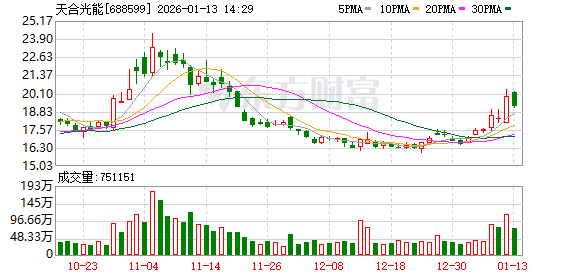
天合光能分布式光伏组件最新报价上调3分/W
Bei Jing Shang Bao· 2026-01-13 06:29
Core Insights - Trina Solar (688599) announced its distributed market guidance price through its WeChat account "Trina Solar Distributed" on January 13, with the lowest component price reaching 0.85 CNY/W, an increase of 0.03 CNY/W compared to the price on January 1 [2] - The Ministry of Finance and the State Administration of Taxation released an announcement on January 9 regarding adjustments to the export tax rebate policy for photovoltaic products, stating that the VAT export rebate for photovoltaic products will be canceled starting April 1 [2] Company Summary - Trina Solar's component pricing reflects a positive trend, with a notable increase in the lowest price per watt [2] - The company's pricing strategy may be influenced by recent policy changes regarding export tax rebates [2] Industry Summary - The cancellation of VAT export rebates for photovoltaic products could impact the overall market dynamics and pricing strategies within the solar industry [2] - The adjustment in export tax policy may lead to increased costs for manufacturers, potentially affecting their competitiveness in international markets [2]

今年4月1日起,光伏产品增值税出口退税取消!
2 1 Shi Ji Jing Ji Bao Dao· 2026-01-09 13:55
Core Viewpoint - The Ministry of Finance announced the cancellation of the VAT export tax rebate for photovoltaic products starting April 1, 2026, which marks the end of the export tax rebate policy for these products [1][2]. Group 1: Policy Changes - From April 1, 2026, the VAT export tax rebate for photovoltaic products will be canceled, and the rebate rate for battery products will be reduced from 9% to 6% until December 31, 2026, after which it will also be canceled [2]. - The previous policy adjustment in November 2024 had already reduced the export tax rebate rate for photovoltaic silicon wafers, batteries, and modules from 13% to 9% effective December 1, 2024 [2]. Group 2: Industry Impact - The China Photovoltaic Industry Association stated that since 2024, the industry has faced intense competition in overseas markets, leading to a "volume increase and price decrease" scenario, where some companies resorted to low-price competition [3]. - The association highlighted that the export tax rebate had effectively turned into a subsidy for foreign markets, resulting in profit losses for domestic companies and increasing the risk of international trade disputes [3]. - The cancellation of the export tax rebate is expected to help stabilize foreign market prices, reduce trade friction risks, and alleviate the financial burden on the state, promoting more efficient allocation of fiscal resources [3].