工商银行

Search documents
头部金店紧急调整回购规则!啥信号?
Xin Lang Cai Jing· 2026-02-08 02:40
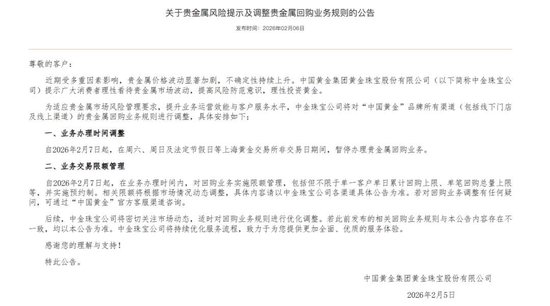
Core Viewpoint - The company, China Gold Group, announced that it will suspend precious metal repurchase services during non-trading days starting February 7, 2026, due to significant price volatility in the precious metals market [1][12]. Group 1: Business Adjustments - Starting February 7, 2026, China Gold will halt precious metal repurchase services on weekends and public holidays when the Shanghai Gold Exchange is closed [1][12]. - The company will implement limit management on repurchase transactions during business hours, including daily repurchase limits per customer and total transaction limits, with a reservation system in place [2][9]. - Other companies, such as Cai Bai Jewelry, will also adjust their precious metal repurchase services similarly, indicating a broader industry trend [9][17]. Group 2: Market Conditions - Precious metal prices have experienced significant fluctuations, with international gold prices rising nearly 15% and silver prices over 8% since the beginning of the year [6][15]. - On February 6, 2026, gold prices saw a drop of over 2% before rebounding to above $4,950 per ounce, while silver prices dropped nearly 10% before recovering to above $77 per ounce [6][15]. - The trading sentiment in the precious metals market has shifted from risk aversion to speculation, increasing trading volatility and valuation risks [18]. Group 3: Company Performance - China Gold's stock price has shown significant volatility, peaking at 14.85 yuan per share on January 30, 2026, a 77.21% increase from 8.38 yuan on January 22, 2026, before falling to 11.42 yuan by February 6, 2026, a decline of 23.1% from the peak [6][15]. - The company has been increasing its gold reserves, reporting 7,419 million ounces at the end of January 2026, up from 7,415 million ounces at the end of December 2025, marking the 15th consecutive month of increases [10][18].

金价:今日金价1110克?不出意外的话,接下来金价可能会重演历史!
Sou Hu Cai Jing· 2026-02-08 02:14
Core Viewpoint - The gold market experienced a historic surge on February 4, 2026, with London gold prices rising by $204.55, a 4.29% increase, reaching $4977.7 per ounce, marking the largest single-day increase since the 2008 financial crisis [1] Group 1: Market Dynamics - The recent surge in gold prices followed a significant drop of 21% in the previous week, indicating a rapid shift from panic selling to aggressive buying within 72 hours, with price fluctuations exceeding $300 [1][3] - The Shanghai Gold Exchange raised margin requirements and expanded price limits, allowing for greater market volatility, which contributed to a 45% increase in COMEX gold trading volume [3] - The current market conditions align with historical bull markets driven by global economic uncertainty, geopolitical conflicts, and loose monetary policies, with active speculative trading amplifying price volatility [5] Group 2: Central Bank Activity - In January 2026, global central banks added a net 1200 tons of gold, with China increasing its gold reserves for 14 consecutive months, indicating a long-term strategic demand rather than short-term speculation [6] - The share of gold in global central bank reserves rose to 20%, surpassing the euro to become the second-largest reserve asset [6] Group 3: Geopolitical and Economic Factors - The surge in gold prices was directly triggered by escalating tensions between the U.S. and Iran, with military incidents prompting safe-haven investments in gold [6] - Weak U.S. employment data reinforced expectations for a Federal Reserve rate cut, contributing to a favorable environment for gold price recovery [6] Group 4: Consumer Behavior and Market Segmentation - The gold market is experiencing structural differentiation, with significant price discrepancies between bank gold bars and retail gold jewelry, exceeding 400 yuan per gram [8] - Traditional gold jewelry sales have declined due to high prices, leading brands to close underperforming stores and shift focus to the high-end market, while artisanal gold products are gaining popularity [9] - The stock market related to gold has seen significant gains, with nearly 30 stocks in the A-share gold concept sector hitting the daily limit, and some companies doubling their stock prices within a month [9] Group 5: Investor Sentiment - Ordinary investors are showing a polarized response, with some queuing to buy gold bars while others are cashing out profits due to rapid price increases, reflecting differing risk perceptions among market participants [11]
部分品牌金店调整回购规则,节假期不能卖金了
Huan Qiu Wang· 2026-02-08 01:20
Group 1 - The core viewpoint of the articles is that major players in the gold market, including China Gold Group and Cai Bai Co., are adjusting their gold buyback policies due to increased volatility and uncertainty in gold prices [1][2] Group 2 - China Gold Group announced on February 6 that it will suspend gold buyback services during non-trading days of the Shanghai Gold Exchange starting February 7 [1] - The company will implement limit management on buyback transactions, including daily limits for individual customers and total limits for single transactions, along with an appointment system [1] - Cai Bai Co. also announced similar adjustments on February 2, including the suspension of buyback services on non-trading days and the implementation of limit management [1] Group 3 - Major commercial banks, such as Industrial and Commercial Bank of China, are also adjusting their gold accumulation services, implementing limit management on weekends and public holidays starting February 7 [2] - The limits will include overall or individual customer daily accumulation/redemption caps and total limits for single transactions, with dynamic settings in place [2]


全省金融“五篇大文章”领域贷款余额6.8万亿元
Da Zhong Ri Bao· 2026-02-08 01:02
Core Viewpoint - The financial sector in Shandong Province has achieved a loan balance of 6.8 trillion yuan in the "Five Major Articles" area, reflecting a year-on-year growth of 16.3%, which is significantly higher than the overall loan growth rate of 8.1% [1][2]. Group 1 - The "Five Major Articles" initiative aims to enhance financial services for high-quality economic development in Shandong Province, with a focus on innovative financial products and service models [2][3]. - By the end of 2025, the loan balance in the "Five Major Articles" sector is expected to reach 6.8 trillion yuan, accounting for nearly 80% of the total loan growth in the province [2]. - Financial institutions in Shandong are actively innovating in areas such as technology finance, green finance, inclusive finance, pension finance, and digital finance, showcasing their contributions to local development [2][3]. Group 2 - The recent conference served as a platform for experience exchange and demonstration, promoting replicable and scalable financial practices in Shandong [3]. - The financial system in Shandong aims to enhance the precision of financial resource allocation to major strategies, key areas, and weak links, thereby improving service quality [3].
紧急调整规则!中国黄金发布公告
证券时报· 2026-02-08 00:09
Core Viewpoint - The article discusses the recent adjustments in precious metal repurchase policies by China Gold and other leading gold retailers due to significant fluctuations in gold prices and increasing market uncertainties [1][3]. Group 1: Company Actions - China Gold announced the suspension of its precious metal repurchase business during non-trading days starting February 7, 2026, to enhance risk management and operational efficiency [1]. - Other companies, such as Caibai Co., also announced similar adjustments to their repurchase policies, including limits on repurchase amounts during operational hours [3]. Group 2: Market Trends - The gold market has experienced notable volatility, with the latest price of gold T+D at 1111 RMB per gram, reflecting a 2.97% increase from the previous trading day, but down 11.47% from a recent high of 1255 RMB per gram [1]. - China Gold's stock price saw significant fluctuations, peaking at 14.85 RMB per share on January 30, 2023, a 77.21% increase from 8.38 RMB per share on January 22, but subsequently fell by 23.1% to 11.42 RMB per share by February 6 [2]. Group 3: Economic Insights - Analysts from CITIC Futures suggest that the current bull market in precious metals is primarily driven by a contraction in dollar credit, indicating a shift in gold's pricing mechanism from interest rate assets to physical currency [4]. - The report highlights that the ongoing rise in debt levels in developed countries and the strengthening trend of de-globalization are contributing to increased demand for gold as a safe-haven asset [4].

省级重点工程及重点民间投资项目融资推介会召开
Xin Lang Cai Jing· 2026-02-07 23:54
1月29日,2026年省级重点工程及重点民间投资项目融资推介会在太原举行。金融机构与15个重点项目 签署融资意向书,意向金额超230亿元,涉及交通、能源、环保、文旅等多个领域。 项目与金融机构推介环节,4家企业介绍了抗癌新药研发、光存储生态等科创绿色项目,国家开发银 行、工商银行、中国银行、浦发银行、山西银行等5家金融机构积极推出专项融资方案,助力重点工程 落地生效。 会议由省发展改革委、省地方金融管理局、省民营经济发展局联合主办,省项目推进中心承办。以"优 化金融要素保障 服务重大项目建设"为主题,会议紧扣省委省政府"重大项目建设年行动"部署,旨在为 全年稳增长注入强劲金融动能。350余位参会嘉宾通过政策解读、项目推介、集中签约、业务培训等环 节,打通信息壁垒,凝聚合作共识。 业务培训环节特别邀请了国家发展改革委专家徐鹏、招商银行专家陆媛分别解读宏观经济政策与新型融 资工具,为项目建设提供理论指导与实践借鉴。(记者姚毅) 据介绍,2026年我省推出629项省级重点工程,总投资超2.4万亿元,年度计划投资2829.3亿元。省发展 改革委相关部门负责人表示,将以更大力度、更实举措推动重大项目建设和民间投资增长。 ...
金价下跌后去哪买金?价差240元暗藏多少消费陷阱?
Sou Hu Cai Jing· 2026-02-07 23:16
Core Viewpoint - The recent fluctuations in gold prices have led to significant changes in the jewelry market, with major brands like Chow Tai Fook and Lao Feng Xiang experiencing sharp declines in their gold prices, reflecting a broader emotional and market-driven response to gold's perceived value and pricing dynamics [1][3]. Group 1: Price Dynamics - International gold prices have seen a dramatic drop, causing domestic gold jewelry prices to fall sharply, with Chow Tai Fook's price dropping to 1482 yuan per gram and Lao Feng Xiang retreating to around 1500 yuan [3]. - In contrast, wholesale markets are offering gold at prices approximately 240 yuan lower than retail, indicating a significant price disparity between retail and wholesale channels [1][5]. Group 2: Consumer Behavior - Consumers are increasingly questioning the value of brand-name gold jewelry versus the intrinsic value of gold itself, as evidenced by the stark price difference between retail and raw gold prices [5]. - The emotional response of consumers is evident, with previous buyers feeling regret over their purchases while potential buyers are torn between excitement and hesitation regarding entry into the market [3][5]. Group 3: Recycling Market - The gold recycling market remains stable, with prices in major cities like Beijing and Shanghai hovering between 1040 to 1060 yuan, suggesting a balance in the market despite retail volatility [5]. - This stability in the recycling market serves as a safety net for gold holders, reinforcing the idea that gold's value extends beyond mere purchasing to include holding and circulation [5]. Group 4: Investment Perspective - For those viewing gold as an asset rather than a decorative item, banks are offering investment gold bars at around 1250 yuan, which eliminates the brand premium and aligns more closely with the concept of gold as a hard currency [6]. - This presents a choice for consumers between paying a premium for aesthetics and brand versus opting for a more straightforward investment approach with lower premiums and higher liquidity [6]. Group 5: Market Reflection - The current market fluctuations provide an opportunity for consumers to reassess their understanding of "true gold" and "value," prompting a more rational approach to purchasing decisions in the gold market [8].
中国黄金回购新规今起实施,周末不能卖金了?
Sou Hu Cai Jing· 2026-02-07 20:05
Core Viewpoint - The recent changes in gold buyback policies by major companies in China, including China Gold Group and Caibai Jewelry, are significantly impacting investors' ability to liquidate their gold investments, particularly during weekends and holidays [1][3]. Group 1: Policy Changes - China Gold Group announced that starting February 7, all offline and online gold buyback services will be adjusted, with buyback operations suspended on weekends and public holidays [1]. - Caibai Jewelry also issued a similar announcement on February 2, halting buyback services on non-trading days and implementing dynamic limits on buyback amounts [3]. - Industrial and Commercial Bank of China (ICBC) announced on January 30 that it would implement limit management for its gold accumulation business starting February 7 [3]. Group 2: Market Reactions - The spot gold price experienced a significant drop of over 2% on February 6, followed by a rebound that pushed it above $4,950 per ounce, marking a nearly 4% increase in a single day [3]. - Year-to-date, international gold prices have risen by nearly 15% [3]. - A surge in customer traffic was observed at Caibai's buyback counters, with queues reaching nearly 200 people, indicating high demand for gold liquidation [3]. Group 3: Buyback Pricing and Costs - China Gold's buyback price is approximately 2 yuan per gram lower than the daily price set by the Shanghai Gold Exchange for its branded gold bars, while non-China Gold products incur a deduction of 5 yuan per gram [5]. - Caibai's buyback standard deducts 3.8 yuan per gram for investment gold bars and 5 yuan per gram for gold jewelry or ornaments [5]. - The purchase of investment gold bars from China Gold incurs an additional fee of 8 yuan per gram, meaning gold prices must rise by more than 10 yuan for investors to recover their costs [5]. Group 4: Market Dynamics and Consumer Behavior - As of January 2026, China's gold reserves stood at 74.19 million ounces, reflecting an increase of 40,000 ounces from the previous month, marking the 15th consecutive month of gold accumulation by the central bank [5]. - Consumers are increasingly cautious, with many comparing prices across different counters and considering the costs associated with gold purchases and sales [5][7]. - The gold buyback market is becoming more complex, with limited channels for non-China Gold products and higher depreciation fees imposed by some gold investment companies [7]. Group 5: Regulatory and Industry Standards - The China Gold Association has previously released standards to regulate the gold recycling market, aiming to enhance service quality and consumer protection [9]. - The recent announcements from China Gold Group emphasize the need for consumers to rationally assess market fluctuations and enhance risk awareness [9].

金价一夜大反转!2月6日全国金店最新价出炉,现在入手到底算不算好时机
Sou Hu Cai Jing· 2026-02-07 18:28
2026年2月6日,对于所有盯着黄金市场的人来说,注定是个难忘的日子。 前一晚还在为暴跌哀嚎,一 觉醒来却发现行情来了个"回马枪",手快的或许庆幸,手慢的只剩懊恼,而更多的人则被彻底搞懵了: 这金价,到底唱的哪一出? 就在2月5日晚上,国际黄金市场还是一片惨淡。 伦敦金现的价格从白天的相对高位一路向下,跌得毫 无阻力,最终单日暴跌超过190美元,收盘价砸到了4815美元/盎司附近,跌幅接近4%。 这种跌幅在近 期的高位震荡中,算得上是一次实实在在的"踩踏"。 国内市场的反应同样迅速。 上海黄金交易所的黄金T D合约,价格跟着国际金价一起跳水,最低探到了 1082元/克左右。 传导到零售端,就是大家最熟悉的金店牌价跟着往下调。 那天晚上,周大福、周大生 这些头部品牌的足金首饰克价,纷纷跌破了1560元关口,老凤祥也回落到了1568元/克。 不少之前在高 位买入,指望着"黄金永远涨"的投资者,心态开始崩了,有些人甚至忍痛割肉离场。 然而,市场的剧本在2月6日清晨被彻底改写。 从凌晨开始,伦敦金现的价格像被一只无形的手猛地托 起,从4815美元附近启动,短短四个小时里,一路狂飙超过160美元,最高冲到了4980美元 ...

今日金价,黄金、白银、铂金、钯金全线收涨,国际金价单日暴涨,国内金店价格却纹丝不动
Sou Hu Cai Jing· 2026-02-07 17:41
Core Viewpoint - The global precious metals market experienced a significant reversal on February 7, 2026, with gold prices reaching $4962.65 per ounce, marking a more than 5% increase, the largest single-day rise since the 2008 financial crisis. Silver prices surged over 10%, surpassing $79 per ounce, while domestic gold consumption remained stable, highlighting a disconnect between international and local market perceptions [1][3]. Group 1: Market Dynamics - The international precious metals market saw widespread gains, with platinum prices rising over 8% to around $2450 per ounce, and palladium also recording significant increases. The trading volume of gold futures surged by 45%, indicating that institutional investors were repositioning rather than retail investors [3]. - Domestic gold prices showed a mixed response, with the Shanghai Gold Exchange's gold T+D product increasing by 2.19% to 1104.00 yuan per gram, while bank investment gold bars saw a decline, reflecting a complex pricing mechanism influenced by brand premiums and operational costs [3][11]. - The pricing strategy of brand gold stores reinforces the independence of domestic gold prices, with significant premiums over the international gold price due to brand image and cultural recognition [11][13]. Group 2: Economic Influences - Weak economic data, particularly a lower-than-expected private sector job growth in the U.S., dampened expectations of an overheating economy and prolonged high interest rates, leading to a decline in the U.S. dollar index and making gold an attractive safe-haven asset [5]. - Geopolitical tensions, particularly between U.S. forces and Iranian-backed groups, have heightened market risk aversion, contributing to the demand for gold as a hedge against uncertainty [5][10]. - The recent technical rebound in gold prices was driven by short covering and opportunistic buying after a significant drop in late January, indicating a volatile market sentiment [6]. Group 3: Structural Changes - The gold market is undergoing a structural shift, with central banks increasing their gold reserves significantly, as evidenced by a net purchase of 53 tons in October 2025, reflecting a long-term strategic shift away from the dollar [8][19]. - The demand for gold jewelry in China is evolving, with younger consumers driving new trends and redefining gold as a financial product rather than just a traditional gift [10][16]. - The volatility in the precious metals market has reached historical highs, prompting banks to increase margin requirements and risk management measures to mitigate the impact of price fluctuations [8][16]. Group 4: Future Outlook - Major investment banks have adjusted their gold price forecasts, with Goldman Sachs raising its 2026 target price to $5400 per ounce, indicating strong bullish sentiment despite potential economic downturns [19]. - The traditional negative correlation between the U.S. dollar index and gold prices is changing, as gold is increasingly viewed as a strategic asset for hedging against sovereign credit risks [17][19]. - The current market dynamics suggest a complex interplay of various investor types, including quantitative funds and retail investors, which complicates the overall market behavior and pricing strategies [19].