名创优品

Search documents
知名经济学家杜帅评论:通过春晚广告商矩阵,解码2026中国经济新流向
Sou Hu Cai Jing· 2026-02-21 14:43
Core Insights - The 2026 Spring Festival Gala serves as a significant indicator of China's economic transformation, showcasing a shift from traditional advertising to a more integrated approach where brands and content coexist harmoniously [3][10] - The sponsorship landscape reflects a trend of "technology taking center stage, traditional industries enhancing quality, and diversified consumption," indicating the current strength and future direction of the Chinese economy [3][5] Group 1: Sponsorship Dynamics - The 2026 Spring Festival Gala achieved a record total reach of 23.063 billion across all media platforms, attracting over 28 brands from various sectors including AI technology, smart transportation, and consumer goods [3][6] - The sponsorship system has become more refined and strategic, with exclusive rights being secured by leading brands, marking a transition from broad naming rights to specialized collaborations [3][5] - Notable participation from robotics companies, such as Yushutech and Magic Atom, transformed the gala into a "hardcore technology show," highlighting the deep integration of technology into mainstream entertainment [3][6] Group 2: Economic Trends - The shift towards "technology taking center stage and consumption upgrading" is a key observation for understanding the economic trends in 2026, with traditional industries optimizing their structures while retaining only top brands [5][6] - The emergence of brands like Miniso and card game companies as official partners signifies a cultural and emotional shift in consumer behavior, moving beyond mere material satisfaction to include cultural identity and emotional connection [6][7] - The automotive sector, represented by Great Wall Motors and the collaboration between JAC and Huawei, underscores the successful transition of the new energy vehicle industry from policy-driven to market-driven dynamics [6][7] Group 3: Capital Flow and Market Sentiment - Eight listed companies participated in the gala, including Wuliangye, Yanghe, and Bilibili, reflecting a shift in investment logic from traditional defensive strategies to technology-driven growth [7][9] - The presence of leading liquor brands demonstrates the resilience of the Chinese economy, while companies in smart transportation and new consumption sectors leverage the gala for brand expansion, indicating a commercial turning point [7][9] - The overall sponsorship landscape encapsulates the confidence in China's economic development, showcasing advancements in AI, high-end manufacturing, and consumer upgrades [9][10]


【兴证策略张启尧团队】2026年出海链有哪些投资机会?
Xin Lang Cai Jing· 2026-02-21 01:42
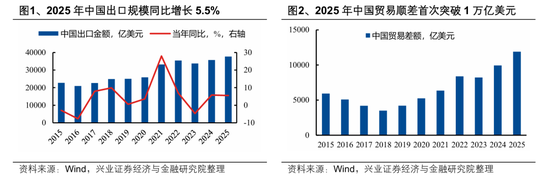
Group 1 - In 2025, China's foreign trade showed strong resilience, with total exports reaching a historical high, growing by 5.5% year-on-year, despite a complex external environment [1][57] - China's trade surplus exceeded $1 trillion for the first time, marking a significant increase of 19.8% year-on-year [1][57] - The net export of goods and services contributed 1.64 percentage points to GDP growth, the second-highest level since 2007, only behind 2021 [3] Group 2 - The diversification of external demand has strengthened, with emerging markets compensating for the decline in exports to the US, which fell by 19.79% year-on-year [6] - Exports to ASEAN, Africa, and the Middle East saw significant growth rates of 25.9%, 13.64%, and 9.7% respectively, contributing positively to the overall export scale [6] - The share of US exports in China's total exports decreased by 3.53 percentage points to 11.15% [6] Group 3 - The product structure of China's foreign trade is shifting towards higher value chains, with high-end products like electrical machinery, machinery, automobiles, and ships being the main export drivers [8] - Traditional light industrial products such as furniture and toys have seen a decline in export scale due to tariff friction and industrial chain relocation [8] Group 4 - The restructuring of global supply chains is creating significant opportunities for Chinese companies, with a notable increase in the number of Chinese enterprises establishing production capacities abroad, reaching 229 in 2025, nearly doubling from 2024 [18] - ASEAN, Mexico, and India are the primary destinations for Chinese production capacity outflows, with ASEAN covering a wide range of industries [18] Group 5 - The AI expansion cycle is a core focus in the Chinese capital market, with significant growth expected in AI computing hardware, supported by macro investment scales and healthy balance sheets of major tech companies [29][30] - The capital expenditure of major cloud service providers is projected to increase significantly, reflecting strong demand for AI computing [35] Group 6 - Cultural and technological value output is becoming a major trend for Chinese enterprises going abroad, with significant growth in IP exports and innovative products in sectors like gaming and new dining [39][41] - The Chinese innovative pharmaceutical sector is increasingly integrated into the global supply chain, with more products commercialized in the US and Europe [41] Group 7 - Key sectors with strong overseas expansion opportunities in 2026 include new energy (batteries, grid equipment), machinery, TMT (technology, media, telecommunications), and innovative pharmaceuticals [46] - The gaming industry is also highlighted for its potential, with significant overseas revenue growth expected [49]




名创优品与央视春晚合作,品牌营销与渠道拓展并举
Jing Ji Guan Cha Wang· 2026-02-20 22:29
Group 1 - The core focus of the company is on brand marketing and channel expansion, highlighted by its partnership with the CCTV Spring Festival Gala to enhance brand influence and drive sales of IP products [1] - The company has launched a new flagship store format called "Super Miniso" in Nanjing, opening two stores to strengthen immersive shopping experiences, aligning with its strategy of "opening large and well-operated stores" [1] Group 2 - The company has recently conducted share buybacks, signaling confidence in its stock. On February 20, 2026, it repurchased 52,600 shares for HKD 1.996 million at a price range of HKD 37.76-37.86 per share, following a previous buyback of 800 shares for HKD 30,300 on February 16 [2] - As of February 20, 2026, the company's stock closed at HKD 37.92, with a daily decline of 2.77% and a minor fluctuation of -0.32% over the past five days, with a total trading volume of approximately HKD 109 million during the period from February 16 to 20 [2]
名创优品(09896)2月20日斥资199.59万港元回购5.26万股
智通财经网· 2026-02-20 10:51
Group 1 - The company Miniso (09896) announced a share buyback plan, intending to repurchase 52,600 shares at a cost of HKD 1.9959 million [1]
名创优品(09896) - 翌日披露报表
2026-02-20 10:35
FF305 翌日披露報表 (股份發行人 ── 已發行股份或庫存股份變動、股份購回及/或在場内出售庫存股份) 表格類別: 股票 狀態: 新提交 公司名稱: 名創優品集團控股有限公司 呈交日期: 2026年2月20日 如上市發行人的已發行股份或庫存股份出現變動而須根據《香港聯合交易所有限公司(「香港聯交所」)證券上市規則》(「《主板上市規則》」)第13.25A條 / 《香港聯合交易所有限公司GEM證券 上市規則》(「《GEM上市規則》」)第17.27A條作出披露,必須填妥第一章節 。 | 第一章節 | | | | | | | | | --- | --- | --- | --- | --- | --- | --- | --- | | 1. 股份分類 | 普通股 | 股份類別 | 不適用 | | 於香港聯交所上市 | 是 | | | 證券代號 (如上市) | 09896 | 說明 | | | | | | | A. 已發行股份或庫存股份變動 | | | | | | | | | | | | 已發行股份(不包括庫存股份)變動 | | 庫存股份變動 | | | | | 事件 | 已發行股份(不包括庫存股份)數 目 | 佔有關 ...
名创优品(09896)2月19日耗资4524美元回购928股
Zhi Tong Cai Jing· 2026-02-20 04:17
Group 1 - The company Miniso (09896) announced a share buyback plan, spending $4,524 to repurchase 928 shares on February 19, 2026 [1]
名创优品(09896) - 翌日披露报表
2026-02-20 04:05
FF305 翌日披露報表 (股份發行人 ── 已發行股份或庫存股份變動、股份購回及/或在場内出售庫存股份) 表格類別: 股票 狀態: 新提交 公司名稱: 名創優品集團控股有限公司 呈交日期: 2026年2月20日 如上市發行人的已發行股份或庫存股份出現變動而須根據《香港聯合交易所有限公司(「香港聯交所」)證券上市規則》(「《主板上市規則》」)第13.25A條 / 《香港聯合交易所有限公司GEM證券 上市規則》(「《GEM上市規則》」)第17.27A條作出披露,必須填妥第一章節 。 (註7) | 第一章節 | | | | | | | | | --- | --- | --- | --- | --- | --- | --- | --- | | 1. 股份分類 | 普通股 | 股份類別 | 不適用 | | 於香港聯交所上市 | 是 | | | 證券代號 (如上市) | 09896 | 說明 | | | | | | | A. 已發行股份或庫存股份變動 | | | | | | | | | | | | 已發行股份(不包括庫存股份)變動 | | 庫存股份變動 | | | | | 事件 | 已發行股份(不包括庫存股份)數 目 ...
名创优品(09896) - 翌日披露报表
2026-02-19 10:05
FF305 翌日披露報表 (股份發行人 ── 已發行股份或庫存股份變動、股份購回及/或在場内出售庫存股份) 公司名稱: 名創優品集團控股有限公司 呈交日期: 2026年2月19日 如上市發行人的已發行股份或庫存股份出現變動而須根據《香港聯合交易所有限公司(「香港聯交所」)證券上市規則》(「《主板上市規則》」)第13.25A條 / 《香港聯合交易所有限公司GEM證券 上市規則》(「《GEM上市規則》」)第17.27A條作出披露,必須填妥第一章節 。 | 第一章節 | | | | | | | | | --- | --- | --- | --- | --- | --- | --- | --- | | 1. 股份分類 | 普通股 | 股份類別 | 不適用 | | 於香港聯交所上市 | 是 | | | 證券代號 (如上市) | 09896 | 說明 | | | | | | | A. 已發行股份或庫存股份變動 | | | | | | | | | | | | 已發行股份(不包括庫存股份)變動 | | 庫存股份變動 | | | | | 事件 | 已發行股份(不包括庫存股份)數 目 | 佔有關事件前的現有已發 行股份(不包括庫 ...
春晚的广告牌 印刻着中国经济的一次次跃迁
Nan Fang Du Shi Bao· 2026-02-17 15:27
Core Insights - The sponsorship history of the CCTV Spring Festival Gala reflects China's economic development and industrial upgrades over the past four decades, showcasing three major transitions: from basic needs to consumer electronics and automobiles, from virtual economy to hard technology, and from demographic dividend to engineer dividend [1][2]. Group 1: Historical Sponsorship Trends - In the 1980s, the main sponsors represented basic household needs, with brands like 康巴丝 leading the way, highlighting the public's desire for precision and the prosperity of light industry [1]. - The 1990s saw a shift towards quality consumption, with liquor brands and home appliance giants like 美的集团 becoming prominent sponsors, marking a transition from survival to quality-focused consumption [1]. Group 2: The Rise of Internet and Technology - The year 2015 marked a turning point with the emergence of internet giants like WeChat and Alipay, initiating a "red envelope war" that transformed user engagement and payment methods [2]. - As the internet traffic peaked, the focus shifted to hard technology, with a notable increase in sponsorship from the electric vehicle sector, indicating a fundamental shift in China's competitive edge from demographic to engineer dividends [2]. Group 3: Future Trends and Cultural Consumption - The upcoming 2026 Spring Festival Gala will feature new partnerships with brands like 名创优品 and 卡游, suggesting a potential shift towards "emotional value" and "cultural consumption" as new wealth drivers in a mature market [3]. - The evolution of sponsors serves as a "value anchor" migration, reflecting China's economic transitions from production capabilities to creative intelligence, providing a lens to observe the pulse of the times [3].
经济越来越差,这八大行业越赚爆!
创业家· 2026-02-17 09:22
Core Insights - The article discusses how certain industries are thriving despite a general perception of economic downturn, highlighting eight key sectors that present significant business opportunities in a low-desire society [3][4]. Group 1: Key Industries - **Second-Hand Economy**: The second-hand luxury market in Japan, represented by companies like Daikokuya, has seen a surge in revenue. In China, platforms like Hongbulin and Panghu are experiencing similar growth, indicating a shift in consumer spending towards second-hand goods [6][7][8][9]. - **Pet Economy**: With declining birth rates, young people are spending more on pets, leading to significant growth in pet food and healthcare products. Companies like Inaba in Japan and Guobao in China are capitalizing on this trend [11][12][14][15]. - **Adult Care Products**: The adult diaper market in Japan has surpassed $10 billion, indicating a growing demand for adult care products in China, with companies like Kexin poised for growth [16][17][18]. - **Health Food and Beverages**: The rise in health consciousness has led to increased demand for sugar-free beverages and functional drinks, with brands like Dongfang Shuye and Jianchun gaining traction in China [21][22]. - **Beauty Economy**: The demand for beauty products, including collagen supplements and at-home beauty devices, is on the rise, with companies like Jinbo Bio and U like seeing significant sales growth [23][25]. - **Outdoor Recreation**: The outdoor equipment market is booming, with brands like Kailas and Camel experiencing rapid sales growth as consumers seek leisure activities [25][26][27]. - **Emotional Economy**: Products that provide emotional comfort, such as low-alcohol beverages and lifestyle brands, are gaining popularity, reflecting a dual consumer behavior of frugality and indulgence [28][29][30]. - **Convenience Economy**: The demand for convenience foods and smart home appliances is increasing as younger generations spend less time cooking. Brands like Anjijia and Kewotai are seeing steady growth [33][35][36]. Group 2: Market Trends - The article emphasizes that the current economic climate, often viewed as a "winter," presents opportunities for those willing to invest in counter-cyclical sectors [39]. - It suggests that the key to success in a low-desire society is to identify and capitalize on emerging trends and consumer needs, rather than retreating from the market [39].