三星

Search documents
破釜沉舟!特斯拉斥资200亿美元将工厂改建机器人产线,马斯克:80%价值靠他它实现
Zhi Tong Cai Jing· 2026-01-30 03:37
Core Viewpoint - Tesla is shifting its focus from electric vehicles to robotics, planning to invest $20 billion this year to support this transformation, indicating a significant pivot in its business strategy [1][2]. Group 1: Financial Performance and Investment Plans - Tesla's capital expenditure decreased by 24% to $8.6 billion last year, but it is projected to more than double to over $20 billion by 2026 as the company transitions towards artificial intelligence and robotics [1][3]. - The automotive revenue, which constitutes about 70% of Tesla's business, is expected to decline by 10% in 2025 due to the lack of new electric vehicle models and increased competition, particularly from BYD in China and Volkswagen and BMW in Europe [2]. Group 2: Product Development and Future Vision - Tesla plans to end production of the Model S and Model X, which accounted for less than 3% of total deliveries last year, to repurpose the Fremont factory for producing the Optimus robot [2][4]. - Elon Musk envisions that Optimus could eventually make Tesla a $25 trillion company, with 80% of its value derived from robotics [2]. Group 3: Technological Challenges and Competition - The company faces significant competition in both robotics and autonomous driving, with rivals like Waymo and Baidu expanding their services [5]. - Tesla is also planning to establish a large-scale chip manufacturing facility, TeraFab, to ensure it can meet its hardware needs and mitigate geopolitical risks [6]. Group 4: Expansion of Services - Tesla aims to expand its Robotaxi fleet in the U.S. and is testing a fully autonomous ride-hailing service in Austin, Texas, with plans to extend this service to seven additional markets [4].


阿里“通云哥”概念亮相;贵州茅台辟谣参与SpaceX融资
2 1 Shi Ji Jing Ji Bao Dao· 2026-01-30 03:28
Group 1: Technology Sector Developments - Alibaba's "Tongyun Ge" concept integrates "Cloud + AI + Chips" as a strategic support triangle for future technology initiatives, emphasizing AI as a core driver of change in cloud computing over the next decade [2] - ByteDance's CEO Liang Rubo announced the company's 2026 focus on "climbing to new heights," highlighting the importance of AI opportunities and the need to enhance talent density and incentives [5] - Waymo plans to launch fully autonomous ride-hailing services in London by Q4 2023, expanding its operations internationally despite regulatory challenges [7] Group 2: Market and Company News - Guizhou Moutai denied rumors of participating in SpaceX's Series A funding, with its stock closing at 1437.72 yuan per share, up 8.61%, and a market capitalization exceeding 1.8 trillion yuan [3] - Byte's new "Doubao" smartphone is expected to be released in late Q2 2026, with significant improvements over its predecessor, developed in collaboration with ZTE Nubia [4] - Meituan's new "one-shot" verification feature requires new restaurant partners to upload unedited videos showcasing their premises, aimed at enhancing platform integrity [8] Group 3: Industry Collaborations - Black Sesame Intelligence and Baidu's "萝卜快跑" signed a strategic cooperation agreement to develop a collaborative ecosystem for autonomous driving, focusing on technology research and product development [11] - Shanghai Xixi Intelligent Technology completed several million yuan in angel financing, aimed at integrating AI with flexible robotics for food processing solutions [12] Group 4: Consumer Electronics - Apple's iPhone 16 was the best-selling smartphone globally in 2025, with Apple and Samsung dominating the top ten list, holding seven and three positions respectively, indicating strong market leadership [10]



2026年成eSIM「爆发元年」:iPhone Air降价,联通强推,手机厂商集体入局
3 6 Ke· 2026-01-30 03:26
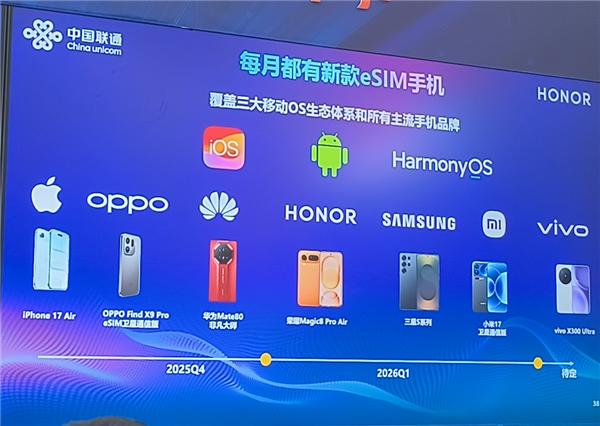
Core Insights - Apple unexpectedly announced a price drop for the iPhone Air, with the 256GB version reduced from 7999 yuan to 5499 yuan after discounts, leading to a rapid sell-out and delayed shipping dates [1] - The iPhone Air's sales were below expectations, with only around 200,000 activations, significantly lower than other models in the iPhone 17 series, primarily due to consumer resistance to eSIM technology [1] Group 1: eSIM Market Dynamics - China Unicom announced plans to launch at least one new eSIM-supported device each month in 2026, indicating a significant push for eSIM adoption [3][4] - The eSIM technology is expected to see a surge in user numbers in 2026, driven by the simultaneous readiness of key industry players, including manufacturers and carriers [6][10] - The first batch of eSIM-supported devices confirmed for release includes models from major brands like Samsung, Xiaomi, and Vivo, highlighting a collective industry shift towards eSIM [4][6] Group 2: Industry Challenges and Opportunities - The transition to eSIM is not merely a technical upgrade but involves significant changes in device design and user experience, which has made manufacturers cautious in the past [7] - The current competitive landscape among carriers is shifting, as traditional user acquisition strategies become less effective due to market saturation, making eSIM a potential new battleground for growth [10][13] - eSIM technology allows for more flexible device designs and reduces the risk of SIM card theft, which could enhance user convenience and attract tech-savvy consumers [12][13] Group 3: Future Outlook - The year 2026 is positioned as a turning point for the mobile communication market, with eSIM transitioning from a niche feature to a standard requirement in new devices [15] - The successful implementation of eSIM services will depend on how well carriers and manufacturers can streamline the user experience and support services [15]


高世代线“第三条路”:维信诺ViP技术如何为中国显示破局?
Jin Rong Jie· 2026-01-30 03:25
Core Viewpoint - The Chinese display industry has transitioned from a reliance on imported technology to becoming a global leader, with a focus on achieving self-sufficiency in high-end OLED technology and supply chains [1][12]. Group 1: Industry Development - The Chinese OLED panel shipment share is projected to reach 48.8% by 2025, nearly matching South Korea, but there is still room for improvement in core equipment and processes for large-sized high-end markets [1][12]. - The competition in high-generation lines is crucial for penetrating the mid-to-large size market, with two main technological paths: traditional evaporation using Fine Metal Masks (FMM) and the "no FMM" route [3][4]. - The traditional evaporation method is mature in small-to-medium sizes but faces significant challenges in larger sizes due to equipment monopolies and cost issues [3][4]. Group 2: Technological Innovation - The introduction of ViP technology by Visionox represents a significant shift, allowing for the replacement of traditional evaporation processes with semiconductor lithography, thus eliminating dependence on FMM [6][7]. - ViP technology enhances pixel independence and significantly increases effective luminous area from 29% to 69%, improving lifespan and brightness metrics [8][10]. - The ViP production line offers flexible manufacturing capabilities, allowing for a wide range of products and customization, which enhances resilience against market fluctuations [8][11]. Group 3: Strategic Implications - Visionox's advancements mark a transition from following to leading in high-end OLED technology, establishing a critical testing ground for domestic equipment and materials [10][11]. - The company's comprehensive innovation system, from basic research to mass production, is fostering a new industry chain and enhancing the localization of core materials [11][12]. - The shift in focus from scale expansion to value creation and ecosystem building reflects the evolving logic of the Chinese display industry amid increasing global competition [12][13].


Omdia:苹果手机2025年出货超2.4亿部创新高,vivo首次跻身全球第四
Feng Huang Wang· 2026-01-30 03:15
Group 1 - Apple achieved a record annual shipment of 240.6 million iPhones in 2025, marking a 7% year-on-year increase and maintaining its position as the global leader for the third consecutive year [5] - In Q4, Apple set a new quarterly shipment record, with a 26% year-on-year growth in the Chinese mainland market, driven primarily by demand for the iPhone 17 series [5] Group 2 - Xiaomi shipped 165.4 million units in 2025, retaining its position as the third-largest global smartphone manufacturer, although its Q4 shipments declined by 2% [6] - Vivo entered the global top four for the first time with shipments of 105.3 million units, reflecting a 4% year-on-year growth [6] - OPPO shipped 100.7 million units, experiencing a 3% year-on-year decline, but returned to growth in Q4 due to new product launches [6] Group 3 - The report indicates that rising costs of key components and memory chips at the end of the year have begun to suppress shipment expectations for 2026 [6] Group 4 - In 2025, the market share of the top ten global smartphone manufacturers was as follows: Apple 19%, Samsung 19%, Xiaomi 13%, Vivo 8%, OPPO 8%, Transsion 8%, Honor 6%, Lenovo 5%, Huawei 4%, and Realme 3% [7]
设备占比较高的半导体设备ETF易方达(159558)最新单日资金净流入1.62亿元,技术产业化进程加速,先进封装迎来国产化落地兑现期
Xin Lang Cai Jing· 2026-01-30 02:42
资金流入方面,半导体设备ETF易方达(159558)最新资金净流入1.62亿元。拉长时间看,近5个交易日内 有4日资金净流入,合计"吸金"3.77亿元。 财通证券指出,随着摩尔定律趋近极限,芯粒集成成为提升AI芯片性能的核心路径,英伟达 Hopper/Blackwell系列GPU及博通主力AI芯片均已采用2.5D/3DIC方案;当前全球80%以上2.5D产能集中 于台积电、英特尔与三星,而国内长电科技XDFOI工艺已进入量产,通富微电南通基地推进2D+先进封 装升级,华天科技完成2.5D/3D产线通线,甬矽电子HCOS平台进入客户验证阶段,盛合晶微拟募资建 设覆盖2.5D/3D Package的规模化产能,2026年有望成为国产先进封装从小批量向大规模扩张的起点。 截至1月29日,半导体设备ETF易方达(159558)近1月规模增长31.86亿元,实现显著增长。半导体设备 ETF易方达(159558)最新份额达21.80亿份,创成立以来新高。 截至2026年1月30日 10:22,半导体设备ETF易方达(159558)盘中换手2.39%,成交1.12亿元。 相关标的:半导体设备ETF易方达(159558,A/ ...
和讯投顾方荣霞:贵金属,商业航天,半导体的风险和机会?
Sou Hu Cai Jing· 2026-01-30 02:41
别再幻想商业航天的二波行情,贵金属也坚决不要再追高,半导体才是接下来最该聚焦布局的核心方 向。为何说商业航天和贵金属两大板块当下坚决不能碰,仅仅是因为涨幅过高吗?当然不是,一分钟为 大家讲透核心逻辑。第一,从涨幅来看,商业航天上个月涨幅达 26%,看似行情亮眼,而贵金属板块 截至今日本月涨幅更是飙升至 114%,已然涨至高位,且今日板块内部分歧已明显显现,这个节点高位 进场,无异于送人头。第二,贵金属板块存在严重的涨幅透支问题,黄金期货本月仅上涨 28%,但贵 金属板块涨幅却达到 114%,板块涨幅与标的基本面完全不匹配,未来的行情早已被提前透支,后续缺 乏持续上行动力。第三,黑天鹅风险拉满,回顾 10 月 21 号的行情,黄金期货单日下跌 5%,次日贵金 属板块便直接大跌 7%,当下的位置,说白了就是暗藏风险的雷区。 那为何半导体必须重点布局?三大硬核利好持续发酵,每一个都极具支撑力。第一,存储芯片行情彻底 爆发,美光、闪迪等海外龙头股价天天创新高,海外强势走势下,A 股存储芯片板块具备极强的跟涨预 期。第二,三星放出大招,直接将存储产品售价上调一倍,提价幅度远超市场预期,这一动作将带动整 个存储产业链迎来 ...
200+企业集结,AI巨头同台竞演!CES Asia2026打造亚洲科技产业新坐标
Sou Hu Cai Jing· 2026-01-30 02:39
Core Insights - CES Asia 2026 will be held in Beijing from June 10 to 12, 2026, focusing on building a global AI technology showcase and cross-industry collaboration hub [2] - Over 200 companies from 28 countries and regions will participate, with international exhibitors accounting for over 40%, creating a top-tier innovation matrix in the Asian tech industry [3] Industry Trends - The exhibition will highlight three core breakthrough areas: large model innovation, embodied intelligence, and cross-industry integration, showcasing cutting-edge AI technologies and application results [4] - The event will feature the first compliant results following the implementation of China's national standard for large AI models, with major models like Huawei's Pangu and iFlytek's Spark being presented [4] Company Highlights - Major companies such as NVIDIA will showcase their new AI chip solutions based on the Blackwell architecture, while SK Telecom will present its 519 billion parameter "A.X K1 teacher model" [3] - Huawei will demonstrate its latest 5G+AI industrial solutions, which have achieved large-scale cooperation across multiple industries, significantly enhancing production efficiency [3] Collaboration Opportunities - CES Asia 2026 aims to create a comprehensive cross-industry cooperation system covering technology, capital, and market, with over 50 international professional purchasing groups expected to attend [6] - The event will host over 50 high-end parallel forums, inviting global tech leaders and industry experts to discuss the integration paths of AI with various sectors [6] Market Positioning - The exhibition is positioned as a strategic opportunity for companies to secure market positioning in the competitive global AI landscape, with over 80% of core exhibition spaces already booked [7] - The event serves as a critical platform for global tech companies to connect with the Asian market and achieve value growth, potentially reshaping the competitive landscape of the Asian AI industry [7]


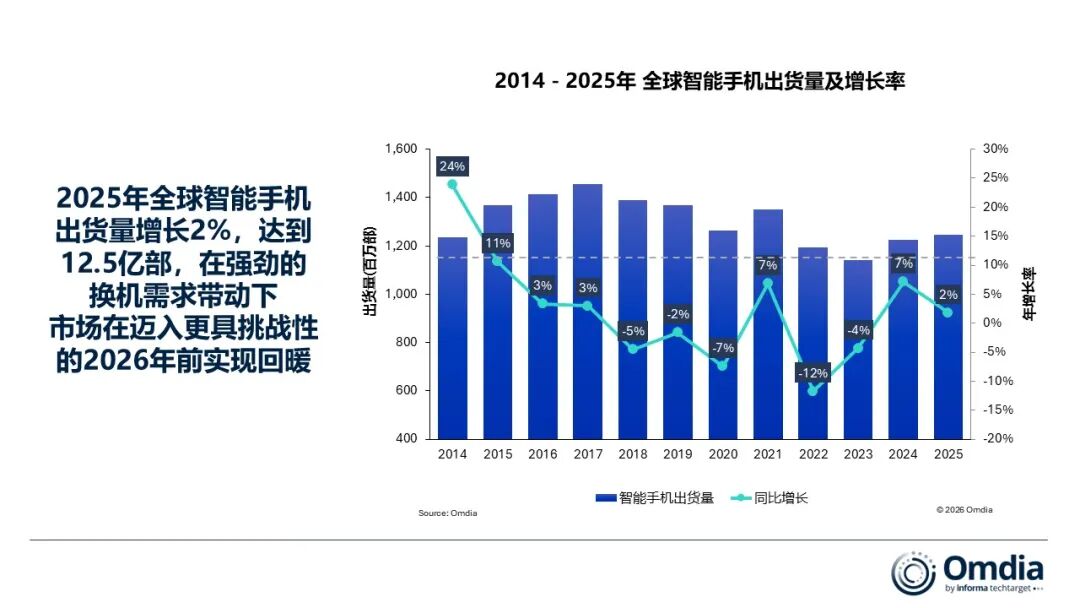
Omdia:2025年全球智能手机出货量增长2% 达到12.5亿部
Zhi Tong Cai Jing· 2026-01-30 01:41
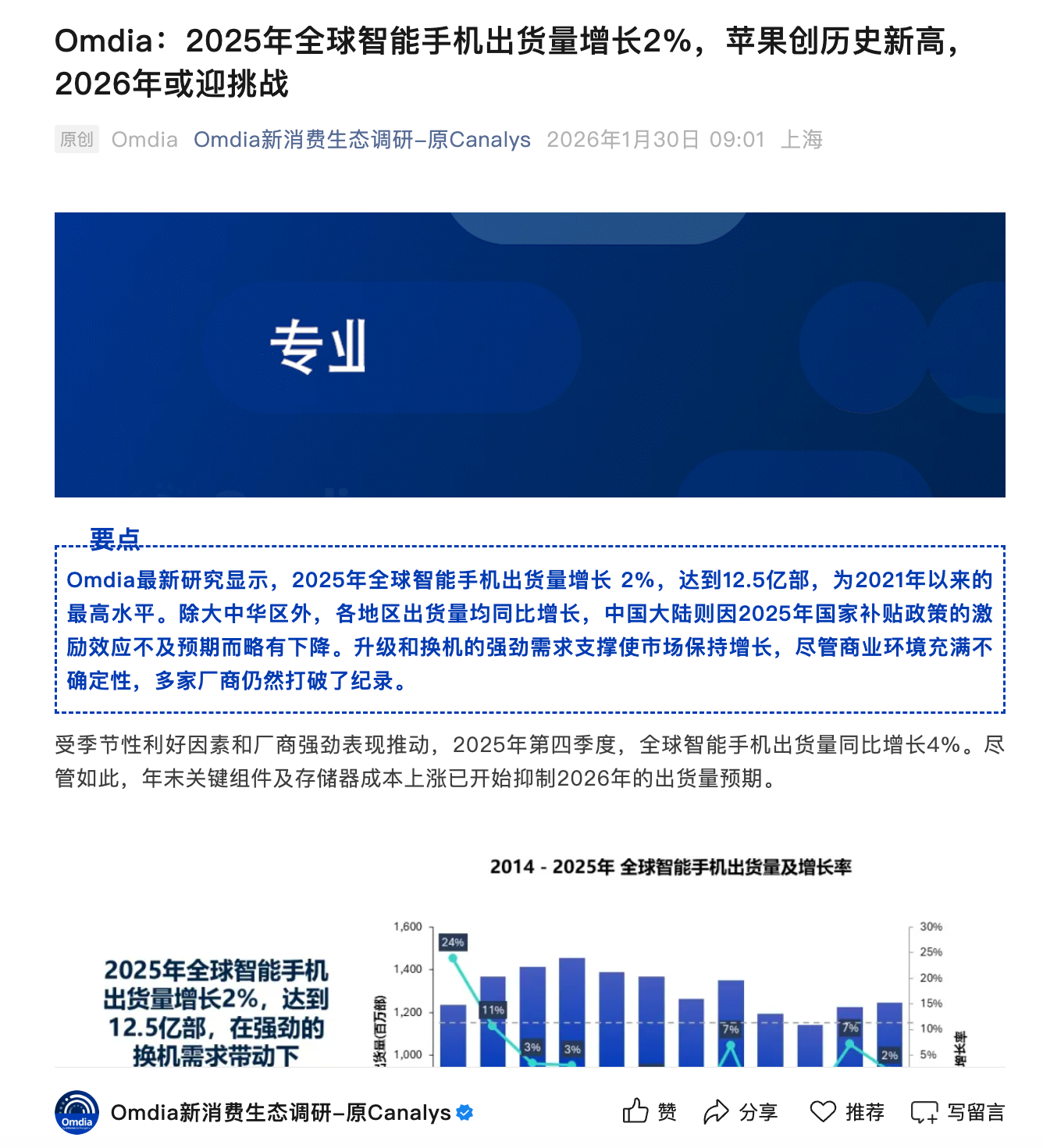
Core Insights - Global smartphone shipments are projected to grow by 2% in 2025, reaching 1.25 billion units, marking the highest level since 2021, with all regions except Greater China experiencing year-on-year growth [1] - The fourth quarter of 2025 saw a 4% year-on-year increase in global smartphone shipments, driven by seasonal factors and strong vendor performance, although rising costs of key components began to suppress expectations for 2026 [1] Group 1: Company Performance - Apple achieved a record annual shipment of 240.6 million iPhones in 2025, a 7% increase year-on-year, maintaining its position as the largest smartphone manufacturer for the third consecutive year [4] - Samsung rebounded in 2025 with a 7% year-on-year increase in shipments, closing the year with a strong fourth quarter, driven by resilient demand for flagship models and a recovery in the entry-level market [4] - Xiaomi defended its top three position despite a 2% decline in fourth-quarter shipments, impacted by weak entry-level demand and significant market contraction [5] Group 2: Market Dynamics - Vivo entered the fourth position for the first time, with a 4% year-on-year increase in shipments to 10.53 million units, supported by success in the Indian market and stable domestic performance [5] - OPPO ranked fifth, with annual shipments of 10.07 million units, experiencing a 3% year-on-year decline, but returning to growth in the fourth quarter with the launch of new models [5] - Despite challenges, several manufacturers outside the top five maintained positive growth, with Honor and Lenovo achieving year-on-year increases of 11% and 6%, respectively [5] Group 3: Future Outlook - Concerns for 2026 are emerging due to escalating supply-side pressures on DRAM, NAND, and other semiconductors, which may compress profit margins and force price adjustments [8] - Companies must effectively manage supply chain pressures and strengthen long-term partnerships to mitigate the impact of rising costs on consumer demand [8] - The focus for manufacturers will shift towards profitability and exploring alternative revenue sources, with a strategic opportunity to capture upgrade demand and ensure market share sustainability [11]

苹果Q1业绩超预期大爆发:iPhone史上最强季度驱动营收创新高,大中华区销售强势反弹同比暴涨38%
Zhi Tong Cai Jing· 2026-01-30 01:20
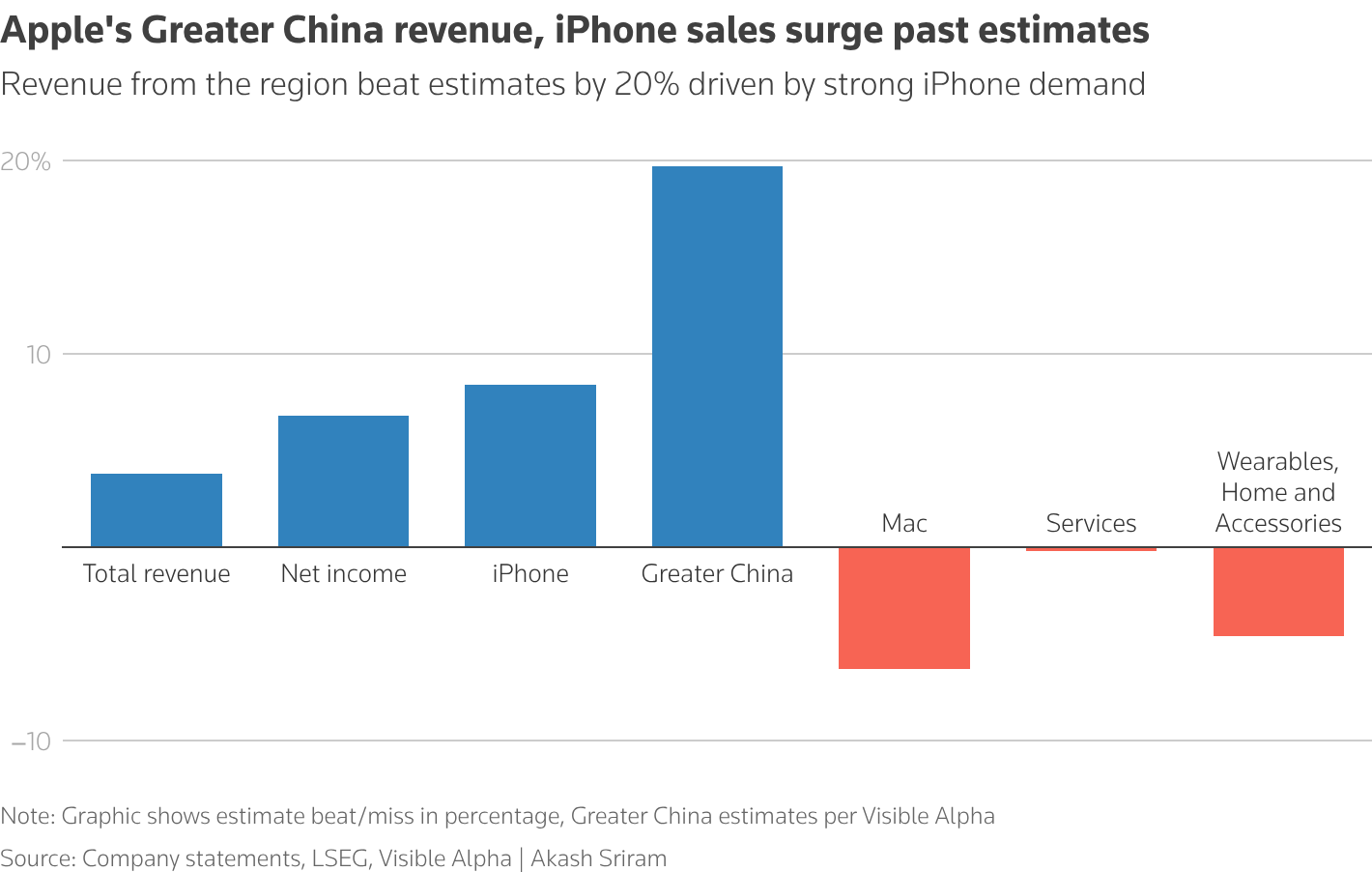
智通财经获悉,美东时间周四美股盘后,苹果(AAPL.US)发布了2026财年第一季度财报。在iPhone 17系列的强劲拉动下,公司假日季营收创下历史新高,大 中华区市场实现38%的同比暴涨,同时苹果还给出了超预期的第二财季营收指引,一扫此前市场对其硬件增长见顶的担忧。 业绩概览:iPhone需求"火爆",驱动创纪录增长 财报显示,在截至2025年12月27日的第一财季,苹果总营收达到创纪录的1438亿美元,同比增长16%,远超分析师平均预期1384亿美元,也高于公司自身此 前10%-12%的增长指引。每股收益为2.84美元,同样超过市场预期的2.68美元。 作为苹果的核心营收支柱,iPhone业务在本季度迎来爆发式增长,营收达853亿美元,同比大增23%,远超分析师782亿美元的预期,创下历史最佳季度表 现。苹果CEO库克表示,iPhone17系列的市场需求"堪称火爆",在全球所有地理区域均创下销量纪录,其中高端版本尤为畅销,成为拉动营收和利润的关 键。这一成绩也助力苹果在近几个月超越三星(SSNLF.US),重新夺回全球智能手机市场销量第一的宝座。库克透露,目前苹果全生态设备的安装基数已达 25亿台。 大 ...