
金地集团

Search documents
海通证券晨报-20250718
Haitong Securities· 2025-07-18 02:46
Group 1: Strategy Overview - The overall growth in Q2 2025 still faces bottlenecks, but the performance improvement in emerging technologies and certain cyclical sectors is becoming clearer [2][11] - The pre-announcement of mid-year reports shows a pre-joy rate of 43.7% among 1,531 disclosed companies, lower than the past three years [11][12] - The cumulative profit growth for the entire A-share market and non-financial A-shares in the first half of the year is estimated at 1.0% and 1.2% respectively [11][12] Group 2: Industry Insights - Traditional economic sectors are improving slowly, with industrial enterprises experiencing a decline in accounts receivable turnover [3][12] - Emerging technologies are the main area for growth expectations, particularly in globally competitive industries [4][13] - Certain cyclical products, such as rare earths and small metals, are seeing price increases, while sectors like steel and construction materials are showing signs of performance improvement [4][13] Group 3: Company Focus - Guangxun Technology - Guangxun Technology's mid-year performance is expected to show a net profit of 3.23 to 4.07 billion yuan, representing a year-on-year growth of 55.00% to 95.00% [6][25] - The company has completed its stock incentive plan, which is expected to motivate employees and enhance future performance growth [7][25] - The target price for Guangxun Technology is maintained at 69.70 yuan, with a current price of 49.31 yuan, indicating a potential upside [25][26]

会客厅|如何打造“高性价比”?“好房子”的N种答案
Bei Ke Cai Jing· 2025-07-17 14:22
Core Insights - The demand for quality housing is increasing, shifting from merely having a home to seeking a "good house" that meets higher living standards [1][3] - The concept of "good houses" has been officially recognized in the 2025 Government Work Report, emphasizing safety, comfort, green living, and smart technology as essential criteria [3][4] - A new national standard for housing, the "Residential Project Specification," has been implemented, setting mandatory requirements for aspects like ceiling height and sound insulation [4] Group 1: Definition and Standards of "Good Houses" - The definition of a "good house" includes not just sales performance but also criteria such as safety, aesthetics, functionality, and emotional well-being [3][4] - Experts propose a comprehensive evaluation system for "good houses," focusing on six dimensions: durability, health, environmental sustainability, smart technology, inclusivity, and aesthetic coordination [6] - The Shanghai Jiao Tong University emphasizes a buyer-centric evaluation standard, which includes three positive attributes (good appearance, usability, and mood) and two savings (peace of mind and cost) [4][6] Group 2: Industry Response and Innovation - Real estate companies are aligning their strategies with the "good house" policy, integrating quality living, service, and brand reputation to enhance urban living experiences [9][22] - Companies are encouraged to innovate in construction techniques and materials to meet the new standards while managing costs effectively [23] - The focus on "good houses" is expected to stimulate innovation within the industry, pushing for the adoption of new construction technologies and practices [23] Group 3: Aging Population and Housing Design - The national standard includes provisions for aging-friendly and barrier-free housing, addressing the needs of an aging population [24][25] - Design considerations for elderly-friendly homes include features like dual-key apartments and accessible bathroom designs to enhance independence for older residents [25][28] - The industry is urged to consider diverse community needs and involve multiple stakeholders in housing development to create more inclusive living environments [29]


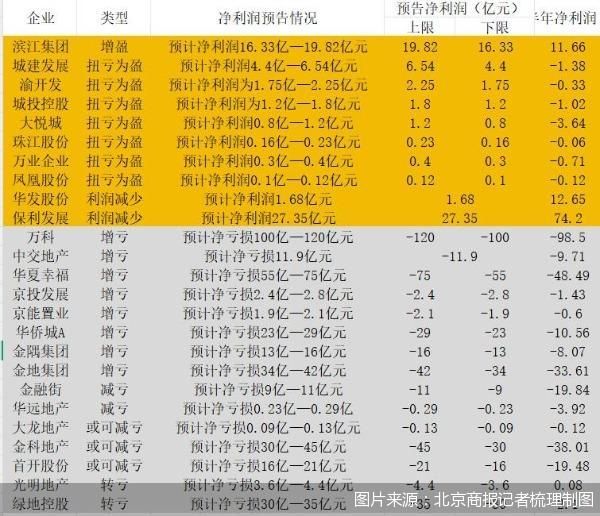
61家房企合计预亏超400亿,上半年哪些房企在盈利?
Nan Fang Du Shi Bao· 2025-07-17 13:26
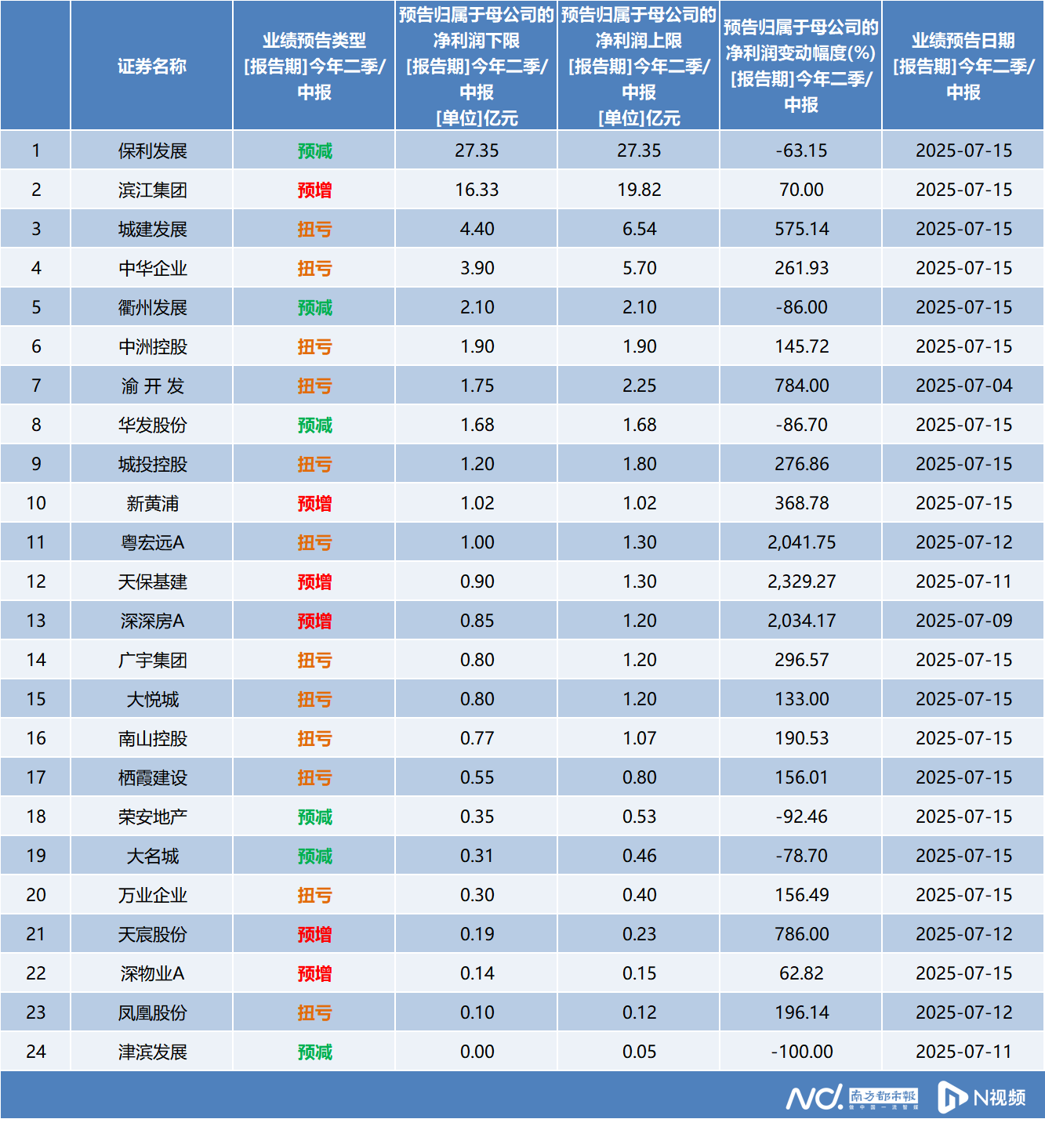
Core Viewpoint - The real estate industry is facing significant challenges in the first half of 2025, with a notable performance divergence among listed companies, as many report substantial losses while a few manage to turn profits [1][2]. Group 1: Overall Performance - As of July 17, 2025, 61 listed real estate companies have disclosed their mid-year performance forecasts, with a total expected loss ranging from 342.56 billion to 464.97 billion [1]. - Out of these, 24 companies anticipate profits while 37 expect losses, indicating that 60% of the companies are projected to report losses [1][2]. - The overall trend shows a decline in performance, with companies like China Vanke and Greenland Holdings shifting from profit to loss, while others like Joy City and Urban Construction Development have managed to turn losses into profits [1][2]. Group 2: Companies Turning Profits - In the first half of 2025, 24 companies are expected to achieve profits totaling between 68.68 billion and 80.16 billion, with 12 companies successfully reversing previous losses [2][3]. - Urban Construction Development is projected to report a net profit of 4.4 billion to 6.54 billion, marking a year-on-year increase of up to 575.14% [3][7]. - Other companies that have turned profitable include Zhongzhou Holdings, City Investment Holdings, and Joy City, showcasing resilience in a challenging market [2][3]. Group 3: Companies Reporting Losses - Among the 37 companies forecasting losses, 13 are expected to report their first-ever losses, including Shahe Co., Xiangjiang Holdings, and Greenland Holdings [8][11]. - The total expected loss for these companies ranges from 422.72 billion to 533.64 billion, with Vanke leading with a projected loss of 100 billion to 120 billion [8][11]. - Other notable companies with significant losses include Jindi Group, which anticipates a loss of 34 billion to 42 billion, and Xinda Real Estate, expecting a loss of 35 billion to 39 billion [11][12]. Group 4: Market Outlook - The overall real estate market is still in an adjustment phase, but signs of stabilization are emerging, particularly in first-tier and some strong second-tier cities [14]. - Analysts suggest that the second half of 2025 may present a turning point for the industry, with potential recovery driven by policy adjustments and improved buyer confidence [13][14]. - The top 100 real estate companies reported a total sales amount of 18,364.1 billion, a year-on-year decline of 11.8%, but the rate of decline is narrowing [13].



A股地产半年报继续“探底”,业内称未来有望修复利润表
第一财经· 2025-07-17 12:26
Core Viewpoint - The overall performance of listed real estate companies in the first half of 2025 is characterized by significant losses, with over 60% of companies reporting losses, indicating a continued downturn in the industry [1][10]. Group 1: Performance Overview - As of July 17, 2025, more than 70 real estate companies in A-shares have released performance forecasts, with only 7 companies expecting profit increases and 14 companies expecting to turn losses into profits [1]. - 28 companies are expected to continue reporting losses, while 16 companies are projected to report losses for the first time in the first half of the year [1]. - The overall trend shows that the majority of companies are facing financial difficulties, with significant impacts on cash flow, credit performance, and balance sheets [1][11]. Group 2: Notable Performers - Poly Developments, a leading company in the industry, expects a net profit of 2.735 billion yuan, but this represents a 63.15% decline compared to the previous year [3]. - In contrast, the private company Binjiang Group anticipates a net profit increase of 40% to 70%, with expected profits between 1.632 billion and 1.982 billion yuan, attributed to increased project deliveries [3][5]. - Other companies like New Huangpu and Tianchen Co. are also reporting profit increases, but their overall profit levels remain low due to their smaller scale [5]. Group 3: Significant Losses - Vanke, a major player in the industry, is expected to report a net loss between 10 billion and 12 billion yuan, primarily due to a significant decrease in project settlement scale and low gross margins [8][9]. - Huaxia Happiness is projected to incur a loss of 7.5 billion to 5.5 billion yuan, with losses attributed to reduced project settlements and high financial costs [9]. - Other companies, including *ST Jinke and Gemdale Group, are also expected to report substantial losses, with figures ranging from 3 billion to 4.2 billion yuan [9]. Group 4: Industry Challenges - The continuous losses in the real estate sector are linked to low-profit project settlements and market adjustments, leading to increased asset impairment provisions [10]. - Analysts suggest that if the current trend of losses persists, it could negatively impact companies' cash flow, credit ratings, and overall financial health, potentially leading to delisting for some firms [11]. - Despite some signs of market recovery, the overall financial pressure on real estate companies remains significant, with ongoing challenges in achieving profitability [12].
金地集团连跌5天,兴证全球基金旗下2只基金位列前十大股东
Sou Hu Cai Jing· 2025-07-17 11:33
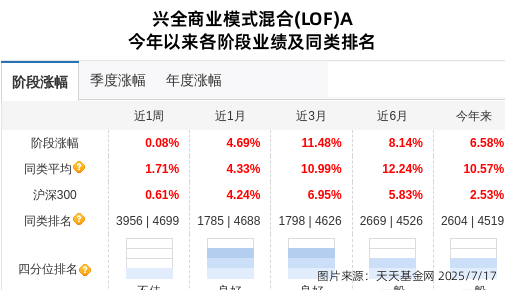
Group 1 - Gindai Group has experienced a decline for five consecutive trading days, with a cumulative drop of -7.28% [1] - Gindai Group, founded in Shenzhen in 1988 and listed on the Shanghai Stock Exchange in 2001, has developed into a comprehensive listed company focusing on real estate development and related diversified businesses [1] - Two funds under Xingquan Global Fund have entered the top ten shareholders of Gindai Group, both being new additions in the first quarter of this year [1] Group 2 - The two funds are Xingquan Business Model Mixed (LOF) A and Xingquan New Vision Open Mixed, with year-to-date returns of 6.58% and 6.12% respectively [1] - Xingquan Business Model Mixed (LOF) A ranks 2604 out of 4519 in its category, while Xingquan New Vision Open Mixed ranks 939 out of 2296 [1]
保利发展净利润暂时领跑,滨江集团增长超四成
Bei Jing Shang Bao· 2025-07-17 10:08
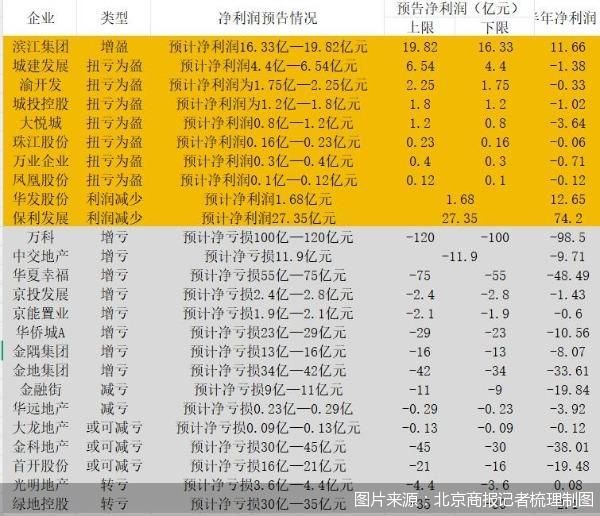
Core Viewpoint - The performance forecasts of real estate companies indicate a mixed outlook, with some companies turning losses into profits while others continue to struggle with significant losses. The focus on product quality and strategic market positioning is essential for profitability in the current market environment [1][3][8]. Group 1: Profitability Trends - As of July 17, 2025, among 25 listed real estate companies, 10 reported profits, with Poly Developments leading at a projected net profit of 27.35 billion yuan [1][3]. - Binhai Group is noted for its impressive profit growth, with an expected net profit increase of 40.01% to 69.98%, attributed to a higher volume of property deliveries [6][7]. - Poly Developments, despite being the highest in net profit, has seen a decline in profits over the past two years, with a projected decrease of 63.14% compared to the previous year [3][4]. Group 2: Losses and Challenges - 15 companies reported losses, with significant projected losses from companies like Vanke and China Communications Real Estate, indicating ongoing challenges in the sector [2][4][5]. - Companies such as Jinke Real Estate and Financial Street are expected to reduce their losses, while others like Greenland Holdings and Bright Real Estate have shifted from profit to loss [4][5]. Group 3: Market Dynamics and Strategies - The real estate market is experiencing a recovery due to various policy measures aimed at stimulating demand, including lower down payment ratios and increased supply of quality land [8][9]. - Companies are encouraged to focus on high-quality residential products and adapt to changing consumer demands by offering customized housing solutions [9][10]. - Binhai Group's success is attributed to its strategic focus on the Zhejiang market, particularly in Hangzhou, where it has achieved significant sales growth [6][7].

房企半年报前瞻 | 保利发展净利润暂时领跑,滨江集团增长超四成
Bei Jing Shang Bao· 2025-07-17 10:03
Core Viewpoint - The performance forecasts of real estate companies indicate a mixed recovery, with some companies turning losses into profits while others continue to face significant losses [1][3]. Group 1: Company Performance - As of July 17, 2025, 25 real estate companies listed on A-shares have disclosed their half-year performance forecasts, with 10 companies, including Poly Developments and Binjiang Group, reporting profits [1][3]. - Poly Developments leads with a forecasted net profit of 27.35 billion yuan, although this represents a decline compared to previous years [3]. - Binjiang Group is noted for its impressive profit growth, with an expected net profit increase of 40.01% to 69.98%, attributed to a higher volume of property deliveries [5][6]. Group 2: Profitability Trends - Among the 25 companies, 15 are expected to report losses, with notable companies like Kinka Real Estate and Financial Street showing potential for reduced losses in the upcoming period [3][4]. - Companies such as China Communications Real Estate and Greenland Holdings have seen their losses increase, while others like Jin Di Group have reported significant losses due to reduced sales and asset impairment provisions [4][5]. Group 3: Market Dynamics - The real estate market is experiencing a recovery driven by policy support, with significant increases in land sales and new housing transactions in cities like Beijing [7][8]. - The focus on high-quality product offerings and understanding consumer needs is emphasized as critical for companies to enhance their market competitiveness [8].
房地产行业2025年6月70个大中城市房价数据点评:70城房价环比跌幅持续扩大,一线城市二手房价跌幅大于二、三线城市
Bank of China Securities· 2025-07-17 06:08
Investment Rating - The industry investment rating is "Outperform the Market," indicating that the industry index is expected to perform better than the benchmark index over the next 6-12 months [25]. Core Insights - The report highlights that the housing price decline pressure has intensified, with new home prices in 70 major cities decreasing by 0.3% month-on-month in June 2025, and second-hand home prices dropping by 0.6% [4][7]. - The number of cities experiencing a decline in new home prices has increased, with 56 cities reporting a month-on-month decrease, up by 3 from May [4][12]. - The report anticipates that the upcoming political bureau meeting in July may lead to more positive statements, potentially creating a trading opportunity in the sector [4]. Summary by Sections Housing Price Trends - In June, new home prices in first-tier cities fell by 0.3%, with Shanghai being the only city to see a price increase of 0.4% [4][9]. - Second-hand home prices in first-tier cities decreased by 0.7%, remaining higher than the declines in second and third-tier cities [4][13]. - Second-tier cities saw new home prices remain stable with a 0.2% decline, while second-hand home prices dropped by 0.6% [4][13]. Investment Recommendations - The report suggests focusing on four main lines of investment: 1. Real estate companies with stable fundamentals and high market share in core cities, such as Binhai Group and China Resources Land [4]. 2. Smaller companies that have made significant breakthroughs in sales and land acquisition since 2024, like Poly Real Estate Group [4]. 3. Companies with operational or strategic changes, including New Town Holdings and Longfor Group [4]. 4. Real estate brokerage firms benefiting from the recovery in the second-hand housing market, such as Beike-W and Wo Ai Wo Jia [4].
房地产行业2025年6月统计局数据点评:单月销售与投资降幅扩大,开竣工降幅虽收窄,但仍处于历史低位
Bank of China Securities· 2025-07-17 01:55
Investment Rating - The industry investment rating is "Outperform the Market," indicating that the industry index is expected to perform better than the benchmark index over the next 6-12 months [30]. Core Insights - The report highlights a significant decline in both sales and investment in the real estate sector, with June sales area at 105 million square meters, a year-on-year decrease of 5.5%, marking the lowest level since 2011 [1][12]. - The total development investment in June was 1.04 trillion yuan, reflecting a year-on-year decline of 12.9%, which is a slight increase in the rate of decline compared to May [1][9]. - New construction area in June was 71.8 million square meters, down 9.4% year-on-year, although the decline rate has narrowed compared to previous months [1][11]. Summary by Sections 1. Commodity Housing Sales - The sales area in June was 105 million square meters, with a year-on-year decline of 5.5%, which is a 2.2 percentage point increase in the decline compared to May [1]. - The sales amount for June was 1.02 trillion yuan, down 10.8% year-on-year, marking a return to double-digit negative growth after eight months [1][14]. - The average selling price of commodity housing in June was 9,634 yuan per square meter, down 5.6% year-on-year [7]. 2. Commodity Residential Inventory - The broad inventory of commodity residential properties stood at 1.63 billion square meters at the end of June, with a year-on-year decrease of 16.2% [2]. - The current housing inventory (completed but unsold) was approximately 408 million square meters, with a year-on-year increase of 6.5% [2]. 3. Real Estate Development Investment, New Construction, and Completion - The development investment in June was 1.04 trillion yuan, down 12.9% year-on-year, with residential development investment at 803.9 billion yuan, down 11.8% [6]. - New construction area in June was 71.8 million square meters, down 9.4% year-on-year, remaining at historically low levels [6][11]. - The completion area in June was 41.82 million square meters, down 1.7% year-on-year, but the decline rate has narrowed significantly [6][16]. 4. Developer Funding - In June, the total funds available to real estate companies were 99.7 billion yuan, a year-on-year decrease of 9.7% [6][16]. - The decline in sales receipts was significant, with housing sales receipts down 18.6% year-on-year [21]. - The report suggests that the second quarter saw a notable weakening in both sales and investment data, with expectations for policy support to improve market conditions [6]. 5. Investment Recommendations - The report recommends focusing on four main lines: stable fundamentals in core cities, "small but beautiful" companies with significant breakthroughs, companies with operational changes, and real estate brokerage firms benefiting from the recovery in the second-hand housing market [6].
金地(集团)股份有限公司 关于为上海项目公司融资提供担保的公告
Zhong Guo Zheng Quan Bao - Zhong Zheng Wang· 2025-07-16 23:38
Group 1 - The company, through its subsidiary Vision Century Investments (China) Limited, provides a guarantee for a loan of up to RMB 57.5 million to Link JV Holdings Limited, with a maximum guarantee amount of RMB 28.75 million [1][2][3] - The loan is intended to support the development of a project located in Shanghai, with a loan term of up to 12 months [1][2] - The guarantee falls within the authorized limit approved by the company's board and shareholders, which allows for a total guarantee amount of up to RMB 10 billion [1][2][3] Group 2 - The company has a total external guarantee balance of RMB 17.991 billion, which accounts for 30.47% of the company's audited net assets attributable to shareholders for 2024 [3] - The guarantees provided to subsidiaries amount to RMB 12.779 billion, while guarantees to joint ventures and associates total RMB 5.212 billion [3] - There are no overdue guarantees reported by the company [3]