龙芯中科

Search documents
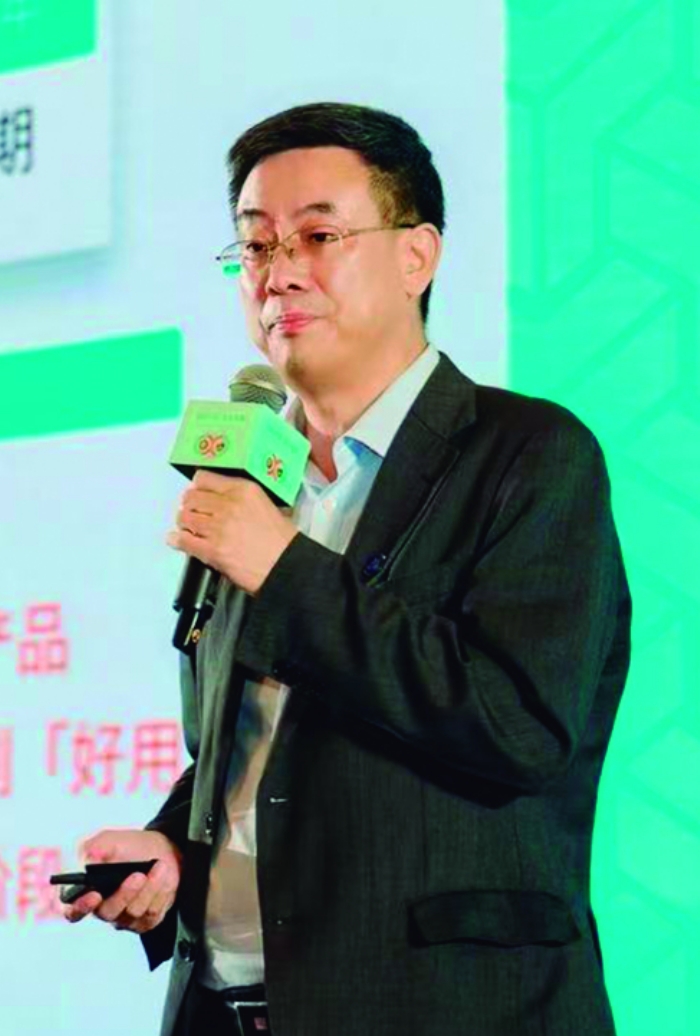
诚迈科技王继平:以“好用”破局推动信创生态迈向繁荣
Shang Hai Zheng Quan Bao· 2025-07-28 18:58
Core Viewpoint - The company aims to address the prevalent issues of sluggish performance and system crashes in the current 15 million domestic "Xinchuang" computers by developing a truly user-friendly product, leveraging its strong software foundation to enhance hardware experience [2][5]. Group 1: Company Background and Development - The company was founded by Wang Jiping in 2006, capitalizing on the smartphone industry's technological transformation, and became one of the first to introduce the Android system to the Chinese market [3][4]. - Over the years, the company has grown from a small team to a leading enterprise with over 10,000 employees and an annual output value reaching several billion yuan [4]. Group 2: Product Development and Innovations - The company has identified that the root cause of performance issues in existing computers lies in the lack of synergy between software and hardware, prompting the decision to develop its own "Xinchuang" computers with optimized software integration [5]. - The newly launched "Chengmai Xinchuang Computer" boasts significant performance improvements, including a boot time reduced from the industry average of 30 seconds to just 10 seconds, and enhanced stability allowing for months of uninterrupted operation [5]. Group 3: Ecosystem and Collaboration - The company has initiated the "Xinchuang Win-Win Ecosystem Alliance" with over 40 leading firms in the industry to foster collaboration and innovation, aiming to expand the alliance to 100-200 companies [7]. - Strategic partnerships have been established with 20 enterprises, including Chang'an Computing and China Unicom Liaoning Branch, to provide comprehensive services from product adaptation to solution delivery for regional government and enterprise clients [7].


一图看懂科创民企策略指数
中国基金报· 2025-07-25 11:14
Core Viewpoint - The article discusses the rapid development of the index system in China, highlighting the increasing market recognition and the accelerating trend of index-based investment, particularly focusing on the Shanghai Stock Exchange's initiatives to educate investors about index investment [8]. Group 1: Index Development and Market Trends - The index system in China has been rapidly improved, leading to a growing acceptance of index-based investment strategies among investors [8]. - The Shanghai Stock Exchange, in collaboration with China Fund News and China Securities Index Company, has launched educational initiatives to help investors understand the key aspects of index investment [8]. Group 2: Private Enterprises in the Sci-Tech Board - As of June 2025, there are 3,478 listed private enterprises on the A-share market, accounting for nearly two-thirds of all listed companies, with 422 of them on the Sci-Tech Board, representing over 70% [10]. - The total market capitalization of private enterprises on the Sci-Tech Board is 3.5 trillion yuan, with total revenue of 0.9 trillion yuan, constituting 58.2% and 68.0% of the total for the Sci-Tech Board, respectively [10][11]. Group 3: R&D Investment and Innovation - The Sci-Tech Board aims to support high-level technological self-reliance, focusing on "hard technology" enterprises, with private enterprises' R&D investment reaching nearly 80 billion yuan in 2024, resulting in an R&D intensity of 8.9% [12]. - The private enterprise strategy index on the Sci-Tech Board selects 50 companies based on their R&D investment and profitability, providing a tool for investors to access high-quality private enterprises [14][16]. Group 4: Index Sample Characteristics - The sample space for the private enterprise strategy index includes all private enterprises listed on the Sci-Tech Board, excluding ST and *ST securities, with a focus on liquidity and market capitalization [15][16]. - As of July 10, 2025, the total market capitalization of the index samples ranges from 2.3 billion to 50 billion yuan, covering 18% of the Sci-Tech Board [21]. Group 5: Industry Distribution - The private enterprise strategy index emphasizes support for technology enterprises, with the top three industries being new generation information technology (55.2%), biomedicine (23.6%), and high-end equipment (9.9%) [23][25]. - The average R&D investment ratio for the index samples is significantly higher than the overall A-share market, with a median of 21.4% compared to 4.3% for the A-share market [25].



ETF热门榜:香港证券相关ETF成交居前,港股医疗ETF(159366.SZ)交易活跃-20250725
Sou Hu Cai Jing· 2025-07-25 10:09
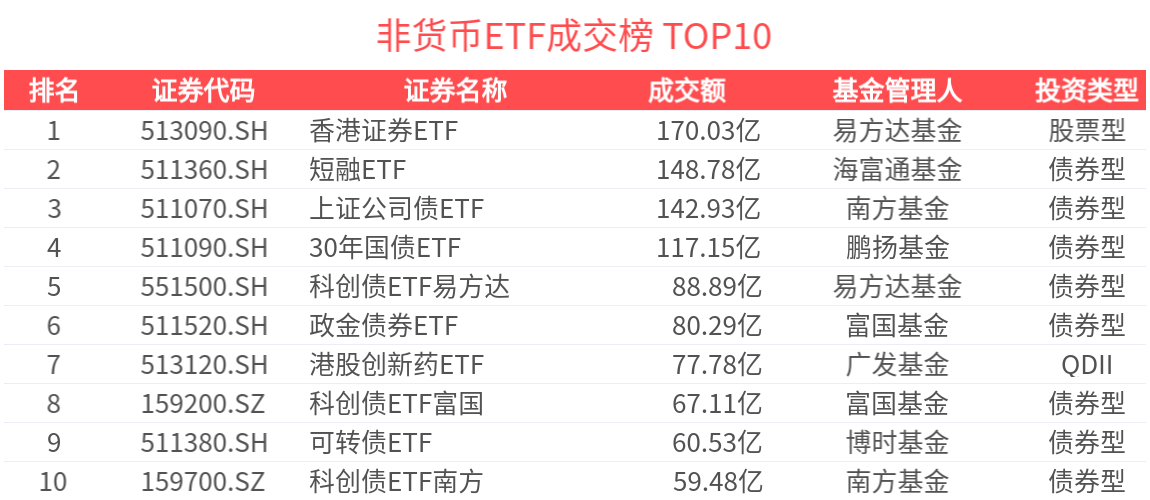
Core Insights - The total trading volume of non-monetary ETFs reached 302.71 billion, with 59 ETFs exceeding 1 billion in trading volume [1] - The top three ETFs by trading volume are Hong Kong Securities ETF, Short-term Bond ETF, and Shanghai Composite Company Bond ETF, with volumes of 17.00 billion, 14.88 billion, and 14.29 billion respectively [1] - The Hong Kong Securities ETF and the Short-term Bond ETF have shown significant recent trading activity, with average daily trading volumes of 19.76 billion and 15.71 billion over the past five and twenty days respectively [2][3] Trading Volume Summary - Hong Kong Securities ETF (513090.SH) has a latest share size of 8.05 billion, with a recent average daily trading volume of 19.76 billion over the past five days, reflecting a 10.56% increase [2] - Short-term Bond ETF (511360.SH) has a latest share size of 0.47 billion, with a recent average daily trading volume of 15.71 billion over the past five days [2] - The Shanghai Composite Company Bond ETF (511070.SH) has a trading volume of 14.29 billion, ranking third in the market [5] Turnover Rate Summary - The Hong Kong Medical ETF has the highest turnover rate at 620.34%, followed by the Short-term Bond ETF at 129.22% and the Hang Seng Innovation Drug ETF at 112.08% [7] - The Hong Kong Securities ETF has a turnover rate of 91.42%, indicating active trading [7] Sector and Index Performance - The Hong Kong Securities ETF tracks the Hong Kong Securities Index, which includes major companies like CITIC Securities and Hong Kong Exchanges [2] - The Hang Seng Innovation Drug ETF tracks the Hang Seng Innovation Drug Index, reflecting the performance of companies involved in innovative drug research and development [3] - The Computer ETF and AI ETFs are focused on the electronic industry, with significant recent trading activity and price movements [8][9]
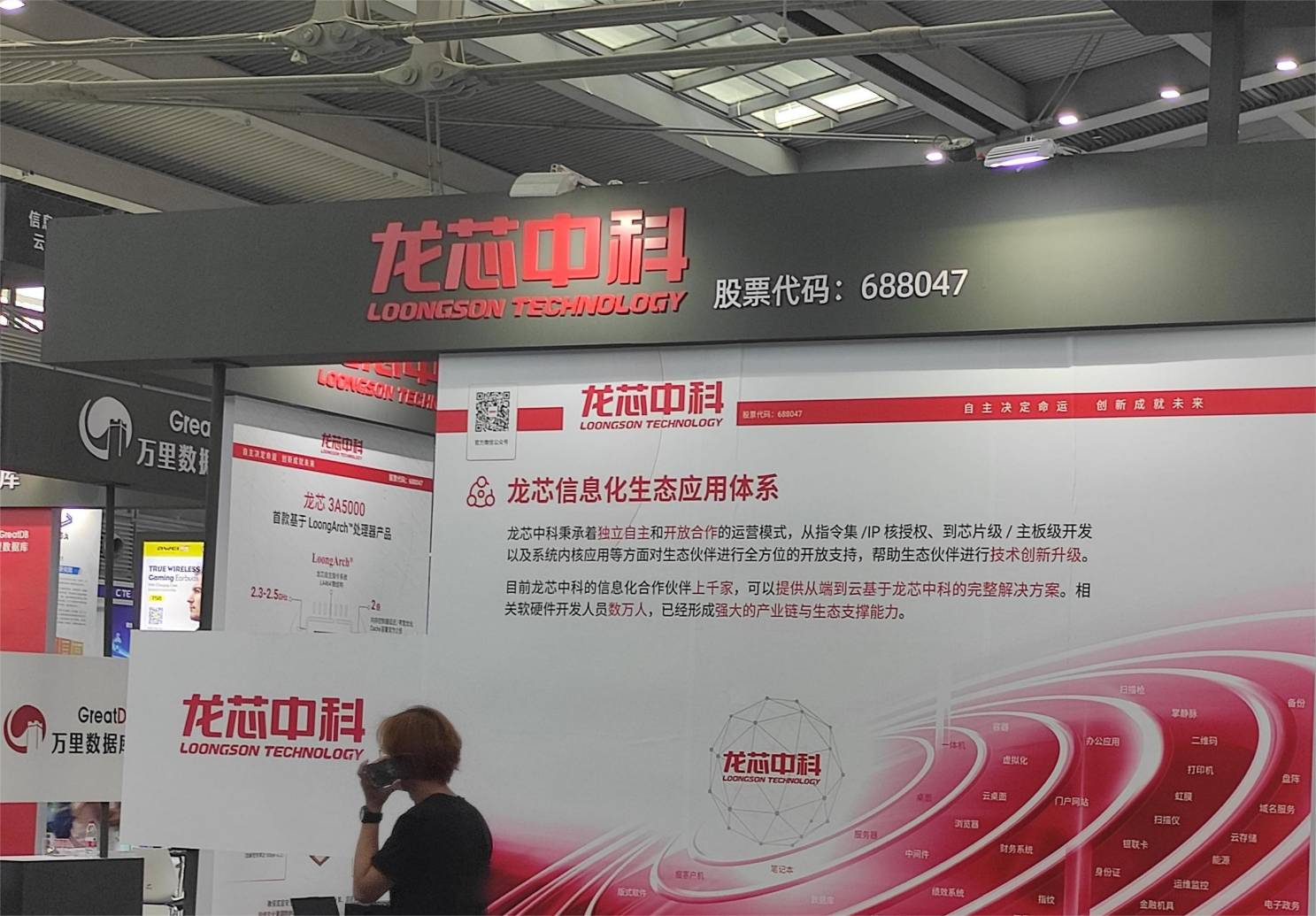
芯联芯一审被判赔龙芯中科45万元,并被要求发布致歉声明
Ju Chao Zi Xun· 2025-07-25 02:25
Core Viewpoint - Longxin Technology Co., Ltd. won a civil lawsuit against Shanghai Xinlianxin Intelligent Technology Co., Ltd., which was ordered to pay 450,000 yuan in damages and publish an apology on its website for ten consecutive days [2] Group 1: Legal Proceedings - Longxin Technology filed a civil lawsuit on March 2, 2021, requesting the court to order Shanghai Xinlianxin to clarify false claims, apologize, restore reputation, and compensate for economic losses [2] - The case was accepted by the Beijing Internet Court on July 29, 2021 [2] - The court ruled that Shanghai Xinlianxin had sent false accusation letters to third parties, claiming that Longxin's 3A5000 processor infringed MIPS's intellectual property rights [2] Group 2: Licensing and Technology - Longxin Technology has signed MIPS technology licensing agreements in 2011 and 2017, granting rights to develop, produce, and sell chips based on the MIPS instruction set [2] - In 2019, Xinlianxin claimed that MIPS transferred the licensing agreement to them, effective from April 1, 2019, but no direct contract was signed between Longxin and Xinlianxin [3] - Longxin Technology ceased the continuation of the licensing agreement in April 2020 [3] Group 3: Business Transition - From 2019 to 2021, approximately 70% of Longxin's main business revenue came from products based on the MIPS instruction set [3] - In 2020, Longxin launched its own instruction set, LoongArch, and prepared for a full transition to products based on this system before its IPO [3] - As of July 2021, Longxin's information technology business began transitioning to the LoongArch-based 3A5000 series processors, with industrial control operations also shifting to this new instruction set [3]
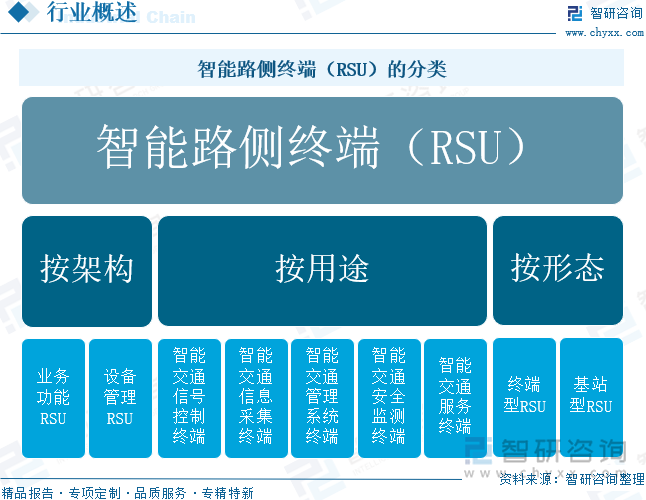
趋势研判!2025年中国智能路侧终端(RSU)行业发展历程、产业链、发展现状、重点企业及未来趋势:车路协同技术快速发展,推动RSU市场规模超200亿元[图]
Chan Ye Xin Xi Wang· 2025-07-25 01:23
Core Insights - The smart roadside unit (RSU) industry is experiencing rapid growth, with market size projected to increase from 3.9 billion yuan in 2019 to 25.524 billion yuan in 2024, representing a compound annual growth rate (CAGR) of 45.61% [1][18] - The development of key technologies such as 5G communication and edge computing will further enhance the capabilities and applications of RSUs in intelligent transportation systems [1][28] Industry Overview - Smart roadside units (RSUs) are critical infrastructure devices that facilitate communication between vehicles and roadside equipment, enhancing traffic safety and efficiency [4][6] - The industry has evolved through various stages, from initial information exchange to applications in automated driving and smart city integration [8] Market Dynamics - The smart transportation market in China is expected to reach approximately 243.48 billion yuan in 2024, growing at a rate of 10.71% [15] - The car-road collaboration industry is projected to grow from 85.08 billion yuan in 2024 to 170 billion yuan by 2028, indicating significant growth potential [17] Key Players - Major companies in the RSU industry include Huaming Intelligent, Jinyi Technology, Wanjie Technology, and Huawei, which hold significant market shares and technological advantages [21][22] - Jinyi Technology is focused on smart traffic solutions and has seen a production decrease of 14.06% in RSUs, while Wanjie Technology is expected to generate 930 million yuan in revenue from the smart transportation sector in 2024 [24][26] Technological Trends - Future developments in RSUs will focus on high-precision sensing and collaborative computing, leveraging technologies like 5G and AI for real-time data processing [28] - Standardization of RSU devices and protocols will be essential for ensuring compatibility and interoperability across different manufacturers [29] Application Expansion - RSUs will extend their applications beyond highways and urban roads to include ports, mines, and other semi-closed environments, supporting specific intelligent needs [30]
龙芯中科技术股份有限公司关于诉讼事项进展的公告
Shang Hai Zheng Quan Bao· 2025-07-24 20:47
Core Viewpoint - The court ruled in favor of the plaintiff, Longxin Zhongke Technology Co., Ltd., ordering the defendant, Shanghai Chip United Intelligent Technology Co., Ltd., to pay 450,000 yuan in damages and publish an apology on its website for ten consecutive days to restore the plaintiff's reputation [2][3][5]. Group 1: Lawsuit Overview - Longxin Zhongke filed a civil lawsuit against Shanghai Chip United on March 2, 2021, seeking clarification, apology, reputation restoration, and compensation for economic losses [4]. - The case was accepted by the Beijing Internet Court on July 29, 2021, with the case number (2021) Jing 0491 Min Chu 29334 [4]. Group 2: Lawsuit Progress - On July 23, 2025, the Beijing Internet Court issued a civil judgment requiring Shanghai Chip United to publish an apology and pay 450,000 yuan in damages [5]. - The judgment specifies that if the defendant fails to comply, they will be subject to additional penalties as per the Civil Procedure Law of the People's Republic of China [5]. Group 3: Financial Implications - The lawsuit is not expected to negatively impact the company's normal operations or financial performance [3][7]. - The company will handle accounting matters in accordance with legal regulations and accounting standards based on the case's progress [3][7].
龙芯中科(688047) - 龙芯中科关于诉讼事项进展的公告
2025-07-24 10:45
证券代码:688047 证券简称:龙芯中科 公告编号:2025-020 龙芯中科技术股份有限公司 关于诉讼事项进展的公告 本公司董事会及全体董事保证本公告内容不存在任何虚假记载、误导性陈 述或者重大遗漏,并对其内容的真实性、准确性和完整性依法承担法律责任。 重要内容提示: ● 案件所处的诉讼阶段:一审已判决 ● 公司所处的当事人地位:原告 ● 涉案的金额:被告上海芯联芯智能科技有限公司(以下简称"上海芯联 芯")赔偿原告龙芯中科技术股份有限公司(简称"公司"或"龙芯中科")经济 损失(含合理开支)450,000 元。 ● 是否会对公司损益产生负面影响:北京互联网法院一审判决被告上海芯 联芯在其官网(www.cipunited.com)首页置顶位置连续十日发布致歉声明,以 消除影响,恢复原告龙芯中科名誉,并赔偿原告龙芯中科经济损失(含合理开支) 450,000 元。该一审判决结果不会影响公司正常生产经营,不会对公司损益产生 负面影响,公司将根据案件进展情况按照法律法规及企业会计准则进行相应会计 处理。截至本公告披露日,该案尚处于一审判决上诉期内。公司将持续关注本次 诉讼事项的进展情况,及时履行信息披露义务,敬请 ...
中国信息产业要有自己的“根”——专访龙芯中科胡伟武
Shang Hai Zheng Quan Bao· 2025-07-23 18:08
Core Viewpoint - The fundamental path for China's information industry lies in establishing a third ecological system independent of X86 and ARM architectures [4][6]. Company Development - Longxin Technology, a company focused on building an independent information industry ecosystem through self-controlled chips, emphasizes self-reliance and innovation in research, production, and software ecology [5][6]. - The company transitioned from a research team to an enterprise in 2010, aiming to industrialize its CPU technology after realizing the limitations of existing architectures [6][7]. - Longxin launched its self-developed instruction system "LoongArch" in 2020, which has since been integrated into various applications across multiple sectors, including government, energy, and finance [7][9]. Market Strategy - Longxin aims to achieve a dual-market strategy by balancing policy-driven and open-market approaches from 2022 to 2024, with a focus on enhancing product competitiveness [8][9]. - The company reported a significant increase in revenue, with a 29.64% quarter-on-quarter growth and a 43.91% year-on-year growth expected in the second half of 2024 [9]. Future Outlook - From 2025 to 2027, Longxin plans to shift focus from R&D to market engagement, improving product cost-performance ratios to reduce reliance on policy-driven markets [10][12]. - By 2025, the third ecological system based on the LoongArch architecture is expected to be largely established, with aspirations to achieve a competitive balance with X86 and ARM by 2035 [12]. Strategic Approach - Longxin maintains a pragmatic yet bold strategy, integrating AI technology into its chip ecosystem while focusing on cost-performance advantages [11]. - The company emphasizes the importance of business logic over mere technological advancement, aiming for practical value in its technological breakthroughs [11].
郑州航空港推出“科创游线路” 新疆青少年体验“智造”
Zhong Guo Xin Wen Wang· 2025-07-23 11:31
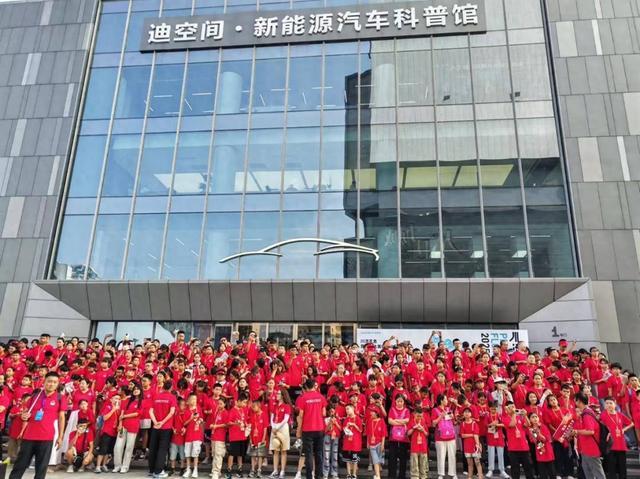
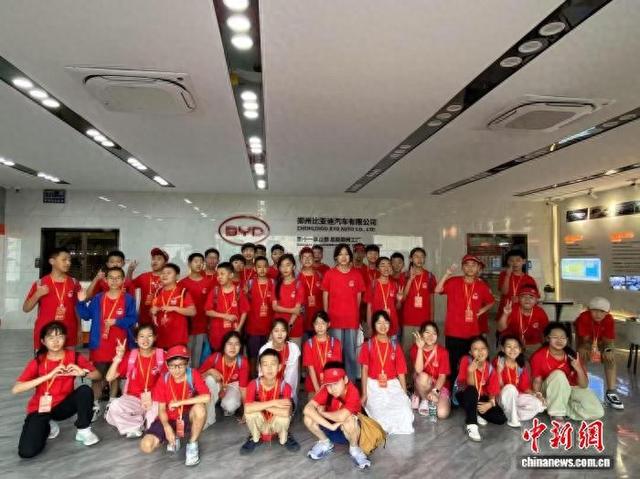
中新网郑州7月23日电 (李海珠 陈贵洋)"哇,太神奇了!这些机械手臂就像在跳舞一样!"近日,在位于 郑州航空港经济综合实验区(以下简称郑州航空港区)的比亚迪工厂总装车间内,来自新疆的"豫哈青少 年夏令营"师生们,在近距离观摩新能源汽车自动化生产线后发出惊叹。 在生产车间,夏令营青少年亲身感受到"智造"的魅力后纷纷说:"原来一辆新能源汽车只需要55秒就能 组装完成,自动化程度这么高!" 本次活动的带队老师则表示,孩子们对机械臂焊接、无人运输车等智能化设备特别感兴趣,"这种实地 观摩比课堂讲解生动得多。" 图为豫哈 青少年夏令营师生走进郑州比亚迪工厂。郑州航空港区供图 "豫哈青少年夏令营"师生们参访的线路便是郑州航空港区最新推出的"解码航空港,触摸未来之城"科创 游线路,由郑州航空港区丝路文旅发展有限公司(以下简称郑州航空港区丝路文发公司)联合专业机构打 造。 郑州航空港区丝路文发公司相关负责人介绍,该线路聚焦"科技创新"与"航空枢纽"两大核心,串联郑州 航空港区的新地标。此次"豫哈青少年夏令营"师生们参访此线路,希望通过沉浸式体验,让青少年直观 地感受中国制造的发展成就。 科创游线路包含郑州航空港市民中心、中 ...

郑州航空港推出科创游 解码中原新引擎崛起密码
Huan Qiu Wang· 2025-07-23 04:06
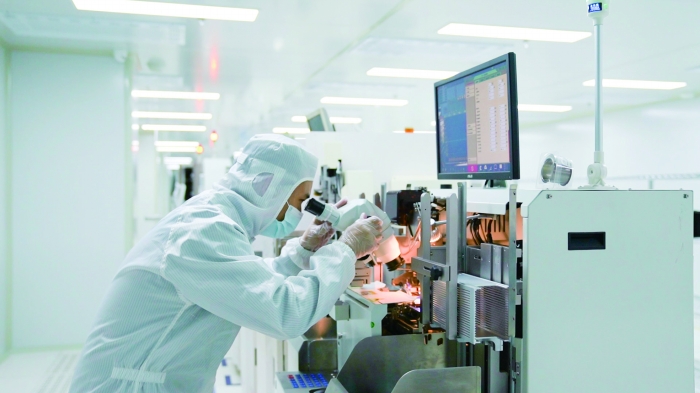
Core Insights - The article highlights the integration of technology and innovation in the development of the Zhengzhou Aviation Port, showcasing its transformation into an international logistics center and a hub for technological advancement [3][4][5] Group 1: Technological Advancements - The Zhengzhou Aviation Port is evolving from a "transportation hub" to an "economic engine," emphasizing the shift from "Henan manufacturing" to "Henan intelligent manufacturing" [3] - The "China chip, China soul" initiative is showcased through the Longxin CPU technology, presenting a complete stack of the domestic chip industry from hardware to software [3][4] - The BYD factory in Zhengzhou exemplifies "China efficiency," with a vehicle assembly line that produces a car every 55 seconds and 97% automation in welding processes [4][5] Group 2: Investment Opportunities - The collaboration between BYD and Longxin aims to localize chip packaging and testing for popular models, indicating a strategic move towards a more integrated domestic supply chain [5] - The carefully designed innovation tour targets potential investors, corporate delegations, and academic partners, providing insights into the industrial landscape and collaboration opportunities in Zhengzhou [5] - The tour allows investors to experience the complete industrial ecosystem from chips to vehicles, highlighting the region's strengths in high-end manufacturing and information technology [5]