海螺水泥

Search documents
建材行业2025年三季报业绩前瞻:淡季修复放缓,优质个股延续改善
Shenwan Hongyuan Securities· 2025-10-09 14:41
Investment Rating - The report maintains an "Overweight" rating for the building materials industry, indicating a positive outlook for the sector's performance relative to the overall market [2][10]. Core Insights - The report highlights that the cement industry is experiencing a traditional seasonal downturn in Q3 2025, with prices expected to decline after peaking earlier in the year. The average cement price in Q3 2025 is projected at 353.1 CNY/ton, down 27.6 CNY/ton from the previous quarter and down 33.5% year-on-year [2][3]. - The report notes that while the cement industry's profitability is under pressure, there are ongoing developments in overseas markets, particularly in Africa, where profitability is expected to improve [2]. - In the fiberglass sector, the report indicates that mid-to-high-end product prices are more resilient, with special fabrics contributing positively to profitability. The report anticipates continued differentiation in the fiberglass market, with low-end products facing weaker profitability [2][3]. - The consumer building materials segment is expected to see strong performance from quality companies, particularly in categories like coatings and tiles, as demand in the residential real estate market remains relatively weak [2]. - The glass industry is facing challenges, with photovoltaic glass prices slightly declining and flat glass prices under pressure. The report suggests that the industry may see a shift towards cleaner production methods, which could improve profitability in the coming years [2]. Summary by Sections Cement - Q3 2025 is a traditional off-season for the cement industry, with prices expected to decline after a peak earlier in the year. The average price is projected at 353.1 CNY/ton, down 27.6 CNY/ton from the previous quarter and down 33.5% year-on-year [2][3]. - The industry is expected to face overall profitability pressure, but overseas expansion, particularly in Africa, shows promise for improved earnings [2]. Fiberglass - Mid-to-high-end fiberglass products are showing stronger price resilience, while low-end products are struggling. The report anticipates continued growth in special fabric sales [2][3]. Consumer Building Materials - Quality companies in the consumer building materials sector are expected to stand out, particularly in categories with strong brand value and retail attributes. Price increases in various segments are anticipated to stabilize in Q3 2025 [2]. Glass - The glass industry is experiencing price declines, particularly in photovoltaic and flat glass. The report suggests a potential shift towards cleaner production methods, which may enhance profitability in the future [2]. Investment Recommendations - The report recommends focusing on companies with improving Q3 performance expectations and strong fundamentals, including major players in the cement, fiberglass, consumer building materials, and glass sectors [2][3].


节日期间港股建材板块表现如何?
Tianfeng Securities· 2025-10-09 12:03
Investment Rating - Industry Rating: Outperform the market (maintained rating) [4] Core Views - During the holiday period (September 29 - October 7), the Hong Kong building materials index rose by 2.55%, with glass products performing the best, including China Glass (+13.21%) and Xinyi Glass (+5.76%). Cement stocks followed, with China National Building Material (+4.55%) and West China Cement (+4.14%). Consumer building materials were relatively weak, with China Liansu down by 2.08% [2][12] - The current valuation percentiles indicate that glass products are below the 50th percentile of the past three years, while cement is above glass. Key companies like China National Building Material and Conch Cement are around the 80th percentile, suggesting that the recent rise is mainly due to the greater elasticity of undervalued glass products [2][12] - The Ministry of Industry and Information Technology and five other departments jointly released the "Building Materials Industry Stabilization Growth Work Plan (2025-2026)", which addresses the weak market demand and structural issues in the building materials industry, outlining key goals and initiatives for 2025-2026. The plan is expected to accelerate capacity reduction and improve the competitive landscape of the industry [2][12] Summary by Sections Market Performance - In the two trading days before the holiday (September 29-30), the CSI 300 index rose by 1.99%, while the building materials sector (CITIC) increased by 1.57%. Notable individual stock performances included Shengfeng Cement (+14.8%) and Wanli Stone (+12.2%) [10][12] Recommended Stocks - The recommended stocks for the week include West China Cement, China National Building Material, Honghe Technology, China Jushi, Huaxin Cement, Sankeshu, and Dongpeng Holdings. The report suggests that the traditional building materials industry is nearing a cyclical bottom, with potential growth in new materials due to high demand in downstream sectors [3][16]
水泥板块10月9日涨2.66%,天山股份领涨,主力资金净流入2.33亿元
Zheng Xing Xing Ye Ri Bao· 2025-10-09 09:03
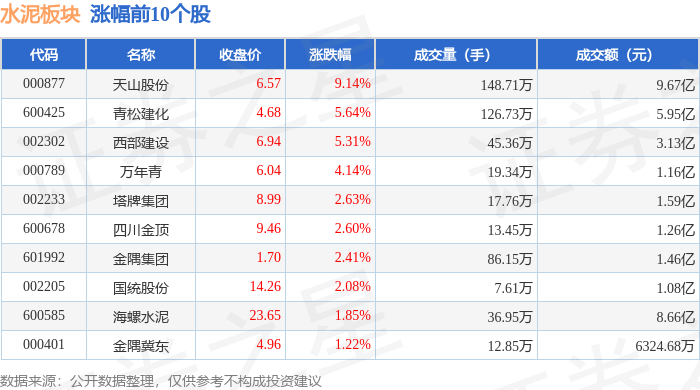
Market Overview - The cement sector increased by 2.66% on October 9, with Tianshan Co. leading the gains [1] - The Shanghai Composite Index closed at 3933.97, up 1.32%, while the Shenzhen Component Index closed at 13725.56, up 1.47% [1] Individual Stock Performance - Tianshan Co. (000877) closed at 6.57, up 9.14% with a trading volume of 1.4871 million shares [1] - Qingsong Jianhua (600425) closed at 4.68, up 5.64% with a trading volume of 1.2673 million shares [1] - Xibu Construction (002302) closed at 6.94, up 5.31% with a trading volume of 453,600 shares [1] - Wan Nian Qing (000789) closed at 6.04, up 4.14% with a trading volume of 193,400 shares [1] - Other notable performers include Tapai Group (002233) and Sichuan Jinding (600678), with increases of 2.63% and 2.60% respectively [1] Fund Flow Analysis - The cement sector saw a net inflow of 233 million yuan from institutional investors, while retail investors experienced a net outflow of 62.51 million yuan [2] - Major stocks like Tianshan Co. and Conch Cement (600585) had significant fund flow variations, with Tianshan Co. experiencing a net outflow of 90.91 million yuan from institutional investors [3] - Conch Cement had a net inflow of 87.31 million yuan from institutional investors, indicating strong interest [3]



投资者演示文稿-中国材料更Investor Presentation-China Materials Updates
2025-10-09 02:39
Summary of Key Points from the Conference Call Industry Overview - The conference call focused on the **Greater China Materials** industry, highlighting a **liquidity-driven bull market** supported by **supply disruptions** that are positively impacting commodity prices. The preference is for **gold, copper, and aluminum equities** in this environment [1][4][10]. Core Insights and Arguments - **Commodity Price Forecasts**: - **Aluminum**: Morgan Stanley forecasts $2,659 per ton for 2H2025, which is 6% higher than consensus. For CY2026, the forecast is $2,750, 8% above consensus [10]. - **Copper**: Expected price of $10,047 per ton for 2H2025, 5% above consensus, and $10,650 for CY2026, 9% above consensus [10]. - **Gold**: Projected at $3,719 per ounce for 2H2025, 9% above consensus, and $4,400 for CY2026, 34% above consensus [10]. - **Steel Demand Drivers**: - The **China Steel Demand Drivers** for 2025 include: - **Machinery**: 30% - **Infrastructure**: 17% - **Residential Property**: 14% - **Auto**: 9% [17][19]. - **Copper Consumption Index**: The **China Copper Consumption Index** indicates a significant reliance on sectors such as **Power (47%)**, **White Goods (15%)**, and **Auto (10%)** [21][22]. - **Aluminum Demand Breakdown**: The **China aluminum demand** is driven by: - **Property**: 22% - **Passenger Vehicles**: 20% - **Grid Investment**: 11% [27]. Additional Important Insights - **Infrastructure Spending**: - Infrastructure spending has partially offset the slowdown in new property starts, with a **5.4% YoY increase** in infrastructure spending for the first eight months of 2025 [35][55]. - **Weekly Shipments**: - Weekly cement and rebar shipments in China are being monitored, indicating trends in demand and supply dynamics [55][56]. - **Market Sentiment**: - The overall sentiment in the materials sector remains **attractive**, with Morgan Stanley's research indicating potential conflicts of interest due to business relationships with covered companies [4][5]. - **Analyst Team**: The call featured insights from a team of equity analysts at Morgan Stanley, emphasizing the importance of their research in investment decision-making [3]. This summary encapsulates the key points discussed in the conference call, providing a comprehensive overview of the Greater China Materials industry and its current market dynamics.






周期专场2-2025研究框架线上培训
2025-10-09 02:00
Summary of Key Points from Conference Call Records Industry Overview - The petrochemical industry is closely tied to ethylene profitability, with historical cycles lasting approximately 6-8 years, and the next peak expected around 2025 due to pandemic impacts [1][4][17]. - Oil prices are positively correlated with the petrochemical stock index, necessitating attention to supply-demand dynamics and full costs, with Middle Eastern countries requiring higher oil prices for fiscal balance [1][5][7]. - The real estate industry requires a comprehensive analysis of policy, valuation, economy, and profitability, with significant influence from the synchronized monetary cycles of China and the US [1][26]. Core Insights and Arguments - **Oil Price Dynamics**: Oil prices are a critical indicator for the petrochemical industry, with fluctuations directly affecting stock indices. The expected price range is between $45-80 per barrel in the coming years [1][5][14]. - **OPEC Strategies**: OPEC will shift to a market share preservation strategy in 2025 due to increased production from non-OPEC countries and US inflation control measures [1][9][13]. - **Geopolitical Risks**: Geopolitical factors significantly impact oil prices, with recent tensions having a pronounced effect, although risks have somewhat diminished recently [1][12][16]. - **Investment Focus**: Investment in the petrochemical sector should prioritize new materials and fine chemicals, moving away from outdated small-scale operations [1][24]. Additional Important Content - **Capital Expenditure**: High oil prices encourage capital expenditure among companies, while low prices can lead to reduced production and investment [6][10]. - **Ethylene as an Indicator**: Ethylene profitability serves as a key measure of the petrochemical industry's health, with historical data indicating cyclical peaks and troughs [4][17]. - **Real Estate Market Dynamics**: The real estate sector is currently undervalued, with stable cash flows and dividend capabilities, making it an area of interest for investors [1][43]. - **Supply-Side Reforms**: The shift from demand-side to supply-side reforms in real estate aims to improve supply quality, despite potential short-term negative impacts on the economy and employment [1][38][40]. Conclusion The petrochemical and real estate industries are undergoing significant transformations influenced by cyclical patterns, geopolitical factors, and strategic shifts in investment focus. Investors should remain vigilant about these dynamics to identify potential opportunities and risks in the market.
华新水泥20251007
2025-10-09 02:00
Summary of Huaxin Cement Conference Call Industry Overview - The cement industry is currently under pressure with overall profitability declining, but there is a strong willingness among companies to raise prices. The traditional peak season of "Golden September and Silver October" may lead to a short-term rebound in cement prices, although actual demand recovery needs to be monitored [2][3] Company Highlights - Huaxin Cement has a significant advantage in overseas operations, with an overseas capacity reaching 35 million tons by the end of 2025, ranking first among domestic companies venturing abroad. The medium to long-term target is 50 million tons, primarily distributed in Africa, where the market structure is relatively stable and competitive pressure is low. The profitability per ton of overseas cement is significantly higher than that of domestic operations [2][4] - The company recently completed the consolidation of its Indonesian capacity, exceeding 30 million tons in overseas capacity. It has launched a broad-based equity incentive plan and a core employee stock ownership plan, focusing on shareholder returns and earnings per share growth, which is expected to enhance management efficiency [2][6] - Huaxin Cement's domestic aggregate business is performing exceptionally well, ranking first in both capacity and profitability nationwide, serving as a major source of profit. Despite a decline in aggregate prices, the company maintains a competitive edge due to prior mining reserves and cost control [2][7] Financial Projections - Future profitability for Huaxin Cement is expected to improve, driven by stable growth in overseas demand, optimized internal incentive mechanisms, and international market expansion. However, attention should be paid to the impact of exchange rate fluctuations on overseas profits, which can affect net profit by approximately 30 yuan per ton [2][8][9] Market Conditions - The current market environment for the cement industry shows that leading companies are operating below safety lines, with many small to medium enterprises in East China facing losses. The industry is strongly advocating for price increases, especially with the arrival of the peak season [3][11] - The domestic cement market lacks significant demand growth, with companies focusing more on supply-side reforms. The capacity replacement progress in the first half of 2025 was below expectations, and the second half will require close attention to capacity replacement and overproduction policies [4][11] Stock Performance and Future Outlook - Huaxin Cement's stock price is highly sensitive to macroeconomic conditions and supply dynamics. The stock price is expected to respond positively to anticipated price increases in the fourth quarter. Following the consolidation of Huaxin's operations, the annual profit forecast has been slightly adjusted upwards, with expected net profits of 2.8 billion, 3.5 billion, and 3.7 billion yuan for 2025-2027, corresponding to growth rates of 17%, 24%, and 7% respectively [12][13] Key Considerations for the Second Half - In the second half of the year, attention should be paid to potential new policies and industry price increase expectations. The strong performance of overseas business and plans for the spin-off of overseas subsidiaries for listing, along with the new equity incentive plan, make the development in the second half of the year promising [13]
中国材料行业-2025 年第四季度展望:上行周期延续-China Materials-4Q25 Outlook – Upcycle Continues
2025-10-09 02:00
Summary of Conference Call Notes Industry Overview - **Industry**: Greater China Materials - **Market Condition**: A liquidity-driven bull market is ongoing, supported by supply disruptions, which is positively impacting commodity prices [1][2][17] Key Insights Commodity Preferences - **Preferred Commodities**: Gold, copper, and aluminum equities are favored in the current market environment due to their strong performance and demand [1][2][17] - **Gold Outlook**: Anticipated further upside in gold prices driven by a weakening USD, strong ETF buying, and central bank purchases, alongside safe haven demand amid uncertainty [2][18] - **Copper Supply Dynamics**: Supply disruptions are expected to widen the global copper supply deficit in 2026, with a supportive macro environment of abundant liquidity and a weak dollar [19] - **Aluminum Margins**: Higher margins for aluminum smelters are projected due to capped capacity in China and limited ability to restart idled capacity in the US/Europe [20] Demand and Supply Trends - **Retail Demand**: Retail growth in autos and home appliances has weakened, attributed to a high base and early demand from trade-in subsidies [3] - **Construction Activity**: Property sales and construction remain subdued, with expectations for a major policy pivot requiring endorsement at the 4th Plenary Session [3] - **Anti-involution Policies**: Industries such as coal, cement, glass, and steel are facing production controls to curb overproduction, with specific guidelines issued to stabilize prices [4][21] Specific Sector Insights - **Cement Industry**: Policies to control overproduction are expected to lead to a 20% capacity exit during 2025-26, benefiting industry leaders through consolidation [21] - **Late-cycle Building Materials**: Demand for late-cycle building materials is expected to remain soft, although improvements may arise from secondary home sales and government programs [22] - **Lithium Demand**: Strong demand for lithium is noted, with potential supply disruptions due to resource reclassification at several mines [23] Price Forecasts - **Commodity Price Projections**: - **Gold**: Expected to rise to $4,400/oz by 2026, a 33% increase from current estimates [15] - **Copper**: Projected to reach $10,650/ton by 2026, reflecting a 9% increase [16] - **Aluminum**: Anticipated price of $2,750/ton by 2026, an 8% increase [16] Investment Recommendations - **Overweight Stocks**: CMOC, Hongqiao, Chalco, Anhui Conch, CNBM, and Baosteel are highlighted as preferred investment choices in the materials sector [2][17] - **Underweight Stocks**: Companies such as China Coal, Asia Cement, and Yancoal are recommended for underweight positions due to unfavorable market conditions [14] Additional Considerations - **Uranium Market**: Strong price momentum is expected in uranium, supported by major investment vehicles and contracting from utilities [24] - **Rare Earths**: Prices are anticipated to remain strong due to good downstream demand and tightened supply-side controls in China [25] This summary encapsulates the key points from the conference call, providing insights into the current state and future outlook of the Greater China materials industry.
建材稳增长方案出台,反内卷有望强化 | 投研报告
Zhong Guo Neng Yuan Wang· 2025-10-09 01:16
Core Viewpoint - The introduction of the "Construction Materials Industry Stabilization and Growth Work Plan (2025-2026)" aims to effectively enhance profitability as a primary goal for the period, with a focus on strengthening industry management and promoting a competitive environment [2] Group 1: Industry Policy and Management - The plan emphasizes the need for capacity replacement proposals for cement enterprises by the end of 2025 to align actual capacity with registered capacity [2] - It also highlights the transition of risk warnings for photovoltaic glass production from project management to planning guidance [2] Group 2: Market Trends and Price Movements - National cement prices have seen a significant month-on-month increase of 1.5%, with attempts to raise prices since late August facing challenges due to insufficient demand [3] - The glass market is experiencing a slowdown in price increases, with overall prices showing slight gains, supported by mid and downstream replenishment [3] Group 3: Investment Recommendations - The stabilization plan is expected to boost industry expectations, particularly in the cement and glass sectors, with companies likely to continue pushing for price increases in Q4 [4] - Recommended companies include Conch Cement, Huaxin Cement, and Taipai Group, with additional focus on investment opportunities in Tibet and Xinjiang due to major project constructions [4][5]
建筑建材双周报(2025年第15期):建材稳增长方案出台,反内卷有望强化-20251008
Guoxin Securities· 2025-10-08 07:05
Investment Rating - The report maintains an "Outperform" rating for the construction materials sector, indicating expected performance above the market index by more than 10% over the next 6 to 12 months [5][89]. Core Views - The introduction of the "Stabilization Growth Work Plan for the Building Materials Industry (2025-2026)" aims to enhance profitability and strengthen industry management, promoting a competitive environment [1][3]. - Cement prices have seen a significant increase of 1.5% recently, with expectations for further price hikes as companies strive to meet annual growth targets [2][22]. - The glass market is experiencing a slight price increase, supported by downstream replenishment, although demand acceptance at higher prices remains limited [2][37]. - The fiberglass market shows stable pricing for non-alkali yarn, while electronic yarn remains in high demand, indicating a robust market for high-end products [2][54]. Summary by Sections Cement - National cement prices have risen significantly, with a 1.5% increase noted. Companies are expected to continue pushing for price increases as the fourth quarter approaches [2][22]. - The report anticipates that cement companies will maintain upward price momentum to achieve annual growth targets [2][22]. Glass - Float glass prices have shown a slight increase, supported by replenishment from downstream sectors, although the acceptance of high prices is limited [2][37]. - The photovoltaic glass market has seen a slight decline in demand, with inventory levels increasing, but manufacturers are maintaining stable pricing strategies [2][45]. Fiberglass - The price of non-alkali yarn remains stable, with mainstream prices for 2400tex yarn at 3250-3700 CNY/ton, while electronic yarn prices are stable due to high demand in the high-end market [2][54]. Investment Recommendations - The report suggests focusing on the cement and glass sectors due to stricter supply controls and improving profitability. Recommended companies include Conch Cement, Huaxin Cement, and Qibin Group [3][5]. - For fiberglass, companies like China National Materials and China Jushi are highlighted as beneficiaries of structural demand growth [3][5]. - In the construction sector, a recovery in infrastructure investment is anticipated, with recommendations for companies such as China Railway Construction and China State Construction [3][5].


四大水泥龙头这一关键指标均下降 | ESG信披洞察
Xin Lang Cai Jing· 2025-10-06 07:44
Core Viewpoint - China is the largest producer and consumer of building materials globally, with the cement industry being a significant contributor to energy consumption and carbon emissions, accounting for approximately 9% of the country's total carbon emissions [1][2]. Group 1: Industry Overview - The cement industry was officially included in the national carbon market in March this year [1]. - In 2019, global cement production capacity was 3.7 billion tons, with China accounting for about 60% of this capacity [1]. - The top five cement companies in China by comprehensive strength for 2025 are Conch Cement, China National Building Material Group, Huaxin Cement, Tianshan Cement, and China Resources Cement Technology [1]. Group 2: Greenhouse Gas Emissions - Conch Cement reported a total greenhouse gas emission of 182 million tons of CO2, a decrease of 0.88% year-on-year [5]. - China National Building Material reported emissions of 167 million tons of CO2 equivalent, down 15.3% year-on-year [6]. - Huaxin Cement's emissions were 30.62 million tons of CO2 equivalent, a decrease of approximately 12% [6]. - China Resources Cement Technology reported emissions of 4.0347 million tons of CO2 equivalent, down 3.4% year-on-year [7]. Group 3: Hazardous Waste Generation - China National Building Material generated 11,400 tons of hazardous solid waste, an increase of 38.6% year-on-year, attributed to the acquisition of Beixin Jiaboli [10]. - Conch Cement's hazardous waste generation was 7,849 tons, up 48.6% year-on-year [11]. - China Resources Cement Technology and Huaxin Cement reported hazardous waste generation of 418 tons and 197.19 tons, respectively, with decreases of 5% and 9.7% year-on-year [12]. Group 4: Energy Consumption - Conch Cement's energy consumption was 200 million megawatt-hours, down 2% year-on-year [13]. - China National Building Material reported 182 million megawatt-hours, a decrease of 20.4% [13]. - Huaxin Cement's energy consumption was 5.1951 million tons of standard coal, down 3.4% [13]. - China Resources Cement Technology reported 5.222 million tons of standard coal, down 2.8% [13]. Group 5: Environmental Investment - China National Building Material's total environmental investment for 2024 was 1.964 billion yuan, the highest among the four companies [15]. - Conch Cement invested approximately 846 million yuan in 307 environmental technology renovation projects [15]. - Huaxin Cement's environmental technology investment totaled 707 million yuan, while China Resources Cement Technology's was 320 million yuan [15]. Group 6: Carbon Reduction Initiatives - China National Building Material launched green low-carbon building materials, including recycled materials and alternative fuels [15]. - Tianshan Cement established 89 alternative fuel production lines, with a substitution of 767,000 tons of standard coal and a thermal substitution rate of 4.19% [15]. - Conch Cement aims for a 15% share of alternative fuel usage by 2030, achieving 13% progress last year [15]. - Companies are implementing energy-saving and carbon reduction technology renovations, with various projects leading to significant reductions in energy consumption and emissions [16].