
牧原股份

Search documents
当政策红利遇上消费刚需 中证主要消费指数如何成为行业压舱石?
Sou Hu Cai Jing· 2026-01-14 06:27
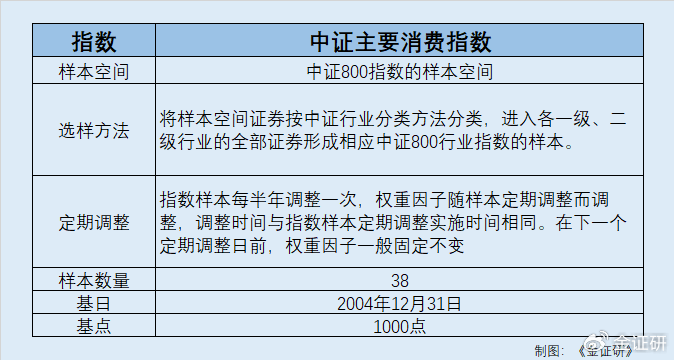
Group 1 - The core viewpoint of the article emphasizes the importance of policies aimed at boosting consumption, highlighting the collaboration between business and financial sectors to enhance consumer spending [1][2] - The China Securities Major Consumption Index, which focuses on the consumption sector, has an average free float market capitalization exceeding 600 billion yuan, reflecting the overall performance of major consumption stocks in the A-share market [2][3] - The index includes 38 sample stocks, with a free float market capitalization ranging from 36.47 billion yuan to 8,885.48 billion yuan, indicating significant growth potential in the consumption sector [2][4] Group 2 - The index is heavily concentrated in the food and beverage sector, with a weight of 67.62%, and agriculture, forestry, animal husbandry, and fishery at 28.42%, together covering over 96% of the index's weight [4][5] - The top ten stocks in the index are supported by leading companies such as Kweichow Moutai, Yili, and Wuliangye, which have strong brand recognition and stable cash flows [5][6] - The ongoing policy support for consumption is expected to enhance the long-term value and growth potential of the consumption sector, making the China Securities Major Consumption Index a quality benchmark for investing in core consumption assets [7]





近期猪价或区间震荡,需关注产能变化
Guotou Securities· 2026-01-14 05:45
Investment Rating - The industry is rated as "Leading the Market - A" with a maintained rating [5]. Core Views - The recent pig prices are expected to fluctuate within a range, with a focus on changes in production capacity [19][21]. - The white feather chicken market is experiencing a supply-demand mismatch, with stable prices but cautious market sentiment [33]. - The aquaculture sector shows stable prices, presenting potential investment opportunities [47]. Summary by Sections 1. Weekly Market Review - The agricultural sector increased by 0.98% during the latest trading week, ranking 29th among the primary industries [12]. - The animal health sector saw significant gains, with notable increases in specific stocks [15]. 2. Industry Data Tracking 2.1. Pig Farming - The average price of live pigs is 12.49 CNY/kg, with a week-on-week increase of 1.54% and a two-week increase of 4.22% [18]. - The average price of piglets is 363 CNY/head, stable over the past two weeks [19]. - The average daily slaughter volume of pigs is 226,500 heads, showing a week-on-week decrease of 5.12% [19]. 2.2. Poultry Farming - The average price of white feather chicken is 7.64 CNY/kg, down 1.04% week-on-week [33]. - The price of chicken seedlings is 3.59 CNY/bird, up 1.70% week-on-week [33]. - The market is stable, but there is a notable increase in inventory levels due to weak demand [33]. 2.3. Planting Sector - The average price of corn is 2,352.77 CNY/ton, with a slight increase of 0.02% week-on-week [42]. - The average price of domestic wheat is 2,512.98 CNY/ton, down 0.12% week-on-week [42]. - The average price of domestic soybeans is 4,048.42 CNY/ton, up 0.50% week-on-week [42]. 2.4. Aquaculture Sector - The average price of carp is 20.00 CNY/kg, stable week-on-week, with a year-on-year increase of 11.11% [47]. - The average price of crab is 260.00 CNY/kg, showing a significant year-on-year increase of 30.00% [47]. - The average price of shrimp is 320.00 CNY/kg, stable week-on-week but down 11.11% year-on-year [47].
开源晨会-20260114
KAIYUAN SECURITIES· 2026-01-14 00:14
Core Insights - The report highlights a rebound in institutional attention towards sectors such as machinery, electronics, and environmental protection, indicating a shift in market focus [3][7][8] - The AI revolution is entering a new phase, with significant advancements in AI chip technology and applications across various industries, particularly in consumer electronics and automotive sectors [4][13][17] Sector Summaries Electronics - Major tech companies like NVIDIA, AMD, Intel, and Qualcomm showcased advancements in AI chips at CES 2026, with NVIDIA's VeraRubin platform achieving a tenfold reduction in AI inference costs [4][13] - AMD's Helios platform demonstrated a tenfold performance increase over previous generations, gaining recognition from leading clients like OpenAI [4][13] - The overall trend indicates continuous improvement in AI inference performance and decreasing costs due to iterative advancements in chip architecture and manufacturing processes [4][13] Agriculture, Forestry, Animal Husbandry, and Fishery - The report anticipates a peak in pig slaughtering by late January, with prices expected to slightly rise from a low base before the Lunar New Year [5][19] - In December 2025, the average selling price of pigs was 11.59 yuan/kg, reflecting a month-on-month decrease of 0.84% and a year-on-year decrease of 26.23% [5][19] - The supply dynamics are influenced by previous over-selling and expectations of price increases, leading to a forecasted weak supply and slight price recovery [5][19][20] Machinery - The report notes an increase in institutional research activity in the machinery sector, indicating growing interest and potential investment opportunities [3][8] - Companies like Chaojie Co. are highlighted for their growth in automotive parts, with a reported revenue increase of 34.49% year-on-year for the first three quarters of 2025 [11] Consumer Electronics - Innovations in traditional consumer electronics are increasingly focused on software and AI interaction experiences, with companies like Lenovo and Dell enhancing their product offerings [14] - The introduction of AI glasses and other AI-enabled devices is marking a significant shift towards personalized and scenario-specific applications in the consumer electronics market [15][17]
生物制造的底层逻辑与产业链分析(附100佳核心企业)
材料汇· 2026-01-13 11:56
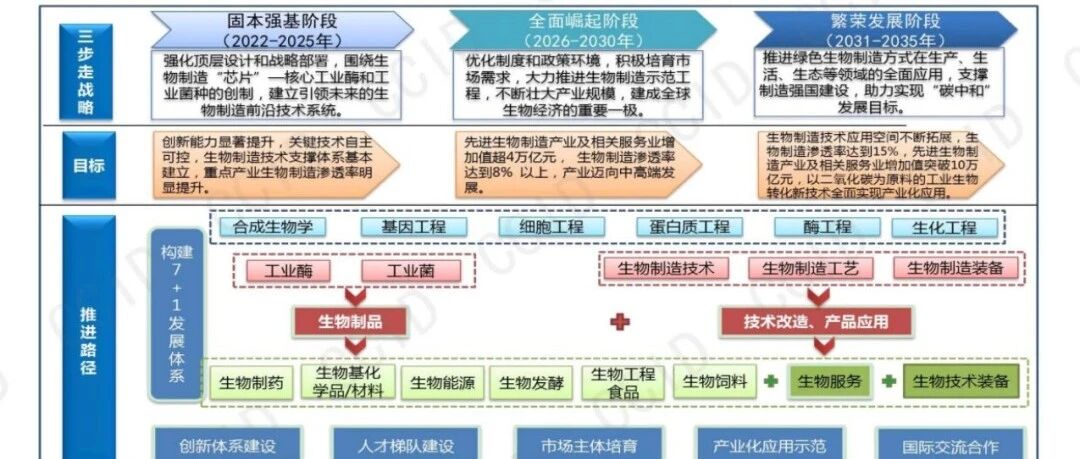
Core Viewpoint - Biomanufacturing is identified as a key future industry in China's 14th Five-Year Plan, expected to create a market worth trillions in the next decade, driven by advancements in technology and policy support [2][5]. Group 1: Industry Overview - The biomanufacturing industry in China is nearing a total scale of 1 trillion yuan, with fermentation capacity accounting for over 70% of the global total [2][4]. - Shenzhen has become a hub for biomanufacturing, with 40% of newly established companies in this sector located there in the past three years, showcasing a significant industry clustering effect [4]. - The industry is supported by a comprehensive system of policy, funding, and technological advancements as outlined in the 14th Five-Year Plan [5]. Group 2: Key Enterprises - The article identifies 100 core enterprises in biomanufacturing, spanning the entire industry chain from upstream technology development to downstream commercial applications [7]. - Notable companies include: - Huada Technology, a leader in gene sequencing technology [17]. - Kaisa Biotech, which has achieved over 80% market share in the global long-chain dicarboxylic acid market [21]. - WuXi Biologics, representing China's capabilities in the global biopharmaceutical industry [27]. Group 3: Upstream Innovations - The upstream sector focuses on providing essential tools and technologies for research and production, with a shift towards domestic innovation and smart integration [16]. - Key trends include the localization of critical tools and the rise of AI-driven platform companies that enhance research efficiency [16][17]. - Over 75% of the 20 identified upstream enterprises are private, indicating a vibrant innovation landscape [16]. Group 4: Midstream Developments - The midstream sector is characterized by a dual structure of "upgraders" and "disruptors," with companies like Meihua Biotech and Chuaning Biotech leading in traditional fermentation while others like Kaisa Biotech innovate with new bioproducts [20][21]. - This segment contains the highest number of enterprises, with 40 out of the 100 identified companies, emphasizing the importance of production capacity and cost control [20]. Group 5: Downstream Applications - The downstream sector serves as a critical market for biomanufacturing, focusing on medical, consumer, and agricultural applications [25]. - Companies like Muyuan Foods exemplify the cost-saving potential of biomanufacturing in agriculture, while WuXi Biologics and Kelaiying represent the pharmaceutical sector's output capabilities [26][27]. - Future trends indicate a broadening of applications into new areas such as biobased textiles and environmental remediation [27].


传东鹏饮料、牧原股份拟最快本周开始香港上市前推介
Zhi Tong Cai Jing· 2026-01-13 11:21
Group 1: Dongpeng Beverage - Dongpeng Beverage plans to raise approximately $1 billion (around 7.8 billion HKD) through its upcoming Hong Kong IPO, with book building expected to start in the week of January 26 [1] - Dongpeng is recognized as the leading functional beverage company in China, with the highest revenue growth among the top 20 listed soft drink companies globally [1] - According to a report by Frost & Sullivan, Dongpeng has maintained its position as the number one functional beverage brand in China for four consecutive years since 2021, increasing its market share from 15.0% in 2021 to 26.3% in 2024 [1] - By retail value, Dongpeng is projected to be the second-largest functional beverage company in 2024, holding a market share of 23.0% [1] Group 2: Muyuan Foods - Muyuan Foods is a technology-driven leader in the pork industry, recognized as a pioneer in smart pig farming [2] - The company employs a vertically integrated business model that encompasses the entire pork supply chain, including breeding, farming, feed production, and meat processing [2] - Revenue from the sale of commercial pigs constitutes a significant portion of Muyuan's total income, accounting for 92.8%, 96.5%, 95.2%, 93.0%, and 92.7% of total revenue for the years 2022, 2023, 2024, and the six months ending June 30, 2024, and 2025, respectively [2]

新股消息 | 传东鹏饮料(605499.SH)、牧原股份(002714.SZ)拟最快本周开始香港上市前推介
智通财经网· 2026-01-13 11:19
Group 1: Dongpeng Beverage - Dongpeng Beverage plans to raise approximately $1 billion (around 7.8 billion HKD) through its upcoming Hong Kong IPO, with book building expected to start in the week of January 26 [1] - Dongpeng is the leading functional beverage company in China, with the highest revenue growth among the top 20 listed soft drink companies globally [1] - According to a report by Frost & Sullivan, Dongpeng has ranked first in the Chinese functional beverage market by sales for four consecutive years since 2021, with market share increasing from 15.0% in 2021 to 26.3% in 2024 [1] - By retail revenue, Dongpeng is projected to be the second-largest functional beverage company in 2024, holding a market share of 23.0% [1] Group 2: Muyuan Foods - Muyuan Foods is a technology-driven leader in the pork industry, recognized as a pioneer in smart pig farming [2] - The company employs a vertically integrated business model that covers the entire pork industry chain, including breeding, farming, feed production, and slaughtering [2] - Revenue from the sale of commercial pigs constitutes a significant portion of Muyuan's total income, accounting for 92.8%, 96.5%, 95.2%, 93.0%, and 92.7% for the years 2022, 2023, 2024, and the six months ending June 30, 2024, and 2025, respectively [2]
新股消息 | 传东鹏饮料、牧原股份拟最快本周开始香港上市前推介
Zhi Tong Cai Jing· 2026-01-13 11:19
Group 1: Dongpeng Beverage - Dongpeng Beverage plans to raise approximately $1 billion (around 7.8 billion HKD) through its upcoming Hong Kong IPO, with book building expected to start in the week of January 26 [1] - Dongpeng is the leading functional beverage company in China, ranking first in revenue growth among the top 20 publicly listed soft drink companies globally [1] - According to a report by Frost & Sullivan, Dongpeng has maintained its position as the number one functional beverage brand in China for four consecutive years since 2021, with market share increasing from 15.0% in 2021 to 26.3% in 2024 [1] - By retail revenue, Dongpeng is projected to be the second-largest functional beverage company in 2024, holding a market share of 23.0% [1] Group 2: Muyuan Foods - Muyuan Foods is a technology-driven leader in the pork industry, recognized as a pioneer in smart pig farming [2] - The company employs a vertically integrated business model that encompasses the entire pork supply chain, including breeding, farming, feed production, and meat processing [2] - Revenue from the sale of commercial pigs constitutes a significant portion of Muyuan's total income, accounting for 92.8%, 96.5%, 95.2%, 93.0%, and 92.7% of total revenue for the years 2022, 2023, 2024, and the six months ending June 30, 2024, and 2025, respectively [2]
养殖业板块1月13日跌1.9%,京基智农领跌,主力资金净流出8.83亿元
Zheng Xing Xing Ye Ri Bao· 2026-01-13 08:57
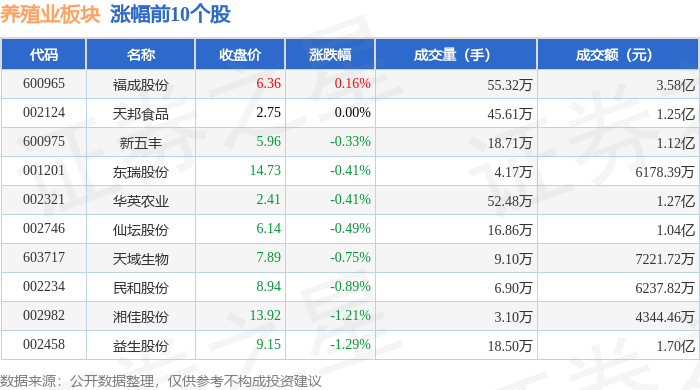
Core Viewpoint - The aquaculture sector experienced a decline of 1.9% on January 13, with Jingji Zhino leading the drop. The Shanghai Composite Index closed at 4138.76, down 0.64%, while the Shenzhen Component Index closed at 14169.4, down 1.37% [1]. Group 1: Market Performance - The aquaculture sector's stocks showed mixed performance, with notable declines in several key companies. For instance, Jingji Zhino fell by 4.62% to a closing price of 15.06, while other companies like Luoniushan and Zhengbang Technology also saw declines of 2.72% and 2.44%, respectively [2]. - The total net outflow of main funds from the aquaculture sector was 8.83 billion yuan, while retail investors saw a net inflow of 5.44 billion yuan [2][3]. Group 2: Individual Stock Performance - Specific stock performances included: - Fucheng Co. closed at 6.36 with a slight increase of 0.16% and a trading volume of 553,200 shares, amounting to a transaction value of 358 million yuan [1]. - Xinfeng Co. had a closing price of 5.96, down 0.33%, with a trading volume of 187,100 shares [1]. - Other notable declines included Minhe Agriculture at 8.94, down 0.89%, and Yisheng Co. at 9.15, down 1.29% [1]. Group 3: Fund Flow Analysis - The fund flow analysis indicated that: - New Wufeng had a main fund net inflow of 2.92 million yuan, while retail investors contributed a net inflow of 1.24 million yuan [3]. - In contrast, Dongrui Co. experienced a main fund net outflow of 3.08 million yuan, with retail investors contributing a net inflow of 6.36 million yuan [3]. - The overall trend showed that while main funds were exiting the sector, retail investors were actively buying into certain stocks [2][3].


上海促消费新政重磅落地,积极布局内需消费!消费ETF(159928)回调超1%,大举揽金超6.8亿份!此前5日累计“吸金”超16亿元!
Sou Hu Cai Jing· 2026-01-13 07:04
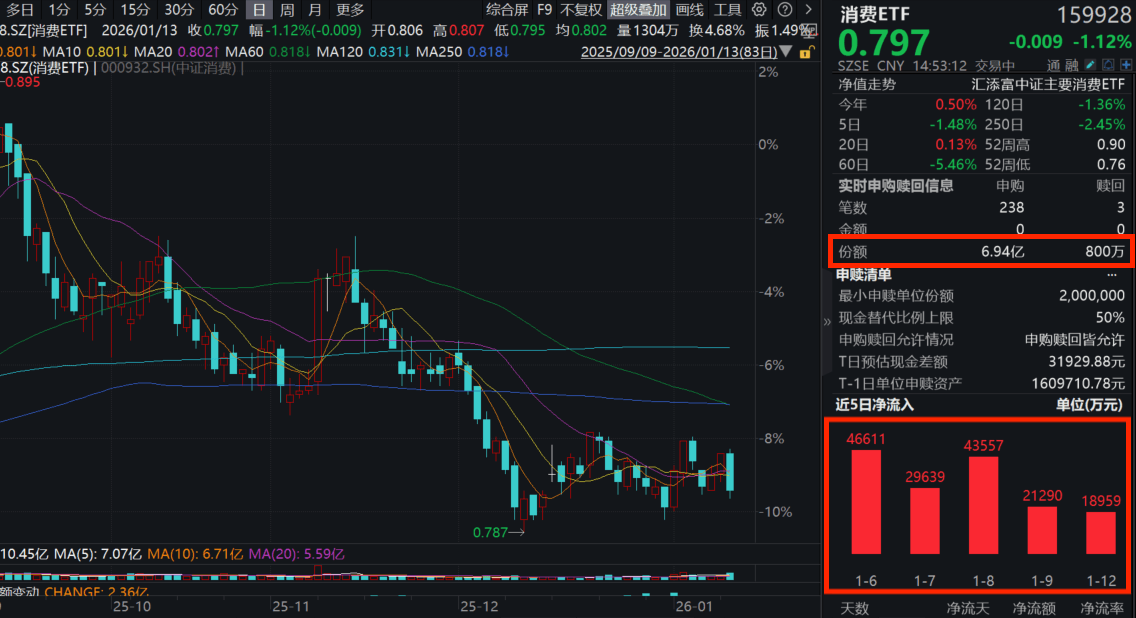
Group 1 - The Shanghai Composite Index experienced fluctuations and a decline, with the consumer sector retreating, as the Consumption ETF (159928) corrected over 1% after two consecutive days of gains, with trading volume exceeding 1 billion yuan [1] - The Shanghai municipal government issued measures to enhance service quality and stimulate consumption, focusing on 28 policy initiatives aimed at optimizing supply and expanding consumption, particularly in key sectors like finance, transportation, and entertainment [3] - Moutai 1935 may implement a new pricing system, with both the payment price and retail price expected to decrease, indicating a potential gross margin of nearly 10% even after the price adjustment [4] Group 2 - The Hong Kong Stock Connect Consumption 50 ETF (159268) fell by 0.86%, with major stocks like Pop Mart and Li Ning experiencing declines of over 3% [6] - Domestic consumption is becoming a key driver of economic growth, with a shift in consumer behavior towards personalized and emotional spending, creating numerous niche opportunities [8] - The Consumer Price Index (CPI) rose by 0.8% year-on-year in December 2025, reflecting the effectiveness of consumption policies and increased consumer demand [9] Group 3 - The Consumption ETF (159928) has a strong resilience to economic cycles, with the top ten constituent stocks accounting for over 68.55% of its weight, including major liquor brands and agricultural companies [10] - The top holdings in the ETF include Yili, Moutai, and Wuliangye, with significant representation from the food and beverage sector [11] - The Hong Kong Stock Connect Consumption 50 ETF (159268) offers efficient access to the consumer sector, particularly targeting the Z generation's spending trends [12]
牧原股份跌2.01%,成交额17.76亿元,主力资金净流出2.95亿元
Xin Lang Cai Jing· 2026-01-13 06:31
Core Viewpoint - The stock price of Muyuan Foods Co., Ltd. has experienced a decline, with a current trading price of 48.36 yuan per share, reflecting a year-to-date drop of 4.39% and a 5-day drop of 5.88% [1] Group 1: Stock Performance - As of January 13, the stock price of Muyuan Foods fell by 2.01%, with a trading volume of 1.776 billion yuan and a turnover rate of 0.95% [1] - The company has seen a net outflow of 295 million yuan in principal funds, with significant selling pressure observed [1] - The stock has declined by 4.39% year-to-date, 5.88% over the last five trading days, and 4.46% over the last 60 days [1] Group 2: Financial Performance - For the period from January to September 2025, Muyuan Foods reported a revenue of 111.79 billion yuan, representing a year-on-year growth of 15.52% [2] - The net profit attributable to shareholders for the same period was 14.779 billion yuan, showing a year-on-year increase of 41.01% [2] Group 3: Shareholder Information - As of September 30, 2025, the number of shareholders for Muyuan Foods was 185,600, a decrease of 11.19% from the previous period [2] - The average number of circulating shares per shareholder increased by 12.60% to 20,534 shares [2] - The company has distributed a total of 26.576 billion yuan in dividends since its A-share listing, with 16.594 billion yuan distributed in the last three years [3]