智元机器人

Search documents
人形机器人企业集体扩产背后是机遇还是“不扩产就丢单”的焦虑?
Tai Mei Ti A P P· 2025-12-19 04:33
文 | GPLP看科技,作者 | 马赫环 2025年对于人形机器人行业来说,确实可以被称为"量产元年",其中的重要标志就是已经有企业初步构 建了一定的量产能力。如智元机器人已经于12月8日宣布,其通用具身机器人已经累计下线5000台,其 中远征系列(A1/A2)下线1742台,精灵系列(G1/G2)为1412台,灵犀系列(X1/X2)达到了1846 台。 在目前的政策态度、市场氛围以及技术发展方向来看,2026年的国内人形机器人企业将具备更大规模的 量产能力。然而,现在的问题是当前阶段的市场能承载下快速增长的产能吗? 海内外同频,人形机器人产能扩张势不可挡 日前,人形机器人赛道正上演着预期与现实的激烈碰撞,这种碰撞不止是源于核心零部件对现有产品的 制约,也有产能快速扩张与现有市场的不匹配。 11月就有报道称,高盛发布了《中国人形机器人供应链实地调研报告》,高盛调研9家中国机器人产业 链企业,认为这些机器人零部件公司正规划中国及海外产能,规划年产能10万台至100万台机器人。但9 家公司中,尚无任何一家获得确定性大额订单,也没有明确的量产计划。 这9家企业中包括了三花智控(002050.SZ/2050.HK)、 ...


估值超越宇树、智元,这家把机器人送去“开店”的公司,刚刚融了3亿美金
3 6 Ke· 2025-12-19 04:22
近日,银河通用机器人(以下简称"银河通用")官宣完成新一轮超3亿美元(约21亿人民币)融资。 本轮融资由中国移动链长基金领投,中金资本、中科院基金、苏创投、央视融媒体基金、天奇股份等重量级投资平台及产业巨头联合注资,并同步获得来 自新加坡、中东的国际投资机构及老股东的加注。 本次融资金额刷新了中国具身智能领域单轮融资纪录。根据公开资料统计,银河通用累计融资额达到约8亿美元,估值已达30亿美元,超200亿人民币,也 是目前人形机器人行业最高估值。 银河通用成立于2023年5月,创始人兼CTO王鹤拥有清华本科、斯坦福博士的学术履历,师从美国三院院士Leonidas J. Guibas教授,是具身智能大模型领 域的领军学者;联合创始人姚腾洲拥有北航机器人研究所的学术背景及千万级智能硬件的量产经验。 "天才学者创始人"的技术笃定 成立仅两年,估值超过两百亿,银河通用有比较鲜明的技术标签,在上一轮11亿人民币融资之后,银河通用创始人王鹤对腾讯科技坦言:"具身智能尚在 早期,技术曙光初现。面对无限种可能,创业公司面临无数个基于技术自信的关键选择。" 在行业普遍依赖人力遥操采集数据时,王鹤多次公开宣讲"合成数据策略","高 ...

东海证券晨会纪要-20251219
Donghai Securities· 2025-12-19 04:01
Group 1: Key Recommendations - Focus on the commercialization progress of embodied intelligent robots, anticipating the establishment of industry standards and ecosystem co-construction [5][7] - Yushutech recently launched a humanoid robot "App Store," facilitating model sharing and establishing a product ecosystem [5] - UBTECH has secured new orders exceeding 50 million yuan for its autonomous industrial humanoid robot Walker S2, which will be delivered within the year [6] Group 2: Industry Tracking - The industry is accelerating the construction of standards and evaluation systems to promote training and pilot platform development, guiding orderly industrial development [7][8] - The "Humanoid Robot Intelligence Grading" group standard has been established, categorizing humanoid robots into five levels (L1-L5) to clarify technical development directions [7] - The Beijing Humanoid Robot Innovation Center is building a public service platform for embodied intelligent robots, providing comprehensive services from technology development to industrial application [8] Group 3: U.S. Employment Market Analysis - The U.S. non-farm employment data for November 2025 showed an increase of 64,000 jobs, slightly above expectations, but the unemployment rate rose from 4.4% to 4.6%, the highest since October 2021 [11][12] - The increase in the unemployment rate is primarily attributed to a surge in re-employment, with 293,000 re-employed individuals in October and November, contributing 129% to the new unemployment figures [12][16] - The labor market is exhibiting signs of "tight balance" vulnerability, with an increase in both immigrant and domestic labor supply, while demand remains weak [12][16] Group 4: Economic Indicators - The European Central Bank maintained its key interest rates, with the deposit facility rate at 2% and the main refinancing rate at 2.15% [19] - The U.S. CPI for November increased by 2.7% year-on-year, lower than the expected 3.1% [19] - The People's Bank of China resumed 14-day reverse repurchase operations, injecting liquidity into the market [19]
商汤科技进军具身智能 大晓机器人走“开源+生态协同”之路
2 1 Shi Ji Jing Ji Bao Dao· 2025-12-18 23:19
Core Insights - SenseTime's Xiaodao Robot is set to debut by the end of 2025, focusing on ecosystem collaboration within the AI industry chain, unlike its peers [1] - The company emphasizes a human-centered approach to address real-world needs with integrated hardware and software products [1] - The transition to embodied intelligence requires a fundamental paradigm shift in data collection and model training due to a significant data volume gap [1][2] Data and Technology - The ACE embodied research paradigm allows for the collection of tens of millions of hours of data annually, significantly enhancing the value of real data [2] - Current embodied intelligence data is limited to 100,000 hours, while Tesla's FSD V14 achieves a training equivalent to 400 million hours of human driving experience daily [1] - The ACE paradigm utilizes environmental data collection through multi-modal devices, providing comprehensive data support for model training [4] Industry Trends - The global humanoid robot market is projected to reach 6 million units sold by 2035, with a market size exceeding $120 billion, potentially rising to $260 billion in optimistic scenarios [6] - Investment institutions are increasingly focusing on the humanoid robotics sector, anticipating a shift towards mass production and diverse business models [6] Challenges and Solutions - The current data collection methods are costly and inefficient, leading to a lack of general cognitive and adaptive capabilities in robots [4] - The industry consensus is that the true value of robots lies in their ability to solve real-world application challenges rather than their physical form [5] - Key obstacles to large-scale deployment include the need for improved data protection and the replicability of industrial applications [6] Cost Reduction and Future Outlook - Key components like planetary roller screws and six-dimensional torque sensors account for about 40% of total costs, with potential reductions of 70% to 80% as domestic supply chains mature [7] - Breakthroughs in AI chips, battery management, and thermal management are expected to take 5 to 10 years, impacting overall cost structures [7] - As costs decrease, humanoid robots may surpass human labor in investment returns, marking a critical point for large-scale replacement of human workers [7]
业界热议:具身智能领域存在一定泡沫,人形机器人明年上半年恐遇到低谷
Mei Ri Jing Ji Xin Wen· 2025-12-18 16:01
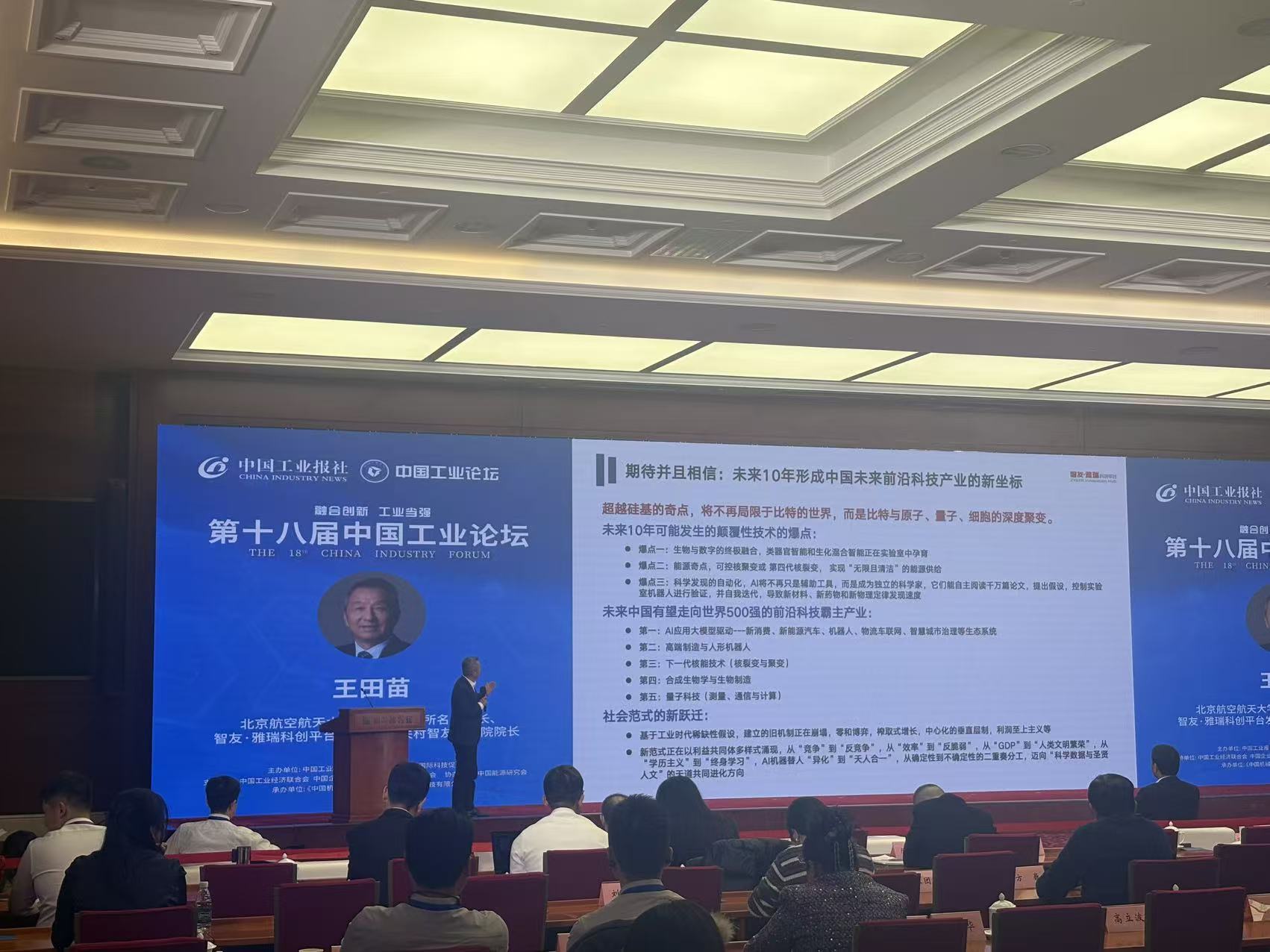
12月16日,第十八届中国工业论坛在京召开。 在论坛上,北京航空航天大学机器人研究所名誉所长、智友点·雅瑞科创平台发起人、中关村智友研究院院长王田苗作了题为《具身智能何以成为新的经济 增长点?》的主题演讲。 他表示,人工智能与数字化浪潮是推动实体经济转型的核心动力。他提出AI发展的两大方向:AI向科学发现推进,通过模型与数据驱动新材料、新药物甚 至物理规律的发现;AI向物理世界挺进,激活一切数据、使一切设备智能化、重构一切软件,实现数控机床、机器人、家电等领域的智能化升级。 企业:预判人形机器人在明年上半年恐遇低谷 当被问及具身智能领域是否有泡沫时,乐聚通研(北京)机器人技术有限公司副总经理苏垚坦言,现阶段具身智能赛道确实存在一定泡沫,但泡沫是暂时 的。"我们内部判断人形机器人可能在明年上半年会遇到一个低谷,就是泡沫逐渐破碎的时候。" 专家:缺乏应用场景与核心技术支撑的具身智能项目可能面临淘汰 在演讲中,他分享了对2026年具身智能领域一级市场孵化投资机会的思考,包括垂直领域应用、端侧芯片、灵巧手执行器/视触觉传感器等。 在随后由王田苗主持的圆桌论坛上,与会者围绕"开启智能新时代"议题,探讨了数实融合与工业A ...
这位95后,一年5轮融资,被雷军追着投资
Sou Hu Cai Jing· 2025-12-18 14:52
责编 | 柒排版| 沐言 第 9340篇深度好文:5664字 | 11 分钟阅读 商业趋势 笔记君说: 2025年,中国具身机器人赛道风起云涌。 从今年年初,宇树科技的机器人登上春晚,正式拉开了中国具身智能机器人元年的大幕; 到今年年底,整个具身智能机器人行业百花其放,涌现出大量的明星企业,智元、众擎、小鹏、优必选…… 显然,具身智能机器人赛道正在成为未来最具想象力的赛道。 根据摩根士丹利全球具身AI团队在最新发布的《机器人年鉴》中预测,基准情形下,全球机器人硬件销售额将从2025年的约1000亿美元激增至2030年的 5000亿美元,2040年达到9万亿美元,并在2050年攀升至25万亿美元。 这一预测仅涵盖硬件销售,若加上软件服务、维护及供应链相关收入,市场规模可能成倍增长。 而今天,我们要分享的也正是一位当下机器人赛道炙手可热的创业明星——首形科技的创始人胡宇航。 大多数人可能都没太听说过这个名字,但是下面视频中的这个机器人,大家应该或多或少在短视频平台上刷到过。 视频中的机器人正是由胡宇航和首形科技研发而成,可以说,在具身机器人微表情领域,胡宇航和他创立的首形科技正在成为行业最受关注的标的之一。 从2 ...

“狂人”俞浩,吹响追觅上市号角?
Xin Lang Cai Jing· 2025-12-18 14:24
俞浩"阳谋"藏不住了 12月16日晚,嘉美包装公告称,苏州逐越鸿智通过股权转让和发起要约收购的方式,共收购54.90%的股份,涉及交易总对价约22.82亿元,意味着交易完 成后,实控逐越鸿智的俞浩将成为上市公司新实控人。 公告一出,便引发了大量媒体的关注,坊间有关俞浩要借壳上市的声音更是此起彼伏。 通常只要收购方完成对上市公司的控制权变更,再将其资产注入上市公司,并在资产、营收、净利、净资产、股本等方面满足相应标准比如要求标的公司 最近两年净利润均为正且累计不低于5000万元后,就能完成借壳上市。 虽然嘉美包装公告中还提及"目前不存在未来12个月内改变上市公司主营业务或对上市公司主营业务进行重大调整的计划。"即目前未构成实质借壳,但是 控股股东变更,仍然带给资本市场强烈刺激,17日嘉美包装复牌"一字"涨停。 显然,对资本市场而言,俞浩这笔23亿的大买卖释放了重磅利好面。 据上海证券报报道,"老牌金属包装巨头迎来科技掌门人,科技赋能传统制造信号强烈。"有市场人士分析认为,随着俞浩入主,嘉美包装或将踏上由"制 造"向"智造"的转型之路。 曾放话造手机跟华为小米三分天下、造车对标布加迪威龙的科技"狂人"俞浩,最近又 ...

首创ACE具身研发范式 大晓机器人构建具身智能开放新生态
Zheng Quan Shi Bao Wang· 2025-12-18 14:04
Core Insights - The launch of the ACE (Ambient Capture Engine) and the open-source Kairos 3.0 model marks a significant advancement in embodied intelligence, aiming to create a fully autonomous and controllable ecosystem in the industry [1][2] - The focus on "human-centered" ACE development paradigm emphasizes the interaction between humans and the physical world, enabling extensive data collection and enhancing the value of real data [1][2] Group 1 - The ACE paradigm allows for the collection of millions of hours of environmental data, which can scale to over a billion hours of data value through the Kairos 3.0 model [1] - The Kairos 3.0 model is open-sourced for developers, facilitating the rapid emergence of lightweight and customized embodied intelligence products [2] - Strategic partnerships with various companies, including Mu Xi Co., Wallen Technology, and Zhongke Shuguang, have been established to enhance chip performance and adapt the Kairos 3.0 model [2] Group 2 - The launch of the A1 super brain module aims to accelerate the commercialization of robots and enhance the value of the embodied intelligence industry [2] - Collaboration with leading companies in the field of robotics, such as Zhiyuan Robotics and Galaxy General, is focused on creating solutions suitable for various scenarios [2] - The expectation of large-scale deployment of four-legged robots in retail sectors like front warehouses and flash purchase warehouses is anticipated to begin next year [3]
中国出口开AI新局:旧硬件打不开新世界
Di Yi Cai Jing· 2025-12-18 12:00
Core Viewpoint - The rise of AI technology is becoming essential for consumer electronics, particularly for Chinese manufacturers, as they prepare for the upcoming CES in Las Vegas, where AI-enabled products are expected to dominate the showcase [1][2]. Group 1: AI Integration in Consumer Electronics - AI has become an unavoidable trend for Chinese manufacturers, with most exhibitors at CES expected to present AI-capable products [2]. - MINISFORUM, a Shenzhen-based company, is focusing on AI integration across its product lines, including Mini PCs and AI workstations, with personal computers being its main revenue source [2]. - Major PC manufacturers like Lenovo and Dell are also embracing AI, but MINISFORUM leverages flexibility in niche markets like Mini PCs, targeting specific audiences with higher-end components [2][3]. Group 2: Market Dynamics and Competition - China's PC exports are under pressure, with a significant portion already featuring basic AI capabilities; Lenovo reported that 33% of its AI PCs were shipped in Q3, with expectations for continued double-digit growth [3]. - The global PC market is projected to grow by 8.1% year-on-year by Q3 2025, driven by the transition from Windows 10 and the demand for AI-capable PCs [3]. - The competitive landscape is shifting, with India and Vietnam emerging as strong contenders in the consumer electronics space, impacting China's export dynamics [6][7]. Group 3: Future Hardware Trends - Smart glasses are seen as a potential next-generation hardware, with companies betting on their ability to transform human-computer interaction [9][10]. - Humanoid robots are a focal point of competition between China and the U.S., with significant investments and advancements expected in manufacturing applications [11]. - The Mini AI workstation is anticipated to become a central computing hub for households, with MINISFORUM's latest model showcasing advanced AI capabilities [12]. Group 4: Export and Trade Insights - China accounts for 15% of global exports and maintains trade surpluses with 177 economies, with expectations to increase its market share to 16.5% by 2030 [13]. - The changing landscape of global trade, influenced by U.S. tariffs and competition from India and Vietnam, is prompting Chinese companies to diversify their markets [7][8].

中国出口开AI新局:旧硬件打不开新世界 | 海斌访谈
Di Yi Cai Jing· 2025-12-18 11:33
Core Viewpoint - The AI ecosystem in China and the US surpasses that of other countries, with AI expected to help strengthen China's manufacturing competitiveness globally [1] Group 1: AI Integration in Consumer Electronics - The upcoming CES in Las Vegas is a significant platform for Chinese consumer electronics, with AI becoming an essential trend for manufacturers [3] - MINISFORUM, a Shenzhen-based company, is fully integrating AI into its products, including Mini PCs and AI workstations, with a focus on niche markets [3][4] - Major PC manufacturers like Lenovo and Dell are also embracing AI, but companies like MINISFORUM leverage flexibility to target specific audiences [3] Group 2: Market Trends and Growth Projections - Lenovo's AI PC shipments reached 33% in Q3, with expectations for double-digit growth in the coming quarters [4] - MINISFORUM anticipates that 60% of its exported PCs will have AI capabilities, potentially reaching 100% within a year [4] - Counterpoint Research forecasts an 8.1% year-on-year growth in global PC shipments by Q3 2025, driven by the transition from Windows 10 [4] Group 3: Competitive Landscape - China's smartphone and computer exports are under pressure, with a notable decline in mobile exports to the US [7][8] - India and Vietnam are emerging as significant competitors in the consumer electronics space, with India becoming the largest source of mobile imports to the US [8][9] - The shift in global supply chains due to trade tensions is prompting Chinese companies to diversify their markets beyond the US [9][10] Group 4: Future Hardware Innovations - Smart glasses are seen as a potential next dominant hardware, with both Chinese and foreign companies investing heavily in this area [12][13] - Humanoid robots are a focal point of competition between China and the US, with significant investments and advancements expected in manufacturing applications [14] - The Mini AI workstation is positioned as a future computing center for households, with potential applications across various industries [15] Group 5: Export Market Dynamics - China accounts for 15% of global exports and maintains trade surpluses with 177 economies, with projections indicating an increase to 16.5% by 2030 [16]