华安证券

Search documents
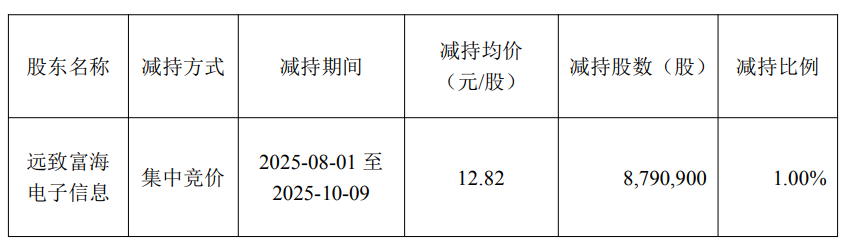
麦捷科技控股股东完成减持879.1万股 套现1.13亿元
Zhong Guo Jing Ji Wang· 2025-10-13 06:57
Core Viewpoint - The controlling shareholder of Maijie Technology has completed a share reduction plan, selling approximately 8.79 million shares, which represents 1% of the company's total share capital, at an average price of 12.82 yuan per share, totaling around 113 million yuan [1][2]. Group 1: Share Reduction Details - The controlling shareholder, Shenzhen Yuanzhi Fuhai Electronic Information Investment Enterprise, disclosed a plan to reduce its holdings by up to 8,790,958 shares [1]. - The share reduction was executed between August 1, 2025, and October 9, 2025, with a total of 8,790,900 shares sold [2]. - The average selling price during the reduction was 12.82 yuan per share, resulting in a total reduction amount of approximately 113 million yuan [1][2]. Group 2: Company Structure and Transactions - Maijie Technology's controlling shareholder is Shenzhen Yuanzhi Fuhai Electronic Information Investment Enterprise, with Shenzhen Special Development Group Co., Ltd. as the actual controller [2]. - The company is involved in a transaction to acquire 100% equity of Anker Yuan and 20% minority equity of Jinzhichuan, increasing its stake in Jinzhichuan to 87.5% post-transaction [2][3]. - The company plans to raise up to 101.4 million yuan through a private placement to no more than 35 specific investors as part of the asset acquisition [3].


关于新增信达证券等机构为万家智胜量化选股股票型证券投资基金销售机构的公告
Zhong Guo Zheng Quan Bao - Zhong Zheng Wang· 2025-10-12 23:14
Group 1 - The company has signed sales agreements with multiple securities firms to offer a new fund called "Wanjia Zhisheng Quantitative Stock Selection Fund" starting from October 13, 2025 [1][4] - The fund will be publicly offered from October 13 to October 24, 2025, through designated sales institutions, allowing investors to open accounts and subscribe [1] - After the fund is established, investors can also engage in subscription, redemption, and regular investment activities, with specific fees determined by the sales institutions [1] Group 2 - Investors can consult various securities firms for more details, including contact numbers and websites for each firm [2]




股市必读:华安证券(600909)10月10日主力资金净流入398.21万元,占总成交额1.15%
Sou Hu Cai Jing· 2025-10-12 20:35
Summary of Key Points Core Viewpoint - As of October 10, 2025, Huazhong Securities (600909) closed at 6.41 yuan, reflecting a 0.31% increase with a turnover rate of 1.15% and a trading volume of 539,800 shares, amounting to a transaction value of 347 million yuan [1]. Trading Information - On October 10, 2025, the net inflow of main funds was 3.98 million yuan, accounting for 1.15% of the total transaction value - Retail investors contributed a net inflow of 1.44 million yuan, representing 4.16% of the total transaction value - Speculative funds experienced a net outflow of 18.42 million yuan, which is 5.31% of the total transaction value [1][3]. Company Announcements - The convertible bond conversion results and share changes were announced, indicating that from September 18, 2020, to September 30, 2025, a total of 825,000 yuan worth of convertible bonds were converted into A-shares, resulting in 116,112 shares, which is 0.0032% of the total shares before conversion - As of September 30, 2025, the remaining unconverted convertible bond amount was 2.799 billion yuan, making up 99.9705% of the total issuance - From January 1, 2025, to September 30, 2025, 13,000 yuan worth of convertible bonds were converted into 2,215 shares, with the total number of unrestricted circulating shares increasing from 4,678,398,535 to 4,678,400,246 shares, resulting in an increase of 1,711 shares [1].
可转债市场交投活跃 年内成交额同比增超37%
Zheng Quan Ri Bao· 2025-10-12 15:52
Core Insights - The convertible bond market has shown strong performance in 2023, with a year-to-date trading volume increase of over 37% and a cumulative rise of 17.14% in the China Convertible Bond Index as of October 10 [2][3] Market Overview - The convertible bond market is experiencing a tightening supply-demand dynamic, driven by a strong equity market and increased investor confidence due to regulatory support and breakthroughs in the technology sector [2][3] - The total outstanding convertible bonds decreased significantly to 606.43 billion yuan, down 127.21 billion yuan from the beginning of the year, with 33 new bonds issued and 119 bonds exiting the market [2][3] Supply and Demand Dynamics - The number of strong redemption cases has increased, primarily due to rising stock prices triggering redemption mechanisms, leading to a contraction in supply while demand remains stable [3] - The average price of convertible bonds is currently at 147.6 yuan, with an average conversion premium of 38.42%, indicating that the market valuation is within a reasonable range [3][4] Future Outlook - The convertible bond market is expected to enter a wide fluctuation range in Q4 2025, with a focus on low-priced bonds that have conversion demands [4] - Investors are advised to pay attention to technology-related catalysts and opportunities related to the "14th Five-Year Plan," particularly in the new energy sector and high-quality technology bonds [4]
三季度金融机构被罚没超10亿,四家机构收超6000万大罚单
2 1 Shi Ji Jing Ji Bao Dao· 2025-10-11 15:02
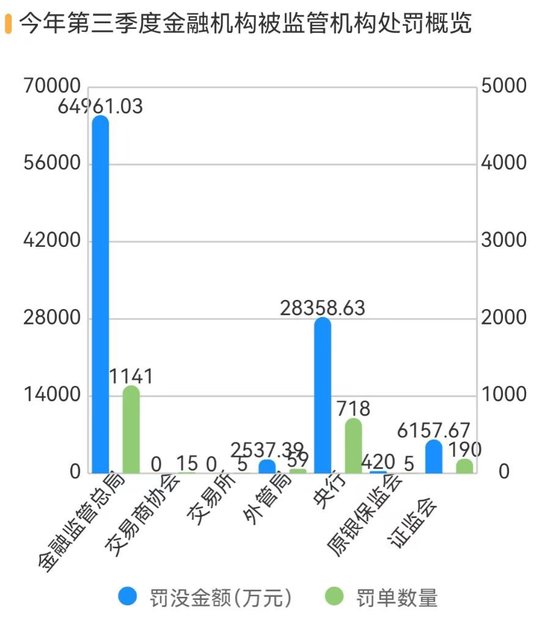
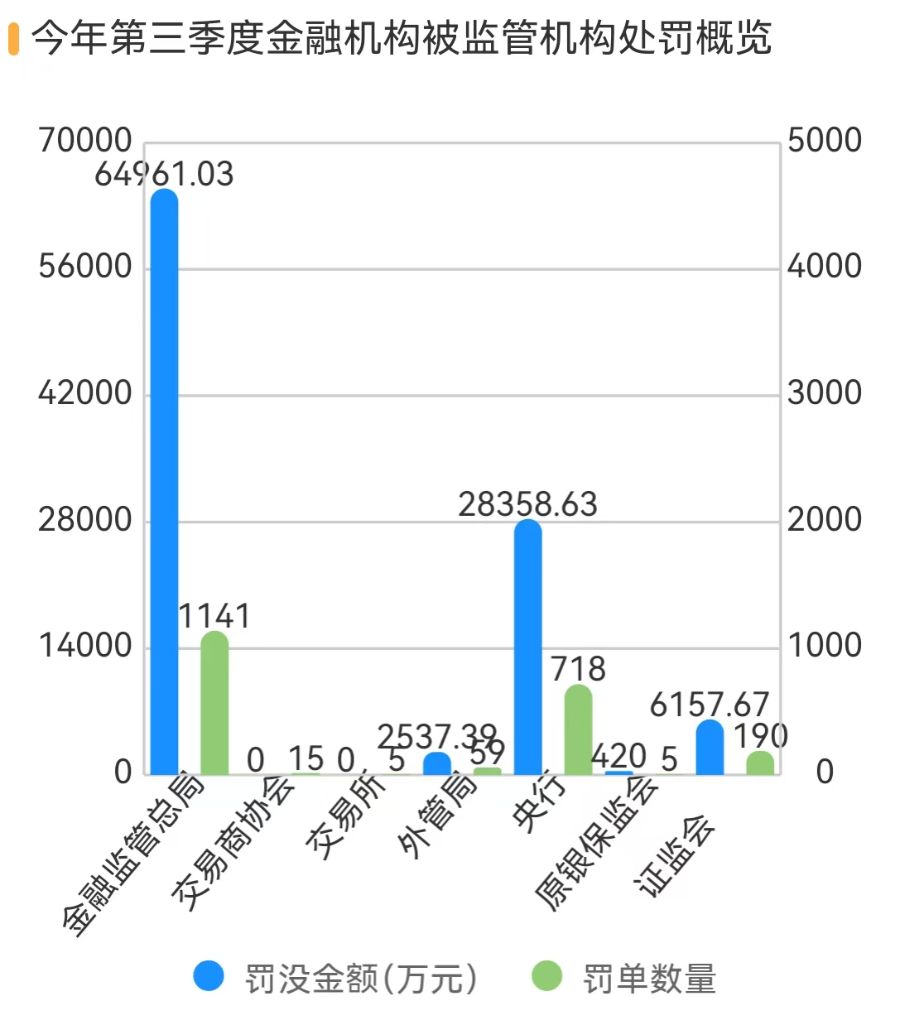
Core Points - In the third quarter of this year, financial institutions received a total of 2,133 fines, amounting to 1.024 billion yuan, representing significant increases of 36.12% and 190.91% respectively compared to the previous quarter, and a notable rise compared to the same period last year [1] Summary by Sections 1. Penalty Situation of Different Types of Institutions in Q3 - The National Financial Regulatory Administration issued 1,141 fines to financial institutions in Q3, totaling 650 million yuan, with a slight decrease of 20.82% in the number of fines year-on-year, but an increase of 46.4% in the total amount [3] - The central bank's penalties increased significantly, with 718 fines issued, a year-on-year increase of 357.32%, and a total penalty amount of 284 million yuan, up 353.34% year-on-year [3] 2. Overall Penalty Situation in the First Three Quarters - The penalty intensity was high in Q1, decreased in Q2, and increased again in Q3 [4] 3. Penalty Breakdown by Institution Type in Q3 - Banks received 1,448 fines, an increase of 18.3% year-on-year, with a total penalty amount of 829 million yuan, up 84.63% year-on-year [8] - Insurance companies received 471 fines, a slight increase of 7.29%, with a total penalty amount of 93.86 million yuan, up 41.57% year-on-year [8] - Securities firms received 45 fines, a decrease of 30.77% year-on-year, but an increase of 40.63% compared to the previous quarter [8] 4. Major Penalties in Q3 - Four fines exceeding 60 million yuan were issued, with Huaxia Bank receiving the largest fine of 87.25 million yuan for imprudent management of loans and related business [13][14] - Other significant fines included 66.70 million yuan for Guangfa Bank and 61.50 million yuan for Hengfeng Bank, both for similar violations [14] 5. Compliance Characteristics in Q3 - There was a notable increase in penalties for internet business violations, with 15 fines issued, a 275% increase from Q2, involving institutions like Postal Savings Bank and Zhejiang Merchants Bank [19] - Loan misappropriation issues were prominent, with 60 related fines issued, a 130.77% increase, primarily involving funds misused for repaying bad loans or investment [21] 6. Penalty Rankings of Financial Institutions in Q3 - Huaxia Bank ranked first in total penalties with 91.62 million yuan, followed by Guangfa Bank with 72.84 million yuan and Hengfeng Bank with 65.55 million yuan [23] - Among non-bank institutions, Donghai Securities topped the list with 60 million yuan in penalties, followed by two wealth management companies, Huaxia Wealth Management and Guangyin Wealth Management [25]



A股:大家要准备好,下周一,股市很有可能要重演历史
Sou Hu Cai Jing· 2025-10-11 14:36
Core Viewpoint - The A-share market is at a critical juncture, with the Shanghai Composite Index recently breaking through 3900 points but experiencing a decline, raising questions about potential historical patterns of rebound after breaking key technical levels [1][10]. Market Dynamics - On October 10, the market showed a mixed performance, with the index fluctuating between 3886.31 and 3933.01 points, indicating a fierce battle between bulls and bears around the 3900-point mark [3]. - The technology sector, particularly semiconductor and battery stocks, faced a pullback, while sectors benefiting from export control policies, such as superhard materials and rare earths, remained strong, reflecting a cautious sentiment among investors [3]. Historical Patterns - Historical trends suggest that breaking key technical levels does not always signal a trend reversal; instead, it may serve as an opportunity for bulls to consolidate and gather strength [5]. - Previous instances, such as the adjustment starting on September 2, where the index fell below 3800 points but later rebounded, support the notion of potential recovery after a dip [5]. Financial and Policy Support - Despite the index's adjustment, the market's funding situation remains resilient, with the A-share financing balance reaching 24,292 billion, a record high, and a net buying amount of 508 billion, indicating that some investors are taking advantage of the dip [5]. - Positive developments in the global AI industry, improving profit growth for domestic industrial enterprises, and better expectations for social financing data provide fundamental support for the market [5]. Technical Signals - From a technical analysis perspective, the market is still in a healthy adjustment phase, with key moving averages indicating support levels at 3880 and 3858 points [7]. - The trading volume decreased to 1.13 trillion, showing a "price drop with volume shrinkage" characteristic, which is seen as a healthy consolidation [7]. Institutional Outlook - Most institutions maintain an optimistic outlook for the market, with expectations of continued upward movement post-holiday [7]. - The technology sector is viewed as a crucial theme, with domestic substitution providing clues for sector rotation [7]. Upcoming Key Factors - The critical focus for the upcoming week is whether the bulls can maintain the 3900-point level; a quick recovery could lead to a historical pattern of rebound, while a sustained drop may prolong the adjustment period [10]. - Investors should monitor two key signals: whether trading volume can exceed 1.2 trillion and if sector rotation, particularly in technology, can stabilize [10].
三季度金融机构被罚没超10亿,四家机构收超6000万大罚单
21世纪经济报道· 2025-10-11 14:05
Core Viewpoint - The article highlights a significant increase in penalties imposed on financial institutions in the third quarter, with a total of 2,133 fines amounting to 1.024 billion yuan, marking substantial year-on-year and quarter-on-quarter growth [1]. Group 1: Penalty Overview - In the third quarter, the National Financial Regulatory Administration issued 1,141 fines totaling 650 million yuan, showing a 46.4% increase in penalty amounts year-on-year despite a 20.82% decrease in the number of fines [3]. - The People's Bank of China significantly increased its penalties, issuing 718 fines with a total amount of 284 million yuan, representing a year-on-year increase of 357.32% in the number of fines and 353.34% in penalty amounts [4]. - Overall, the penalty intensity increased in the third quarter after a decline in the second quarter, indicating a trend of heightened regulatory scrutiny [7]. Group 2: Penalty Distribution by Institution Type - Banks received 1,448 fines in the third quarter, an 18.3% increase year-on-year, with total penalties amounting to 829 million yuan, a substantial year-on-year increase of 84.63% [10]. - Insurance companies faced 471 fines, with a slight year-on-year increase of 7.29%, and total penalties of approximately 93.86 million yuan, reflecting a 41.57% increase [10]. - Securities firms received 45 fines, showing a 30.77% decrease year-on-year but a 40.63% increase quarter-on-quarter [10]. Group 3: Major Penalties - Four fines exceeded 60 million yuan in the third quarter, with Huaxia Bank facing the largest penalty of 87.25 million yuan for improper management of loans and regulatory non-compliance [14]. - Guangfa Bank received the second-largest fine of 66.70 million yuan for similar violations, while Hengfeng Bank was fined 61.50 million yuan for issues related to both loan management and wealth management [14]. Group 4: Compliance Cases - Huaxia Securities was penalized for promoting false financial products, resulting in significant client losses, leading to administrative measures against the responsible employee [16][17]. - Donghua Futures faced penalties for improper procurement practices involving funds from its parent company, highlighting internal control deficiencies [18]. Group 5: Compliance Trends - There has been a notable increase in penalties related to internet business violations, with 15 fines issued in the third quarter, a 275% increase from the previous quarter, involving institutions like Postal Savings Bank and Zhejiang Merchants Bank [20]. - Loan misappropriation issues have become prominent, with 60 related fines issued in the third quarter, primarily for using loan funds to repay bad debts or for investment purposes [22][23]. Group 6: Penalty Rankings - In the third quarter, Huaxia Bank led in total penalties with 91.62 million yuan, followed by Guangfa Bank with 72.84 million yuan and Hengfeng Bank with 65.55 million yuan [25]. - Among non-bank institutions, Donghai Securities topped the list with a penalty of 60 million yuan, while two wealth management companies, Huaxia Wealth and Guangyin Wealth, ranked second and third with penalties of 12 million and 11.60 million yuan, respectively [28].

三季度金融机构被罚没超10亿 四家机构收超6000万大额罚单
2 1 Shi Ji Jing Ji Bao Dao· 2025-10-11 07:54
Core Insights - In the third quarter of this year, financial institutions received a total of 2,133 fines, amounting to 1.024 billion yuan, representing significant increases of 36.12% and 190.91% respectively compared to the previous quarter, and a notable rise compared to the same period last year [1] Summary by Sections 1. Penalty Situation in Q3 - The National Financial Regulatory Administration issued 1,141 fines to financial institutions in Q3, totaling 650 million yuan, with a slight decrease of 20.82% in the number of fines year-on-year, but a 46.4% increase in the total amount [2] - The central bank significantly increased its penalties, issuing 718 fines, which is a year-on-year increase of 357.32%, with a total penalty amount of 284 million yuan, also up 353.34% year-on-year [2] 2. Overall Penalty Trends - The overall penalty situation for financial institutions in the first three quarters shows a strong enforcement in Q1, a slight decline in Q2, and a resurgence in Q3 [4] 3. Breakdown by Institution Type - Banks received 1,448 fines in Q3, an increase of 18.3% year-on-year, with penalties totaling 829 million yuan, a year-on-year increase of 84.63% [7] - Insurance companies received 471 fines, with a slight increase of 7.29% year-on-year, and penalties amounting to 93.86 million yuan, up 41.57% [7] - Securities firms received 45 fines, a decrease of 30.77% year-on-year, but an increase of 40.63% compared to the previous quarter [7] 4. Major Penalties - In Q3, there were four penalties exceeding 60 million yuan, with Huaxia Bank receiving the largest fine of 87.25 million yuan for improper management of loans and regulatory data reporting [11] - Guangfa Bank received the second-largest fine of 66.70 million yuan for similar violations [12] - Hengfeng Bank was fined 61.50 million yuan for issues related to loan management and investment [13] 5. Compliance Cases - Huaxia Securities faced penalties for promoting false financial products, resulting in significant client losses [15] - Donghua Futures was penalized for improper procurement processes involving funds [14] 6. Compliance Characteristics - There has been an increase in penalties related to internet business violations, with 15 fines issued in Q3, a 275% increase from Q2 [15] - Loan misappropriation issues were prominent, with 60 related fines issued, a 130.77% increase from the previous quarter [17] 7. Penalty Rankings - In Q3, Huaxia Bank had the highest total penalty amount of 91.62 million yuan, followed by Guangfa Bank at 72.84 million yuan, and Hengfeng Bank at 65.55 million yuan [19] - Among non-bank institutions, Donghai Securities led with a penalty of 60 million yuan, followed by Huaxia Wealth Management and Guangyin Wealth Management [21]


三季度金融机构被罚没超10亿,四家机构收超6000万大额罚单
2 1 Shi Ji Jing Ji Bao Dao· 2025-10-11 07:47
Summary of Key Points Core Viewpoint - In the third quarter of this year, financial institutions received a total of 2,133 fines amounting to 1.024 billion yuan, representing significant increases of 36.12% and 190.91% respectively compared to the previous quarter, and a notable rise from the same period last year [1]. Group 1: Penalty Overview - The National Financial Supervision Administration issued 1,141 fines totaling 650 million yuan in the third quarter, with a year-on-year increase of 46.4% in penalty amounts despite a slight decrease of 20.82% in the number of fines [1]. - The central bank's penalties surged, with 718 fines issued, marking a year-on-year increase of 357.32%, and total penalties amounting to 284 million yuan, up 353.34% [1]. Group 2: Sector-Specific Penalties - Banks received 1,448 fines in the third quarter, an increase of 18.3% year-on-year, with penalties totaling 829 million yuan, reflecting an 84.63% increase [6]. - Insurance companies faced 471 fines, a slight increase of 7.29%, with penalties amounting to 93.86 million yuan, up 41.57% [6]. - Securities firms received 45 fines, a decrease of 30.77% year-on-year, but an increase of 40.63% compared to the previous quarter [6]. Group 3: Major Penalties - Four fines exceeding 60 million yuan were issued in the third quarter, with Huaxia Bank receiving the largest fine of 87.25 million yuan for improper management of loans and regulatory data reporting [11]. - Guangfa Bank was fined 66.70 million yuan for similar violations, while Hengfeng Bank received a fine of 61.50 million yuan for issues related to loan and wealth management [11]. Group 4: Compliance Cases - Hua'an Securities faced penalties for promoting false financial products, resulting in significant client losses [12]. - Donghua Futures was penalized for improper procurement practices involving funds from its parent company [13]. Group 5: Compliance Trends - There has been a notable increase in penalties related to internet business violations, with 15 fines issued in the third quarter, a 275% increase from the previous quarter [14]. - Major banks such as Postal Savings Bank and Zhejiang Merchants Bank were penalized for improper management of internet loan operations [15]. Group 6: Loan Misuse Issues - A total of 60 fines related to loan misuse were recorded, a 130.77% increase from the previous quarter, with funds often misallocated to repay bad loans or for investment purposes [17]. Group 7: Penalty Rankings - In terms of total penalties, Huaxia Bank led with 91.62 million yuan, followed by Guangfa Bank with 72.84 million yuan, and Hengfeng Bank with 65.55 million yuan [17].
风格切换?高股息ETF、煤炭ETF、红利低波50ETF逆势上涨,电池50ETF、集成电路ETF、科创芯片ETF领跌
Ge Long Hui· 2025-10-11 02:33
Market Overview - On the second trading day of October, major A-share indices declined, with growth indices like the ChiNext and STAR Market experiencing significant pullbacks, while dividend sectors rose against the trend [1] - The trading volume remained above 2.5 trillion, indicating active market participation despite a slight decrease in transaction volume [2] Performance of Indices - In the first three quarters of 2025, the Shanghai Composite Index rose by 15.84%, the Shenzhen Component Index by 29.88%, the CSI 300 Index by 17.94%, and the ChiNext Index by 51.20% [2] - The performance of various sectors showed a majority of gains, with non-ferrous metals leading at 67.52%, followed by communications at 62.61%, and electronics at 53.51% [2] ETF Performance - Several ETFs, including construction materials and high-dividend ETFs, saw gains exceeding 2%, while battery and integrated circuit ETFs dropped over 7% [1] - In the first three quarters, Hong Kong's innovative drug ETFs doubled, while energy and coal ETFs faced significant declines [2] Earnings Forecasts - As of October 10, 32 companies had released earnings forecasts, with 90.63% indicating positive growth, particularly in sectors like basic chemicals, steel, and non-ferrous metals [5] - The expected doubling of earnings is concentrated in the main board, ChiNext, and STAR Market, with 6, 2, and 1 stocks respectively [5] Investment Themes - Key investment themes include sectors benefiting from external interest rate cuts and emerging demand, such as non-ferrous metals and stable price sectors like steel and coal [5] - The focus on AI and related infrastructure is emphasized as a core investment direction, with applications in robotics, gaming, and military sectors also highlighted [6] Historical Context - Historically, the Shanghai Composite Index has shown mixed performance in October, with a 55% chance of monthly gains over the past 20 years, but with an average increase of only about 0.29% [4] - The Shenzhen Component Index has a 70% win rate, while the ChiNext Index has a 60% win rate, indicating a generally favorable outlook for these indices in October [3]