
合盛硅业

Search documents
合盛硅业(603260) - 2025 Q2 - 季度业绩预告
2025-07-14 11:15
Key Highlights This section provides a summary of the company's expected financial performance for the first half of 2025, indicating a projected loss [Summary of Current Period Performance Forecast](index=1&type=section&id=Summary%20of%20Current%20Period%20Performance%20Forecast) The company forecasts a net loss for the first half of 2025, with both reported and non-recurring adjusted net profits expected to be negative 2025 Half-Year Performance Forecast (Preliminary Estimates) | Indicator | Estimated Amount (Million RMB) | | :--- | :--- | | Net Profit Attributable to Owners of the Parent Company | -400 to -300 | | Net Profit Attributable to Owners of the Parent Company After Deducting Non-Recurring Gains and Losses | -550 to -450 | I. Current Period Performance Forecast This section details the company's performance forecast for the first half of 2025, including the period covered and preliminary financial estimates [(I) Performance Forecast Period](index=1&type=section&id=%28I%29%20Performance%20Forecast%20Period) This performance forecast covers the period from January 1, 2025, to June 30, 2025 - The performance forecast period is from **January 1, 2025, to June 30, 2025**[4](index=4&type=chunk) [(II) Performance Forecast Details](index=1&type=section&id=%28II%29%20Performance%20Forecast%20Details) The company projects a net loss for the first half of 2025, with both reported and non-recurring adjusted net profits expected to be negative, a reversal from the prior year's profitability 2025 Half-Year Performance Forecast (Preliminary Estimates) | Indicator | Estimated Amount (Million RMB) | | :--- | :--- | | Net Profit Attributable to Owners of the Parent Company | -400 to -300 | | Net Profit Attributable to Owners of the Parent Company After Deducting Non-Recurring Gains and Losses | -550 to -450 | [(III) Unaudited Data Statement](index=1&type=section&id=%28III%29%20Unaudited%20Data%20Statement) The performance forecast data represents preliminary estimates by the company's finance department and remains unaudited - The performance forecast data is a preliminary estimate and has not been audited[4](index=4&type=chunk) II. Prior Period Operating Performance and Financial Position This section presents the company's key profit indicators and earnings per share for the first half of the prior year [(I) Key Profit Indicators for the Prior Period](index=1&type=section&id=%28I%29%20Key%20Profit%20Indicators%20for%20the%20Prior%20Period) For the first half of 2024, the company reported a total profit of **RMB 1,437.02 million** and a net profit attributable to owners of the parent company of **RMB 978.05 million** 2024 Half-Year Key Profit Indicators | Indicator | Amount (Million RMB) | | :--- | :--- | | Total Profit | 1,437.02 | | Net Profit Attributable to Owners of the Parent Company | 978.05 | | Net Profit Attributable to Owners of the Parent Company After Deducting Non-Recurring Gains and Losses | 898.98 | [(II) Earnings Per Share for the Prior Period](index=2&type=section&id=%28II%29%20Earnings%20Per%20Share%20for%20the%20Prior%20Period) For the first half of 2024, the company reported earnings per share of **RMB 0.83** 2024 Half-Year Earnings Per Share | Indicator | Amount (RMB/share) | | :--- | :--- | | Earnings Per Share | 0.83 | III. Main Reasons for Current Period's Expected Loss The company's expected loss for the first half of 2025 is primarily due to weak downstream demand, low operating rates, and continuous price declines in industrial silicon and polysilicon markets - Overall weak downstream demand for industrial silicon and low operating rates for polysilicon[8](index=8&type=chunk) - Continuous decline in industrial silicon and polysilicon spot and futures market prices, with a significant acceleration in price drops since Q2 due to the fading solar installation rush and temporary cooling of terminal demand[8](index=8&type=chunk) - Significant year-over-year decline in the company's industrial silicon sales prices, and the photovoltaic segment incurred a temporary operating loss due to factors such as shutdown losses and inventory impairment provisions[8](index=8&type=chunk) - The company will adhere to its "focus on core business, strengthen fundamentals, optimize allocation" strategy, implementing refined management, cost reduction and efficiency improvement strategies, and production process optimization to leverage scale and supply chain advantages, reduce production costs, enhance efficiency and competitive advantage, and maintain positive operating cash flow[8](index=8&type=chunk) IV. Risk Warning This performance forecast is a preliminary, unaudited estimate based on professional judgment, with no material uncertainties affecting its accuracy - This performance forecast is a preliminary, unaudited estimate based on the company's financial department's professional judgment[9](index=9&type=chunk) - The company confirms no material uncertainties exist that would affect the accuracy of this performance forecast[9](index=9&type=chunk) V. Other Explanatory Notes Investors are advised that the forecast data is preliminary; final accurate financial figures will be in the official 2025 half-year report, and investment risks should be noted - The forecast data is preliminary; the final accurate financial figures will be based on the company's officially disclosed 2025 half-year report[10](index=10&type=chunk) - Investors are advised to be aware of investment risks[10](index=10&type=chunk)

合盛硅业:预计上半年净利润亏损3亿元-4亿元 同比转亏
news flash· 2025-07-14 10:57
Core Viewpoint - Hosheng Silicon Industry (603260.SH) expects a net profit loss of 300 million to 400 million yuan for the first half of 2025, marking a shift from profit to loss year-on-year due to weak downstream demand in industrial silicon and low operating rates in the photovoltaic industry [1] Group 1: Financial Performance - The company anticipates a significant decline in net profit, projecting a loss of 300 million to 400 million yuan for the first half of 2025 [1] - This represents a year-on-year transition from profitability to a loss, indicating a challenging financial outlook [1] Group 2: Market Conditions - The primary reasons for the performance decline include weak downstream demand for industrial silicon and low operating rates in the photovoltaic sector [1] - Continuous price declines in industrial silicon and polysilicon have contributed to reduced sales prices for the company [1] Group 3: Operational Impact - The company is facing operational challenges, including losses from the photovoltaic segment's shutdown and inventory impairment provisions [1] - These factors have collectively led to a phase of loss for the company [1]
有机硅概念涨1.64%,主力资金净流入这些股
Zheng Quan Shi Bao Wang· 2025-07-14 09:37
Group 1 - The organic silicon concept increased by 1.64%, ranking 6th among concept sectors, with 31 stocks rising, including Morning Light New Materials which hit the daily limit, and others like Morning Chemical, Hongbo New Materials, and Heyuan Gas showing significant gains of 6.82%, 6.74%, and 5.94% respectively [1] - The organic silicon sector experienced a net outflow of 169 million yuan in main funds today, with 19 stocks receiving net inflows, led by Hesheng Silicon Industry with a net inflow of 40.92 million yuan [2][3] - In terms of fund inflow ratios, Demai Chemical, Xiangyuan New Materials, and Feilu Co. had the highest net inflow ratios at 8.96%, 7.83%, and 6.85% respectively [3] Group 2 - The top stocks in the organic silicon concept by net inflow include Hesheng Silicon Industry, Huaitian New Materials, and Fuxiang Pharmaceuticals, with respective net inflows of 40.92 million yuan, 30.94 million yuan, and 15.94 million yuan [3] - Stocks with significant declines include ST Hongda, Jin Yinhe, and Huasheng Lithium Battery, which fell by 1.69%, 0.96%, and 0.90% respectively [1][5] - Morning Light New Materials and Hongbo New Materials showed notable increases of 9.97% and 6.74%, respectively, despite the overall sector experiencing some outflows [5]
硅料硅片大涨,光伏“拐点”,这次真的要来了?
3 6 Ke· 2025-07-14 00:32
Core Viewpoint - The photovoltaic industry is experiencing a rebound after nearly two years of losses, with significant price increases in silicon materials and a surge in stock prices for key companies in the sector [1][5]. Group 1: Market Dynamics - The recent price increase in N-type silicon materials reached a maximum rise of 6.92%, with the average price for multi-crystalline silicon materials rising to 37,100 RMB per ton [1][5]. - The A-share photovoltaic sector has seen substantial gains, with companies like Yamaton and Yijing Optoelectronics rising by 33% and 26% respectively over three trading days [1]. - The market sentiment has been positively influenced by policy signals aimed at reducing excessive competition and promoting product quality [2][3]. Group 2: Policy Implications - The Central Financial Committee's recent meeting emphasized the need to regulate low-price competition and facilitate the exit of outdated production capacity in the photovoltaic industry [2][3]. - The Ministry of Industry and Information Technology discussed plans to limit multi-crystalline silicon production to a maximum of 1.4 million tons by 2030, which represents a reduction of at least 56% from the current capacity of 3.23 million tons [3][4]. - The government has indicated that companies selling below cost may face severe penalties, echoing previous supply-side reforms in other industries [4]. Group 3: Supply Chain Adjustments - Despite the recent price increases, the overall supply-demand imbalance in the multi-crystalline silicon market remains unresolved, and the effectiveness of the "anti-involution" measures will take time to manifest [9][10]. - A proposed plan involves leading silicon material companies forming a platform to consolidate excess capacity, which would help stabilize production and sales across the industry [10][11]. - The recent price adjustments in silicon wafers, driven by rising upstream silicon prices, have seen increases of 8% to 11.7% across various sizes [6][7]. Group 4: Future Outlook - The industry anticipates that the supply-side reforms will lead to a significant turnaround in the photovoltaic sector, with expectations for a more structured approach to capacity control [12][13]. - The commitment from national authorities to enforce these reforms is expected to instill confidence among financial institutions and industry players [11][13].

有机硅行业动态研究之二:陶氏计划退出其欧洲有机硅产能,关注有机硅行业修复机会
Guohai Securities· 2025-07-12 13:14
Investment Rating - The report maintains a "Recommended" rating for the organic silicon industry, indicating a positive outlook for the sector [1]. Core Insights - Dow Chemical plans to close its basic siloxane plant in Barry, UK, by mid-2026 as part of its European asset optimization strategy, which will reduce siloxane production capacity by 145,000 tons per year, representing nearly one-third of Europe's total capacity [5]. - The closure is expected to enhance the pricing of organic silicon materials and improve the industry's overall profitability, while also creating significant opportunities for Chinese exporters to fill the supply gap left by the European exit [5]. - The report highlights a steady increase in industrial silicon prices, which supports the upward trend in organic silicon prices, with the average market price reaching 8,881 CNY per ton as of July 10, 2025, up 245 CNY from June 11, 2025 [6][7]. Summary by Sections Recent Trends - The organic silicon industry has shown a positive performance relative to the basic chemical sector and the CSI 300 index over the past year, with a 12-month increase of 17.4% for basic chemicals and 15.8% for CSI 300 [3]. Investment Highlights - The anticipated exit of major overseas producers from the market is expected to enhance the industry's outlook, with a notable increase in demand for organic silicon intermediates, which saw a 5.77% year-on-year increase in exports from China in the first five months of 2025 [5]. - The report emphasizes the importance of monitoring companies with organic silicon intermediate DMC production capacity, such as Xingfa Group, Luxi Chemical, Dongyue Silicon Materials, and others [8]. Key Companies and Earnings Forecast - The report provides earnings per share (EPS) forecasts for several key companies, indicating a positive growth trajectory for firms like Hoshine Silicon Industry and Xingfa Group, with projected EPS of 1.72 and 1.85 for 2025, respectively [8].




基础化工行业双周报(2025、6、27-2025、7、10):中央财经委员会第六次会议强调依法依规治理企业低价无序竞争-20250711
Dongguan Securities· 2025-07-11 09:31
Investment Rating - The report maintains an "Overweight" rating for the basic chemical industry [1] Core Insights - The Central Financial Committee's sixth meeting emphasized the need to govern low-price disorderly competition legally and regulate the exit of backward production capacity, indicating a focus on improving product quality and sustainable industry development [4][28] - The basic chemical industry has seen a recent price increase in key products, with significant gains in certain sectors such as refrigerants, sweeteners, and organic silicon [4][30] Market Performance - As of July 10, 2025, the CITIC basic chemical industry index rose by 2.57% over the past two weeks, outperforming the CSI 300 index by 0.95 percentage points, ranking 14th among 30 CITIC industries [11] - Year-to-date, the basic chemical industry has increased by 9.67%, surpassing the CSI 300 index by 7.76 percentage points, ranking 11th [11] Chemical Product Price Trends - The top five products with the highest price increases recently include Vitamin B1 (+12.82%), fatty alcohol (+8.16%), dichloropropane-white material (+8.11%), Vitamin D3 (+7.14%), and paraquat (+6.56%) [21] - The top five products with the largest price declines include liquid chlorine (-48.51%), hydrochloric acid (-8.29%), butyl rubber (-7.79%), aniline (-6.05%), and calcium chloride (-5.06%) [21] Industry Subsector Highlights - The organic silicon sector has shown a recent increase of 11.11% over the past two weeks, indicating strong performance [17] - The refrigerant sector is expected to benefit from the accelerated reduction of second-generation refrigerant quotas and the continued freeze on third-generation quotas, with companies like Juhua Co. and Sanmei Co. projected to see significant profit increases [30][31] Company Announcements - Sanmei Co. expects a net profit of approximately 947.619 million to 1.042381 billion yuan for the first half of 2025, marking a year-on-year increase of 146.97% to 171.67% [31] - Juhua Co. anticipates a net profit of 1.97 billion to 2.13 billion yuan for the same period, reflecting a year-on-year increase of 136% to 155% [31]
控股股东换购ETF的“隐秘角落”,是支持ETF发展还是隐蔽退出?
Xin Lang Cai Jing· 2025-07-11 04:09
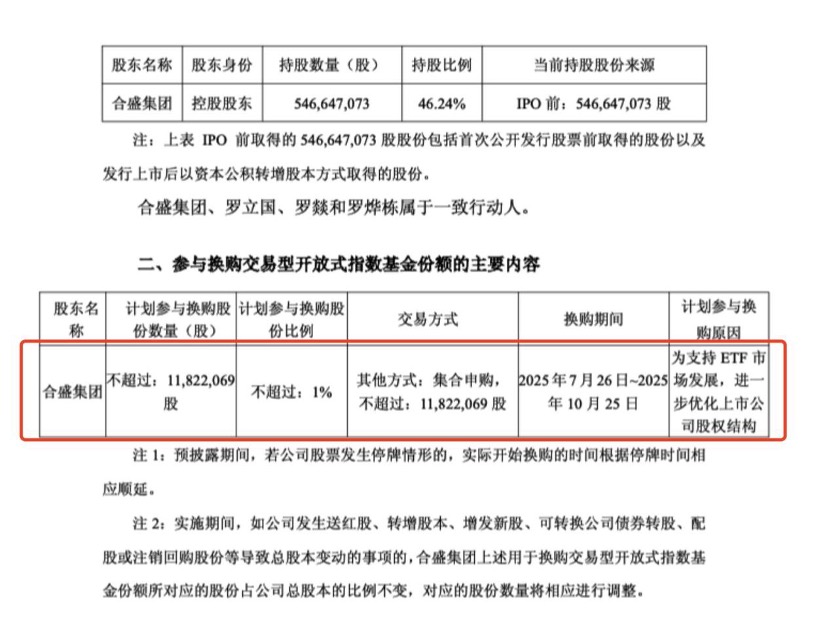
Core Viewpoint - Recent activities of several listed companies' shareholders engaging in ETF swap transactions have drawn market attention, with a focus on the implications for stock structure optimization and potential hidden risks associated with large shareholder exits [1][2][9]. Group 1: Company Actions - Hosheng Silicon Industry announced that its controlling shareholder, Hosheng Group, plans to swap up to 11.82 million shares, representing no more than 1% of the total share capital, for ETF shares within three months after 15 trading days from July 26, 2025, with an estimated market value of 591 million yuan based on a closing price of 50 yuan on July 11 [1][3][5]. - Other companies, including Shanghai Electric, Hangzhou Steel, and Longi Green Energy, have also disclosed ETF swap plans, indicating a trend among major shareholders to engage in such transactions [1][7]. Group 2: Market Implications - The move to swap single stock assets for ETF shares is seen as a way to diversify investments and reduce risks associated with holding individual stocks, which can have positive implications for optimizing the equity structure of listed companies [1][7]. - However, there are concerns that ETF swaps may serve as a covert method for major shareholders to reduce their holdings, potentially leading to hidden exits from the market [1][9]. Group 3: Regulatory Context - Regulatory bodies have encouraged the expansion of ETF offerings and the normalization of ETF swap activities, which can enhance ETF scale and liquidity, but past instances of excessive swaps have led to significant tracking errors and performance issues for ETFs [2][10]. - The industry has noted the need for careful assessment of the liquidity impact of these swaps on ETF products to ensure fair treatment of smaller investors [10].

光伏行业“反内卷” 关注兴业上证180ETF投资机会
Zhong Zheng Wang· 2025-07-11 03:59
Group 1 - The photovoltaic industry is experiencing a recovery in sentiment driven by favorable policies and industry self-discipline expectations, leading to a rapid rebound in the prices of polysilicon and industrial silicon [1] - Leading companies in the photovoltaic sector, such as Daqo New Energy, Tongwei Co., Trina Solar, and Hoshine Silicon Industry, have seen significant stock price increases, contributing to the rapid rise of the Shanghai 180 Index [1] - After the resolution of tariff issues, the impact of overseas risks on the Chinese market is expected to diminish, with a relatively stable period anticipated for the A-share market in the third quarter, driven by domestic factors and corporate performance [1] Group 2 - The Shanghai 180 Index is characterized by a lower valuation level and higher dividend yield compared to other mainstream indices like the CSI 300 and the CSI A500, making it an attractive option for investors [2] - The index has a higher weight in technology sectors, particularly represented by the STAR Market, reflecting a clear "barbell" market feature where both dividend and growth styles are performing well [2] - Investors are encouraged to focus on the allocation value of the Shanghai 180 Index through the Xingye Shanghai 180 ETF and its linked funds, aiming for medium to long-term investment opportunities in the A-share market [2]
有机硅更新:陶氏将关闭英国工厂,有机硅产能有力出清
Tebon Securities· 2025-07-11 03:50
Investment Rating - The industry investment rating is "Outperform the Market" (maintained) [2] Core Viewpoints - The report highlights that the closure of Dow's UK plant, which has a capacity of 145,000 tons, is part of a strategy to optimize European assets and focus on high-value derivatives, signaling a potential marginal improvement in the organic silicon industry [6] - The report anticipates that the exit of overseas capacity will lead to an increase in the prices of organic silicon base materials, alleviating some of the downward price pressure caused by global overcapacity [6] - The report notes that the domestic manufacturers with better cost control are likely to benefit from the demand shift due to the closure of overseas plants [6] - The report emphasizes that the organic silicon industry is entering a phase of supply-side pressure relief, with a significant increase in production capacity expected in 2024, but the lack of large-scale new capacity following this period may lead to improved supply dynamics [6] - The report indicates that the domestic demand for organic silicon is expected to grow steadily, driven by increased penetration in emerging fields such as electronics, new energy vehicles, and photovoltaic cells [6] - The report also highlights that China's exports of polysiloxane are projected to reach approximately 80,000 tons in 2024, reflecting a significant growth opportunity as overseas demand remains strong [6] Summary by Sections Market Performance - The report provides a comparative performance analysis showing a range of market movements from -15% to +29% for the basic chemical sector against the CSI 300 index from July 2024 to July 2025 [3] Related Research - The report references several related studies that discuss trends in deep-sea technology, policy impacts on capacity overcapacity, and the recovery of demand for light initiators, indicating a broader context for the organic silicon market [4] Investment Recommendations - The report suggests focusing on companies such as Hoshine Silicon Industry, Xin'an Chemical, Xingfa Group, Dongyue Silicon Materials, and Sanyou Chemical as potential investment opportunities [5]
多晶硅近期价格变化及展望
2025-07-11 01:05
Summary of the Conference Call on the Polysilicon Industry Industry Overview - The polysilicon price has recently increased by over 10%, primarily due to cost audits in Xinjiang and Inner Mongolia, but actual transaction volumes remain limited as downstream wafer manufacturers are cautious [1][2] - The average transaction price is around 40 yuan per kilogram, while many polysilicon manufacturers are still operating at a loss [1][4] - The market is expected to see a shift in competitive dynamics by 2025, with major manufacturers adjusting strategies to avoid aggressive competition [3][21] Key Points and Arguments Price Dynamics - Current pricing levels for major polysilicon manufacturers include Tongwei and Daqo at approximately 40 yuan per kilogram, while GCL's granular silicon is priced between 36 to 38 yuan [2] - Despite high market quotes, actual transaction prices are lower, with some quotes exceeding 45 yuan per kilogram [3] - The increase in polysilicon prices has led to a corresponding rise in wafer prices by 11% to 12% [3] Cost Audit Impact - Cost audits may lead manufacturers to price above their cost lines, potentially driving some smaller firms out of the market [5][10] - Large manufacturers like Daqo, New Energy, and Tongwei are better positioned to handle this pricing strategy due to their lower production costs [5][22] Technological Advancements - GCL has made significant breakthroughs in sulfur bed technology, reducing energy consumption and increasing the purity of granular silicon, which poses a competitive threat to traditional rod silicon [6][14] Challenges for Smaller Manufacturers - Second and third-tier manufacturers face significant challenges, with production costs significantly higher than industry benchmarks, leading to potential shutdown risks [7][10] - These manufacturers often resort to low pricing strategies to secure orders, which accelerates cash flow issues [8] Inventory Levels - Polysilicon manufacturers maintain inventories around 400,000 tons, with an increasing trend, while wafer manufacturers have lower inventories that can support production for 15 to 30 days [17][19] - High inventory levels suggest a lower risk of price declines, with polysilicon and wafer segments likely to see price increases first [19][20] Future Market Trends - The market may experience a consolidation of production capacity, especially if cost audits enforce stricter pricing policies [12][13] - The transition from rod silicon to granular silicon is expected to continue, with the price gap narrowing significantly [14] Regulatory Environment - The lack of clear regulations regarding cost audits and pricing strategies poses challenges for the industry, with potential implications for market stability [11][32] - The enforcement of a "no lower than cost" sales policy may lead to significant market changes, particularly affecting smaller manufacturers [12][31] Export Market Challenges - The export market faces challenges due to strict EU regulations on carbon footprints and issues related to products from Xinjiang, impacting competitiveness [30] Other Important Insights - The cancellation of export tax rebates is not expected to significantly impact industry prices, as Chinese components are already sold at low prices [26] - The futures market's stability may encourage manufacturers to engage in hedging activities, particularly among leading firms [27] - The operational feasibility of maintaining production at low-cost manufacturers is contingent on market demand, which is projected to be between 1 million to 1.08 million tons [28]