
优酷

Search documents
被忽视的2200万块酒店屏幕,催生60亿新市场?
Hu Xiu· 2025-10-21 06:31
Core Insights - The future of long video content in China is increasingly tied to large screens, with smart TVs covering 1.197 billion people, surpassing the number of internet users [1] - The commercial TV screen segment is significant, with over 22 million screens in various venues, contributing to a market size of nearly 6 billion annually, excluding hardware costs [3] Commercial TV Screens - Commercial TV screens are prevalent in hotels, guesthouses, esports rooms, KTVs, and wellness centers, indicating a robust market presence [3][4] - The importance of commercial screens has led to regulatory actions by the National Radio and Television Administration to address complex hotel TV operations, covering 1.62 million hotel rooms [5][8] Industry Dynamics - The commercial screen industry has developed a complete supply chain involving system integrators, hardware manufacturers, and content rights holders, with a single pay-per-view contributing over 30 yuan [6][20] - The hotel market, with over 20 million rooms, is a primary battleground for commercial screens, with significant regulatory oversight and a focus on improving user experience [9][10] User Experience and Content Consumption - Modern travelers view hotel TVs as multifunctional, with an average viewing time of 3 hours per stay, predominantly for on-demand movies and series [11][19] - The shift from complex interfaces to simplified systems has improved user satisfaction, with 97.9% of users reporting easier operation post-regulation [36][43] Revenue Models - Revenue generation in hotels is facilitated through two main models: ToC (customer pays) and ToB (hotel pays a flat fee), with a renewal rate of about 70% for the latter [17] - The average hotel cost for content services is approximately 0.7 to 0.8 yuan per day, with potential for revenue recovery through value-added services [17] Content Distribution and Industry Growth - The commercial screen market is emerging as the fourth major distribution channel for film content, alongside cinemas, traditional TV, and OTT platforms [20][57] - Companies like Xiaoshuai Technology are leading the market with innovative solutions, aiming to integrate content distribution and enhance guest experiences [21][31] Regulatory Environment - Recent regulations have streamlined hotel TV operations, mandating direct access to live broadcasts and reducing advertising clutter [8][43] - Enforcement actions against illegal content distribution have increased, pushing hotels to adopt compliant content delivery systems [44][45] Future Trends - The commercial screen market is expected to expand beyond hotels into other sectors like wellness centers and retirement homes, driven by the growing demand for entertainment in various settings [47][49] - The integration of new technologies, such as cloud gaming and AI applications, is seen as a potential growth area for enhancing user engagement in hotel rooms [53][54]


国产悬疑剧,需要一出“回魂计”
3 6 Ke· 2025-10-20 09:02
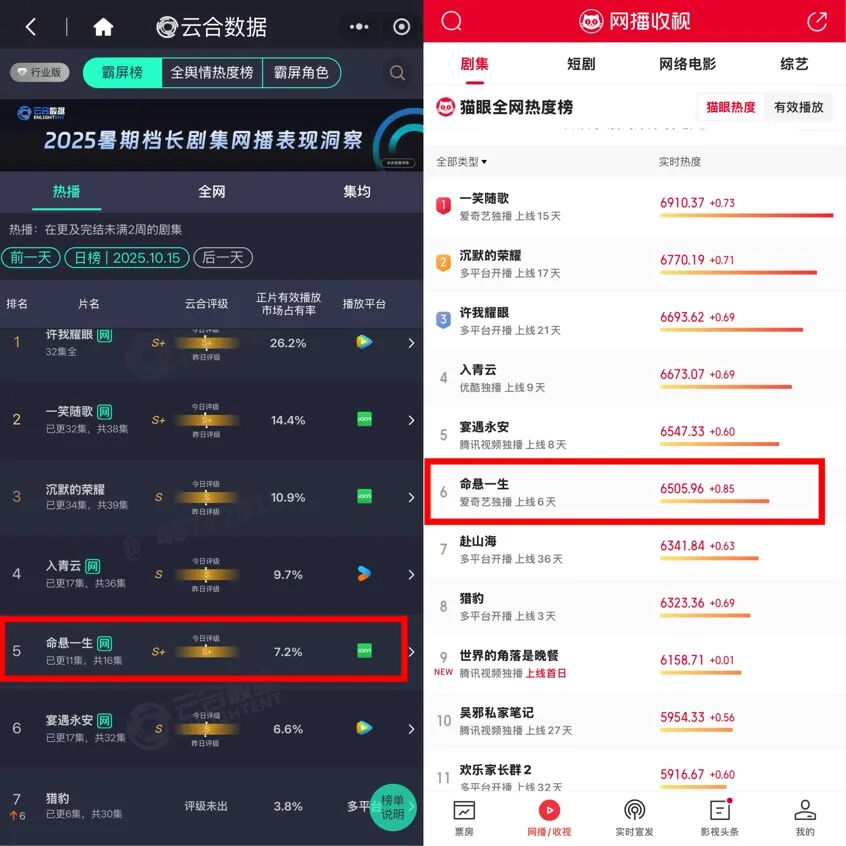
Core Viewpoint - The drama "命悬一生" (Life Suspended) has high expectations due to its strong production team and adaptation from a popular novel, but it has not resonated well with audiences, leading to concerns about its quality and engagement [1][3]. Summary by Sections Audience Reception - The initial viewership metrics for "命悬一生" show a peak heat score of 5782 on iQIYI, with a modest increase of only 1700+ the following day, indicating a lukewarm reception [1]. - Despite surpassing a heat score of 8000, its performance is considered only "threshold-level" within the context of the Mist Theater, and it has not significantly improved its market share [1]. Narrative and Production Quality - The drama features a solid narrative framework and visually detailed presentation, successfully creating dramatic tension through multiple murder cases in the early episodes [4]. - However, the lack of engagement is attributed to a perceived dullness in the suspense elements, with audience feedback suggesting that the show fails to provide the excitement expected from a mystery drama [4][6]. Thematic and Structural Issues - "命悬一生" employs familiar themes and stylistic choices typical of the Mist Theater, such as a gray color palette and a focus on lower-class narratives, which may lead to a sense of déjà vu for viewers [6]. - The show struggles with pacing and coherence in its suspense narrative, often diverting attention to emotional storylines, which disrupts the overall suspense experience [6][7]. Industry Context - The challenges faced by "命悬一生" reflect broader issues within the Chinese suspense drama industry, where many productions rely on similar narrative structures and emotional appeals, leading to a lack of innovation [8][9]. - In contrast, other shows like "回魂计" (The Soul Return Plan) demonstrate that a more complex and engaging narrative can still attract viewers, despite its own flaws [11][12]. Future Prospects - The industry is encouraged to embrace creativity and risk-taking to revitalize the suspense genre, as evidenced by successful past productions that broke traditional molds [13][14]. - Upcoming projects from major platforms are anticipated to explore new themes and styles, potentially reigniting audience interest in Chinese suspense dramas [16].
电视大屏用户的存在感,被低估了?
Hu Xiu· 2025-10-11 09:20
Core Insights - The perception that television is becoming obsolete is challenged by data showing that large screen viewing is nearly equal to mobile viewing, with significant increases in viewing time on platforms like iQIYI and Youku during the recent holiday season [1][2][3] - The Chinese smart screen market is expanding, with nearly 1 billion people covered and a steady annual growth rate, indicating that viewers are not abandoning television but are reallocating their viewing habits between mobile and large screens [1][5][9] Group 1: User Behavior and Demographics - The total number of television viewers in China remains the highest among all viewing populations, with 1.197 billion television viewers compared to 1.108 billion internet users in 2024 [4][5] - Smart TV users are expected to exceed 1 billion by the end of 2025, with OTT users reaching 940 million, reflecting a 25% growth over the past five years [5][8] - The user demographics for large screen viewing include diverse groups such as couples, single young adults, families with children, and older adults, all of whom share a common preference for high-quality long content [12][19][20] Group 2: Content Consumption Trends - Long-form content, particularly dramas, remains the most consumed category on large screens, accounting for 56% of viewing in 2023, with projections for slight increases in subsequent years [23][24] - The viewing habits of different demographics indicate a strong preference for long content, with single young adults watching 1.5 times more on-demand content than live broadcasts [17][19] - The rise of short video content has not diminished the demand for long-form content on large screens, as viewers still prefer the immersive experience that large screens provide [27][29] Group 3: Market Dynamics and Future Outlook - The market for large screens is expected to grow, with stable sales figures and a projected increase in smart TV sales due to government subsidies [8][9] - The integration of short-form content into large screen programming is being explored, with platforms adapting to include micro-dramas and live broadcasts to attract viewers [36][37] - The relationship between long-form content and large screens is symbiotic, as the latter enhances the viewing experience for long dramas, which in turn drives the demand for high-quality content [45][46]

大屏才是长视频真正的未来
3 6 Ke· 2025-10-10 23:40
Core Insights - The ratio of small screen to large screen usage has reached 1:1, indicating a significant presence of large screen users in the entertainment landscape [1] - Despite the perception that television is declining, data shows that large screen viewing is thriving, with platforms like iQIYI and Youku reporting substantial increases in viewing time on large screens [1][3] - The Chinese smart large screen market is expanding, with nearly 1 billion people covered and a steady annual growth rate [1][4] User Demographics - The total number of television users in China remains the highest among all viewing populations, with 1.197 billion television users compared to 1.108 billion internet users [4][7] - Smart TV users are projected to exceed 1 billion by the end of 2025, with a 25% growth rate over the past five years [4][7] - The user base for large screens is diverse, including couples, single young adults, families with children, and older adults, each with distinct viewing preferences [8][10] Viewing Behavior - Large screen users are primarily engaged in watching long-form content, with a significant portion of viewing time dedicated to dramas and movies [12][13] - The viewing habits of different demographics show a preference for quality long content, with single young adults and families particularly active during prime viewing hours [10][11] - The demand for long-form content on large screens remains strong, despite the rise of short video formats [11][15] Market Trends - The sales of smart TVs are on the rise, with an expected increase of 23.59 million units in 2024, driven by government subsidies and consumer demand [7][20] - The content landscape is shifting, with a growing emphasis on high-quality long-form content as the primary draw for large screen users [18][22] - Platforms are adapting to the large screen environment, with strategies that include offering exclusive content and enhancing user experience [20][22] Industry Implications - The resurgence of large screens as a viable platform for long-form content suggests a potential shift in content strategy for streaming services [19][23] - The integration of short-form content into large screen viewing is being explored, but long-form content remains the dominant format [11][15] - The industry must address the operational challenges of large screen platforms to fully capitalize on the growing user base and viewing habits [22][24]


虎鲸文娱发布国庆文娱消费报告:假日“大屏化”成新趋势
Xin Jing Bao· 2025-10-09 08:15
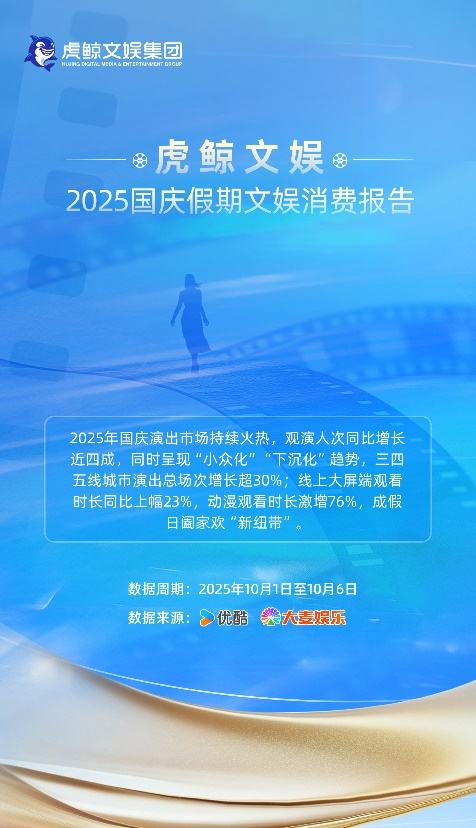
Core Insights - The entertainment market during the "Golden Week" shows a new consumption trend, with offline performances becoming more localized and niche, particularly in lower-tier cities [1][11] - Online viewing has increased significantly, with a 23% rise in viewing time on large screens, and anime viewing time skyrocketing by 76%, becoming a new family bonding activity during the holiday [1][12] Offline Market - The box office for the National Day film market reached 1.539 billion yuan in the first six days, with several films surpassing 100 million yuan in revenue [4][6] - The average ticket price during the holiday was 36.8 yuan, down from 40.4 yuan the previous year, making it more accessible for audiences [6] - The number of offline performances increased significantly, with over 3,100 projects and nearly 15,000 performances, marking a 4.4% year-on-year growth [9][11] Performance Market - The audience for offline performances reached 1.94 million, a 39.5% increase year-on-year, with sports events, music festivals, and concerts being the fastest-growing categories [9][11] - The performance market is experiencing a downward trend, with a 34.1% increase in total performances and an 86.6% rise in total box office revenue in lower-tier cities [11][12] Online Entertainment - Online entertainment consumption is trending towards large-screen and immersive experiences, with significant growth in categories like anime, movies, and documentaries [12][18] - The viewing time for documentaries increased by over 40%, with popular titles seeing notable viewership growth [18] - The 30-39 age group has become the main demographic for online entertainment, showing a 38.2% increase in viewing time compared to the previous week [21]
国庆文娱消费报告:线下演出日趋下沉小众化
Bei Ke Cai Jing· 2025-10-09 06:53
Core Insights - The entertainment consumption report for the National Day holiday indicates significant growth in domestic performance projects and audience attendance, highlighting a shift towards smaller, niche events in lower-tier cities [1][2] Group 1: Performance and Attendance Growth - From October 1 to 6, the total number of domestic performance projects exceeded 3,100, representing a year-on-year increase of 12.3% [1] - The total number of performances reached nearly 15,000, up approximately 4.4% year-on-year [1] - Total audience attendance reached 1.94 million, showing a year-on-year growth of 39.5% [1] - The fastest-growing categories include sports events, music festivals, and concerts, with audience attendance increasing by 264%, 66.6%, and 39.7% respectively [1] Group 2: Market Trends in Lower-Tier Cities - There is a notable trend of performances becoming more "downward" and "niche," with total performances in third to fifth-tier cities increasing by 34.1% and total box office revenue rising by 86.6% year-on-year [1] - Niche performances such as stand-up comedy and Livehouse events are gaining popularity among younger audiences, with theater performances and stand-up comedy ticket sales increasing by 16.8% and Livehouse ticket sales growing by over 16% year-on-year [1] Group 3: Box Office Performance - The total box office revenue for the first six days of the National Day holiday reached 1.539 billion yuan [2] - The top five films during this period each surpassed 100 million yuan in box office revenue, with audience preferences varying by region [2] - The average ticket price during the first six days was 36.8 yuan, down from 40.4 yuan in the same period last year, indicating a lower barrier to entry for moviegoers [2] Group 4: Online and Offline Consumption Trends - The report indicates that the 30 to 39 age group is becoming the main force in "home entertainment," with their viewing time during the holiday increasing by 38.2% compared to the week before the holiday [2] - In contrast, older adults show a stronger willingness for offline cultural consumption, reflecting differing vacation needs across age groups [2]
虎鲸文娱发布国庆文娱消费报告:电影票房破15亿,线上动漫观看时长激增76%
Xin Lang Ke Ji· 2025-10-08 04:11
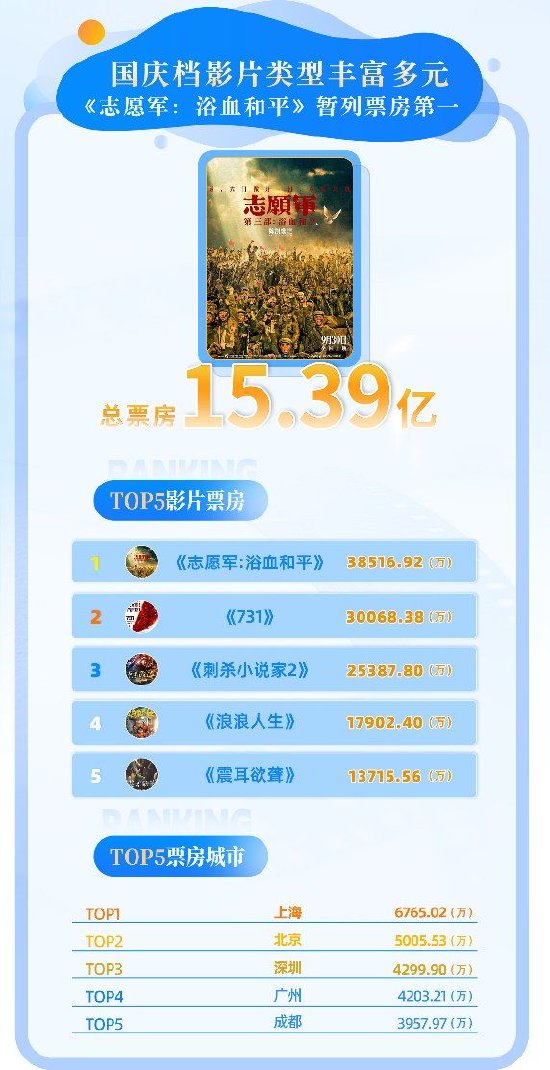
Core Insights - The report by Tiger Whale Entertainment highlights a significant shift in entertainment consumption patterns during the National Day holiday, with a notable increase in both offline and online activities [1][2]. Offline Entertainment Trends - There is a growing trend of offline performances becoming more localized and niche, with a 34.1% increase in total performances in third to fifth-tier cities [2]. - The total box office revenue for the first six days of the National Day holiday reached 1.539 billion yuan, with several films surpassing 100 million yuan in box office during the holiday [1]. - The average ticket price during this period was 36.8 yuan, down from 40.4 yuan the previous year, making it more accessible for audiences [1]. Online Entertainment Trends - Online viewing time on large screens increased by 23% year-on-year, with anime viewing time surging by 76%, indicating a shift towards immersive content consumption [2]. - The report notes that the rise of domestic animation is reshaping family entertainment dynamics, particularly among younger parents [2]. Audience Demographics - The 30-39 age group has become the primary demographic for "home entertainment," showing a 38.2% increase in viewing time compared to the previous week [3]. - In contrast, older adults exhibit a stronger inclination towards offline cultural consumption, reflecting differing leisure preferences across age groups [3]. Performance Highlights - The top five films during the holiday included "The Volunteer Army: Blood and Peace" with a box office of 385.17 million yuan, followed by "731" and "The Assassination of Novelists 2" [5]. - Major cities contributing to the box office included Shanghai, Beijing, and Shenzhen, with significant revenue figures reported [5].
红果「成熟」,短剧「爆仓」?
Ge Long Hui· 2025-10-05 19:35
Core Viewpoint - The short drama platform is entering a "post-guarantee era," raising questions about who can build a competitive moat through technology as the industry shifts focus from quantity to quality [1][2][3]. Group 1: Market Dynamics - Redfruit's monthly active users have reached 212 million, surpassing Youku's 200.6 million, indicating a competitive landscape in the short drama market [1]. - The cancellation of the guaranteed payment mechanism by Redfruit means that production companies will now bear their own risks and profits will depend on market performance [2][5]. - The current short drama market is still primarily driven by content quantity, with platforms like Kuaishou and Bilibili also investing in short dramas, presenting alternatives to Redfruit [5][15]. Group 2: Quality vs. Quantity - Redfruit's ambition to focus on quality in a market that has been driven by volume may not be feasible, as many viewers still prefer quick, entertaining content [3][10]. - The shift towards quality could lead to a decline in the traditional volume-based revenue model for short drama producers, who may seek opportunities elsewhere [5][15]. - The industry's focus on emotional value and quick gratification has made short dramas popular, but this could conflict with the pursuit of higher production quality [10][11]. Group 3: Technological Impact - Advances in AI technology are significantly reducing production costs and time for short dramas, allowing even small teams to create content quickly [12][14]. - The AI-driven reduction in production costs could lead to a market expansion, but it also raises concerns about the sustainability of quality in short dramas [12][18]. - The potential for AI to replace human actors in short dramas could further disrupt the industry, emphasizing the need for platforms to rely on technology for competitive advantage [20]. Group 4: Industry Challenges - The short drama market is facing issues of content homogenization and regulatory scrutiny, with platforms like Redfruit and Kuaishou taking steps to remove low-quality content [21][22]. - The need for improved script creation and review processes is critical for the industry's move towards quality, as current AI capabilities are insufficient [23]. - Redfruit's decision to abandon quantity-driven competition in favor of quality presents challenges, as the industry must balance emotional engagement with production standards [24].
6省市卫视4K超高清频道开播
Ren Min Ri Bao· 2025-09-29 21:53
Core Points - The launch ceremony for 4K ultra-high-definition channels by six provincial satellite TV stations took place on September 28, marking a significant step in the development of ultra-HD broadcasting in China [1] - By the end of 2025, it is expected that all new TV dramas, web series, and documentaries produced in China will achieve ultra-high-definition quality, in line with the national broadcasting authority's 2025 "Ultra HD Development Year" initiative [1] Summary by Category Industry Development - Six provincial satellite TV stations have launched ultra-HD channels, which are now accessible in 31 provinces, regions, and municipalities through cable TV and IPTV [1] - The ultra-HD channels are also available on various new media platforms, including China Audio-Visual, Kankan News, Mango TV, and others [1] - The initiative is part of a broader plan to enhance the quality of television content and services across the country [1] Future Projections - By 2025, over 40% of new ultra-HD programs are expected to be produced by leading online video platforms such as Mango TV, iQIYI, Youku, Tencent Video, Bilibili, and Migu Video [1] - The number of ultra-HD set-top boxes for cable TV and IPTV is projected to reach nearly 300 million units by the end of 2025 [1]
我国已建成广播电视和网络视听大国
Ren Min Ri Bao· 2025-09-26 08:24
Core Viewpoint - The news highlights the significant achievements in the broadcasting and online audio-visual industry during the "14th Five-Year Plan" period, emphasizing China's emergence as a major player in this sector in terms of users, content, and industry scale [1] Group 1: Governance and User Experience - The State Administration of Radio and Television (SARFT) initiated a "dual governance" approach in August 2023 to enhance user experience and service levels [2] - Key initiatives include the deployment of millions of micro set-top boxes and integrated TVs, the promotion of a unified remote control for TV viewing, and the expansion of services to various institutions such as hotels and hospitals [2] - The governance efforts have led to 93% of smart TV models allowing users to disable startup ads, with a permanent opt-out option available [2] Group 2: Content Creation and Quality - The broadcasting and online audio-visual sectors have seen a flourishing of content creation, with a focus on high-quality productions that convey mainstream values and resonate emotionally with audiences [3] - Notable works include commemorative productions for the 80th anniversary of the victory in the War of Resistance, such as the series "Our Rivers and Mountains" and documentaries like "Victory" [3] - The domestic animation sector has also made significant strides, with popular series like "Panda+" and "Chinese Folktales" achieving substantial production growth [3] Group 3: Regulatory Framework and Industry Environment - SARFT is committed to creating a favorable environment for content creation by combining top-down and bottom-up approaches, enhancing policy precision, and regulating industry order [4] - Ongoing revisions to regulations, including the "Television Drama Management Measures," aim to provide a solid legal foundation for industry governance [4] Group 4: Ultra-High Definition Development - The development of ultra-high definition (UHD) broadcasting has been prioritized, with new policies supporting its expansion [5] - By 2024, new UHD channels are being launched across various platforms, with a significant increase in UHD content expected [5] - The total number of UHD set-top boxes for cable and IPTV has surpassed 280 million units, with standards for mobile UHD displays and video distribution being developed [6] Group 5: International Outreach and Cultural Exchange - The broadcasting and online audio-visual sectors are playing a crucial role in promoting cultural dialogue and international friendship, with a 40% increase in the export scale of audio-visual programs during the "14th Five-Year Plan" [7] - Chinese audio-visual content has reached over 200 countries, generating an estimated annual overseas revenue exceeding $63 billion [7] - Collaborative initiatives with various countries and regions are being strengthened, enhancing the global presence of Chinese media [8]