
沙特阿拉伯国家石油公司

Search documents
国泰君安期货原油周度报告-20250706
Guo Tai Jun An Qi Huo· 2025-07-06 10:03
Report Industry Investment Rating No relevant content provided. Core Viewpoints of the Report - Brent and WTI may challenge $80 per barrel in the third quarter, and SC may challenge 580 yuan per barrel. In the long - term, there is significant downward pressure on oil prices. Brent and WTI may test $50 per barrel, and SC may test 420 yuan per barrel this year [5][6]. - In the first half of the third quarter, the market is bullish, mainly due to OPEC+ production increase falling short of expectations, a decline in U.S. shale oil production, and a relatively low global inventory center. In the long - term, the market is bearish because of the large - scale production increase from OPEC+, Brazil, Guyana, Norway, etc., leading to a high probability of inventory accumulation [6]. - The strategy is to buy on dips and conduct band trading in the short - term, and to short on rallies in the long - term. Close out and take profits on long - short spreads, and avoid reverse spreads [6]. Summary by Directory 1. Macro - The long - end U.S. Treasury yield fluctuates significantly, and the gold - oil ratio rebounds [11]. - Overseas inflation rises, and the service industry PMI rebounds [17]. - The RMB exchange rate continues to strengthen, and social financing recovers [19]. 2. Supply - OPEC+ production increase slightly exceeds expectations. For example, Iraq's Basrah crude export to Europe weakens, the UAE reduces Murban crude allocation, Saudi may use more heavy crude for domestic power generation, and Russia's ESPO Blend export decreases in June but is expected to rebound in July [7]. - The Dallas Fed Energy Survey shows that the business activity index turns negative. U.S. oil and gas executives are pessimistic about production prospects due to Trump's tariff policies and trade wars. Although U.S. crude production increased by 1.8 million barrels per day in April, WTI export profitability has deteriorated [8]. - Kazakhstan, Venezuela, and Iran have different supply situations. Venezuela's production is expected to decline, and Iran's export is affected by sanctions, but there are signs of possible sanction relief [8]. - The IEA predicts a global crude oil supply surplus in the second half of 2025, and global visible inventories have been accumulating in the past three months [8]. 3. Demand - The seasonal peak demand continues. In Asia, China's crude oil processing volume increases, and some countries like Japan, South Korea, and India increase their U.S. crude oil imports. In Europe, refineries are cautious due to conflicts, and freight increases have raised costs [9]. 4. Inventory - U.S. commercial inventory rebounds, while Cushing inventory declines and is significantly lower than the historical average. Refining margins are strongly volatile, European crude inventory rebounds while diesel and gasoline inventories decline, and domestic refined oil margins are recovering [61][70][75]. 5. Price and Spread - The North American basis rebounds slightly, the monthly spread declines, SC underperforms foreign markets with a declining monthly spread, and the net long position increases [79][80][83].
“欧佩克+”增产抢夺市场份额,专家称国际油价下行概率加大
news flash· 2025-07-06 04:04
当地时间7月5日,由石油输出国组织(欧佩克)和非欧佩克产油国组成的"欧佩克+"部分成员国举行线 上会议,最终,与会的沙特阿拉伯、俄罗斯、伊拉克、阿联酋、科威特、哈萨克斯坦、阿尔及利亚和阿 曼的代表决定,自8月起日均增产54.8万桶原油。中国人民大学重阳金融研究院研究员刘英在接受专访 时表示,尽管增产可能会带来国际油价下行,但是,增产体现了"欧佩克+"从非"欧佩克+"产油国手中夺 回市场份额的决心。(总台环球资讯广播) ...
中企参建的沙特国王港项目陆域工程全面完成
news flash· 2025-07-02 10:22
Core Viewpoint - Saudi Aramco and China Electric Power Construction Group Shandong Company celebrated the completion of land works for the King Salman International Port project, which is a key part of Saudi Arabia's Vision 2030 [1] Group 1: Project Overview - The King Salman Port project is located in the Ras Al Khair Industrial City in the Eastern Province of Saudi Arabia and was personally inaugurated and named by King Salman [1] - The project is a joint investment between Saudi Aramco and IMI International Port Company, with the main contract for sections P4-P5-P6 exceeding $3 billion [1]

报道称伊朗6月波斯湾秘密装载水雷,引发“封锁霍尔木兹”忧虑
Hua Er Jie Jian Wen· 2025-07-02 00:37
Core Viewpoint - Iran's recent actions of loading mines onto ships in the Persian Gulf have raised concerns about a potential blockade of the Strait of Hormuz, a critical global shipping route for oil and gas [1][2]. Group 1: Iran's Military Actions - U.S. officials reported that Iran's military loaded mines onto ships in June, heightening fears of a blockade of the Strait of Hormuz following an Israeli missile strike on Iran [1]. - Although the mines have not yet been deployed, this indicates Iran's serious consideration of closing one of the world's busiest shipping lanes, which carries about 20% of global oil and gas transport [1][3]. - Iran's parliament has suggested closing the Strait, but the final decision rests with the Supreme National Security Council [1]. Group 2: U.S. Response and Intelligence - U.S. officials suggest that Iran's mine-loading could be a bluff to pressure Washington, indicating that Iran may not intend to follow through with a blockade [2]. - The U.S. Defense Intelligence Agency estimates that Iran possesses over 5,000 mines, which can be rapidly deployed using small high-speed boats [2]. - The U.S. Fifth Fleet, stationed in Bahrain, is responsible for protecting commercial shipping in the region, and had temporarily withdrawn mine countermeasure vessels prior to potential Iranian retaliation [2]. Group 3: Strategic Importance of the Strait of Hormuz - The Strait of Hormuz connects the Persian Gulf with the Gulf of Oman and the Arabian Sea, with its narrowest point being 21 miles wide and only 2 miles wide for navigation [3]. - Major OPEC members, including Saudi Arabia, UAE, Kuwait, and Iraq, export oil through this strait, while Qatar, a leading LNG exporter, relies on it for nearly all its LNG shipments [3]. - Iran also exports a significant portion of its oil through the Strait, which theoretically limits its willingness to close it, although it continues to invest resources to ensure a blockade can be implemented if necessary [3].
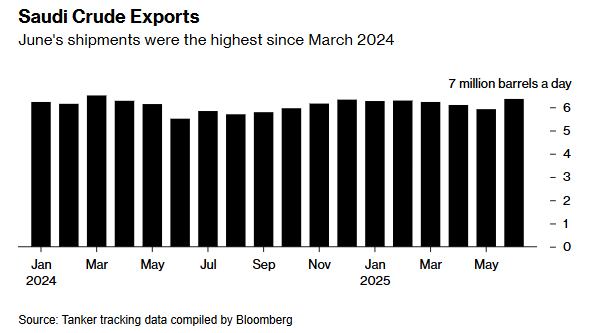
欧佩克+主导国争夺市场份额 沙特原油出口激增
news flash· 2025-07-01 11:56
Core Viewpoint - Saudi Arabia is significantly increasing its crude oil exports, aiming to regain market share in the global oil market as the leader of OPEC+ [1] Group 1: Export Data - In June, Saudi Arabia's crude oil exports rose by 441,000 barrels per day, reaching 6.36 million barrels per day, representing an increase of approximately 7% [1] - This surge in exports coincides with OPEC+'s accelerated oil production recovery plan, benefiting consumers [1] Group 2: Regional Impact - Despite regional shipping disruptions due to the conflict between Israel and Iran, oil transportation through the Strait of Hormuz remains uninterrupted [1] - The current trend indicates that Saudi Arabia's actual export growth has surpassed OPEC+ agreement expectations, even during the domestic air conditioning demand peak season [1] Group 3: Future Outlook - As OPEC+ considers further production increases, Saudi Arabia may release a larger proportion of supply after the summer [1]

原油周评:OPEC+增产消息再现,油价或维持弱势
Chang An Qi Huo· 2025-06-30 06:37
1. Report Industry Investment Rating No relevant content provided. 2. Core View of the Report - Last week, crude oil prices dropped significantly, with international oil prices falling 12% weekly, fully reversing the previous geopolitical risk premium. The market's focus may shift back to OPEC+ led production increases, which could lead to long - term expectations of a supply - side surplus and put pressure on oil prices. The increasing expectation of a fourth - quarter interest rate cut will relieve some macro - economic downward pressure but may not boost oil prices effectively in the short term. The cease - fire in the Israel - Iran conflict has eliminated the risk premium, and it's difficult for it to boost oil prices again. Overall, oil prices are likely to return to pre - conflict levels and remain volatile with limited chances of a significant rebound [18][65]. 3. Summary by Directory 3.1 Operation Ideas - Last week, oil prices rapidly reversed the previous risk premium due to the cooling of geopolitical factors, resulting in a significant decline. This week, the market may calm down and return to trading the logic of a supply - side surplus. Prices are unlikely to rebound significantly. It is recommended to focus on the range of 470 - 495 yuan/barrel, mainly engage in short - spread trading, and cautiously short at high prices. Also, pay attention to the changes in the US labor market data in June, manufacturing performance, and subsequent OPEC+ production increase news [12]. 3.2 Market Review - Last week, oil prices dropped significantly at the beginning of the week due to the end of the Israel - Iran conflict. The market quickly reversed a large amount of the previous risk premium, causing oil prices to plunge. Then, the trading logic returned to the judgment of crude oil fundamentals and macro - financial attributes. With the expectation of a looser supply - side in the long term, oil prices gradually declined. International oil prices fell 12% last week, returning to the level before the Middle East geopolitical conflict [18]. 3.3 Fundamental Analysis 3.3.1 Macro - aspects - **Powell maintains a hawkish view**: Fed Chairman Powell attended the semi - annual monetary policy hearings in the Senate and the House of Representatives last week, reiterating that he won't cut interest rates rashly before the economic data is clear. He emphasized that the current policy still "depends on data" and hasn't decided whether to cut rates in July. The data from June to August is crucial, and the impact of tariff increases on inflation needs to be observed. The uncertainty of US tariff policies may cause fluctuations in the market's expectation of a July rate cut [23]. - **US economic data fluctuates**: The annual rate of the US core PCE price index in May slightly exceeded expectations, reaching 2.7%, the highest since February 2025. However, personal spending decreased by 0.1% month - on - month, the largest decline since the beginning of the year. These two data indicate the pressure of tariff policies on economic growth. Although the economic data doesn't fully support the market's pricing of a rate cut, some Fed officials have publicly supported it, which may influence the market's expectations [26]. - **Geopolitical situation cools down**: Iran and Israel ended a 12 - day conflict and reached a cease - fire agreement last week. Although there were still attacks after the cease - fire news, the fighting has basically stopped. Trump said the cease - fire is progressing smoothly but didn't rule out the possibility of a resurgence of the conflict. He also hinted at adjusting sanctions on Iran. The geopolitical factor's impact on oil prices has basically cooled down [30]. 3.3.2 Supply - aspects - **OPEC achieved production increase in May**: OPEC's total production in May was 27,022 thousand barrels per day, an increase of 183 thousand barrels per day compared to April. OPEC+ total production was 41,230 thousand barrels per day, an increase of 180 thousand barrels per day compared to April [33]. - **OPEC+ may increase production again**: OPEC+ has three sets of production - cut measures. Two of them have been extended to the end of 2026, and the goal of this round of production increase is to withdraw the additional voluntary production cut of 2.2 million barrels per day by the end of 2026. So far, nearly 60% of the 2.2 million barrels per day production restoration target has been completed, which may lead to long - term concerns about a global oil supply surplus and put pressure on oil prices [34]. - **Saudi Arabia's production increased**: No specific increase data was provided, but it is mentioned that Saudi Arabia's production has increased [37]. - **Iraq compensates for production cuts**: No specific compensation data was provided [40]. - **US production remains stable**: No specific production data was provided, but it is mentioned that US production remains stable [43]. 3.3.3 Demand - aspects - **Summer demand shows slight improvement**: No specific improvement data was provided [45]. - **Pay attention to this week's manufacturing performance**: No specific performance data was provided [48]. - **Refined oil production slows down slightly**: No specific slow - down data was provided [53]. 3.3.4 Inventory - aspects - **Crude oil inventory decreases and consumption recovers**: The US API crude oil inventory for the week ending June 20 was - 4.277 million barrels, compared with an expected - 0.183 million barrels and a previous value of - 10.133 million barrels. The EIA crude oil inventory for the same week was - 5.836 million barrels, compared with an expected - 0.797 million barrels and a previous value of - 11.473 million barrels. This is the fifth consecutive week of decline, mainly due to the low net import of US crude oil and the increase in the refining level of downstream factories, which may support oil prices in summer [55]. - **Refined oil inventory decreases and supports prices**: The US gasoline inventory for the week ending June 20 was - 2.075 million barrels, compared with an expected 0.381 million barrels and a previous value of 0.209 million barrels. The refined oil inventory was - 4.066 million barrels, compared with an expected 0.41 million barrels and a previous value of 0.514 million barrels. The significant decline in the inventory of the two major refined oils indicates the recovery of fuel consumption in North America. With the expectation of the subsequent consumption peak season, it's difficult for oil prices to decline further in summer [59]. 3.4 Viewpoint Summary - Last week, crude oil prices dropped significantly, and international oil prices fell 12% weekly, fully reversing the previous geopolitical risk premium. The market may focus on OPEC+ production increases, leading to long - term supply - side surplus expectations and putting pressure on oil prices. The increasing expectation of a fourth - quarter interest rate cut will relieve some macro - economic downward pressure but may not boost oil prices effectively in the short term. The cease - fire in the Israel - Iran conflict has eliminated the risk premium, and it's difficult for it to boost oil prices again. Overall, oil prices are likely to return to pre - conflict levels and remain volatile with limited chances of a significant rebound [18][65].
国泰君安期货·原油周度报告-20250629
Guo Tai Jun An Qi Huo· 2025-06-29 10:02
1. Report Industry Investment Rating No information provided. 2. Core Viewpoints of the Report - Brent and WTI may challenge $80 per barrel in the third quarter, and SC may challenge 580 yuan per barrel; in the long - term, there is significant downward pressure on oil prices, and Brent and WTI may test $50 per barrel, while SC may test 420 yuan per barrel this year [6]. - In the first half of the third quarter, the market is bullish, mainly due to OPEC+ production increase falling short of expectations, a decline in US shale oil production, and a relatively low global inventory center with difficult - to - refute inventory drawdown; in the long - term, the market is bearish, mainly because of the large long - term surplus pressure from production increases in OPEC+, Brazil, Guyana, Norway, etc., with difficult - to - refute inventory build - up [6]. - For trading strategies, go long on dips in the short - term and conduct band trading; go short on rallies in the long - term and trend - follow short positions. Clear and take profits on calendar spreads and avoid reverse spreads [6]. 3. Summary According to Relevant Catalogs 3.1 Macro - The long - end US Treasury yield fluctuates significantly, and the gold - oil ratio rebounds [11]. - Overseas inflation rises, and the Sino - US "trade" relationship eases [16]. - The RMB exchange rate continues to strengthen, and social financing rebounds [17]. 3.2 Supply - OPEC+ production increase falls short of expectations, and attention should be paid to the OPEC+ meeting in early July. In different countries/regions, there are various supply situations: Qatar shows supply tightness; Iraq's Basrah crude export has issues; the UAE reduces oil allocation; Saudi Arabia may use more heavy crude for domestic power generation; Russia's crude export decreases; the US sees changes in production, drilling, and inventory; Kazakhstan and other regions face supply shortages; Venezuela has supply changes; and Iran's export is at high risk [7][8]. 3.3 Demand - In June, refinery operating rates continue to increase, and attention should be paid to the seasonal demand surge. In different regions, demand varies: in Asia, China's refinery demand is affected by sanctions and conflicts, and India, Japan, and South Korea have slow demand recovery; in the Americas, the US is a major consumer, and its demand is affected by the economy and policies; in Europe, refineries are highly dependent on Middle - Eastern sour crude, and the conflict makes buyers cautious [9]. 3.4 Inventory - US commercial inventories decline; Cushing inventories stabilize but are significantly lower than historical averages. European crude inventories rebound, while diesel and gasoline inventories decline. Domestic refined oil profit margins recover [59][68][71]. 3.5 Price, Spread, and Position - The North American basis rebounds slightly. The monthly spread declines. SC underperforms overseas markets, and the monthly spread also declines. Net long positions increase [75][76][80].
全球能源市场的咽喉要道霍尔木兹海峡,并非不可绕行
财富FORTUNE· 2025-06-25 13:13
Core Viewpoint - The article discusses the temporary ceasefire between Israel and Iran, highlighting the geopolitical implications for global energy trade, particularly through the Strait of Hormuz, a critical chokepoint for oil and gas transportation [1][4]. Group 1: Geopolitical Context - The ceasefire between Israel and Iran has been established, with both sides declaring their positions, which may influence regional stability and energy markets [1]. - The Strait of Hormuz remains a significant concern for shipping due to ongoing security risks, despite current operations being uninterrupted [2]. Group 2: Energy Trade Importance - Approximately 20 million barrels of oil pass through the Strait of Hormuz daily, accounting for 20% of global liquid oil consumption and 25% of maritime oil trade [3]. - In addition to oil, about 20% of global liquefied natural gas trade also transits through the Strait, primarily from Qatar [4]. Group 3: Potential Market Impact - A complete blockade of the Strait could lead to oil prices soaring above $120 per barrel, representing a 56% increase from current Brent crude prices [4]. - The U.S. Energy Information Administration (EIA) estimates that Saudi Arabia and the UAE can divert 2.6 million barrels of oil daily through alternative pipelines, mitigating some impacts of a potential blockade [10]. Group 4: Alternative Routes - Saudi Aramco operates a pipeline that connects the Abqaiq oil processing center to the Red Sea, providing an alternative route for oil exports [8]. - The UAE has a pipeline that bypasses the Strait, linking land oil fields to the Fujairah export terminal, further diversifying export options [9]. Group 5: Iranian Export Dynamics - Iran's oil exports heavily rely on the Strait, with an average of 1.5 million barrels per day last year, most of which were transported through this route [12]. - Iran has a pipeline with a capacity of 300,000 barrels per day to Oman, but actual usage is significantly lower, with exports expected to be below 70,000 barrels per day by summer 2024 [11]. Group 6: Risk Assessment - Analysts believe the likelihood of Iran blocking the Strait is low, as it would severely damage its economy and provoke a strong U.S. response [13][14]. - Kenneth Pollack, a former CIA analyst, suggests that any aggressive action by Iran could lead to its perception as a dangerous adversary, prompting military intervention from Western nations [15].

沙特石油出口收入降至近四年最低
news flash· 2025-06-25 08:49
Group 1 - Saudi Arabia's oil export revenue in April fell to its lowest level in nearly four years, reaching $16.5 billion, a year-on-year decrease of approximately 21% [1] - Month-on-month, the revenue declined by 7% [1] - The price of crude oil plummeted in April, with the benchmark Brent crude dropping over 15% to a four-year low [1]
原油:以伊仍存不确定性,油价波动扩大
Zheng Xin Qi Huo· 2025-06-23 11:08
原油:以伊仍存不确定性,油价波动扩大 正信期货原油周报 20250623 研究员:付馨苇 投资咨询编号:Z0022192 Email: fuxw@zxqh.net Tel:027-68851659 研究员:赵婷 投资咨询编号:Z0016344 Email: zhaot@zxqh.net Tel:027-68851659 5 原油供需平衡总结 PPT模板:www.1ppt.com/moban/ PPT素材:www.1ppt.com/sucai/ PPT背景:www.1ppt.com/beijing/ PPT图表:www.1ppt.com/tubiao/ PPT下载:www.1ppt.com/xiazai/ PPT教程: www.1ppt.com/powerpoint/ 资料下载:www.1ppt.com/ziliao/ 范文下载:www.1ppt.com/fanwen/ 试卷下载:www.1ppt.com/shiti/ 教案下载:www.1ppt.com/jiaoan/ PPT论坛:www.1ppt.cn PPT课件:www.1ppt.com/kejian/ 语文课件:www.1ppt.com/kejian/y ...