
金蝶国际

Search documents
春节后首日,港股跳水,百度、阿里、网易、腾讯、京东下跌!智谱大涨
Mei Ri Jing Ji Xin Wen· 2026-02-20 02:36
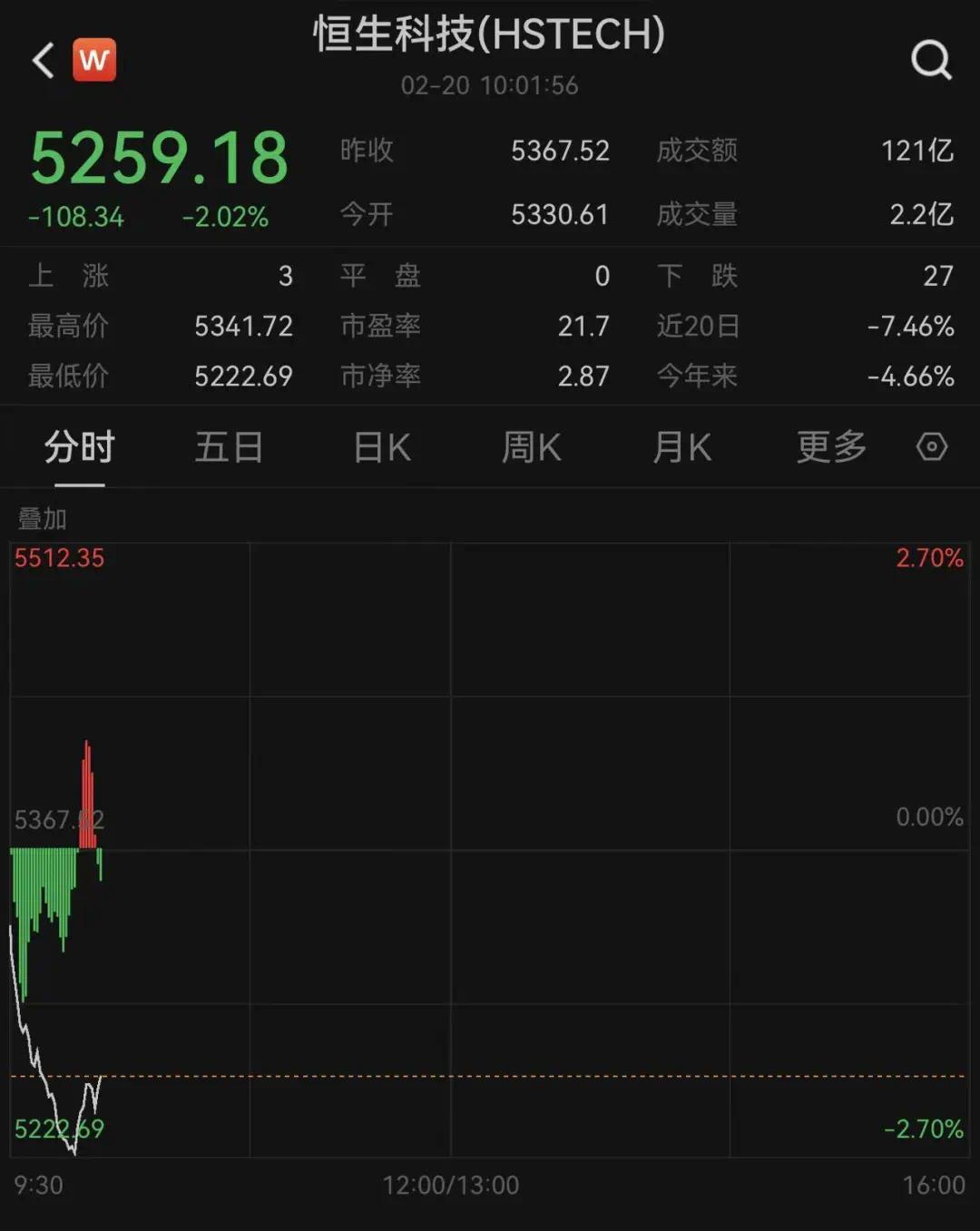
Market Overview - The Hang Seng Index and Hang Seng Tech Index opened lower, with the Hang Seng Index dropping by 1.31% at one point and currently down by 0.68% [1] - The Hang Seng Tech Index saw a decline of 2.7% at its lowest, now down by 2.02% [1] Hang Seng Tech Index Details - The Hang Seng Tech Index opened at 5330.61, with a current value of 5259.18, reflecting a decrease of 108.34 points or 2.02% [2] - The trading volume for the day is 2.2 billion, with a market capitalization rate of 21.7 [2] Hang Seng Index Details - The Hang Seng Index opened at 26657.84, currently at 26524.99, down by 180.95 points or 0.68% [3] - The trading volume is reported at 23.4 billion, with a market capitalization rate of 12.1 [3] Notable Stock Movements - Hai Zhi Technology Group (2706.HK) surged by 19.25%, while MINIMAX-WP (0100.HK) increased by 11.63%, and Zhi Pu (2513.HK) rose by 18.31%, with a total market capitalization reaching 268 billion HKD [3] - Victory Securities (8540.HK) saw a rise of 13.12% following the approval of its virtual asset trading platform [7][8] - Bitcoin-related stocks, such as Xing Tai Chain Group (0399.HK), increased by 46.67% amid news of upcoming stablecoin licenses in Hong Kong [8] Declines in Tech Stocks - Major tech stocks experienced declines, with Kingdee International and Baidu Group dropping over 5%, and Alibaba and Bilibili falling over 4% [10] - Other notable declines include Netease down by 3.95%, and Tencent Holdings down by 2.25% [10][11] Gains in Other Sectors - Midea Group, Horizon Robotics, and SenseTime saw increases, with Midea Group rising by 1.47% [12]

港股AI、机器人大爆发!智谱飙升21% 越疆涨超20% 科网股跳水
2 1 Shi Ji Jing Ji Bao Dao· 2026-02-20 02:25
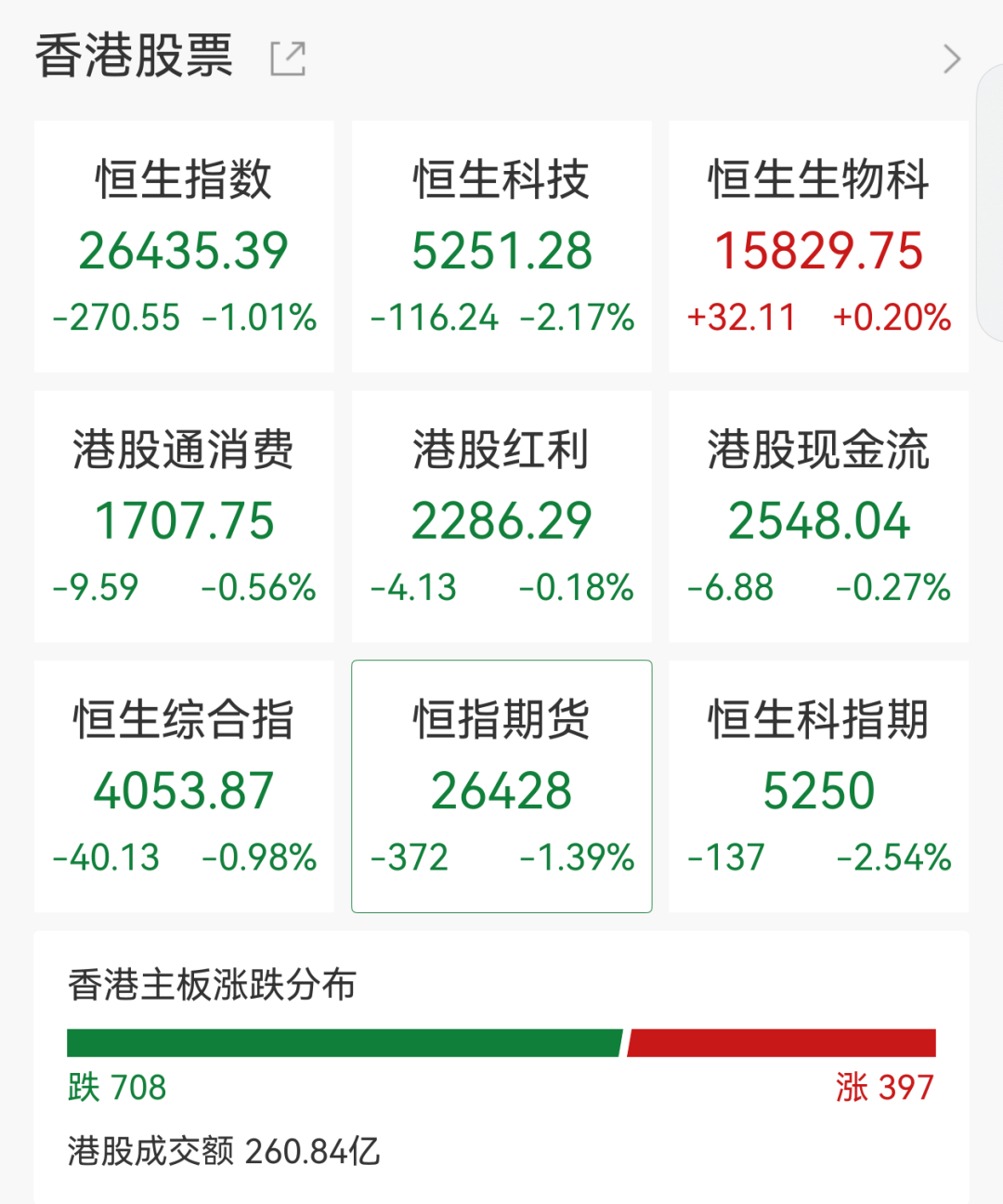
Group 1: Market Overview - On February 20, the Hong Kong stock market opened lower, with the Hang Seng Index down by 1.01%, the Hang Seng Tech Index down by 2.17%, and the Hang Seng China Enterprises Index down by 1.1% [1] Group 2: AI and Robotics Sector - AI application stocks performed strongly against the market trend, with Zhihui rising over 21%, Haizhi Technology Group up by 23%, and MINIMAX-WP increasing by 10% [2] - Zhihui announced a "Computing Power Partner" recruitment plan, aiming to collaborate with chip manufacturers and service providers to optimize their GLM-5 model [2] - The robotics sector saw significant gains, with companies like Yujian rising over 20%, Sutech increasing by nearly 12%, and UBTECH up by 10% [3] - The popularity of robotics was boosted by performances during the Spring Festival Gala, attracting audience attention and driving sales on platforms [3] Group 3: Oil Sector - Oil stocks surged, with China National Offshore Oil Corporation rising by 2.23%, reaching a historical high of HKD 25.70, and a total market capitalization of HKD 12,215.20 million [4] Group 4: Technology Sector - The majority of technology stocks in Hong Kong experienced declines, with Kingdee International down over 5%, Baidu down over 5%, Alibaba and Bilibili down over 4%, NetEase down over 3%, and Tencent down over 2% [5] Group 5: Precious Metals - Precious metals like gold and silver saw slight adjustments, with spot gold down by 0.11% and spot silver down by 0.29% [6] - Goldman Sachs indicated that central bank purchases and increased exposure to gold by private investors due to potential Fed rate cuts could lead to gold prices gradually rising to USD 5,400 per ounce by the end of 2026 [6]


春节后首日,港股跳水,百度、阿里巴巴、网易、腾讯、京东下跌!智谱大涨,市值达2600亿港元|开盘播报
Mei Ri Jing Ji Xin Wen· 2026-02-20 02:21
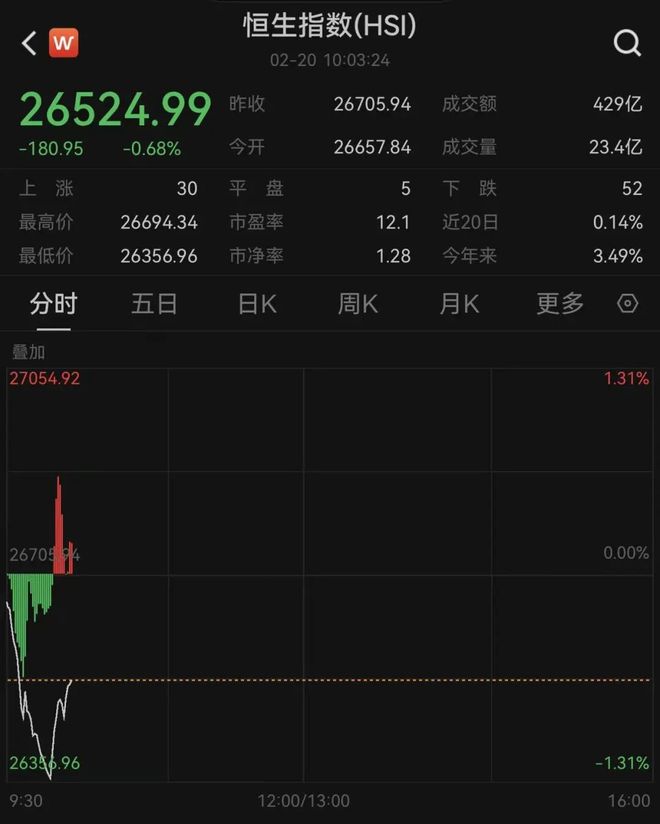
Market Overview - The Hang Seng Index and Hang Seng Tech Index opened lower, with the Hang Seng Index dropping by 1.31% at one point and currently down by 0.68% [1] - The Hang Seng Index is currently at 26,524.99, with a trading volume of 4.29 billion and a market capitalization of 429 billion [2] Stock Performance - AI application stocks in Hong Kong showed strong performance, with Haizhi Technology Group (2706.HK) rising by 19.25%, MINIMAX-WP (0100.HK) increasing by 11.63%, and Zhipu (2513.HK) up by 18.31%, bringing their market capitalization to 268 billion HKD [1] - Victory Securities (8540.HK) saw a rise of 13.12% following the approval of its virtual asset trading platform VDX by the Hong Kong Securities and Futures Commission [6] - Bitcoin-related stocks also performed well, with Star Chain Group (0399.HK) surging by 46.67% after news of the issuance of stablecoin licenses in Hong Kong [6] Declines in Tech Stocks - Many tech stocks experienced declines, with notable drops including Kingdee International and Baidu Group falling over 5%, Alibaba and Bilibili down over 4%, and Netease down by 3.95% [8] - Other companies such as Tencent Music, Meituan, and JD Group also saw declines of over 3% [8][9][10] Notable Gainers - Midea Group, Horizon Robotics, and SenseTime recorded gains, with Midea Group increasing by 1.47% [11]
港股AI、机器人大爆发,智谱飙升21%,越疆涨超20%,科网股跳水
2 1 Shi Ji Jing Ji Bao Dao· 2026-02-20 02:08
Market Overview - On February 20, the Hong Kong stock market opened lower on the first trading day of the Year of the Rabbit, with the Hang Seng Index down by 1.01%, the Hang Seng Tech Index down by 2.17%, and the Hang Seng China Enterprises Index down by 1.1% [1][2]. Sector Performance - AI and robotics sectors showed strong performance, with AI application stocks like Zhizhu rising over 21%, Haizhi Technology Group up 23%, and MINIMAX-WP increasing by 10% [3]. - The semiconductor sector also saw gains, with Lanke Technology rising by 3.22% to a new high of 217.80 HKD, and Tianshu Zhixin increasing by 4.68% to 281.60 HKD, marking a historical high [3]. - The robotics sector experienced significant growth, with companies like Yujian rising over 20% and Sutech increasing nearly 12% [3]. Oil Sector - The oil sector saw a notable surge, with China National Offshore Oil Corporation (CNOOC) rising by 2.23% to 25.70 HKD, achieving a historical high with a total market capitalization of 1,221.52 billion HKD [4]. Technology Sector - The technology sector faced declines, with companies such as Kingdee International down over 5%, Baidu Group down nearly 5%, and Bilibili down nearly 4% [4][5]. Precious Metals - Precious metals experienced adjustments, with spot gold down by 0.11% and spot silver down by 0.29%. Goldman Sachs projected that overall central bank gold purchases and increased exposure from private investors due to potential Fed rate cuts will gradually raise gold prices to 5,400 USD per ounce by the end of 2026 [5][6].

跌幅扩大!恒生科技指数跌超2%,恒指跌超1%
Ge Long Hui· 2026-02-20 02:00
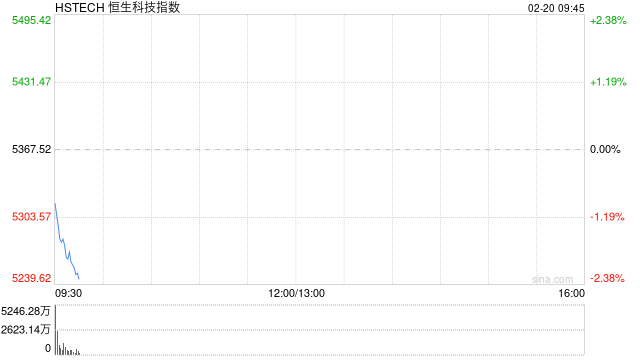
2月20日,港股跌幅进一步扩大,恒生科技指数跌2.2%,恒指、国企指数跌超1%。恒生科技指数成分股中,金蝶国际跌 5%,百度集团跌近5%,哔哩哔哩、网易、阿里巴巴、理想汽车、腾讯音乐、同程旅行跌超3%。 股票频道更多独家策划、专家专栏,免费查阅>> 责任编辑:安东 | 代码 | 名称 | | | | 涨幅% | | 年初至今涨幅% | | --- | --- | --- | --- | --- | --- | --- | --- | | HSTECH | 恒生科技指数 | 1 | | 5249.58 | -2.20 | | -4.83 | | મટા | 恒生指数 | 1 | | 26427.30 | -1.04 | | 3.11 | | HSCEI | 恒生国企指数 | 1 | | 8972.95 | -1.07 | | 0.66 | | 代码 | 名称 | | | 涨跌幅 ^ | 年初至今涨跌 | 总市值 | | | 00268 | 金蝶国际 | | (0) | -5.02% | -20.24% | 376.24 乙 | | | 09888 | 百度集团-SW | | | -4.94% | -0.53% ...

马年开市首日港股三大指数持续下挫,恒生科技指数跌超2%,百度跌超5%
Xin Lang Cai Jing· 2026-02-20 01:45
Market Overview - On the first trading day of the Year of the Horse, Hong Kong's three major indices continued to decline, with the Hang Seng Technology Index dropping over 2% and the Hang Seng Index falling over 1% [1][6] - The Hang Seng Index closed at 26,431.18, down by 274.76 points or 1.03% [2][7] - The Hang Seng China Enterprises Index ended at 8,973.39, decreasing by 96.93 points or 1.07% [2][7] - The Hang Seng Technology Index finished at 5,247.78, down by 119.74 points or 2.23% [2][7] Company Performance - Baidu Group saw a significant decline, with its stock price dropping by 5.09% to 130.60 [4][7] - NetEase experienced a decrease of 4.43%, closing at 179.00 [4][7] - Alibaba's stock fell by 3.75%, ending at 148.90 [4][7] - Li Auto's shares dropped by 3.26%, closing at 69.75 [4][7] - Other notable declines included Bilibili, Xiaomi, and Sunny Optical Technology, all of which fell over 2% [1][6]
谁是中国AI“第一城”?
机器人圈· 2026-02-14 09:48
Core Insights - The article highlights the rapid growth and development of China's artificial intelligence (AI) industry, showcasing significant user adoption and innovation across various sectors [3][4][14][24][31]. Group 1: AI Industry Growth - By the end of 2025, China's generative AI user base is projected to reach 602 million, a 141.7% increase from the end of 2024, with a penetration rate of 42.8%, up 25.2 percentage points year-on-year [3]. - The AI industry in Beijing has surpassed 2,400 companies, including 46 listed firms and 36 unicorns, accounting for over half of the national total [4]. - Shanghai's AI industry is expected to exceed 550 billion yuan in scale by the end of 2025, with a year-on-year growth rate of over 30% [14]. Group 2: Key Players and Innovations - Major companies leading the AI sector include ByteDance, Baidu, and Huawei, focusing on areas such as large models, AI algorithms, and smart driving [5][24]. - Shenzhen has seen a 22.6% year-on-year growth in its core AI industry, with a total scale reaching 368.5 billion yuan in 2024, indicating a shift towards source innovation [24]. - Hangzhou's AI industry is projected to grow from 300 billion yuan in 2023 to 399 billion yuan in 2024, with 84 listed companies and 10 unicorns by the end of 2025 [31]. Group 3: Data and Infrastructure - Beijing has registered 123 large model products and established a data foundation with over 150 petabytes of data [4]. - Shanghai has completed 137 registrations for generative AI services, building a workforce of 300,000 in the AI sector [14]. - Shenzhen's AI industry encompasses a full range of the supply chain, from chips to applications, with 2,887 related enterprises [24].






AI Agent如何实现商业化?
Xin Lang Cai Jing· 2026-02-14 08:31
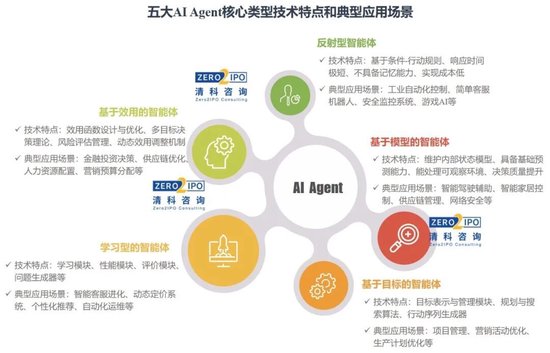
Core Insights - AI Agents are evolving from technical tools to new production factors, marking a critical phase for industry development and increasing investment interest [1][8] - The Chinese government aims for over 90% penetration of new generation AI applications by 2030, indicating a broad market potential for AI Agents [8][34] - The global AI Agent market is projected to grow from $5.1 billion in 2024 to $47.1 billion by 2030, with a CAGR of 44.8% [8][34] Group 1: AI Agent Definition and Characteristics - AI Agents are defined as autonomous or semi-autonomous software entities that perceive, decide, and act to achieve business goals, emphasizing autonomy, interactivity, and adaptability [2][3] - The "perception-decision-action" loop in AI Agents is powered by large models, which provide essential capabilities like dialogue and logical reasoning, although they lack autonomous action [3][29] - AI Agents can be categorized into five core types: reflex agents, model-based agents, goal-based agents, utility-based agents, and learning agents, each serving different applications [5][31] Group 2: Market Growth and Policy Support - The AI Agent industry is structured into three layers: foundational technologies, platform development, and application layers, with significant growth expected in enterprise and consumer applications [7][33] - The Chinese government's policies are driving rapid growth in the AI Agent market, with a focus on integrating AI into various sectors, including manufacturing [8][34] - Market forecasts indicate that by 2026, the proportion of enterprise applications integrating task-specific AI agents will rise from under 5% to 40% [8][34] Group 3: Competitive Landscape and Business Models - The AI Agent market features diverse players, including AI-native platform providers, tech giants, large model vendors, vertical solution providers, and traditional enterprises undergoing digital transformation [9][35] - Main business models in the AI Agent field include SaaS subscription, platform ecosystem, and customized enterprise services, each with distinct advantages [16][41] - The competition is intensifying, with companies focusing on integrating AI capabilities into existing products and developing specialized agents for various industries [15][40] Group 4: Application Areas and Demand Differentiation - AI Agents are being deployed across various sectors, including media, customer support, finance, and software development, with significant value realized in customer service and data analysis [19][44] - Different industries exhibit distinct needs for AI Agents, with manufacturing focusing on efficiency, finance on risk control, and healthcare on diagnostic accuracy [22][47] - The trend is shifting towards specialized AI Agents that cater to specific industry requirements, enhancing their effectiveness and value [22][47] Group 5: Investment Trends and Challenges - Investment in the AI Agent sector has surged since 2025, with notable funding rounds and acquisitions highlighting the growing interest in this space [48][49] - The investment focus is shifting from general platforms to specialized agents in vertical industries, with a preference for companies with established customer bases and positive cash flow [49] - Challenges remain in the commercialization of AI Agents, including technical limitations, integration difficulties, and emerging security risks [26][52]
港股互联网ETF博时(159568)跌0.91%,成交额5962.44万元
Xin Lang Cai Jing· 2026-02-13 10:32
来源:新浪基金∞工作室 流动性方面,截止2月13日,港股互联网ETF博时(159568)近20个交易日累计成交金额18.56亿元,日 均成交金额9280.31万元;今年以来,30个交易日,累计成交金额35.85亿元,日均成交金额1.20亿元。 港股互联网ETF博时(159568)现任基金经理为李庆阳。李庆阳自2024年2月8日管理(或拟管理)该基 金,任职期内收益66.36%。 最新定期报告显示,港股互联网ETF博时(159568)重仓股包括腾讯控股、阿里巴巴-W、小米集团- W、美团-W、商汤-W、快手-W、贝壳-W、京东健康、哔哩哔哩-W、金蝶国际,持仓占比如下。 股票代码股票名称持仓占比持仓股数(股)持仓市值(元)00700腾讯控股15.35%12.02万6503.17万 09988阿里巴巴-W14.43%47.39万6112.35万01810小米集团-W13.96%166.64万5915.14万03690美团- W12.30%55.85万5210.95万00020商汤-W4.08%869.70万1728.17万01024快手-W3.77%27.65万1597.09万 02423贝壳-W3.73%42. ...
期指:不确定性仍多,注意仓位管理
Guo Tai Jun An Qi Huo· 2026-02-13 01:52
Group 1: Report Investment Rating - No information provided on the industry investment rating Group 2: Core View - Uncertainty in index futures remains high, and attention should be paid to position management [1] Group 3: Summary of Related Catalogs 1. Index Futures Data Tracking - On February 12, the closing prices of the four major index futures contracts showed mixed trends: IF rose 0.07%, IH fell 0.29%, IC rose 1.24%, and IM rose 1% [1] - The total trading volume of index futures increased, indicating that investors' trading enthusiasm has increased. Specifically, the total trading volume of IF increased by 6,363 lots, IH by 2,280 lots, IC by 12,192 lots, and IM by 21,933 lots [2] - In terms of positions, the total positions of IF decreased by 945 lots, IH by 133 lots, while IC increased by 3,605 lots, and IM increased by 4,216 lots [2] 2. Top 20 Member Position Changes - The position changes of the top 20 members in each index futures contract vary. For example, in the IF2602 contract, long positions increased by 1,825 lots with a net change of 82 lots, and short positions increased by 2,886 lots with a net change of 1,042 lots [5] 3. Trend Strength - The trend strength of IF and IH is 1, and that of IC and IM is also 1. The trend strength ranges from -2 to 2, with -2 being the most bearish and 2 the most bullish [6] 4. Important Drivers - Concerns about AI eroding corporate profits led to a sharp decline in the US stock market, causing a broad decline in risk assets. Technology stocks led the decline, with the Nasdaq falling more than 2%, and the Nasdaq Golden Dragon China Index falling 3% [6] - Trump's tariff policies face major uncertainties. The US House of Representatives passed a resolution against Trump's tariff on Canada, and the future of the USMCA also faces significant uncertainties [7] - The Chinese central bank will conduct a 1 - trillion - yuan six - month outright reverse repurchase operation on February 13, with an incremental scale of 500 billion yuan [6] 5. Market Performance - A - shares showed narrow - range fluctuations, with the Shanghai Composite Index rising 0.05% to 4,134.02 points. Power stocks strengthened, while consumer stocks such as film and television, retail, and food underperformed [7] - Hong Kong stocks fluctuated and declined. The Hang Seng Index fell 0.86% to 27,032.54 points, and the Hang Seng Tech Index fell 1.65% to 5,408.98 points [8]