Kimi

Search documents
AI大模型,别只盯着手机端MAU
创业邦· 2025-12-25 03:08
Core Viewpoint - The article discusses the strategic shift of Kimi, a model company, from a focus on user acquisition metrics like DAU and MAU to enhancing its model and product capabilities, positioning itself in the AI market as a provider of high-value productivity tools rather than a player in the traffic-driven entertainment space [6][9][24]. Group 1: Kimi's Strategic Shift - Kimi has decided to abandon the "traffic cola" approach of large tech companies and instead focus on "value craft," emphasizing deep, complex tasks over shallow, high-frequency interactions [8][9]. - The company aims to assist users in completing intricate tasks that require significant time investment, such as analyzing lengthy financial reports or debugging complex code, rather than generating simple multimedia content [11][20]. - Kimi's web users spend an average of 8.5 minutes per visit, indicating that they are engaged in meaningful work rather than casual browsing, which highlights the importance of depth over scale in evaluating AI applications [14][16]. Group 2: New Metrics for Evaluation - Traditional metrics like MAU are deemed outdated for assessing AI tools; instead, new metrics focusing on user engagement depth, such as ARPU (Average Revenue Per User) and LTV (Lifetime Value), are more relevant [17][24]. - The article contrasts Kimi with other applications like Doubao, which cater to light entertainment and instant feedback, suggesting that Kimi's focus on deep research and complex tasks attracts a more specialized user base [14][16]. - Kimi's approach emphasizes the importance of "intelligence" over "hype," as its tools become indispensable for professional users, leading to a natural willingness to pay for the service [16][17]. Group 3: Kimi's Competitive Advantages - Kimi's commitment to technical depth and foundational model development sets it apart from competitors, ensuring that it maintains control over its pricing and application stability [19][20]. - By focusing on professional users and integrating its tools into their workflows, Kimi creates a "flywheel" effect where deeper usage leads to higher retention and willingness to pay [20][22]. - The company has strategically positioned itself in a niche market by providing compatible APIs and cost-effective solutions for developers, making it difficult for them to switch to other models [22][23]. Group 4: Implications for the AI Industry - Kimi's path illustrates a potential strategy for AI startups to build competitive advantages by prioritizing technical depth and value creation over mere traffic metrics [24]. - The shift from a traffic-driven model to one focused on delivering substantial value may redefine success in the AI industry, emphasizing the need for tools that are not only intelligent but also essential for professional tasks [24].


月活暴跌70%背后,Kimi走在钢索之上
36氪· 2025-12-19 13:19
听潮TI . 关注商业前沿,记录新商业故事。 以下文章来源于听潮TI ,作者听潮TI 融资?上市?张予彤走向台前, 月之暗面的商业化大考。 文 | 郭佳哿 编辑 | 张晓 来源| 听潮TI(ID: gh_49e8c5638ce2 ) 封面来源 | 视觉中国 最近,《时代》刚发布的年度人物封面选择复刻那张诞生于经济大萧条时期的经典照片《摩天大楼上的午餐》。 不同的是,这一次坐在高空钢梁上的,不再是工人,而是八位被视作 "推动人类进入 AI 时代"的关键人物。 图/时代周刊 这个位置本身,也正是当下整个 AI 行业所处的现状。 在一个尚未完工、规则仍在快速变动的系统中,没有人真正处在安全地带。脚下是技术红利逐渐收 敛的现实,身后是尚未被验证的商业模式,而市场已经开始要求答案。 当行业逐渐意识到,单纯的模型能力已经难以拉开决定性差距,关于 " AI 下一步该往哪里走"的判断被再度强调。李彦宏在接受《时代》采访时再次指出 应用层的重要性。这样的表述并不新鲜,但其被反复提起,本身已经构成一个信号——行业正在从技术叙事,转向结果叙事。 谁来负责商业化?谁来回应增长与现金流? 这些问题开始从幕后,被推到台前。对于那些尚未背 ...
月活暴跌70%背后,Kimi走在钢索之上
Tai Mei Ti A P P· 2025-12-18 08:26
文 | 听潮TI,作者 | 郭佳哿,编辑 | 张晓 最近,《时代》刚发布的年度人物封面选择复刻那张诞生于经济大萧条时期的经典照片《摩天大楼上的 午餐》。 不同的是,这一次坐在高空钢梁上的,不再是工人,而是八位被视作"推动人类进入AI时代"的关键人 物。 图/时代周刊 这个位置本身,也正是当下整个AI行业所处的现状。在一个尚未完工、规则仍在快速变动的系统中, 没有人真正处在安全地带。脚下是技术红利逐渐收敛的现实,身后是尚未被验证的商业模式,而市场已 经开始要求答案。 谁来负责商业化?谁来回应增长与现金流?这些问题开始从幕后,被推到台前。对于那些尚未背靠大厂 生态、主要依靠单一产品形态生存的AI公司而言,这种转向带来的并不是机会,而是压力。 也正是在这样的压力之下,张予彤首次以"Kimi 总裁"的身份走向台前,正式承担对外核心职责。这一 人事变化本身并不高调,只是在外界持续质疑Kimi融资节奏、算力成本与长期现金流模型的当下,行 业需要看到一条更清晰的商业落地与资本路径。 曾经,Kimi因技术稀缺性站上聚光灯;如今,当聚光灯转向"落地与回报",它也被推到了必须作答的位 置。 01从幕后到台前:当张予彤有了确定性新 ...

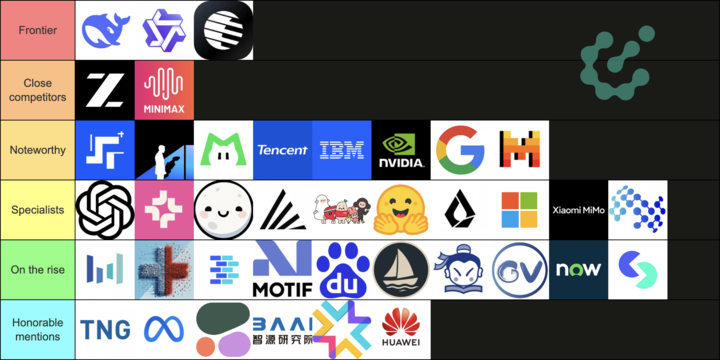
在这个开源「从夯到拉」榜单,我终于明白中国 AI 为什么能逆袭
Xin Lang Cai Jing· 2025-12-17 14:25
Core Insights - The recent ranking of open-source AI models highlights the dominance of Chinese models, with DeepSeek, Qwen, Kimi, Zhipu, and MiniMax leading the global landscape, while OpenAI and Meta's models lag behind [3][5][25]. Group 1: Performance and Market Position - Chinese open-source models are rapidly closing the performance gap with closed-source giants, excelling in dimensions such as performance, pricing, ecosystem, and usability [5][25]. - Kimi's K2 Thinking model, featuring a trillion parameters, has outperformed OpenAI's GPT-5 and Anthropic's Claude 4.5 in various benchmarks [11][14]. - MiniMax M2 has also shown strong performance, ranking fifth in comprehensive lists, surpassing competitors like Gemini 2.5 Pro and Claude Opus 4.1 [14][79]. Group 2: Technological Advancements - The introduction of interleaved thinking in models like MiniMax M2 and Kimi K2 Thinking allows for more efficient task execution by alternating between action and reflection [34][36]. - MiniMax M2 employs a full attention mechanism, which, despite increasing training and inference demands, has proven to deliver better performance compared to sparse attention models [75][78]. Group 3: Cost and Accessibility - MiniMax's API offers competitive pricing at $0.3/$1.2 per million input/output tokens, although its verbose nature leads to high token usage, which can offset cost advantages [79]. - The open-source movement in China is gaining momentum, with MiniMax's release reinforcing the leadership established by DeepSeek and other Chinese AI labs in the open-source domain [80][84]. Group 4: Community and Developer Adoption - There is a growing recognition among developers for the practicality and affordability of Chinese open-source models, with many citing them as preferable alternatives to established closed-source options like OpenAI [25][84]. - The rapid updates and releases from various Chinese companies indicate a robust and collaborative open-source ecosystem that is continuously evolving [11][14].

X @0xLIZ
0xLIZ· 2025-12-12 02:46
AI Application & User Behavior - US AI platforms like ChatGPT/Gemini are primarily used for productivity enhancement, such as professional writing and code debugging, reflecting a focus on efficiency among users [1] - Chinese AI platforms like 豆包/Kimi are more frequently used for daily life inquiries, including health advice and emotional support, indicating a broader range of user needs [1] - Users exhibit curiosity and a degree of distrust towards AI capabilities, as evidenced by frequent questions about the AI's origin and comparisons between different AI products [1] - A common use case across both US and Chinese AI platforms is content creation (text and images), information explanation, brainstorming, and advice seeking [1] Emotional & Social Trends - Gemini users often question the AI's sentience, suggesting a perception of AI as an advanced, almost alien entity [1] - 豆包 users seek emotional encouragement from the AI, indicating a desire for companionship and support [1] - Users across platforms express politeness by saying "thank you" to AI, suggesting a generally positive and respectful interaction [1] - Gemini users frequently request assistance in writing polite refusal emails, highlighting a difficulty in direct communication and a reliance on AI for managing social interactions [1]
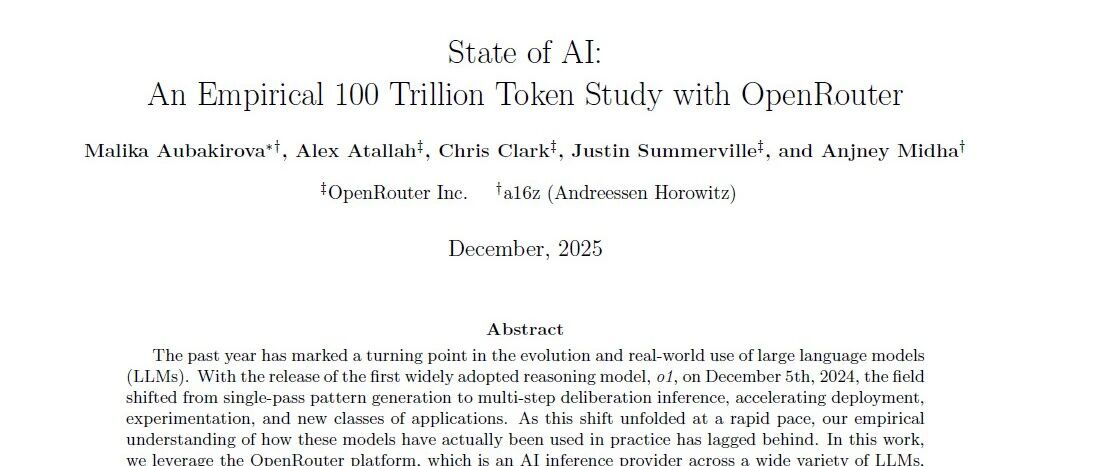
观察| 100万亿Tokens的:AI正在发生你看不见的巨变
未可知人工智能研究院· 2025-12-07 03:02
Core Insights - The report reveals that AI is undergoing a significant revolution, characterized by a shift from traditional models to reasoning models that can think and plan in multiple steps [3][11][12]. Group 1: OpenRouter and Its Importance - OpenRouter is likened to "Meituan" in the AI world, connecting over 500 million developers to more than 300 AI models, making its data highly credible [5][6]. - OpenRouter's daily token processing volume has surpassed 1 trillion, indicating a rapid growth from approximately 100 trillion tokens annually from early 2024 to mid-2025, marking a tenfold increase [8][6]. Group 2: Reasoning Revolution - The report identifies a "reasoning revolution," where AI models evolve from simple response machines to complex reasoning machines capable of multi-step thinking [11][12]. - The launch of OpenAI's o1 reasoning model (codename Strawberry) is a pivotal event, as it incorporates internal reasoning processes that enhance its problem-solving capabilities [18][19]. - Users are increasingly engaging in complex tasks, leading to longer prompts and more dialogue rounds, indicating a shift towards training AI for intricate tasks [20][21][23]. Group 3: Agentic AI - Agentic AI represents a transformation where AI can autonomously plan, execute, and verify tasks, moving from passive response to active engagement [27][30]. - The report highlights that agentic reasoning is the fastest-growing behavior on OpenRouter, indicating a shift in user expectations from simple answers to task completion [34][35]. Group 4: Rise of Open Source Models - Open source models, particularly from Chinese teams like DeepSeek R1 and Kimi K2, are rapidly gaining market share, challenging the dominance of closed-source models [44][47]. - DeepSeek R1 offers significant cost advantages, with a cost of $0.003 per 1K tokens compared to $0.03 for GPT-4, making it attractive for developers [52]. Group 5: Real-World AI Usage - The primary applications driving token usage are creative writing and programming, with AI becoming indispensable for developers [71][72]. - Users are not merely relying on AI for content generation but are engaging in co-creation, indicating a shift in the role of AI from a tool to a creative partner [77][78]. Group 6: Model Personality - Users' choices of AI models are influenced by the "personality" of the models, which affects user retention and engagement [88][95]. - The report suggests that models with unique personalities can outperform those with higher benchmark scores in terms of user loyalty [96][100]. Group 7: Implications for the Chinese AI Industry - The success of Chinese models like DeepSeek R1 and Kimi K2 in the global market indicates that they have competitive capabilities [109]. - The report emphasizes the importance of focusing on reasoning and agentic capabilities as key technological directions for the Chinese AI industry [115].
让AI分析这波大模型公司宣传战:原来每家都有自己的鲜明人设 | Jinqiu Scan
锦秋集· 2025-11-25 11:41
Core Insights - The article explores the brand communication strategies of leading AI companies, emphasizing the importance of effective storytelling and emotional connection in technology marketing [2][56] - It highlights the balance between technical strength and emotional warmth as a key to successful brand positioning in the AI industry [56][57] Group 1: Brand Communication Strategies - The analysis involves using AI tools to dissect the brand stories, market positioning, and communication styles of eight prominent AI companies [4][6] - The selected companies include both international and domestic players, such as OpenAI, Anthropic, Google Gemini, DeepSeek, Kimi, MiniMax, Tongyi Qianwen, and Doubao [7][19] - The study aims to identify common themes in their narratives, positioning strategies, and marketing tactics that can be replicated by emerging AI startups [3][5] Group 2: Brand Personas - Each of the eight companies has developed distinct brand personas, ranging from technical authority to warm companionship, reflecting their unique approaches to market engagement [16][57] - For instance, OpenAI is characterized as a technical authority, while Anthropic positions itself as an AI safety guardian [19][22] - The personas are categorized into six types, showcasing the diversity in brand representation within the AI sector [16][17] Group 3: Marketing Insights - The article outlines three levels of communication strategy: functional competition, emotional connection, and social value, emphasizing the need for a coherent brand persona that aligns with the company's culture [60] - It suggests that companies should leverage open-source technology to build trust within the developer community, enhancing their professional image [61] - The importance of genuine belief in the technology's potential to effect change is highlighted as a crucial element in establishing a relatable brand persona [62]

两部门发文,DeepSeek、Kimi、豆包等或将入围
2 1 Shi Ji Jing Ji Bao Dao· 2025-11-23 14:41
Core Points - The National Internet Information Office and the Ministry of Public Security released a draft regulation on personal information protection for large internet platforms, establishing criteria for identifying such platforms and their obligations for personal information protection [1][3] - The draft regulation aligns with previous regulations and emphasizes the principle that greater capabilities entail greater responsibilities in digital economy regulation [1][3] Group 1: Identification Criteria for Large Platforms - Large platforms are identified based on having over 50 million registered users or over 10 million monthly active users, providing significant network services, and handling data that could impact national security and economic operations if compromised [5][6] - Traditional internet platforms like Tencent, Alibaba, and ByteDance, as well as emerging AI companies and smart device manufacturers, are likely to fall under this regulation [3][6] Group 2: Compliance and Reporting Requirements - Large platforms must appoint a personal information protection officer and establish a dedicated team to manage personal information protection, including creating internal management systems and emergency response plans [9][10] - The draft regulation requires platforms to publish annual social responsibility reports on personal information protection, addressing previous shortcomings in compliance and transparency [9][10] Group 3: Independent Supervision Mechanism - The draft regulation proposes the establishment of independent supervisory committees composed mainly of external members to oversee personal information protection compliance [12][13] - These committees will have specific responsibilities, including monitoring compliance systems, evaluating the impact of personal information protection measures, and maintaining regular communication with users [13][14]




两部门发文,DeepSeek、Kimi、豆包等或将入围
21世纪经济报道· 2025-11-23 14:31
Core Viewpoint - The article discusses the newly released draft regulations for personal information protection by large internet platforms in China, emphasizing the responsibilities and obligations these platforms must adhere to in safeguarding user data [1][3]. Group 1: Regulatory Framework - The draft regulations define large internet platforms based on user scale, specifically those with over 50 million registered users or 10 million monthly active users [5]. - Major companies like Tencent, Alibaba, ByteDance, and emerging AI firms such as DeepSeek and MiniMax are included under this definition, indicating a broader scope of regulation [3][5]. - The principle of "with great power comes great responsibility" is highlighted, indicating that larger platforms will face stricter compliance requirements [1][3]. Group 2: Compliance Requirements - Large platforms are required to establish dedicated personal information protection teams responsible for creating and implementing internal management systems and emergency response plans [10]. - The regulations mandate that personal information collected within China must be stored in domestic data centers, and platforms must conduct compliance audits and risk assessments [11]. - There is an emphasis on the need for platforms to publish social responsibility reports regarding personal information protection, which has previously been inadequately addressed by many companies [10]. Group 3: Independent Oversight - The draft regulations propose the establishment of independent supervisory committees composed mainly of external members to oversee personal information protection practices [13][15]. - These committees are tasked with monitoring compliance, evaluating the protection of sensitive personal information, and ensuring regular communication with users [15]. - Concerns are raised about the feasibility of these committees, as many platforms have yet to take significant steps towards establishing them [14].





两部门拟明确“守门人”认定标准,AI新贵们也入围了?
2 1 Shi Ji Jing Ji Bao Dao· 2025-11-23 07:57
Core Viewpoint - The draft regulations on personal information protection for large internet platforms have been released, establishing criteria for identifying such platforms and outlining their obligations for personal information protection [1][2]. Group 1: Identification of Large Platforms - The draft specifies that platforms with over 50 million registered users or 10 million monthly active users will be classified as large internet platforms, which includes traditional internet giants and emerging AI companies [3][4]. - Companies like DeepSeek, MiniMax, and Kimi, as well as smart device manufacturers such as OPPO, vivo, and Honor, are also likely to fall under this classification due to their user base [1][3]. Group 2: Responsibilities and Compliance - Large platforms are required to establish dedicated personal information protection teams, appoint responsible personnel, and publish annual social responsibility reports regarding personal information protection [6][7]. - The draft emphasizes the need for platforms to store personal information generated within China in domestic data centers and to conduct compliance audits and risk assessments [7]. Group 3: Independent Supervision - The draft regulations propose the establishment of independent supervisory committees composed mainly of external members to oversee personal information protection compliance [10][11]. - These committees will be responsible for monitoring compliance with personal information protection regulations and will need to maintain regular communication with users [11].