天弘基金

Search documents
大举增持美股,QDII基金大动作
Zheng Quan Shi Bao· 2025-11-04 11:14
Group 1 - The core narrative shift among tech giants like Nvidia, Microsoft, Google, and Samsung is driving public QDII funds to increase their positions in US stocks, particularly in the AI healthcare sector [1][6] - Star fund managers, including Zhang Kun and Li Yaozhu, have significantly raised their US stock allocations, reducing their exposure to Hong Kong stocks amid recent market adjustments [3][4] - The performance of QDII funds has improved, with many previously underperforming funds seeing accelerated gains due to the strong performance of AI healthcare stocks [1][6] Group 2 - The report from GF Global Select Fund indicates that by the end of Q3, the fund's US stock allocation rose to 75%, while its Hong Kong stock allocation dropped to approximately 3.72% [3] - Similarly, the E Fund Global Growth Select Fund saw its US stock allocation increase to 52%, with only about 10% in Hong Kong stocks, focusing on major US tech companies [3] - The Chuangjin Hexin Global Pharmaceutical Fund completely liquidated its Hong Kong stock holdings, increasing its US stock allocation to 71% by the end of September [4] Group 3 - The core reason for the increase in US stock holdings among QDII fund managers is the high elasticity exhibited by the AI healthcare sector in the US market [6] - QDII funds focusing on US stocks have dominated performance rankings, with notable returns such as 39% for E Fund Global Growth Select Fund and 36% for Huaxia New Era Fund over the past three months [6] - Funds with minimal Hong Kong exposure, like the Jianxin Emerging Markets Mixed Fund, have also seen significant returns, ranking first with an 11% return in the last month [6] Group 4 - Recent developments in the US AI healthcare sector, including major collaborations and investments by companies like Nvidia and Microsoft, have significantly contributed to the performance of QDII funds [7] - For instance, the GRAIL company, which focuses on cancer early detection, has seen its stock price rise by 55% after receiving investments from major firms, benefiting funds like Chuangjin Hexin [7] Group 5 - Fund managers are optimistic about the growth potential of AI healthcare, viewing it as a key investment area amid the ongoing technological advancements in the sector [9][10] - The focus is shifting towards AI medical devices and applications with substantial market potential, as evidenced by adjustments in fund holdings [9][10] - The Silver Hua Healthcare Fund has also invested heavily in AI healthcare stocks, emphasizing the underestimated potential of AI technology in the pharmaceutical industry [10]
5只上证180指数ETF成交额环比增超100%
Zheng Quan Shi Bao Wang· 2025-11-04 10:02
Core Insights - The trading volume of the Shanghai Stock Exchange 180 Index ETF reached 210 million yuan today, an increase of 95.63 million yuan compared to the previous trading day, representing a growth rate of 83.58% [1] Trading Volume Summary - The Huazhong Shanghai 180 ETF (510180) had a trading volume of 143 million yuan today, up by 74.68 million yuan from the previous day, with a growth rate of 109.13% [1] - The Southern Shanghai 180 ETF (530580) recorded a trading volume of 25.14 million yuan, an increase of 12.22 million yuan, reflecting a growth rate of 94.62% [1] - The 180 Index (530300) saw a trading volume of 6.87 million yuan, up by 5.52 million yuan, with a significant growth rate of 410.26% [1] - The Ping An Shanghai 180 ETF (530280) and the Shang 180 ETF (530800) had the highest increases in trading volume, with growth rates of 6220.16% and 436.42% respectively [1] Market Performance - As of market close, the Shanghai 180 Index (000010) fell by 0.65%, while the average decline for related ETFs tracking the index was 0.61% [1] - The ETFs with the largest declines included the Shang 180 ETF (530800) and the 180 Index (530300), both down by 0.81% [1]
易方达规模首破2.5万亿
2 1 Shi Ji Jing Ji Bao Dao· 2025-11-04 07:56
Core Insights - The total net asset value of public funds in China reached a historic high of 36.74 trillion yuan as of September 2025, marking a nearly 7% increase from the end of Q2 2025 and a 14.56% increase year-on-year [1][3][4]. Fund Management Landscape - There are 165 public fund management institutions in China, including 150 fund management companies and 15 asset management institutions with public qualifications [1]. - The top two fund management companies, E Fund and Huaxia, have assets under management (AUM) exceeding 2.5 trillion yuan and 2.2 trillion yuan, respectively [1][8]. - The top ten fund managers collectively manage 15.06 trillion yuan, accounting for 41.31% of the total market size, indicating a trend of "the strong getting stronger" [6][8]. Fund Type Performance - In Q3 2025, the total scale of public funds increased by 2.35 trillion yuan, with all fund types except bond funds showing growth [4][6]. - The fastest-growing fund types were overseas investment funds, which saw a 33.18% increase, and stock funds, which grew by 25.3% [5][6]. - The total scale of stock funds reached 5.94 trillion yuan, while mixed funds reached 3.91 trillion yuan, reflecting significant growth in these categories [5][9]. Investor Behavior and Trends - There has been a notable demand for thematic ETFs and cross-border ETFs, with several funds seeing net subscriptions exceeding 10 billion units in Q3 2025 [13][14]. - Despite the overall growth, there is a significant divergence in the subscription patterns of equity funds, with some experiencing heavy redemptions as investors lock in profits [14][15]. - High-performing active equity funds also attracted net subscriptions, but their levels were lower compared to ETF products [14]. Redemption Trends - Some ETFs, particularly in sectors that had previously seen long adjustments, experienced significant redemptions as investors opted to cash out after recent performance recoveries [15]. - Notable examples include the Huaxia Sci-Tech 50 ETF and E Fund Medical ETF, which saw reductions in fund shares of 307.89 billion and 133.28 billion, respectively [15].


易方达规模首破2.5万亿
21世纪经济报道· 2025-11-04 07:48
Core Viewpoint - The total scale of public funds in China has reached a historical high of 36.74 trillion yuan, marking a nearly 7% increase from the end of the second quarter of 2025, driven by a recovering stock market and strong performance of equity funds [1][3]. Fund Scale and Growth - As of September 2025, the total net asset value of public funds in China is 36.74 trillion yuan, a 14.56% increase year-on-year and an increase of 2.35 trillion yuan in the third quarter alone [3][5]. - All major fund types, except for bond funds, experienced growth in the third quarter, with overseas investment funds showing the fastest growth rate of 33.18% [4][5]. Fund Type Performance - The scale of various fund types at the end of the third quarter is as follows: - Stock funds: 5.94 trillion yuan, up 25.3% from the end of June - Mixed funds: 3.91 trillion yuan, up 17.89% - Money market funds: 14.40 trillion yuan, up 3.32% - Overseas investment funds: 904.52 billion yuan, up 33.18% - FOF: 193.49 billion yuan, up 17.22% - Bond funds: 10.62 trillion yuan, down 1.33% [4][5]. Market Leaders - The top ten fund management companies account for 41.31% of the total market scale, with their combined net asset value reaching 15.06 trillion yuan [5][6]. - The leading fund management companies by scale as of September 2025 are: - E Fund: 2.53 trillion yuan - Huaxia Fund: 2.25 trillion yuan - GF Fund: 1.61 trillion yuan - Southern Fund: 1.48 trillion yuan - Other notable firms include Tianhong, Jiashi, Boshi, and Huitianfu, all exceeding 1 trillion yuan [6][7]. Investor Behavior - There is a significant divergence in the subscription of equity funds, with tool-type products like industry-themed ETFs and cross-border ETFs being highly favored, achieving net subscriptions of over 10 billion units each [10][11]. - Conversely, some actively managed equity funds have also seen substantial net subscriptions, but their "attraction" is not as strong as that of ETFs [12]. - Despite the overall market expansion, there is a notable trend of profit-taking among investors, particularly in sectors that have recently rebounded [12][13].
港股通央企红利ETF天弘(159281)跌0.29%,成交额7058.70万元
Xin Lang Cai Jing· 2025-11-04 07:20
Core Points - Tianhong CSI Hong Kong Stock Connect Central State-Owned Enterprises Dividend ETF (159281) closed down 0.29% on November 4, with a trading volume of 70.587 million yuan [1] - The fund was established on August 20, 2025, with an annual management fee of 0.50% and a custody fee of 0.10% [1] - As of November 3, the fund's latest share count was 225 million, with a total size of 231 million yuan [1] - Over the past 20 trading days, the fund's cumulative trading amount reached 1.16 billion yuan, with an average daily trading amount of 58.005 million yuan [1] - The current fund manager is He Yuxuan, who has managed the fund since its inception, achieving a return of 1.18% during the tenure [1] Holdings Summary - The top holdings of Tianhong CSI Hong Kong Stock Connect Central State-Owned Enterprises Dividend ETF include: - COSCO Shipping Holdings (0.85% holding, 218,000 shares, market value of 2.9175 million yuan) [2] - Orient Overseas International (0.40% holding, 10,500 shares, market value of 1.3717 million yuan) [2] - China Foreign Transport (0.33% holding, 270,000 shares, market value of 1.1396 million yuan) [2] - China Petroleum (0.32% holding, 162,000 shares, market value of 1.0973 million yuan) [2] - CITIC Bank (0.32% holding, 175,000 shares, market value of 1.1136 million yuan) [2] - CNOOC (0.29% holding, 58,000 shares, market value of 1.0041 million yuan) [2] - China Shenhua Energy (0.29% holding, 30,500 shares, market value of 982,600 yuan) [2] - China Pacific Insurance (0.29% holding, 164,000 shares, market value of 1.0107 million yuan) [2] - China Unicom (0.28% holding, 104,000 shares, market value of 952,800 yuan) [2] - Agricultural Bank of China (0.27% holding, 189,000 shares, market value of 933,900 yuan) [2]


赤峰黄金股价跌5.08%,天弘基金旗下1只基金重仓,持有35.9万股浮亏损失54.57万元
Xin Lang Cai Jing· 2025-11-04 06:59
Group 1 - The core point of the news is that Chifeng Jilong Gold Mining Co., Ltd. experienced a 5.08% drop in stock price, closing at 28.40 CNY per share, with a trading volume of 1.036 billion CNY and a turnover rate of 2.16%, resulting in a total market capitalization of 53.972 billion CNY [1] - The company primarily engages in gold and non-ferrous metal mining and resource recycling, with its main revenue sources being 90.03% from gold, 3.76% from electrolytic copper, and smaller contributions from other minerals [1] - The company is located in Chifeng City, Inner Mongolia, and was established on June 22, 1998, with its stock listed on April 14, 2004 [1] Group 2 - Tianhong Fund has a significant holding in Chifeng Gold, with its Tianhong CSI 500 ETF reducing its stake by 10.77 thousand shares in the third quarter, now holding 35.9 thousand shares, which represents 0.52% of the fund's net value [2] - The Tianhong CSI 500 ETF was established on August 7, 2020, with a current size of 2.05 billion CNY, achieving a year-to-date return of 30.09% and a one-year return of 27.94% [2] - The fund manager, Chen Yao, has been in charge for 7 years and 268 days, with the fund's total asset size at 42.16 billion CNY, achieving a best return of 55.16% and a worst return of -34.94% during the tenure [3]

亨通光电股价跌5.04%,天弘基金旗下1只基金重仓,持有80.75万股浮亏损失89.63万元
Xin Lang Cai Jing· 2025-11-04 06:57
11月4日,亨通光电跌5.04%,截至发稿,报20.90元/股,成交15.44亿元,换手率2.96%,总市值515.55 亿元。 天弘中证全指通信设备指数发起A(020899)成立日期2024年4月15日,最新规模1.65亿。今年以来收益 93.55%,同类排名8/4216;近一年收益93.87%,同类排名10/3896;成立以来收益131.85%。 从基金十大重仓股角度 风险提示:市场有风险,投资需谨慎。本文为AI大模型自动发布,任何在本文出现的信息(包括但不 限于个股、评论、预测、图表、指标、理论、任何形式的表述等)均只作为参考,不构成个人投资建 议。 数据显示,天弘基金旗下1只基金重仓亨通光电。天弘中证全指通信设备指数发起A(020899)三季度 增持70.83万股,持有股数80.75万股,占基金净值比例为2.28%,位居第七大重仓股。根据测算,今日 浮亏损失约89.63万元。 责任编辑:小浪快报 天弘中证全指通信设备指数发起A(020899)基金经理为张戈。 截至发稿,张戈累计任职时间2年334天,现任基金资产总规模82.23亿元,任职期间最佳基金回报 129.5%, 任职期间最差基金回报-18.12 ...

粤桂股份股价跌5.02%,天弘基金旗下1只基金位居十大流通股东,持有158.64万股浮亏损失130.09万元
Xin Lang Cai Jing· 2025-11-04 06:45
Core Points - On November 4, Yuegui Co., Ltd. experienced a decline of 5.02%, with a stock price of 15.52 CNY per share, a trading volume of 710 million CNY, a turnover rate of 9.83%, and a total market capitalization of 12.448 billion CNY [1] Company Overview - Yuegui Co., Ltd. was established on October 5, 1994, and listed on November 11, 1998. The company is based in Liwan District, Guangzhou, Guangdong Province [1] - The main business activities include the production and sale of refined sugar (white sugar, brown sugar), pulp (unbleached pulp, bleached pulp), and paper products (cultural paper, specialty paper), as well as the mining, processing, and sale of sulfur iron ore, sulfuric acid, reagent acid (refined sulfuric acid), iron ore powder (sulfur iron ore slag), and phosphate fertilizer (ordinary calcium phosphate) [1] - The revenue composition of the main business is as follows: sulfur concentrate 37.15%, refined sugar 21.46%, pulp 13.92%, others 7.53%, sulfuric acid 5.79%, iron ore powder 4.79%, silver powder 2.30%, phosphate fertilizer 1.89%, block ore 1.40%, trading business 0.97%, -3mm ore 0.96%, cultural paper 0.67%, amino sulfonic acid 0.58%, reagent sulfuric acid 0.50%, and exported hand-picked ore 0.08% [1] Shareholder Information - Tianhong Fund has a presence among the top ten circulating shareholders of Yuegui Co., Ltd. The Tianhong CSI Food and Beverage ETF (159736) entered the top ten circulating shareholders in the third quarter, holding 1.5864 million shares, which accounts for 0.35% of the circulating shares [2] - The Tianhong CSI Food and Beverage ETF (159736) was established on September 9, 2021, with a current scale of 5.525 billion CNY. Year-to-date, it has incurred a loss of 1.58%, ranking 4173 out of 4216 in its category; over the past year, it has lost 0.1%, ranking 3819 out of 3896; and since inception, it has lost 28.4% [2]

公募基金规模暗战正酣:万亿俱乐部扩容,易方达首破2.5万亿
2 1 Shi Ji Jing Ji Bao Dao· 2025-11-04 06:33
Core Insights - The total scale of public funds in China reached 36.74 trillion yuan by the end of September 2025, marking a 7% increase from the second quarter of the year and a 14.56% increase year-on-year [1][2][5] Fund Management Landscape - As of September 2025, there are 165 public fund management institutions in China, including 150 fund management companies and 15 asset management institutions with public qualifications [1] - The top ten fund managers account for 41.31% of the total market scale, with their combined asset value reaching 15.06 trillion yuan, reflecting a trend of "the strong getting stronger" [5][7] Fund Type Performance - In the third quarter of 2025, various fund types, except for bond funds, experienced growth. Notably, overseas investment funds saw the highest growth rate at 33.18%, followed by stock funds at 25.3% [2][4] - The total scale of stock funds reached 5.94 trillion yuan, while mixed funds reached 3.91 trillion yuan, and money market funds totaled 14.40 trillion yuan [4][5] ETF and Active Fund Trends - Tools that capture market trends, such as thematic ETFs and cross-border ETFs, have become highly sought after, with several funds seeing net subscriptions exceeding 10 billion units in the third quarter [10] - Some actively managed equity funds also attracted significant net subscriptions, although their "capital-absorbing" capacity was lower than that of ETF products [11] Redemption Trends - Despite the overall market expansion, there is a notable trend of investors cashing out, particularly in sectors that have seen recent rebounds. For instance, several ETFs experienced significant reductions in fund shares during the third quarter [12][14][15]

11月首周新基发行回暖 环比增近3成
Xin Hua Cai Jing· 2025-11-04 05:58
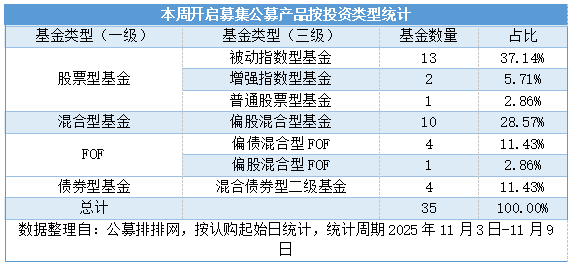
Core Insights - The public fund issuance showed signs of recovery in the first week of November, with a total of 35 public products launched, marking a 29.63% increase from the previous week [1][2] - The average subscription days for the new funds decreased to 19 days, indicating enhanced market activity [1] Fund Issuance Overview - A total of 35 new public funds were issued, with equity funds (including stock and mixed funds) being the primary contributors, accounting for over 70% of the total issuance [2][3] - The breakdown of fund types shows that stock funds comprised 16 of the new issues, representing 45.71% of the total, with passive index funds leading at 13 issues (37.14%) [3][4] Fund Type Distribution - The issuance of mixed funds reached 10, making up 28.57% of the total, with the core being the equity-mixed funds [3] - Bond funds maintained a stable issuance with 4 mixed bond funds, accounting for 11.43% of the total [4] - FOF products also performed well, with 5 new issues, matching the highest weekly issuance for the year [4] Institutional Participation - The 35 new funds were launched by 25 different public fund institutions, with 18 institutions issuing one fund each and 7 institutions issuing two or more [4] - E Fund led the issuance with 4 new funds, primarily in passive index stock funds, followed by Huatai-PineBridge with 3 new funds [4]