Spotify Technology S.A.

Search documents
AI×音乐:下一个千亿级市场,来了!
混沌学园· 2025-05-22 09:32
Core Viewpoint - The article discusses how AI is fundamentally reshaping the music industry, transforming everything from creation to consumption, and emphasizes the potential for AI to enhance human creativity rather than replace it [3][19]. Group 1: AI in Music Creation - AI music generators are emerging, allowing even those without musical knowledge to create songs easily, as demonstrated by a case where a teacher won a competition using AI [9]. - The traditional music creation process is being replaced by a new model driven by AI, which enhances collaboration between humans and machines [9]. - Collaborations between major music companies and AI firms are setting industry standards, showcasing AI as a creative partner for musicians [9]. Group 2: AI in Music Production - AI is significantly improving efficiency in music production, particularly in mixing and mastering, as illustrated by the revival of a long-lost Beatles song using AI technology [12][13]. - The ability of AI to separate and restore audio tracks demonstrates its potential in preserving musical heritage [12][13]. Group 3: AI in Music Promotion - AI is revolutionizing music promotion by analyzing fan preferences and generating personalized marketing strategies, allowing artists to focus more on creation [14]. - The use of AI for targeted music recommendations has led to significant increases in streaming numbers for independent artists [14][18]. - Collaborations between music labels and tech companies are creating new paradigms for music distribution, enhancing audience engagement through intelligent recommendations [14]. Group 4: AI in Music Consumption - AI is transforming music consumption into an immersive experience, integrating social elements and digital collectibles [17]. - The rise of virtual idols and AI-generated performances is changing the dynamics of fan engagement and monetization in the music industry [18]. - AI's ability to analyze user behavior and preferences is reshaping how music is consumed, leading to increased user engagement and spending [18].


Fortnite approved by Apple, returns to U.S. App Store 5 years after removal
CNBC· 2025-05-20 22:59
Core Points - Apple has approved the return of Fortnite to the U.S. App Store after five years since its removal in 2020 due to a legal dispute with Epic Games over payment mechanisms [1][2] - A recent court ruling stated that Apple cannot charge a commission for apps linking out for payments, which has led to changes in how major app developers like Amazon and Spotify operate their apps [2][4] - Epic Games has been able to offer Fortnite in Europe through a third-party app store under the Digital Markets Act, despite ongoing challenges with Apple [6] Group 1: Legal and Approval Process - Epic Games submitted Fortnite to the U.S. App Store, which had to pass Apple's App Review process to ensure compliance with guidelines [2] - Apple delayed the approval process since May 9, leading to a legal challenge from Epic Games, prompting a judge to require Apple to explain the delay [3] - Apple is appealing the recent court order that affects its App Store policies and is seeking a pause to roll back changes made in response to the ruling [4] Group 2: Financial Implications - The fees from the App Store are a significant revenue source for Apple, contributing to its Services business, which reported nearly $27 billion in revenue during the March quarter [7]


谷歌:情况看起来不太好,但至少价格便宜
美股研究社· 2025-05-20 12:14
Core Viewpoint - Google is facing significant challenges in the digital advertising market, with a declining market share compared to competitors like Meta. However, its current valuation is much lower, which reduces the safety margin for continuing to hold a bearish view on the stock [1][3]. Advertising Market Performance - Google's advertising revenue growth is lagging behind the overall industry, with a 1-year CAGR of 8.5%, compared to Meta's 19.3% and the total advertising market's 14.4% [4]. - The removal of the de minimis exemption is expected to create further headwinds for Google's advertising business, particularly affecting retailers in the Asia-Pacific region [6]. Profitability and Cost Management - Despite challenges in advertising revenue, Google has shown resilience in profitability, with improvements in gross margins attributed to lower traffic acquisition costs (TAC) and slower wage growth [10]. - The company's operating profit margins benefit from healthy revenue growth and a favorable shift towards lower TAC advertising revenue [10]. Analyst Sentiment and Valuation - Analysts have a mixed outlook on Google's earnings, with a consensus indicating a more optimistic view due to the structural shift towards lower TAC search revenue and slowing wage growth [11]. - Google's 1-year forward P/E ratio is 18.0, which is a 13.1% discount compared to its 3-year median P/E of 20.8 [12]. - The stock is trading at a 43% discount relative to its peers, which is lower than its typical 33% discount over the past year [14][17]. Legal Challenges - Google is currently involved in a lawsuit regarding its advertising technology stack, with a ruling indicating that it has maintained a monopoly through bundling practices [21][23]. - The U.S. Department of Justice is pushing for Google to divest its Google Ad Manager, which could further weaken its competitive position in the digital advertising market [24]. Conclusion - While Google's valuation appears low and presents potential upside, the ongoing challenges in revenue growth and competitive pressures raise concerns about the sustainability of its profitability and market position [25].


《堡垒之夜》重返iOS再生变,法官下令苹果限期解决争端
Feng Huang Wang· 2025-05-20 00:54
Core Points - A U.S. District Court judge has ordered Apple to resolve its dispute with Epic Games regarding the return of Fortnite to the iOS platform, or Apple executives must appear in court by May 27 [1] - The judge emphasized that Apple has the capability to resolve the issue without further submissions or hearings [1] - Epic Games recently submitted a request to relist Fortnite, which Apple rejected, leading to Epic's motion to enforce a prior court order [1] Group 1 - The ongoing legal battle between Apple and Epic Games dates back to 2020 when Apple removed Fortnite from the App Store for using unauthorized direct payment methods [1] - Despite Apple's initial victory in the lawsuit, the court mandated limited modifications to Apple's external link policy under California law [2] - Following the court's ruling, other applications like Spotify and Kindle have been allowed to resubmit their apps with options for external purchases, while the outcome of the new dispute between Epic and Apple remains uncertain [2]
Apple approves Spotify update so US users can buy audiobooks within the app
TechCrunch· 2025-05-19 21:09
Core Viewpoint - Spotify has received approval from Apple for a new app update that allows U.S. iPhone users to purchase audiobooks directly within the app, enhancing user experience and accessibility for publishers and authors [1][2]. Group 1: App Update Features - The new update enables users to buy individual audiobooks directly in the app, view prices, and purchase additional listening hours beyond the initial 15 hours [1]. - Previously, users had to purchase audiobooks via the web before accessing them in the app, which was a barrier to entry [2]. - The update allows users to purchase "top-ups" for additional listening hours directly within the app, with each top-up costing $13 for 10 additional hours [3]. Group 2: Context and Background - This update follows a U.S. court ruling that mandated Apple to stop charging fees on purchases made outside of the App Store, which has facilitated this change [2]. - Earlier in the month, Spotify also began allowing iPhone users to purchase subscriptions outside the App Store, indicating a shift in Apple's policies regarding pricing information and external payment links [3].


高盛:2025 年美股十大行业主题及前景聚焦股票(年中更新)
Zhi Tong Cai Jing· 2025-05-19 04:27
Core Insights - Goldman Sachs has updated its top investment themes for 2025, focusing on long-term growth opportunities, key sub-industry controversies, and significant risk factors [1][2]. Group 1: Long-term Growth Opportunities - The investment themes primarily target sectors such as the evolving digital advertising industry, the blurring lines between large-scale advertising and commerce, cloud computing, and local business [2]. - Artificial intelligence (AI) is highlighted as a major driver of change, particularly impacting cloud service providers and digital advertising platforms [2]. Group 2: Key Sub-industry Controversies - The report discusses the implications of autonomous vehicles on transportation networks, the normalization of online travel patterns, and the expansion of interactive entertainment companies [2][6][8]. Group 3: Significant Risk Factors - Ongoing regulatory scrutiny, political and judicial reviews, and potential disruptions from AI are identified as critical risks facing the industry [2][9]. - The year 2025 is seen as pivotal for platforms to demonstrate the practical applications and effectiveness of their AI investments, as investor expectations for tangible returns increase [3]. Group 4: Overview of Investment Themes - The ten investment themes cover various companies, including: 1. Evolution of consumer AI landscape: Most companies within the coverage [5]. 2. Impact of AI on cloud computing and capital expenditures: Major companies affected include Amazon (AMZN) and Google (GOOGL) [5]. 3. Blurring lines between advertising and e-commerce: Companies such as Amazon (AMZN), Google (GOOGL), Meta (META), and others are involved [5]. 4. Shift of digital advertising towards AI automation: Key players include Google (GOOGL), Meta (META), and Amazon (AMZN) [5]. 5. Future of autonomous vehicles and transportation networks: Companies like Uber (UBER) and Lyft (LYFT) are discussed [6]. 6. E-commerce competition in Japan: Involves Amazon (AMZN) and Uber (UBER) [7]. 7. Normalization of online travel demand: Companies such as Expedia (EXPE) and Booking Holdings (BKNG) are highlighted [8]. 8. Evolution of interactive entertainment platforms: Companies like Netflix (NFLX) and Spotify (SPOT) are included [8]. 9. Long-term shift from spatial computing to mobile computing: Involves Meta (META), Google (GOOGL), and others [8]. 10. Regulatory issues and ecosystem defaults as major risk factors: Affected companies include Amazon (AMZN), Google (GOOGL), and others [9].



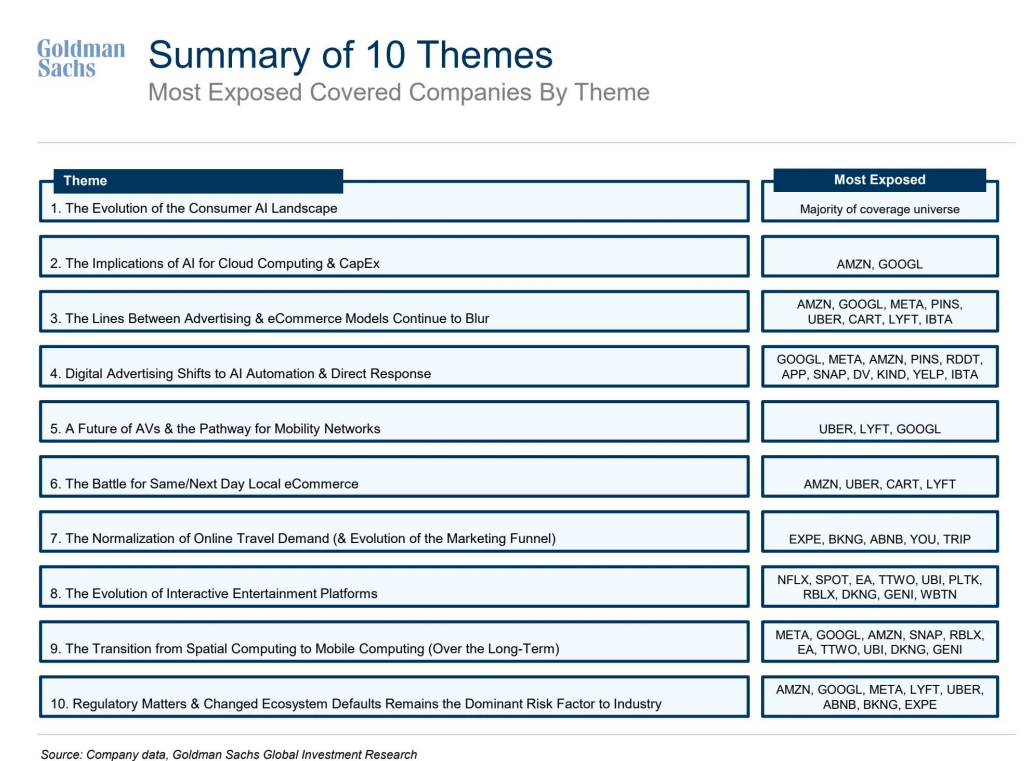
高盛:美股2025 年十大行业主题(年中更新)PPT
Goldman Sachs· 2025-05-19 02:35
Investment Rating - The report does not explicitly state an overall investment rating for the industry but highlights various themes and trends impacting covered companies [2]. Core Insights - The report identifies ten key themes shaping the industry landscape through 2025, focusing on the evolution of consumer AI, implications for cloud computing, the blurring lines between advertising and eCommerce, and the impact of digital advertising automation [5][7][39][43]. Summary by Themes Theme 1: The Evolution of the Consumer AI Landscape - The consumer AI landscape is evolving, with major companies like GOOGL and META positioned to capitalize on changing consumer behaviors through innovative AI applications [20][21]. Theme 2: The Implications of AI for Cloud Computing & CapEx - AI is expected to drive significant growth in cloud computing, with companies like AMZN and GOOGL focusing on stable revenue trends and capital investments to support AI workloads [29][30]. Theme 3: The Lines Between Advertising and eCommerce Models Continue to Blur - Companies are increasingly adopting partnership models rather than competing directly, with GOOGL, META, and AMZN well-positioned to benefit from social commerce trends [39][40]. Theme 4: Digital Advertising Shifts to AI Automation & Direct Response - The digital advertising sector is shifting towards AI-driven automation, with platforms focusing on direct-response advertising to enhance revenue growth amid macroeconomic uncertainties [47][48]. Theme 5: A Future of AVs & the Pathway for Mobility Networks - The rise of autonomous vehicles (AVs) is expected to reshape mobility networks, with companies like UBER and LYFT exploring partnerships to adapt to this evolving landscape [55][56]. Theme 6: The Battle for Same/Next Day Local eCommerce - Local eCommerce is experiencing growth driven by faster delivery speeds, with AMZN and UBER competing aggressively in this space [61][62]. Theme 7: The Normalization of Online Travel Demand (& Evolution of the Marketing Funnel) - The online travel sector is stabilizing post-pandemic, with growth expected to normalize, focusing on brand loyalty and optimizing marketing spend [68][72]. Theme 8: The Evolution of Interactive Entertainment Platforms - Interactive entertainment companies are diversifying their offerings, expanding into new verticals and enhancing user engagement through innovative content strategies [80][81]. Theme 9: The Transition from Mobile Computing to Spatial Computing (Over the Long-Term) - The industry is transitioning towards spatial computing, with companies investing in hardware and software developments to drive consumer adoption of AR/VR technologies [93][94]. Theme 10: Regulatory Matters & Changed Ecosystem Defaults Remains the Dominant Risk Factor to Industry - Regulatory scrutiny, particularly around antitrust issues, poses significant risks to major players like AMZN, GOOGL, and META, impacting their operational strategies [95][96].
全球在线音乐深度:需求稳,竞争缓,量价齐升构筑长期增长潜力
China Securities· 2025-05-19 00:20
Investment Rating - The report provides a positive investment rating for the online music industry, highlighting its long-term growth potential due to stable demand and competitive dynamics [3][5]. Core Insights - The domestic music industry is experiencing stable demand, with leading companies differentiating themselves through community building and support for independent music content, indicating long-term growth potential [3]. - Compared to long video platforms, the online music sector benefits from higher switching costs, longer content lifecycles, and stronger payment stickiness, creating a favorable growth environment [4]. - The end of exclusive copyright agreements has reduced cost pressures, while regulatory guidance fosters healthy competition, enhancing growth potential [5]. - The overseas market, particularly Spotify, shows high growth potential through expansion in non-European and American countries, exploring higher-tier membership systems, and enhancing advertising capabilities [5]. Summary by Sections Industry Overview - The report indicates that the online music platforms are experiencing a 1% slight growth in overall MAU by December 2024, while video platforms show stagnation or decline in some cases [4][7]. - The community atmosphere and user relationships on music platforms create higher switching costs compared to video platforms, which rely heavily on top-tier content [4][14]. Competitive Landscape - The competitive landscape is characterized by two leading music platforms against four major video platforms, with music platforms benefiting from reduced copyright costs and a more fragmented content supply [31][39]. - The report notes that the domestic music market has entered a stable growth phase post-2020 regulatory normalization, with leading companies focusing on their core online music business [5][31]. Company Performance - Tencent Music and NetEase Cloud Music are positioned for steady growth, with Tencent Music reporting a MAU of 555 million and a 8.3% year-on-year increase in paid users as of Q1 2025 [5][13]. - NetEase Cloud Music's growth is attributed to its UGC community and support for independent musicians, with a current ARPPU of 6.9 yuan, indicating room for improvement compared to Tencent Music's 10.8 yuan [5][13]. International Market Insights - Spotify, as the largest global online music platform, has over 675 million users, with 263 million being paid subscribers, showcasing its significant market presence [47][87]. - The report highlights Spotify's strategy of expanding into non-European and American markets, which has been a key driver for its MAU growth [87][97]. Future Outlook - The report suggests that the online music industry is well-positioned for sustainable growth, driven by favorable competitive dynamics, regulatory support, and innovative strategies from leading companies [3][5].

美洲互联网:从游戏、媒体与货币化交叉领域审视行业趋势
2025-05-18 14:09
Summary of Key Points from the Conference Call Industry Overview - The report focuses on the **Gaming, Media & Monetization** industry, particularly highlighting trends in **interactive entertainment** and the **video game** landscape [2][3][4]. Core Insights 1. **Global Gaming Market Growth**: The global gaming market is expected to exceed **$300 billion** by **2028**, growing at a **5% CAGR** from **2024 to 2028** [9][10][14]. 2. **User Engagement Trends**: There is a significant increase in user engagement, particularly among **younger generations** (Gen Z & Millennials), who are spending more time on gaming compared to previous generations [14][19][20]. 3. **Emerging Markets**: A growing share of users is coming from **emerging markets**, with expectations that these regions will outpace growth rates in more mature markets [15][19]. 4. **Monetization Channels**: The evolution of monetization channels includes in-app purchases, advertising, and ecosystem partnerships, with a notable impact from AI on content creation and consumption habits [8][37][38]. 5. **Roblox Case Study**: Roblox (RBLX) is highlighted as a case study, showcasing its growth potential with expected bookings growth of **20% CAGR** from **2024 to 2029** [80][84]. Financial Performance Indicators 1. **Roblox Revenue Growth**: Roblox's total revenue is projected to grow from **$4.369 billion** in **2024** to **$9.311 billion** by **2028**, with a significant portion of revenue derived from user engagement [36][81]. 2. **Adjusted EBITDA Growth**: Expected to grow at a **32% CAGR**, indicating strong profitability and margin expansion [82][84]. 3. **Free Cash Flow Generation**: Roblox is anticipated to generate substantial free cash flow, with projections reaching **$2.965 billion** by **2029** [86]. User Demographics and Engagement 1. **Aging User Base**: Video game users are aging, with a notable increase in the average age of players in North America, expected to rise from **29** in **2004** to **36** in **2024** [21][25]. 2. **Engagement Across Platforms**: Users are engaging with games across a wider array of channels, blending gameplay and content consumption [31]. Advertising and Monetization Strategies 1. **Advertising Opportunities**: The report emphasizes the potential of advertising as a key monetization strategy, particularly through reward-based ads, which have shown high completion rates [38][41]. 2. **Regionalized Pricing**: There is a significant opportunity for regionalized pricing in emerging markets, which could enhance monetization efforts [43][47]. Risks and Challenges 1. **Regulatory Matters**: Regulatory changes remain a dominant risk factor for the industry, impacting operational dynamics [4]. 2. **Economic Downturn Resilience**: The gaming industry has historically performed well during economic downturns, with entertainment spending being one of the last areas to see cutbacks [62][67]. Conclusion - The gaming industry, particularly through platforms like Roblox, is poised for significant growth driven by user engagement, innovative monetization strategies, and expanding markets. However, potential risks from regulatory changes and economic fluctuations must be monitored closely [9][14][19][62].

A Billionaire Just Bought One of My Favorite Stocks. Should You Jump in Too?
The Motley Fool· 2025-05-18 08:10
Core Viewpoint - Philippe Laffont of Coatue Management has invested significantly in Philip Morris International, indicating the company's potential as a growth stock within the defensive tobacco industry [1][3][17] Investment Details - Laffont purchased over $220 million worth of Philip Morris stock in Q1, marking it as his fourth-largest purchase and second-largest new addition [3] - This investment is notable given Laffont's typical focus on technology stocks, which include major companies like Meta Platforms and Amazon [2] Growth Drivers - Philip Morris is experiencing growth through its smokeless products, particularly Zyn and Iqos, which are appealing alternatives to traditional tobacco [5][8] - Zyn's U.S. shipment volumes surged 53% to 202 million cans in Q1, prompting an increase in full-year shipment guidance to between 800 million and 840 million cans [7] - Iqos has also seen a nearly 12% increase in heated tobacco units (HTUs) to 37.1 billion units, with strong sales growth in Japan and Europe [9] Market Position - Philip Morris has successfully bought back Iqos' U.S. rights and is preparing for a broader rollout in the U.S. market, which could enhance growth without cannibalizing existing customers [10] - The company has managed to produce modest cigarette volume growth internationally, contrasting with the steep decline seen in the U.S. market [12][13] Financial Metrics - Zyn and Iqos have better unit economics compared to traditional cigarettes, with Zyn offering six times better product contribution levels and Iqos providing 2 to 2.5 times [11] - The stock is currently trading at a forward P/E ratio of under 23 and a PEG ratio of under 0.35, suggesting it is undervalued [15] Conclusion - Given its defensive nature, growth potential, and attractive valuation, Philip Morris is viewed as a favorable investment opportunity [14][17]