
巨子生物

Search documents
业绩连降后触底?华熙生物反击“玻尿酸过气论”
阿尔法工场研究院· 2025-09-04 00:06
Core Viewpoint - The competition between Huaxi Biological and Juzhi Biological in the skincare industry has intensified, with Huaxi experiencing a significant decline in performance while Juzhi shows robust growth, indicating a shift in market dynamics and consumer preferences [2][3][4]. Financial Performance Comparison - Huaxi Biological reported revenue of 2.261 billion, net profit of 221 million, and gross profit of 1.605 billion for the first half of 2025, with year-on-year declines of 19.57%, 35.38%, and 23.35% respectively [4]. - In contrast, Juzhi Biological achieved revenue of 3.113 billion, net profit of 1.182 billion, and gross profit of 2.542 billion, with all metrics showing over 20% year-on-year growth [4]. - From 2022 to 2024, Juzhi's revenue growth averaged around 50%, while Huaxi's revenue growth has been declining since 2022, with significant reductions continuing into 2023 and 2024 [4]. Brand Performance and Market Dynamics - Huaxi's skincare business, led by the "Runbaiyan" brand, generated 4.607 billion in functional skincare revenue in 2022, accounting for over 70% of total revenue, but is projected to decline to 2.569 billion by 2024, a drop of over 44% [8][10]. - Juzhi's functional skincare revenue, primarily from the "Kefumei" brand, is expected to rise from 1.562 billion in 2022 to 4.3 billion in 2024, marking an increase of over 175% [10]. - The competition reflects a shift in the narrative of effective skincare from "hyaluronic acid hydration" to "recombinant collagen + medical aesthetics synergy" [14]. Marketing and Strategic Responses - Huaxi Biological has initiated a "three-pronged attack" in response to market challenges, including public statements against perceived misinformation regarding its products and the efficacy of hyaluronic acid [15][21]. - The company has faced criticism for its reliance on hyaluronic acid, with analysts noting that its product lines exhibit significant overlap and homogeneity, which may dilute brand differentiation [25][27]. - Juzhi Biological's heavy reliance on its flagship product, "Kefumei," poses risks, as any quality issues could severely impact overall performance [11][13]. Future Outlook and Strategic Recommendations - Huaxi's path to recovery lies in rebuilding its growth mechanisms, focusing on channel efficiency, pricing discipline, and new product positioning [28]. - The market's evolving preferences indicate that simply reiterating the benefits of hyaluronic acid may not suffice; a more diversified and innovative approach is necessary to regain market share [27][28].



巨子生物(02367) - 截至2025年8月31日止股份发行人的证券变动月报表
2025-09-03 08:52
股份發行人及根據《上市規則》第十九B章上市的香港預託證券發行人的證券變動月報表 截至月份: 2025年8月31日 狀態: 新提交 致:香港交易及結算所有限公司 公司名稱: 巨子生物控股有限公司 | 1. 股份分類 | 普通股 | 股份類別 | 不適用 | | | 於香港聯交所上市 (註1) | | 是 | | | --- | --- | --- | --- | --- | --- | --- | --- | --- | --- | | 證券代號 (如上市) | 02367 | 說明 | | | | | | | | | | | 法定/註冊股份數目 | | | 面值 | | | 法定/註冊股本 | | | 上月底結存 | | | 5,000,000,000 | USD | | 0.00001 | USD | | 50,000 | | 增加 / 減少 (-) | | | | | | | USD | | | | 本月底結存 | | | 5,000,000,000 | USD | | 0.00001 | USD | | 50,000 | 本月底法定/註冊股本總額: USD 50,000 FF301 第 1 頁 共 10 ...
胶原蛋白锦波生物、巨子生物
2025-09-02 14:41
Summary of Conference Call on Recombinant Collagen Industry Industry Overview - Recombinant collagen technology has gained popularity in the beauty and skincare industry due to its ability to reduce allergic reactions associated with animal-derived collagen and optimize production costs [1][2] - The industry has seen significant supply-side innovations since 2022, with advancements in gene engineering technology facilitating the commercial production of recombinant collagen [2] Key Companies Jinbo Biotechnology - Jinbo Biotechnology is a leading player in the recombinant collagen medical aesthetics sector, with revenue projected to grow from 160 million yuan in 2020 to 1.44 billion yuan in 2024, achieving a compound annual growth rate (CAGR) of over 70% [1][5] - The company's profit is expected to reach 730 million yuan in 2024, with a CAGR exceeding 100% [5] - Jinbo's new low-temperature gel filler product, approved in 2025, is anticipated to capture market share from animal-derived and regenerative materials [6] - The company plans to implement precise marketing strategies and product innovations to promote new products in the second half of the year [6] Juzhi Biotechnology - Juzhi Biotechnology has made significant strides in the functional skincare sector with products like the "collagen stick" and is expanding into niche markets such as scalp and intimate care [1][7] - The company benefits from national policy support, which has solidified its leading position in the industry [7] - Juzhi has transitioned to direct-to-consumer (DTC) online channels, enhancing sales performance through partnerships with top influencers on platforms like Tmall and Douyin [3][13] Jingbo Biotechnology - Jingbo has achieved progress in the research and certification of recombinant collagen products, accelerating its international market expansion [1][8] - The company has received certifications for functional skincare products in the U.S., Saudi Arabia, and Thailand, contributing to significant revenue growth [8] - Profit forecasts for Jingbo indicate 1.05 billion yuan in 2025 and 1.4 billion yuan in 2026, with a valuation of approximately 30 times earnings in 2025, decreasing to below 25 times in 2026 [9][10] Market Trends and Future Outlook - The acceptance of new products and materials by consumers is increasing, leading to the emergence of industry leaders like Jinbo and Juzhi in the medical aesthetics and functional skincare sectors [4] - The market for recombinant collagen is expected to grow as companies continue to innovate and expand their product offerings [6][7] - The focus on online sales channels and influencer marketing is driving growth in the skincare sector, with Juzhi's online sales showing exceptional performance [3][13] Important Considerations - Future performance indicators to watch include sales growth during the September and October periods, particularly around the Double Eleven shopping festival [16] - The approval of new medical aesthetic products will serve as a significant catalyst for growth, as current valuations primarily reflect cosmetics business performance [16][17] - Jinbo and Juzhi's advancements in recombinant collagen technology position them well for sustained growth in the evolving beauty and skincare market [18]
巨子生物-业绩说明会要点 -消费信心韧性显现;期待 “双 11” 线上加速
2025-09-02 14:24
Summary of Giant Biogene Holding (2367.HK) Conference Call Company Overview - **Company**: Giant Biogene Holding (2367.HK) - **Industry**: Cosmetics and Skincare Key Points and Arguments Consumer Sentiment and Growth Outlook - Resilient consumer sentiment observed with 35-40% repeat purchases and 60% new consumer mix, indicating strong brand loyalty and market presence [1][3] - Management expressed confidence in achieving FY25 guidance, projecting sales growth of 25-28% year-over-year, targeting revenue between RMB6.9 billion and RMB7.1 billion [8][15] - Online growth expected to accelerate to approximately 30% year-over-year in the second half of FY25, with Double 11 sales anticipated to exceed this pace [3][14] Product Performance and New Launches - Luminous Facial Cream and Tier-2 product lines expected to outperform previous management expectations, while single-use essence may experience slower growth due to prior product content issues [3][9] - New SKUs under the Jiaodian series are set to launch in 1H26, targeting core consumer pain points in a fast-growing category [7][9] - Smaller brands like Keyu and SKIGIN projected to deliver strong performance, with Keyu generating over RMB100 million in sales last year [10][12] KOL (Key Opinion Leader) Strategy - Management noted a strong recovery in KOL promotions, with top KOLs like Austin Li and Sun Jian resuming product endorsements, which is expected to enhance brand visibility and sales [1][6][14] - KOLs have not reported negative feedback regarding product quality, indicating strong consumer trust [3][14] Offline Expansion and Channel Strategy - The company plans to increase its offline presence from 24 stores to over 30 by the end of 2025, with a focus on expanding sales through Sephora [7][12] - Positive feedback received for the Precise and Intensive Repair series, which is expected to contribute to incremental sales growth [12] Risk Factors and Market Position - Key risks include slower-than-expected growth, intensified competition in the skincare market, and potential regulatory challenges [13] - The company maintains a strong brand equity rooted in scientific innovation and a long-term commitment to functional skincare [2][13] Financial Metrics and Valuation - Target price set at HK$71, representing a potential upside of 31.8% from the current price of HK$53.85 [15] - Projected financials include revenue growth to RMB8.78 billion by FY26 and EBITDA growth to RMB3.33 billion by FY26 [15] Additional Important Insights - Management emphasized a disciplined approach to discounting during Double 11, aiming for stable pricing compared to previous shopping festivals [6][14] - The company is collaborating with Umer, a dermatology learning platform, to enhance medical-level endorsements for its products [14] This summary encapsulates the key takeaways from the conference call, highlighting the company's growth strategies, product performance, and market positioning within the cosmetics and skincare industry.
创新药指数“提纯”:CXO被剔除 影响几何?
2 1 Shi Ji Jing Ji Bao Dao· 2025-09-02 11:27
Core Viewpoint - The recent adjustments to the Hang Seng Innovation Drug Index and the Hang Seng Hong Kong Stock Connect Innovation Drug Index aim to refine the indices by removing companies primarily involved in the CXO (Contract Research Organization, Contract Manufacturing Organization, and Contract Development and Manufacturing Organization) sector, thereby better reflecting the trends in the innovative drug industry [1][2][3]. Index Adjustments - The Hang Seng Innovation Drug Index has reduced its constituent stocks from 36 to 29 by removing 7 companies, while the Hang Seng Hong Kong Stock Connect Innovation Drug Index has decreased from 34 to 29 by excluding 5 companies [1][3]. - The removed CXO companies previously accounted for approximately 20% of the weight in the Hang Seng Hong Kong Stock Connect Innovation Drug Index, which is expected to enhance the index's ability to reflect the development trends of the innovative drug industry [1][2]. Performance Metrics - Historical data shows that the revised index has improved its performance, with the annualized return increasing from 3.2% to 8.2% for 2023, and from -11.5% to -4.5% for 2024 [4]. - The Hang Seng Innovation Drug Index is projected to achieve its first annual increase since 2020, with a year-to-date increase of 116% as of August 22, 2025, outperforming the broader market and the healthcare sector [4]. CXO Sector Insights - The removal of CXO companies, particularly those from the WuXi AppTec group, may lead to short-term capital outflows but could be offset by long-term industry recovery trends and strategic adjustments by the companies [5][6]. - Despite being removed from the indices, several CXO companies reported strong performance in the first half of the year, with WuXi Biologics achieving a revenue of 9.95 billion yuan, a year-on-year increase of 16.1% [5]. Future Outlook - Analysts suggest that the CXO sector is poised for recovery, driven by the increasing demand for clinical trial services and the strategic direction of domestic innovative drug companies [6]. - The CXO industry is expected to benefit from the competitive advantages of being a major production country, alongside a favorable regulatory environment and the rising complexity of new drug development [6].
从“规模扩张”到“价值深耕” 医美行业重塑竞争格局
2 1 Shi Ji Jing Ji Bao Dao· 2025-09-02 10:15
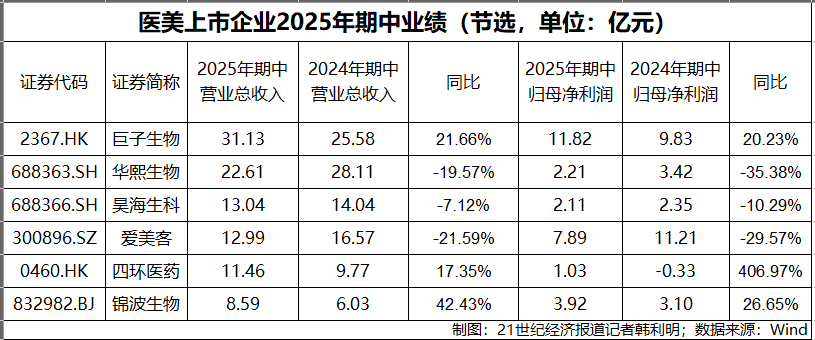
Core Viewpoint - The performance of listed medical beauty companies in China shows significant divergence in the first half of 2025, with major players in the hyaluronic acid market facing growth bottlenecks, while companies in the recombinant collagen segment are experiencing substantial growth [1][2][7]. Group 1: Performance of Major Companies - Huaxi Biological reported revenue of 2.261 billion yuan, a year-on-year decline of 19.57%, and a net profit of 221 million yuan, down 35.38% [1][2]. - Haohai Biological achieved revenue of 1.304 billion yuan, a decrease of 7.12%, with a net profit of 211 million yuan, down 10.29% [1][2]. - Aimeike's revenue was 1.299 billion yuan, down 21.59%, with a net profit of 789 million yuan, a decline of 29.57% [1][2]. - In contrast, Jinbo Biological, the first stock of recombinant collagen on the Beijing Stock Exchange, reported revenue of 859 million yuan, an increase of 42.43%, and a net profit of 392 million yuan, up 26.65% [1][2]. - Giant Biological's revenue reached 3.113 billion yuan, a year-on-year increase of 21.66%, with a net profit of 1.182 billion yuan, up 20.23% [1][2]. Group 2: Market Trends and Competition - The medical beauty market in China has seen rapid growth, with the market size increasing from 99.3 billion yuan in 2017 to 189.2 billion yuan in 2021, reflecting a compound annual growth rate of 17.5% [4]. - The competition in the hyaluronic acid sector has intensified, leading to price reductions and impacting the performance of leading companies [4][6]. - The demand for aesthetic products is evolving, with a shift towards user-oriented solutions and a growing emphasis on product innovation and technology [3][7]. Group 3: Strategic Adjustments and Innovations - Huaxi Biological is shifting its marketing strategy to focus on brand building and consumer engagement through platforms like Xiaohongshu and WeChat, moving away from price-driven promotions [5]. - Haohai Biological is also adapting its product offerings, with new high-end hyaluronic acid products showing promising market performance [6]. - The recombinant collagen market is projected to grow significantly, with estimates suggesting it will reach 585.7 billion yuan by 2025, driven by new product launches and market expansion [8][9]. Group 4: Regulatory and International Expansion - The medical beauty industry is witnessing an increase in compliant products, with several companies obtaining third-class medical device registration certificates, enhancing market offerings [10][11]. - Companies like Huaxi Biological and Haohai Biological are actively pursuing international markets, with Huaxi reporting significant revenue from overseas operations [11][12]. - Aimeike's acquisition of a majority stake in a South Korean company highlights the trend of domestic firms expanding their global footprint [12].


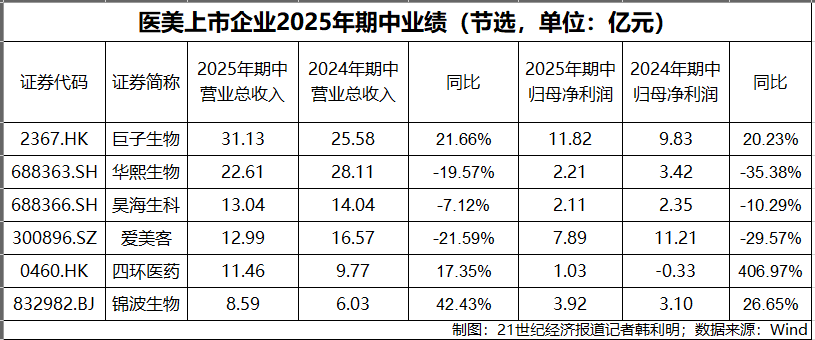
从“规模扩张”到“价值深耕”,医美行业重塑竞争格局
2 1 Shi Ji Jing Ji Bao Dao· 2025-09-02 10:09
Core Viewpoint - The performance of listed medical beauty companies in China shows significant divergence in the first half of 2025, with major players in the hyaluronic acid market facing growth bottlenecks while companies in the collagen reconstruction sector are experiencing substantial growth [1][2]. Group 1: Performance of Major Companies - Huaxi Biological reported revenue of 2.261 billion yuan, a year-on-year decline of 19.57%, and a net profit of 221 million yuan, down 35.38% [2]. - Haohai Biological achieved revenue of 1.304 billion yuan, a decrease of 7.12%, with a net profit of 211 million yuan, down 10.29% [2]. - Aimeike's revenue was 1.299 billion yuan, down 21.59%, with a net profit of 789 million yuan, a decline of 29.57% [2]. - In contrast, Jinbo Biological, the first stock of collagen reconstruction on the Beijing Stock Exchange, reported revenue of 859 million yuan, an increase of 42.43%, and a net profit of 392 million yuan, up 26.65% [1][2]. Group 2: Market Dynamics - The medical beauty industry is undergoing a transformation driven by increasing aesthetic demands and technological upgrades, necessitating higher core technology and product innovation capabilities from companies [3]. - The competition in the hyaluronic acid sector has intensified, with a significant increase in supply and aggressive pricing strategies from downstream medical beauty institutions [4]. - The market for collagen reconstruction products is rapidly growing, with projections indicating a compound annual growth rate of 44.93%, reaching 585.7 billion yuan by 2025 [9][10]. Group 3: Strategic Adjustments - Companies like Huaxi Biological are shifting from a traffic-driven sales model to a brand communication strategy based on scientific validation, aiming to enhance brand efficacy and customer acquisition [5][6]. - Haohai Biological is focusing on high-end hyaluronic acid products, with the "Haimeiyuebai" product showing promising market performance despite overall revenue declines in its hyaluronic acid segment [7]. - Aimeike acknowledges the shift towards a user-oriented market, emphasizing the importance of product innovation and systematized competition [8]. Group 4: Regulatory and International Expansion - The medical beauty industry is witnessing an increase in compliant products, with several companies obtaining third-class medical device registration certificates, enhancing market options [11][12]. - Companies are actively pursuing international markets, with Huaxi Biological reporting 331 million yuan in international raw material business revenue, accounting for 52.93% of its raw material income [12][13]. - Aimeike's acquisition of a majority stake in a South Korean company marks its strategic entry into the global regenerative injection market [13].
直击产品入市痛点 深圳合成生物产业立法10月起施行
2 1 Shi Ji Jing Ji Bao Dao· 2025-09-02 03:52
Core Viewpoint - Shenzhen has officially passed the "Regulations on Promoting the Innovative Development of the Synthetic Biology Industry in the Shenzhen Special Economic Zone," which will take effect on October 1, 2025, aiming to address key issues in the synthetic biology sector, including long product review cycles and slow application promotion [1][4]. Group 1: Legislative Framework - The regulations consist of 32 articles and represent Shenzhen's first attempt at industry promotion legislation in a "small cut" format, focusing on top-level design, result transformation, product market entry acceleration, service optimization, and support reinforcement [1][4]. - The legislation aims to enhance the efficiency of product review and approval processes, particularly in the fields of "new food," cosmetics, and other synthetic biology applications [5][6]. Group 2: Industry Growth and Data - Approximately 40% of the newly established synthetic biology companies in China over the past three years are located in Shenzhen, with the city's biopharmaceutical manufacturing industry experiencing an annual compound growth rate of 11.3% from 2014 to 2023 [1][7]. - A McKinsey report predicts that the global bioeconomy could reach $2 trillion to $4 trillion in the next 10-20 years, with biological modification contributing significantly to this growth [7]. Group 3: Central-Local Collaboration - The regulations emphasize "central-local collaboration," particularly in the review and approval of new raw materials, by fostering new models for review institutions and technical agencies [5][6]. - Shenzhen will work with national and provincial departments to build cooperative platforms and cultivate qualified technical review institutions [5][6]. Group 4: Comprehensive Support Measures - The regulations outline a comprehensive support system for the synthetic biology industry, addressing aspects such as space, talent, funding, and customs facilitation [7][8]. - Specific measures include prioritizing land supply for synthetic biology enterprises, increasing financial support through government investment funds, and facilitating customs processes for special biological medical items [8][9].
巨子生物(02367.HK):中报增长彰显品牌韧性下半年销售有望提升
Ge Long Hui· 2025-09-02 02:46
Core Viewpoint - The company demonstrated strong brand resilience and internal management capabilities, achieving significant growth in mid-term performance despite challenges faced in the second quarter [1][2]. Financial Performance - In the first half of the year, the company's revenue and net profit attributable to shareholders increased by 22.5% and 20.2% year-on-year, respectively [1]. - The gross margin and net profit margin remained high at approximately 82% and 38% [1]. Revenue Drivers - The main revenue growth drivers were online direct sales through e-commerce platforms (such as JD.com) and offline direct sales, which accounted for 75% of total revenue [1]. - Online direct sales to e-commerce platforms increased by 134%, while offline direct sales grew by 74% year-on-year [1]. Cost Management - The company effectively controlled sales expenses, with the sales expense ratio decreasing by 0.86 percentage points year-on-year, allowing for sufficient marketing investment in the second half of the year [2]. - The good control of sales expenses is attributed to the balanced development across various channels and the reduction in promotional activities due to the product issues in the second quarter [2]. Future Outlook - The company is expected to see a ramp-up in revenue in the second half of the year, driven by the recovery from short-term impacts, increased investment, and the launch of new products [2]. - Long-term focus on scientific research and commercialization in the collagen sector is recommended, with particular attention to upcoming sales during the Double Eleven shopping festival and the progress of medical device certifications [2]. Earnings Forecast - The earnings forecast for 2025-2027 has been slightly adjusted, with expected earnings per share of 2.33, 2.85, and 3.50 RMB, respectively [2]. - A target price of 81.46 HKD has been set for 2025, based on a 32x PE valuation [2].
可选消费W35周度趋势解析:全球奢侈品板块触底反弹,A/H业绩落地主导各子行业表现-20250901
Haitong Securities International· 2025-09-01 14:31
研究报告 Research Report 可选消费 W35 周度趋势解析:全球奢侈品板块触底反弹,A/H 业绩落地主导各子行业表现 Week 35 Discretionary Trends: Global Luxury Sector Bottoms Out and Rebounds, A/H Results Drive Sub-sector Performance [Table_yemei1] 观点聚焦 Investment Focus | 股票名称 | 评级 | 股票名称 | 评级 | | --- | --- | --- | --- | | 耐克 | Outperform 石头科技 | | Outperform | | 美的集团 | Outperform 科沃斯 | | Outperform | | 京东集团 | Outperform 永辉超市 | | Outperform | | 海尔智家 | Outperform 波司登 | | Outperform | | 安踏体育 | Outperform 李宁 | | Outperform | | 格力电器 | Outperform 苏泊尔 | | Outperf ...