
邮储银行

Search documents
抢滩“开门红”揽储:中小行限时上调利率,大行分层经营稳成本
2 1 Shi Ji Jing Ji Bao Dao· 2026-01-14 05:41
Core Viewpoint - The current trend in the banking sector shows that while small and medium-sized banks are raising deposit rates to attract funds, the overall enthusiasm for deposit collection has decreased compared to previous years, reflecting a balance between managing funding costs and maintaining market competitiveness in the context of deepening interest rate marketization [1][8]. Group 1: Deposit Rate Adjustments - Several small and medium-sized banks have recently raised their fixed deposit rates, albeit by limited margins compared to previous years, indicating a cautious approach to managing funding costs [3][4]. - For instance, the DeShang Village Bank in Henan raised its one-year and three-year fixed deposit rates from 1.50% and 1.70% to 1.55% and 1.73%, respectively [3]. - The Yangling Rural Commercial Bank has unified its personal fixed deposit rates to a range of 1.1% to 1.6%, with three-year and five-year rates set at 1.6% [4]. Group 2: Competitive Landscape - The competitive landscape among banks is intensifying, particularly for small and medium-sized banks, which are under pressure to stabilize liabilities and attract deposits, leading to temporary increases in deposit rates [5][7]. - Major state-owned banks, while not increasing deposit rates, are adjusting the minimum deposit thresholds for their products, indicating a strategic shift towards customer relationship management [6][8]. - The Agricultural Bank of China has raised the minimum deposit for a three-year certificate to 5 million yuan, while still offering products with a lower threshold of 200,000 yuan [6]. Group 3: Future Trends - Analysts predict that banks will continue to lower funding costs due to pressure on net interest margins, suggesting that deposit rates may further decline in the future [8][9]. - The net interest margin for commercial banks has narrowed to 1.42%, with expectations that the average cost of deposits may decrease by approximately 35 basis points as high-interest deposits mature [9]. - The overall trend indicates that banks may adopt varied pricing strategies for deposits, balancing between lowering rates and adjusting minimum deposit requirements [8][9].

农产品:超短期融资券和中期票据获准注册
Ge Long Hui· 2026-01-14 04:06
Core Viewpoint - The company plans to issue short-term financing bonds and medium-term notes to meet funding needs and optimize its financing structure, with a total registration amount of up to 40 billion yuan [1][2]. Group 1 - The company announced the approval of the issuance of short-term financing bonds and medium-term notes during the 34th meeting of the 9th Board of Directors on November 14, 2025 [1]. - The company has applied to the National Association of Financial Market Institutional Investors for the registration of up to 20 billion yuan in short-term financing bonds and up to 20 billion yuan in medium-term notes [1]. - The registration amounts for both the short-term financing bonds and medium-term notes are valid for two years from the date of the acceptance notice issued by the association [1]. Group 2 - The company can issue the short-term financing bonds and medium-term notes in installments during the registration validity period, and must file with the association prior to issuing medium-term notes [2]. - The issuance management must comply with the resolutions of authorized institutions and relevant management requirements [2]. - After the issuance is completed, the company is required to disclose the results through channels recognized by the association [2].

农产品(000061.SZ):超短期融资券和中期票据获准注册
Ge Long Hui A P P· 2026-01-14 03:57
Core Viewpoint - The company plans to issue short-term financing bonds and medium-term notes to meet funding needs and optimize its financing structure, with a total registration amount of up to 40 billion yuan [1][2]. Group 1 - The company announced the approval of the issuance of short-term financing bonds and medium-term notes at the 34th meeting of the 9th Board of Directors on November 14, 2025 [1]. - The company has applied to the National Association of Financial Market Institutional Investors for the registration of up to 20 billion yuan in short-term financing bonds and up to 20 billion yuan in medium-term notes [1]. - The registration amounts for both the short-term financing bonds and medium-term notes are valid for two years from the date of the acceptance notice issued by the association [1]. Group 2 - The company can issue the short-term financing bonds and medium-term notes in installments during the registration validity period [2]. - Prior to issuing medium-term notes, the company must file with the association if required [2]. - The issuance management must comply with the resolutions of authorized institutions and relevant management requirements [2].
2026年险资举牌热度能否延续?
Jin Rong Shi Bao· 2026-01-14 02:37
Core Viewpoint - In 2025, insurance capital's shareholding activities reached a record high of 35 times, driven by regulatory encouragement, the pursuit of higher returns in a low-interest environment, and new accounting standards that help smooth profit fluctuations [1][4]. Group 1: Characteristics of Insurance Capital Shareholding - The number of shareholding activities by insurance capital in 2025 significantly exceeded the average level of recent years, marking the most active year since 2015 [2]. - A total of 14 insurance institutions participated in shareholding activities, including major listed insurance companies, bank-affiliated insurers, and Sino-foreign joint ventures, with Ping An Life being the most active, conducting 12 shareholdings [2]. - Approximately 80% of the shareholding activities were executed through the Hong Kong Stock Connect or continuous purchases in the secondary market, with other methods including agreement transfers and passive shareholding due to mergers [2]. Group 2: Strategic Logic Behind Shareholding - Insurance capital's shareholding activities were not random but followed a clear strategic logic, with a preference for the financial sector, which saw 15 shareholdings involving six banks and two insurance institutions [3]. - Other favored sectors included public utilities, transportation, and environmental protection, indicating a focus on stable, cash-generating industries [3]. - The core demand of insurance capital is for long-term, stable returns, leading to an increased allocation to equity assets as traditional fixed-income returns fail to cover liability costs [3]. Group 3: Factors Driving Shareholding Activities - Regulatory policies have encouraged long-term capital to enter the market, with measures such as increasing the investment limit for insurance companies in equity assets to 50% [4]. - Insurance institutions are responding to downward pressure on interest rates by increasing their allocation to equity assets to enhance long-term investment returns [4]. - New accounting standards impose higher requirements for asset-liability matching, allowing insurance companies to reduce the impact of market value fluctuations on current profits through shareholding [5][6]. Group 4: Future Outlook for Insurance Capital Shareholding - There is optimism that insurance capital will continue to increase equity asset allocations in 2026, with expectations of maintaining high shareholding activity levels [8]. - Analysts suggest that insurance capital's shareholding motivations will focus on stable dividend cash flows and high return on equity (ROE) targets, particularly in sectors aligned with national strategic directions such as high-end manufacturing and technological innovation [8].

人工智能行业:人机共智·创变未来千梦引擎AI内容营销白皮书
网易新闻· 2026-01-14 02:35
Investment Rating - The report does not explicitly state an investment rating for the industry. Core Insights - The integration of AI in content marketing is transforming the industry, shifting from efficiency tools to becoming the "second brain" for creative production and brand expression [15][21][23]. - AI is evolving from a tool for generating content to a core driver of creative production, enabling brands to produce high-quality, multi-modal content [23][24]. - The focus of competition is shifting from superficial creative contests to building a robust "multi-modal brand corpus" that AI can understand and utilize [11][12]. Summary by Sections AI-Driven Content Marketing - The report highlights the transition of AI from a mere efficiency tool to a central figure in creative production, allowing brands to engage in deeper emotional connections with users [15][21]. - AI's role is evolving to encompass not just content generation but also understanding brand aesthetics and conveying brand values effectively [23][24]. New Creative Standards - The report emphasizes the need for AI systems to deeply understand brand tone, visual style, and core values to ensure consistent brand expression [27]. - AI's capabilities are expanding to include semantic understanding, aesthetic consistency, and alignment with brand values [29]. Content Production Efficiency - AI is significantly reducing the time and cost associated with content production, enabling rapid generation of diverse content tailored for various platforms [30][31]. - Traditional content production timelines are being compressed from weeks to days, allowing brands to respond quickly to market trends [30][31]. Contextual Marketing Shift - The report notes a shift from static user profiling to real-time contextual understanding, enabling brands to create personalized content that resonates with users' immediate needs [32][33]. - AI's ability to generate content based on real-time user context is becoming crucial for effective marketing strategies [35][36]. Human-AI Collaboration - The concept of "human-machine co-intelligence" is introduced, where humans set strategic directions while AI enhances creative boundaries and execution efficiency [37][38]. - This collaboration aims to produce innovative outcomes that neither humans nor AI could achieve alone [43][44]. AI Content Generation Innovations - The report discusses the emergence of multi-modal content forms, such as interactive narratives and AI-generated videos, which enhance user engagement [46][47]. - AI is enabling brands to create immersive experiences that transform traditional content consumption into participatory interactions [50][51]. Challenges in AI Content Marketing - The report identifies four core challenges: inconsistency in content quality, content homogenization, difficulties in maintaining brand alignment, and high costs of manual content review [55][56][61]. - Brands face a growing imbalance between the demand for rapid content production and the limitations of traditional content creation processes [61][62]. 千梦引擎 (Qianmeng Engine) - The Qianmeng Engine is introduced as a comprehensive AI creative engine designed to facilitate the entire content marketing process, from creative generation to large-scale distribution [74][75]. - It aims to provide brands with a platform that combines powerful AI capabilities with human creativity to produce emotionally resonant content [74][75].
雷厉风行抓落实 广发银行党支部助力赛车企业“换道提速”
Xin Hua Wang· 2026-01-14 02:21
Core Viewpoint - The article highlights the proactive measures taken by Guangfa Bank to support a specialized small giant enterprise in the automotive aftermarket, emphasizing the importance of timely financial assistance in the context of the transition to electric vehicles [1][2]. Group 1: Financial Support and Initiatives - Guangfa Bank launched a "Four Grabs and Implement Actions" initiative to showcase its commitment to high-quality development and financial innovation [1]. - Within three weeks, Guangfa Bank completed the credit approval process and provided a loan of 30 million yuan to the enterprise at a preferential interest rate, facilitating its research and production efforts [2]. - The bank's Chongqing Beibei branch actively engaged with the enterprise by assessing its production line and understanding its challenges, leading to tailored financial solutions that reduce funding costs [1][2]. Group 2: Strategic Focus and Community Engagement - The Beibei branch of Guangfa Bank serves as a pilot for strengthening small and micro enterprise support through party-building initiatives, enhancing consensus and capabilities [2]. - The bank aims to guide private enterprises to focus on their core businesses and strengthen their operations, which is crucial for the high-quality development of the private economy [3]. - Guangfa Bank's frontline institutions are positioned to respond quickly to regional development strategies, contributing to the cultivation of new productive forces and the construction of a modern industrial system [3].

“马年贺岁纪念币钞”今晚开抢!银行预约攻略来了
Xin Lang Cai Jing· 2026-01-14 01:20
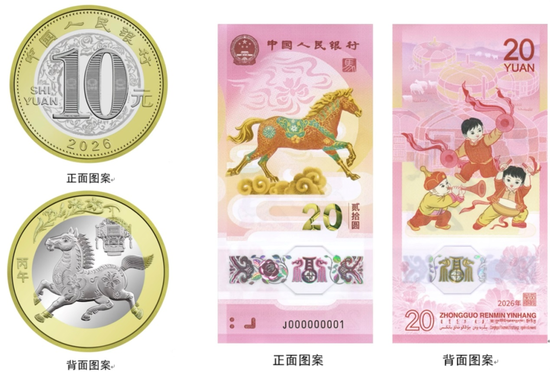
Core Viewpoint - The annual zodiac commemorative coins and banknotes for the Year of the Horse in 2026 will be available for online reservation starting at 22:00, with a limit of 20 coins and 20 banknotes per person [1][3][12]. Group 1: Product Details - The commemorative coin has a face value of 10 yuan, made of bimetallic copper alloy, with a total issuance of 100 million pieces [5][6]. - The commemorative banknote has a face value of 20 yuan, made of plastic, with a total issuance of 100 million pieces [5][6]. - The design of the coin features the "People's Bank of China" and the year "2026," while the banknote showcases a horse design along with the national emblem [3][5]. Group 2: Reservation Process - Reservations can be made through the official websites of the participating banks or at designated branches during business hours [9][10]. - Users can access the reservation page via mobile banking apps, with some banks offering streamlined processes for registered users [10]. - Each bank has different allocation limits for the coins and banknotes, with specific numbers for cities like Beijing and Tianjin [6][10]. Group 3: Market Performance - Recent years have seen a surge in public interest in zodiac commemorative coins and banknotes, with previous releases selling out within minutes [1][13]. - The secondary market for these items remains robust, with the Dragon Year commemorative items maintaining high premium prices [11][13].






邹澜:加速金融科技创新赋能 扎实做好金融“五篇大文章”
Jin Rong Shi Bao· 2026-01-14 00:59
从应用规模看,关键核心技术攻关应用广泛开展。核心系统整体改造与迁移尤为亮眼,既有大中型 银行勇立潮头、率先垂范,亦有地方中小金融机构紧随其后、多点开花,形成多级联动、全域推进的生 动格局。其中,建设银行核心银行系统从集中式部署迁移至分布式平台,实现自主可控、性能提升、弹 性扩展,为大型银行核心系统架构转型作出了新示范。浦发银行重构信用卡核心系统,一次性完成"四 合一"技术架构转型,重构"三位一体"业务架构,实现技术和业务双重革新,是股份制银行信用卡核心 转型标杆。中国银行IT架构全面转型战略工程构建企业级技术平台,协同实施"移机—挪库—换面",全 面实现从技术底座到业务场景的端到端、全链条架构转型。中信银行苍穹工程则建设了标准化的应用运 行环境、服务治理体系和可弹性伸缩的云化能力,实现了企业级技术中台能力的沉淀、复用、共享和一 体化管控。 从应用成效看,金融业在关键业务系统中推进自主技术应用的广度与深度已显著提升,核心软硬件 正处于从"可用"迈向"好用"的关键跨越,这不仅坚定了行业深化自主可控转型的道路自信,也为其他重 点行业的转型升级树立了标杆、提供了成熟路径。 近年来,金融业深入贯彻落实党中央决策部署,紧 ...

42家A股上市行全面撤销监事会,部分披露监事长去向
Xin Lang Cai Jing· 2026-01-14 00:41
2025年以来,中国银行业掀起一场标志性的治理架构变革。 近期,随着平安银行、中原银行、宁波银行等完成监事会撤销程序,截至目前,42家A股上 市银行均已公开宣布不再设立监事会。同时,亦有不少中小银行正在推进相关事宜。至此, 运行近三十年的银行监事会制度将逐步退出历史舞台,此亦成为落实新《公司法》精神、深 化金融改革的关键步骤。 银行监事会退出后,其监督职能并未因撤销而弱化,而是全面移交至董事会审计委员会,此 意味着,银行业将从传统的"三会一层"治理模式转向更具效率的"两会一层"架构。 银行年内密集"去监事会", 42家A股上市行均宣告撤销 2026年是A股上市银行监事会制度的收官之年,从年初至今,多家上市行发布了不再设立监 事会的相关公告。 与此同时,该行披露,叶望春、车国宝、王春汉、韩小京、孙永桢和邓红不再担任该行监事 及监事会相关职务。 此外,中原银行同日发布公告称,随着修订后公司章程生效,该行自今年1月5日起不再设立 监事会。 1月4日,宁波银行发布公告表示,自2025年12月31日起,公司不再设立监事会,由董事会审 计委员会承接法律法规规定的原监事会职权。监事会下设各专门委员会同步撤销,《宁波银 行股 ...
多家上市银行大股东或高管增持落地!
Xin Lang Cai Jing· 2026-01-14 00:20
Core Viewpoint - The recent increase in shareholding by major shareholders and executives in several banks reflects confidence in the banking sector's development and may signal a potential valuation recovery for bank stocks [1][6]. Group 1: Shareholder and Executive Purchases - Yunnan Rural Commercial Bank announced that several directors and senior management purchased 192,000 shares between January 5 and January 7, 2026, at prices ranging from RMB 6.36 to RMB 6.42 per share [7]. - Nanjing Bank reported that its major shareholder, Zijin Group, increased its stake by 123,472,060 shares, representing 1.00% of the total share capital, between September 11, 2025, and January 12, 2026 [7]. - Qilu Bank disclosed that its directors, supervisors, and senior management successfully purchased 771,000 shares for a total of RMB 4.48 million, exceeding their initial commitment of at least RMB 3.5 million [2][7]. Group 2: Market Signals and Insights - Analyst Yang Haiping indicated that the increase in shareholding sends three signals: it supplements the capital of listed banks, demonstrates shareholder confidence in future performance, and may serve as a catalyst for valuation recovery [8]. - The insurance sector is increasingly investing in bank stocks, with significant purchases from companies like Ping An Life, reflecting a strategic long-term choice rather than a short-term tactical adjustment [9]. Group 3: Future Outlook - Multiple institutions predict that the trend of increasing interest in bank stocks will continue into 2026, with a focus on the dividend attributes of bank shares attracting long-term capital [10]. - Analysts believe that the valuation of bank stocks remains low, suggesting further potential for appreciation in the banking sector [11].



