九号公司

Search documents
宏昌科技(301008):家电电磁阀小巨人企业 大力拓展机器人减速器业务
Xin Lang Cai Jing· 2025-09-01 06:54
Core Viewpoint - The company reported a decline in net profit despite a steady increase in revenue, primarily due to stock-based compensation and depreciation from new fixed assets [1][2]. Financial Performance - In H1 2025, the company achieved revenue of 540 million yuan, a year-on-year increase of 20.8%, but the net profit attributable to shareholders was 20 million yuan, a decrease of 47.8% [1]. - In Q2 2025, revenue was 270 million yuan, up 18.5% year-on-year and 0.6% quarter-on-quarter, while net profit was 4.03 million yuan, down 72.0% year-on-year and 66.2% quarter-on-quarter [1]. - The overall gross margin for H1 2025 was 13.8%, a decrease of 4.7 percentage points year-on-year, with a net profit margin of 2.9%, down 3.8 percentage points [2]. Business Segments - The smart home appliance components segment generated revenue of 520 million yuan in H1 2025, a year-on-year increase of 17.34%, with a gross margin of 14.59%, down 4.08 percentage points [1]. - The automotive parts business is gradually ramping up, with the company securing multiple projects from Leap Motor and providing bumper production for Geely commercial vehicles [3][4]. Growth Opportunities - Future growth points include expanding the washing machine components line and increasing sales of high-end fluid electromagnetic valves, which are expected to enhance gross margins [3]. - The company is actively investing in the robotics industry, holding a 30% stake in a joint venture focused on humanoid robot components and establishing a manufacturing facility for joint modules and reducers [4]. Profit Forecast - The company forecasts net profits attributable to shareholders of 50 million yuan, 90 million yuan, and 150 million yuan for 2025, 2026, and 2027 respectively, indicating a compound annual growth rate of 43% over the next three years [4].

科创信息技术ETF(588100)近2周新增规模超5500万元同类居首,机构:AI产业正处于政策、技术、应用多重共振阶段
Sou Hu Cai Jing· 2025-09-01 03:31
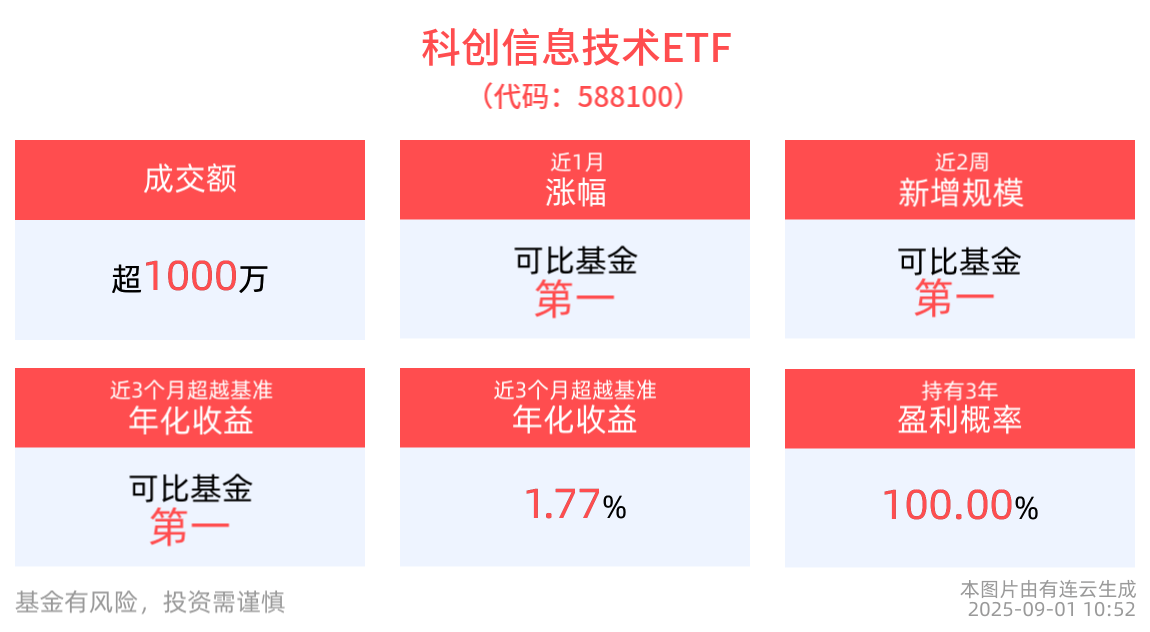
Core Insights - The new generation information technology index on the Shanghai Stock Exchange's Sci-Tech Innovation Board has seen a decline of 0.57% as of September 1, 2025, with mixed performance among constituent stocks [1] - The Sci-Tech Information Technology ETF (588100) has been adjusted downwards, but it has shown a cumulative increase of 7.53% over the past week, ranking first among comparable funds [1] - The ETF has experienced significant growth in scale, with an increase of 55.58 million yuan over the past two weeks, also ranking first among comparable funds [3] - A total of 5,299 A-share companies have disclosed their semi-annual reports for 2025, with 4,085 companies reporting positive net profits, representing 77.09% of the total [3] - Artificial intelligence has emerged as a high-frequency term in the semi-annual reports, indicating strong growth momentum in the technology manufacturing sector driven by technological breakthroughs and product diversification [3] Market Performance - The top ten weighted stocks in the new generation information technology index account for 60.14% of the index, with notable companies including Cambricon, SMIC, and Haiguang Information [4] - The performance of individual stocks varies, with Haiguang Information up by 2.63% and Cambricon down by 5.53% [6] Industry Trends - The artificial intelligence industry is currently experiencing a phase of policy, technology, and application resonance, which is expected to accelerate the industrialization process [4] - The short-term outlook suggests that policy implementation and standardization will promote sustainable development in the industry [4] - The long-term perspective indicates that the multi-dimensional upgrades of large models will penetrate various sectors such as education and film [4]


新国标落地引领电动自行车进入“安全为王”时代
Zheng Quan Ri Bao· 2025-08-31 17:08
9月1日,中国电动自行车行业迎来一场历史性变革——新版《电动自行车安全技术规范》(GB17761— 2024)(以下简称"新国标")正式实施。 这项关乎全国超3亿辆电动自行车的新国标,直指火灾风险与非法改装两大安全痛点。一方面,新国标 强化了对非金属材料防火阻燃性能的要求,限制塑料使用量,从源头上减少易燃材料的使用;另一方 面,要求企业对电池组、控制器和限速器采用"三位一体"的防篡改设计,从根本上杜绝改装可能。 "3C认证和生产许可证审核趋严,叠加环保监管压力,电动自行车行业在新国标下将加速洗牌,产能将 向头部企业集中。"广西电动车行业协会执行会长钱震向《证券日报》记者表示。 设置过渡期显政策温度 电动车国标修订于2018年。彼时电动自行车电池仍以铅酸为主,整车车体自重需小于或等于55千克,并 要求必须具备脚踏骑行功能。7年过去,车速、重量和锂电池能量密度加速增长,标准却一直滞后。据 北京交警统计,涉电动自行车伤亡事故中,近六成车辆超出原设计时速。换句话说,旧标准已无法覆盖 新技术、新材料所带来的新风险。 新国标的出台,不是为了限制行业发展,而是以更高、更细的"安全护栏"将狂奔的3亿辆车拉回正轨。 政策为新国 ...

如何看待两轮车高端升级机会?
Changjiang Securities· 2025-08-31 07:11
Investment Rating - The report maintains a "Positive" investment rating for the electric two-wheeler industry [10]. Core Insights - The electric two-wheeler market is experiencing a high-end upgrade, with companies like Niu, Ninebot, and Jike leveraging technology and user needs to capture market share. Niu focuses on urban user demands for convenience, security, and safety, while Ninebot capitalizes on the 3C certification transition to enhance its market position. Jike emphasizes product reliability through extreme testing and community engagement [4][8][41]. Summary by Sections Review of the High-End Electric Two-Wheeler Journey - Niu Electric has effectively identified and addressed three key pain points: charging convenience, theft prevention, and safety. By utilizing Panasonic lithium batteries, Niu has reduced weight and improved performance, leading to significant revenue growth from 769 million yuan in 2017 to 3.288 billion yuan in 2024, with a CAGR of 23.07% [19][33]. Niu: Redefining High-End Electric Two-Wheelers - Niu's strategy includes using high-quality components like Bosch motors and advanced battery management systems to enhance performance and safety. The company has also implemented a user-friendly app for remote vehicle control, contributing to its brand recognition and market penetration [20][27]. Current Competitive Landscape of High-End Two-Wheelers - The competitive landscape features new brands like Jike, Ninebot, and Niu, which focus on community engagement and product reliability. Traditional brands like Yadi and Aima are improving core technologies but lag in smart features compared to new entrants [7][70]. Ninebot: Differentiated Positioning in the Mid-High-End Market - Ninebot has rapidly grown its revenue, reaching 14.196 billion yuan in 2024, with a 38.87% year-on-year increase. The company has successfully transitioned to a major player in the electric two-wheeler market, with a focus on smart technology and user engagement [44][41]. Investment Recommendations: New Force Brands Stand Out - The report recommends focusing on new force leaders like Ninebot and Chuncheng Power, which have demonstrated significant advantages in technology and market positioning. These companies are well-positioned to capture the growing demand for high-end electric two-wheelers [8][11].

A股分红大爆发
2 1 Shi Ji Jing Ji Bao Dao· 2025-08-29 23:15
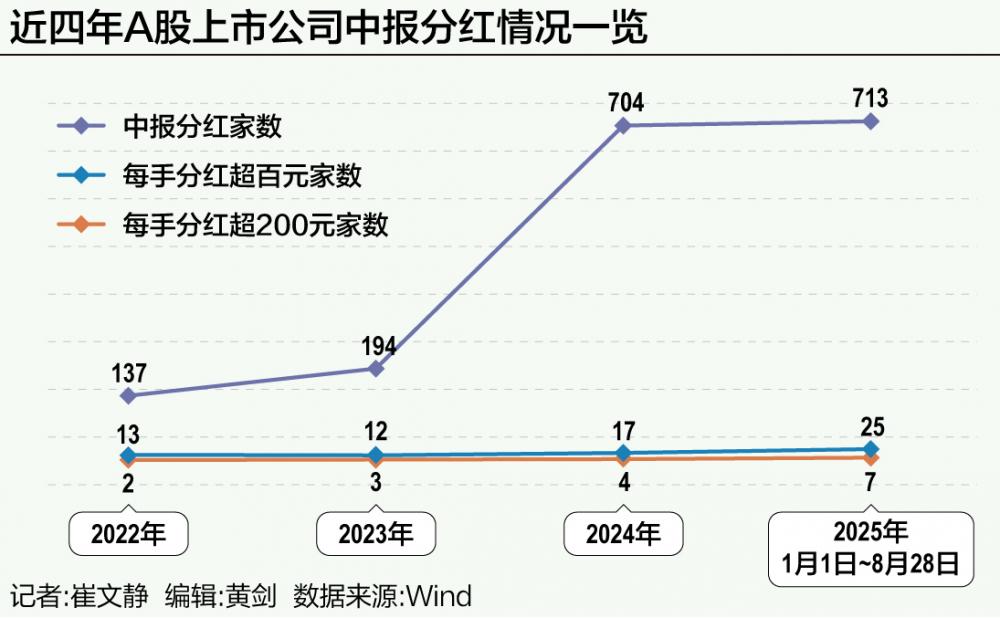
Group 1 - A-share listed companies are experiencing a significant positive change in their dividend distribution patterns, with 713 companies disclosing mid-term dividend plans as of August 28, 2025, surpassing the previous year's figures and indicating a strong trend since 2024 [1][5] - The number of companies distributing mid-term dividends has increased from fewer than 200 annually to several hundred, reflecting a shift towards greater shareholder returns driven by regulatory policies and internal demand [1][5] - Traditional high cash flow sectors such as finance, energy, and telecommunications remain the primary contributors to dividends, while consumer and manufacturing sectors are also rapidly releasing their dividend potential [1][11] Group 2 - The new "National Nine Articles" policy links dividend distribution to refinancing and share reduction behaviors, significantly enhancing companies' motivation to distribute dividends [2][11] - The information disclosure evaluation mechanism includes incentives for companies to increase the frequency and proportion of dividends, promoting a more stable, transparent, and efficient dividend system in the A-share market [2][11] Group 3 - The number of companies with mid-term dividend distributions exceeding 100 yuan per share has risen from 13 in 2022 to 25 in 2025, indicating a notable increase in dividend strength [6][11] - Companies like China Mobile and JiBit have established a consistent high-dividend style, with China Mobile's mid-term dividend per share increasing from 222.47 yuan in 2023 to 250.25 yuan in 2025, reflecting strong confidence in future profitability and cash flow [9][10] Group 4 - More companies are adopting clear medium- to long-term dividend plans, enhancing predictability and market trust, with firms like Mindray Medical committing to distribute at least 65% of their distributable profits over the next three years [11][12] - The shift in dividend philosophy among companies is evident, with many viewing dividends as a means to actively reward shareholders and foster a healthy investment ecosystem [12]



以数据见证专业:QYResearch 2025年8月权威引用案例精选
QYResearch· 2025-08-29 23:04
Group 1 - The global game console accessories market is projected to reach $16.49 billion in 2024 and $34.24 billion by 2031, with a compound annual growth rate (CAGR) of 11.2% from 2025 to 2031 [4] - The flexible tactile sensor market is expected to grow from approximately $1.53 billion in 2022 to $5.32 billion by 2029, with a CAGR of 17.9% [7][28] - The IoT smart terminal market for two-wheeled vehicles is forecasted to reach $19.75 billion by 2031, with a CAGR of 16.3% from 2025 to 2031 [11] Group 2 - The Southeast Asian metal packaging market for food and beverages is anticipated to reach $5.75 billion by 2029, providing significant growth opportunities for companies in the region [13] - The global electric scooter market is projected to reach $2.37 billion in 2024 and $5.685 billion by 2031, with a CAGR of 13.5% from 2025 to 2031 [16] - The automotive micro-motor market is expected to reach $20.4 billion by 2031, driven by the increasing use of micro-motors in high-end electric vehicles [18] Group 3 - The global SiC power module market is estimated to reach $65.71 billion by 2030, with a CAGR of 24.1% from 2024 to 2030 [20] - The edge AI chip market is projected to grow from $3.246 billion in 2024 to $9.342 billion by 2031, with a CAGR of 16.5% [22] - The quartz crystal component market is dominated by the top ten manufacturers, holding a combined market share of 66.4%, with the company ranking ninth globally at 3.08% [24] Group 4 - The global robotic multi-finger dexterous hand market is expected to exceed $5 billion by 2030, with a CAGR of 64.6% from 2024 to 2030 [51] - The global high-pressure cleaning machine market is projected to reach $4.42 billion by 2031, with a CAGR of 4.7% from 2025 to 2031 [53] - The global FMM market is expected to grow from $365 million in 2024 to $952 million by 2031, indicating a shift in industry dynamics [56]

让 AI 云帮客户赚钱,云厂商的下一个赛点
晚点LatePost· 2025-08-29 16:18
Core Viewpoint - The article emphasizes the transition of cloud computing from cost reduction and efficiency enhancement to directly creating value through AI integration, highlighting the importance of AI capabilities in driving business growth and innovation [3][5][10]. Group 1: AI Integration and Business Impact - A report from MIT indicates that 95% of companies attempting to use AI have not seen commercial returns, but the remaining 5% have generated significant value, with some startups achieving revenues of $20 million within a year by focusing on specific business pain points [3]. - Baidu's intelligent cloud has supported 65% of central enterprises and 80% of systemically important banks, showcasing its extensive reach and impact in various industries [5]. - Baidu's AI capabilities are being transformed into revenue-generating tools for enterprises, with AI new business revenue expected to exceed 10 billion yuan by Q2 2025 [14]. Group 2: Cloud Computing Evolution - The cloud computing landscape is shifting from resource leasing to supporting AI capabilities for training, deployment, and invocation, marking a new phase in cloud competition [17]. - Baidu's cloud strategy has evolved from "cloud intelligence integration" to "intelligent priority," focusing on redefining how enterprises utilize cloud services starting from AI [7][10]. - The competition among cloud providers is now centered on engineering capabilities, scene adaptation, and system integration rather than just model capabilities [8]. Group 3: Technological Advancements and Offerings - Baidu has upgraded its AI computing platform to version 5.0 and its Qianfan platform to version 4.0, enhancing multi-model high-concurrency scheduling and integrating various capabilities for enterprise services [10]. - The company has developed a digital employee and compliance analysis tools, aiming to standardize AI applications across industries [10]. - Baidu's self-developed Kunlun AI chips and training platforms provide a competitive edge in terms of cost efficiency and scheduling capabilities [8][9]. Group 4: Market Position and Future Outlook - Baidu holds a leading position in China's AI public cloud service market with nearly 25% market share and 15% share in the large model platform market [14]. - The company aims to convert complex AI capabilities into practical business solutions, addressing the dual challenges of finding new growth curves and ensuring secure development space in a competitive global landscape [18][19]. - Baidu's strategy includes comprehensive self-research across infrastructure, model frameworks, and engineering platforms to reduce reliance on external ecosystems [19].


A股千亿分红来了,最高每手派现660元
2 1 Shi Ji Jing Ji Bao Dao· 2025-08-29 09:04
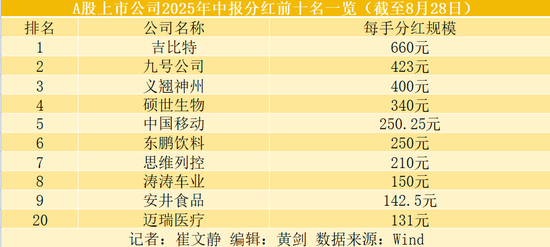
Core Viewpoint - The A-share market is experiencing a significant transformation in its dividend distribution landscape, with an increasing number of companies announcing mid-term dividend plans, reflecting a stronger emphasis on shareholder returns [1][3][11]. Group 1: Dividend Distribution Trends - As of August 28, 2025, 713 A-share companies have disclosed mid-term dividend plans, surpassing the previous year's 704 companies, indicating a growing trend in dividend distribution [3][4]. - The total scale of mid-term dividends has exceeded 100 billion yuan, continuing the rapid expansion of the dividend pool since 2024 [1][3]. - The number of companies distributing mid-term dividends has increased from fewer than 200 annually to several hundred, showcasing a shift towards prioritizing shareholder returns [1][3][11]. Group 2: Industry and Company Performance - Traditional high cash flow sectors such as finance, energy, and telecommunications remain the primary contributors to dividends, while consumer and manufacturing sectors are rapidly releasing their dividend potential [2][11]. - Leading companies like China Mobile and JiBit have established stable and predictable high-dividend styles, with China Mobile's mid-term dividend increasing from 222.47 yuan in 2023 to 250.25 yuan in 2025 [9][10]. - JiBit, recognized as the "dividend sincerity king," has maintained a high dividend level, with 660 yuan per share in 2025, reflecting a strong commitment to shareholder returns [10][11]. Group 3: Regulatory and Policy Impact - The new "National Nine Articles" policy links dividend distribution to refinancing and share reduction behaviors, significantly enhancing companies' motivation to distribute dividends [2][7]. - The information disclosure evaluation mechanism incentivizes companies to increase the frequency and proportion of dividends, fostering a more robust dividend culture [2][7][11]. - Regulatory guidance has led to a notable increase in the number of companies announcing mid-term dividends, with eight newly listed companies also introducing mid-term dividend plans [7][11]. Group 4: Future Outlook - The A-share dividend system is expected to evolve towards greater stability, transparency, and efficiency, driven by market and institutional collaboration [2][11]. - Companies are increasingly adopting long-term dividend plans, enhancing predictability and investor confidence, as seen with companies like Mindray Medical and China National Automotive [11][12]. - The trend of increasing dividend frequency and amounts is anticipated to continue, further attracting long-term capital to the A-share market [10][12].
A股千亿分红来了,最高每手派现660元
21世纪经济报道· 2025-08-29 08:58
Core Viewpoint - The A-share market is experiencing a significant transformation in its dividend distribution patterns, with an increasing number of companies announcing mid-term dividend plans, reflecting a stronger focus on shareholder returns [1][2]. Group 1: Dividend Distribution Trends - As of August 28, 2025, 713 A-share companies have disclosed mid-term dividend plans, surpassing last year's 704, indicating a continuous upward trend in dividend distribution [4]. - The number of companies distributing mid-term dividends has increased from under 200 annually to several hundred, showcasing a shift towards prioritizing shareholder returns [1][4]. - The scale of mid-term dividends has significantly increased since 2024, with notable growth in the number of companies offering substantial dividends per share [4][9]. Group 2: Industry Insights - Traditional high cash flow sectors such as finance, energy, and telecommunications remain the primary contributors to dividends, while consumer and manufacturing sectors are rapidly unlocking their dividend potential [1][12]. - Leading companies like China Mobile and JiBit have established a stable and predictable high-dividend style, with China Mobile's dividend per share increasing from 222.47 yuan in 2023 to 250.25 yuan in 2025 [10][12]. - The introduction of new policies linking dividend behavior to refinancing and shareholding actions has significantly enhanced companies' motivation to distribute dividends [2][4]. Group 3: Future Outlook - The A-share dividend system is expected to evolve towards greater stability, transparency, and efficiency, driven by market and regulatory collaboration [2][11]. - More companies are adopting long-term dividend plans, enhancing predictability and investor confidence, with firms like Mindray Medical committing to distribute at least 65% of their distributable profits over the next three years [12][14]. - The increasing focus on dividends is also reflected in the performance of dividend-linked financial products, which have seen net value increases in 2025, highlighting the growing appeal of high-dividend assets [13][14].

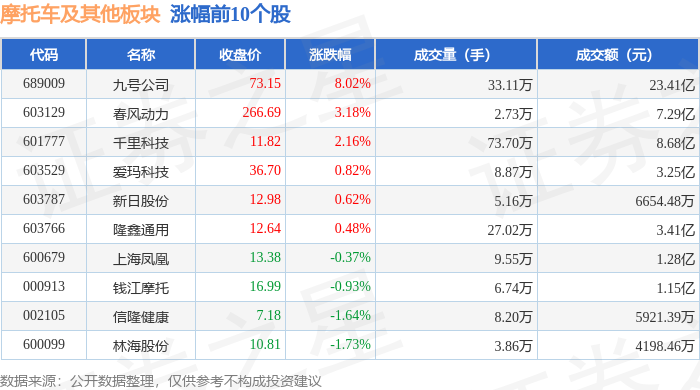
摩托车及其他板块8月29日涨2.19%,九号公司领涨,主力资金净流入2.47亿元
Zheng Xing Xing Ye Ri Bao· 2025-08-29 08:41
Market Performance - The motorcycle and other sectors rose by 2.19% on August 29, with Ninebot leading the gains [1] - The Shanghai Composite Index closed at 3857.93, up 0.37%, while the Shenzhen Component Index closed at 12696.15, up 0.99% [1] Stock Performance - Ninebot Company (code: 6000689) closed at 73.15, with an increase of 8.02% and a trading volume of 331,100 shares, amounting to a transaction value of 2.341 billion yuan [1] - Other notable stocks included: - Chunfeng Power (code: 603129) at 266.69, up 3.18% [1] - Qianli Technology (code: 601777) at 11.82, up 2.16% [1] - Aima Technology (code: 603529) at 36.70, up 0.82% [1] - New Vision Co. (code: 603787) at 12.98, up 0.62% [1] Capital Flow - The motorcycle and other sectors saw a net inflow of 247 million yuan from main funds, while retail investors experienced a net outflow of 140 million yuan [3][4] - Ninebot Company had a main fund net inflow of 178 million yuan, representing 7.59% of its total [4] - Qianli Technology experienced a net inflow of 85 million yuan from main funds, accounting for 9.80% [4] ETF Overview - The Food and Beverage ETF (code: 515170) tracked the sub-index with a recent five-day change of 0.50% and a P/E ratio of 20.74 [6] - The Gaming ETF (code: 159869) tracked the animation and gaming index with a five-day change of 3.39% and a P/E ratio of 44.92 [6] - The Semiconductor ETF (code: 588170) tracked the semiconductor materials and equipment index with a five-day change of 10.78 and a net inflow of 2.3759 million yuan [6]