乐鑫科技

Search documents
DeepSeek发源地再推人工智能创新高地方案!科创板人工智能ETF(588930)现涨超2%,实时成交额突破6000万元
Mei Ri Jing Ji Xin Wen· 2025-06-05 06:55
Group 1 - The core viewpoint of the news is the significant development and investment in artificial intelligence (AI) in Hangzhou, with specific targets set for 2025, including a market-scale computing power exceeding 50 EFLOPS and a revenue target for the AI core industry exceeding 390 billion yuan [1] - The implementation plan for AI innovation in Hangzhou aims to cultivate two internationally leading foundational models and over 25 industry-specific influential models, alongside establishing more than 700 large-scale enterprises in the AI sector [1] - The A-share market showed a slight fluctuation, but AI-related stocks surged, with notable increases in companies like Yuke Technology and Chipone Technology, indicating a high market interest in AI themes [1] Group 2 - Shanxi Securities highlighted the growing global demand for AI computing power, particularly driven by large model training and inference, presenting significant opportunities for domestic AI and server manufacturers [2] - The domestic demand for AI computing power remains strong, especially from major internet companies and intelligent computing centers, with IDC predicting the accelerated server market in China to reach $25.3 billion by 2028, growing at a compound annual growth rate of over 20% from 2024 to 2028 [2] - The introduction of DeepSeek R1 is expected to lower the barriers for AI application development and deployment, making inference demand a primary growth driver for AI computing power, thus expanding market space for domestic manufacturers [2]

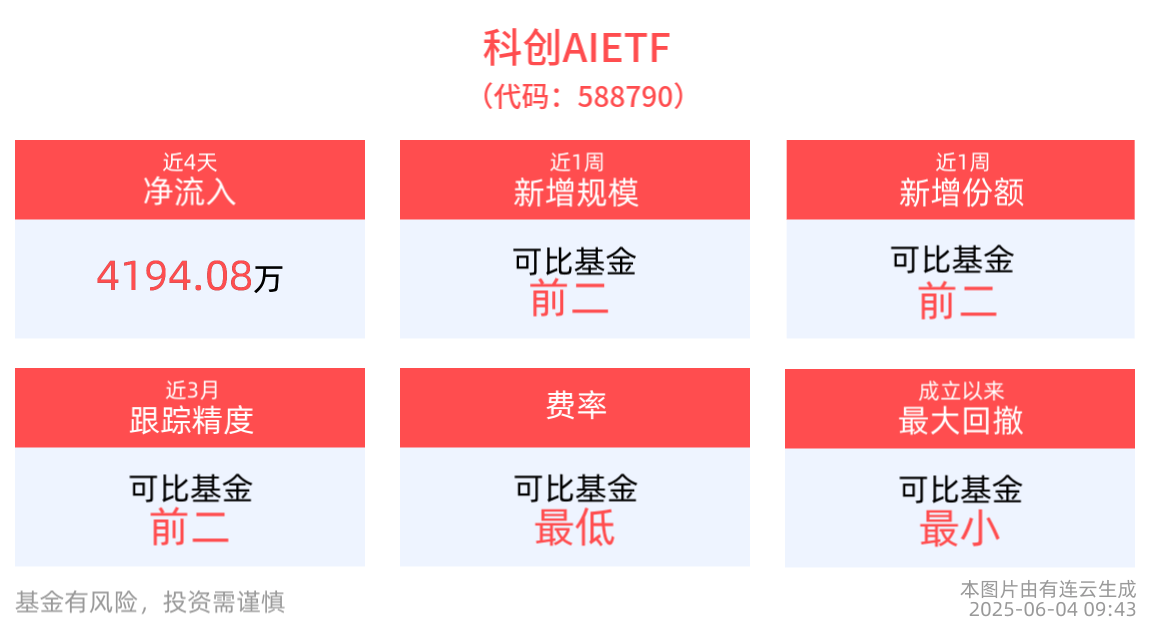
海内外AI催化不断,科创AIETF(588790)盘中飘红,寒武纪涨超3%
Sou Hu Cai Jing· 2025-06-04 02:25
Core Insights - The AI sector is experiencing rapid development in evaluation systems, interactive experiences, intelligent applications, and technological innovations, leading to increased competition and accelerated technological iterations, presenting both opportunities and challenges for the future [3]. Group 1: Market Performance - As of June 4, 2025, the Shanghai Stock Exchange Sci-Tech Innovation Board AI Index (950180) rose by 0.16%, with notable increases in constituent stocks such as Cambricon (688256) up 3.53% and Kingsoft Office (688111) up 1.87% [3]. - The Sci-Tech AI ETF (588790) increased by 0.18%, with a latest price of 0.57 yuan and a trading volume of 22.02 million yuan [3]. - Over the past year, the average daily trading volume of the Sci-Tech AI ETF was 271 million yuan, ranking first among comparable funds [3]. Group 2: Fund Performance - The Sci-Tech AI ETF saw a significant growth of 17.7 million yuan in scale over the past week, ranking second among comparable funds [4]. - The fund's shares increased by 6 million over the past week, also ranking second among comparable funds [4]. - In the last four trading days, the fund experienced net inflows on three occasions, totaling 41.94 million yuan, with an average daily net inflow of 10.49 million yuan [4]. Group 3: Financial Metrics - The latest financing buy-in amount for the Sci-Tech AI ETF reached 15.95 million yuan, with a financing balance of 72.43 million yuan [4]. - Since its inception, the fund's highest monthly return was 15.59%, with the longest consecutive months of increase being two, and the longest increase percentage being 26.17% [4]. - As of June 3, 2025, the fund's relative drawdown since inception was 0.40% compared to its benchmark [4]. Group 4: Fee Structure and Tracking Accuracy - The management fee for the Sci-Tech AI ETF is 0.50%, and the custody fee is 0.10%, which are the lowest among comparable funds [5]. - The tracking error over the past three months was 0.015%, indicating high tracking accuracy compared to similar funds [5]. Group 5: Valuation and Top Holdings - The latest price-to-earnings ratio (PE-TTM) for the index tracked by the Sci-Tech AI ETF is 116.72, which is below 82.49% of the time over the past year, indicating a historical low valuation [5]. - As of May 30, 2025, the top ten weighted stocks in the index accounted for 70.6% of the total, with companies like Lanqi Technology (688008) and Cambricon (688256) being significant contributors [5].


天工2.0视频更新,小米向月之暗面转让多个kimi商标
Mei Ri Jing Ji Xin Wen· 2025-06-04 01:10
Market Overview - On June 3, 2025, the Sci-Tech Innovation Artificial Intelligence ETF (Hua Xia, 589010) rose by 0.81%, with leading stocks such as Lanke Technology increasing by 5.77%, Lexin Technology by 4.81%, and Fudan Microelectronics by 4.41% [1] - The Robotics ETF (562500) remained unchanged, with leading stocks including iFlytek (002230) up by 4.02%, while Yingfeng Environment (000967) fell by 2.33% [1] - The trading volume for the day was 384 million yuan, making it the top ETF in terms of trading activity, with a turnover rate of 3% [1] Key Developments - On June 3, Xiaomi's founder Lei Jun revealed at the Xiaomi Investor Conference that the company has been investing in robotics for five years, with current trials of related capabilities in automotive factories [2] - The Beijing Humanoid Robot Innovation Center released a video showcasing the "Tiangong 2.0" humanoid robot's performance in various real-world environments, highlighting its long battery life and applications in commercial services, industrial tasks, logistics, and home use [2] - Recent intellectual property information indicates that Xiaomi Technology has transferred several "kimi" trademarks to Beijing Moonlight Technology Co., Ltd., with these trademarks originally applied for in 2013 and currently mostly registered [2] Industry Insights - Open Source Securities believes that the commercialization of humanoid robots has officially begun, with a surge in orders pushing the industry to expand production capacity, making delivery capabilities crucial for companies competing for orders [3] - The entry of robots into real-world scenarios is accelerating the evolution of intelligence, with high-frequency usage allowing robots to continuously collect real-world data, aiding in algorithm optimization and operational capability enhancement, particularly in unstructured environments [3] ETF Highlights - The Robotics ETF (562500) is the only fund in the market with a scale exceeding 10 billion yuan, offering the best liquidity and comprehensive coverage of the Chinese robotics industry chain, facilitating investors' access to the sector [4] - The Sci-Tech Innovation Artificial Intelligence ETF (Hua Xia, 589010) serves as the "brain" of robotics, with a 20% fluctuation range and the potential to capture "singularity moments" in the AI industry [4]
芯片公司,一年买EDA要花多少钱?
是说芯语· 2025-06-04 00:43
Core Viewpoint - The article summarizes the EDA (Electronic Design Automation) tool expenditures mentioned in the 2024 financial reports of 15 listed SoC/MCU/ASIC chip design companies, indicating that EDA expenses are relatively low, around 1% of total R&D costs, but are crucial for chip design [1]. Group 1: EDA Expenditures - Few companies disclose EDA tool expenses in their annual reports, and the disclosed amounts are generally low compared to overall R&D expenses [1]. - EDA tools are essential in chip design, akin to physical education in school exams, where despite low scoring weight, failing to meet standards can prevent entry into prestigious institutions [1]. - Companies like 瑞芯微 reported a significant increase of 294.58% in long-term payables due to increased EDA tool purchases [1][2]. Group 2: Company-Specific Insights - 中科蓝讯 reported EDA tool payables with a year-end balance of 5,309,734.52 yuan, down from 6,163,510 yuan at the beginning of the period [2][3]. - 普冉半导体 noted a 77% increase in intangible assets attributed to new EDA and IP purchases [5]. - 炬芯科技 indicated a 217% increase in other payables, primarily due to increased EDA tool procurement [7]. - 国民技术 reported EDA tool amortization of 370,000 yuan in long-term deferred expenses [14]. Group 3: Government Support and Risks - 晶晨股份 received government subsidies for EDA innovation applications [9]. - Several companies, including 恒玄科技 and 国科微, mentioned risks associated with EDA in their reports [13][16]. - 北京君正 received multiple EDA-related subsidies, highlighting government support for the industry [16].




“奔私”三年后顶流董承非宣布封盘,旗下产品业绩表现如何?
Xin Lang Cai Jing· 2025-06-03 06:08
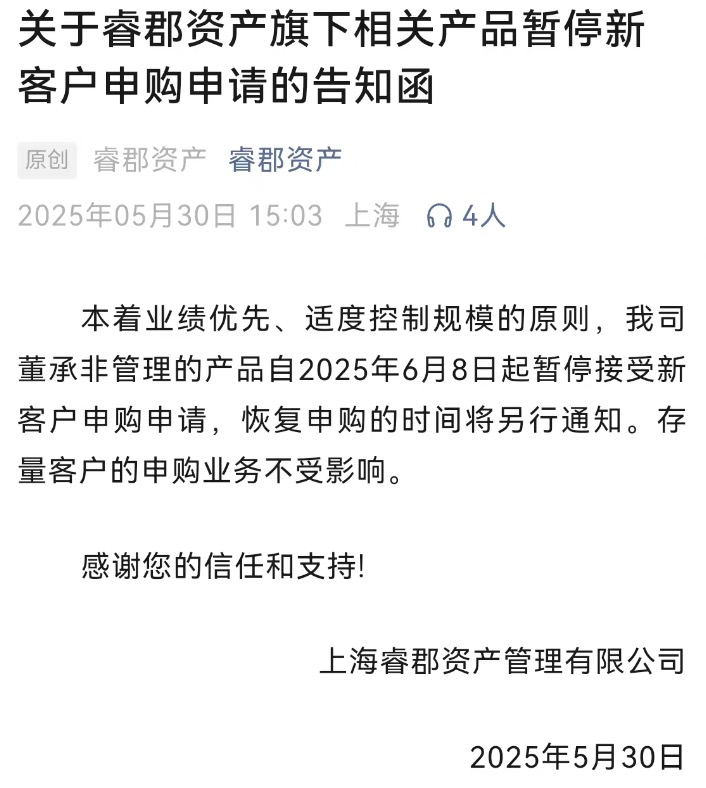
Group 1 - Renowned private equity firm Ruijun Asset announced that starting from June 8, 2025, it will suspend new client subscription applications for products managed by Dong Chengfei, prioritizing performance and controlling scale [1] - Dong Chengfei, a prominent fund manager, transitioned from public to private equity in 2022, joining Ruijun Asset and investing at least 40 million yuan of personal funds into the firm's products, achieving a first fundraising scale of 4.5 billion yuan [2][6] - Under Dong Chengfei's management, products like "Ruijun Chengfei" series have shown significant performance, with cumulative returns around 32% since their inception [6] Group 2 - Dong Chengfei's historical performance includes annualized returns of 19.87%, 10.97%, and 19.13% for various funds during his tenure at Xingzheng Global Fund [6] - The "Ruijun Youfu" series products have substantial holdings in technology stocks, with a cumulative market value of 5.93 billion yuan as of the latest reports [7] - The firm has increased its holdings in key technology stocks, including significant positions in companies like Yuanli Co., Lexion Technology, and Chipong Micro, with total holdings reaching 15.42 billion yuan [8][9] Group 3 - Dong Chengfei's investment strategy has shifted towards materials and design sectors, indicating a cautious approach to semiconductor investments due to high valuations [9][10] - Ruijun Asset has conducted extensive research, with 70 investigations into 65 stocks in Q2, focusing on sectors like electronics, pharmaceuticals, and basic chemicals, which constitute over 55% of their research activities [10]

新一轮“东升西落”交易起点!科创板人工智能ETF(588930)现涨1.17%,连续2个交易日获得资金净流入
Mei Ri Jing Ji Xin Wen· 2025-06-03 03:08
Group 1 - The article discusses the potential for a new round of "East Rising, West Falling" trading as the US dollar weakens, benefiting non-US assets and the Chinese market [1] - The US dollar index has fallen below 100 points since mid-May, driven by multiple factors including Trump's policies, US government debt pressure, and fundamental risks [1] - The A-share market is expected to benefit from the weak dollar environment, particularly in the technology sector, which is anticipated to see significant event catalysts in June [1] Group 2 - The AI sector in the STAR Market has shown significant rebounds, with stocks like Lanke Technology and Lexin Technology rising over 5% [1] - The STAR Market AI ETF (588930) has seen a trading volume exceeding 30 million yuan, indicating high market interest [1] - The ETF tracks 30 leading AI companies in the STAR Market, covering various segments of the AI industry, with the top five stocks accounting for 47% of the index weight [1] Group 3 - Open Source Securities reports that DeepSeek's latest R1 model has achieved domestic leadership in multiple benchmark assessments, nearing international top models [2] - The R1 model has significantly reduced "hallucination" issues by approximately 45-50%, enhancing its reliability in text rewriting and comprehension tasks [2] - The model's optimization across various literary forms expands AI's potential in content creation [2]
2025全球人工智能技术大会即将召开,科创AIETF(588790)涨超1%,连续5天净流入
Xin Lang Cai Jing· 2025-06-03 02:00
Core Insights - The Shanghai Stock Exchange Sci-Tech Innovation Board Artificial Intelligence Index (950180) has shown a strong increase of 1.23% as of June 3, 2025, with notable gains in constituent stocks such as Lanke Technology (688008) up by 5.57% and Fudan Microelectronics (688385) up by 3.75% [2] - The upcoming Global Artificial Intelligence Technology Conference (GAITC 2025) will be held in Hangzhou from June 7 to 8, focusing on themes of "crossing, integration, mutual growth, and win-win" [2] - CITIC Securities reports that the process of re-evaluating the value of China's technology industry is ongoing, recommending investors to focus on the expansion of the AI ecosystem and the investment opportunities arising from application implementation [2] ETF Performance - The Sci-Tech AI ETF (588790) closely tracks the Shanghai Stock Exchange Sci-Tech Innovation Board Artificial Intelligence Index, which includes 30 large-cap companies providing resources, technology, and application support for AI [3] - The ETF has seen a significant growth in scale, increasing by 82.29 million yuan in the past week, ranking it in the top one-sixth among comparable funds [3] - As of the latest data, the ETF's shares reached a new high of 5.578 billion shares, also placing it in the top one-sixth among comparable funds [3] Fund Flows - The Sci-Tech AI ETF has experienced continuous net inflows over the past five days, with a peak single-day net inflow of 42.23 million yuan, totaling 115 million yuan in net inflows [3] - The latest margin buying amount for the ETF reached 11.92 million yuan, with a margin balance of 72.73 million yuan [3] Return Metrics - As of May 30, 2025, the Sci-Tech AI ETF has achieved a maximum monthly return of 15.59% since its inception, with the longest consecutive monthly gain being two months and a total increase of 26.17% [4] - The ETF has a relative drawdown of 0.40% compared to its benchmark since inception [4] Fee Structure and Tracking Accuracy - The management fee for the Sci-Tech AI ETF is 0.50%, and the custody fee is 0.10%, making it the lowest among comparable funds [5] - The ETF has a tracking error of 0.016% over the past three months, indicating high tracking accuracy compared to similar funds [5] Valuation Insights - The latest price-to-earnings ratio (PE-TTM) for the index tracked by the ETF is 116.45, which is in the 16.67th percentile over the past year, indicating a valuation lower than 83.33% of the time in the past year [5] - The top ten weighted stocks in the index account for 70.6% of the total, with Lanke Technology (688008) holding the highest weight at 10.47% [5][7]


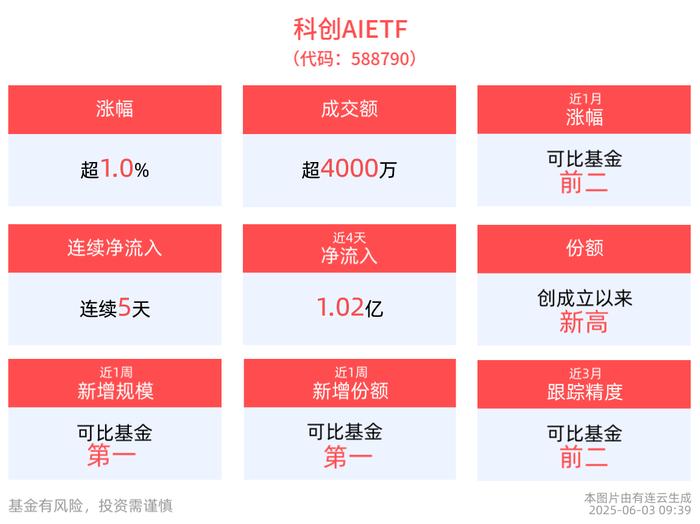
科创板人工智能ETF(588930)涨超1%,澜起科技涨超5%,机构判断中国科技产业价值重估仍未结束
2 1 Shi Ji Jing Ji Bao Dao· 2025-06-03 01:48
Group 1 - The core viewpoint highlights the positive performance of the AI sector in China, particularly through the rise of the STAR Market AI ETF, which has seen a net inflow of nearly 25 million yuan over two days [1] - The STAR Market AI ETF closely tracks the Shanghai STAR Market AI Index, which consists of 30 large-cap companies providing foundational resources, technology, and application support for AI [1] - According to the "2025 China AI Computing Power Development Assessment Report," China's intelligent computing power is expected to grow significantly, with a projected increase of 43% by 2025 compared to 2024, and potentially doubling by 2026 [1] Group 2 - CITIC Securities notes that the AI industry in China has gained sustained attention from society, driven by the breakout effect of DeepSeek, with upcoming releases of DeepSeekR2 and GPT-5 expected to continue the revaluation of the tech sector [2] - UBS highlights that international market interest in Chinese assets is increasing, supported by improved market liquidity, which enhances investor confidence and attracts long-term overseas investors [2] - The appeal of new productive forces, particularly in AI and high-end manufacturing, is driving a shift in the narrative logic of the Chinese stock market [2]

百亿私募宣布:董承非管理产品“封盘”
Zhong Guo Ji Jin Bao· 2025-05-30 14:36
Group 1 - The core point of the announcement is that Rui Jun Asset's products managed by Dong Chengfei will suspend new client subscriptions starting June 8, 2025, to prioritize performance and control scale [1][4][6] - This is the first time Dong Chengfei has taken such a "lock-up" action since transitioning from public to private management three years ago, with his managed scale exceeding 10 billion yuan [1][7] - The company emphasizes that existing clients will not be affected by this suspension and will continue to receive regular updates and communication [6][8] Group 2 - Dong Chengfei expresses optimism about the market in 2025, citing clear policy turning points and a positive outlook on real estate and corporate earnings [8] - He is currently focused on sectors such as semiconductors, public utilities, and plans to invest in quality growth stocks in the Hong Kong market [8][9] - As of the end of Q1 2025, Dong Chengfei's managed products are among the top ten shareholders in several listed companies, including Lexin Technology and Dinglong Co., Ltd [9]
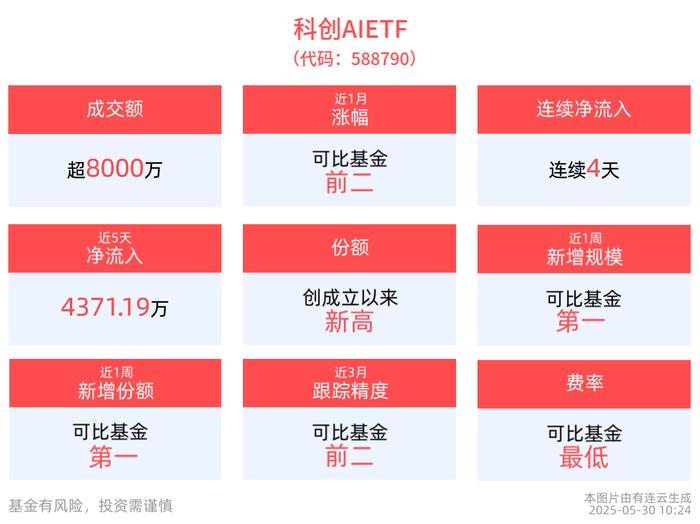
智能眼镜产业链蓄势待发,科创AIETF(588790)近4天获得连续资金净流入
Xin Lang Cai Jing· 2025-05-30 02:54
Core Viewpoint - The article discusses the performance of the Sci-Tech Innovation Board AI Index and the related AI ETF, highlighting recent declines in stock prices and the growth of the ETF's scale and net inflows, as well as the introduction of new AI+AR products by RayNeo. Group 1: Market Performance - As of May 30, 2025, the Sci-Tech Innovation Board AI Index (950180) fell by 2.00%, with major declines in stocks such as Zhongke Xingtou (688568) down 9.47% and Tianzhun Technology (688003) down 5.41% [3] - The Sci-Tech AI ETF (588790) decreased by 1.91%, with the latest price at 0.56 yuan, but has seen a cumulative increase of 11.68% since its inception, ranking 2nd among comparable funds [3] - The ETF's trading volume was 81.63 million yuan, with an average daily trading volume of 273 million yuan over the past year, leading among comparable funds [3] Group 2: Fund Growth and Inflows - The Sci-Tech AI ETF experienced a significant scale increase of 86.99 million yuan over the past week, ranking 1st among comparable funds [4] - The latest share count for the ETF reached 5.503 billion, a new high since its inception, also ranking 1st among comparable funds [4] - The ETF has seen continuous net inflows over the past four days, with a maximum single-day net inflow of 38.97 million yuan, totaling 73.09 million yuan, averaging 18.27 million yuan daily [4] Group 3: Performance Metrics - Since its inception, the Sci-Tech AI ETF has achieved a maximum monthly return of 15.59%, with an average monthly return of 15.59% and a monthly profit probability of 60.26% [5] - The ETF's relative benchmark drawdown since inception is 0.40% [5] Group 4: Fee Structure and Valuation - The management fee for the Sci-Tech AI ETF is 0.50%, and the custody fee is 0.10%, the lowest among comparable funds [6] - The ETF's tracking error over the past three months is 0.014%, indicating high tracking precision compared to similar funds [6] - The latest price-to-earnings ratio (PE-TTM) for the index tracked by the ETF is 118.7, which is below 80.47% of the time over the past year, indicating a historical low valuation [6] Group 5: Top Holdings - As of April 30, 2025, the top ten weighted stocks in the Sci-Tech Innovation Board AI Index accounted for 70.68% of the index, with notable companies including Lanke Technology (688008) and Cambricon Technologies (688256) [6]