
奇瑞汽车

Search documents
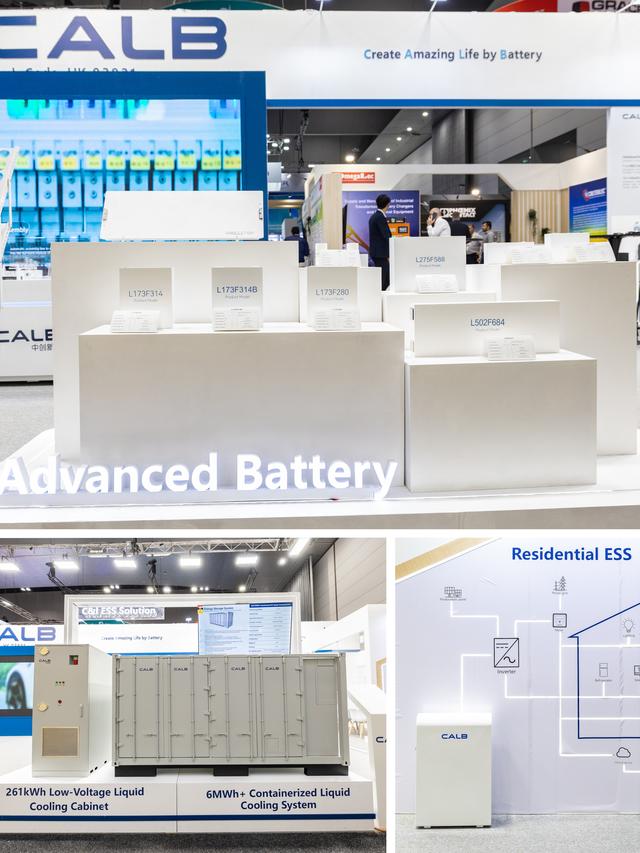
行业产能“饥荒”背后的供需博弈 动力电池再陷“抢货潮”
Zhong Guo Jing Ying Bao· 2025-11-21 21:13
Core Insights - The current supply tightness in the battery industry is prompting leading automotive companies to secure orders from top battery manufacturers, indicating a competitive landscape for battery procurement [3][4] - The domestic power battery installation volume reached 578.0 GWh from January to October, reflecting a year-on-year growth of 42.4% [4][6] - The upcoming adjustment in the new energy vehicle purchase tax policy is expected to influence battery demand, with companies implementing strategies to mitigate the impact [5][7] Industry Overview - The Chinese new energy vehicle market continues to grow rapidly, with production and sales reaching 1,301.5 million and 1,294.3 million units respectively from January to October, marking a year-on-year increase of 33.1% and 32.7% [6] - In October alone, the installation volume of domestic power batteries was 84.1 GWh, a month-on-month increase of 10.7% and a year-on-year increase of 42.1% [6] - The market is witnessing a structural competition between power batteries and energy storage batteries, with both sectors driving the growth of the battery industry [9][10] Company Strategies - Companies like Chery are implementing policies to ensure customers are not adversely affected by the upcoming tax changes, offering subsidies to cover potential tax increases [5] - Guoxuan High-Tech has reported a strong order volume and high capacity utilization, indicating confidence in continued growth [7] - Many battery manufacturers are diversifying into energy storage solutions, with companies like Funeng Technology developing innovative products to capture market share [9][10] Future Outlook - The global battery production capacity is projected to reach 7.5 TWh by 2030, with a demand of 5 TWh, suggesting a balanced supply-demand scenario [8] - The competition among second and third-tier battery manufacturers is intensifying, with differentiation and strong customer relationships becoming critical for sustainable growth [10]



机器人成广州车展“新主角” 车企用具身智能拓展新空间
Shang Hai Zheng Quan Bao· 2025-11-21 18:43
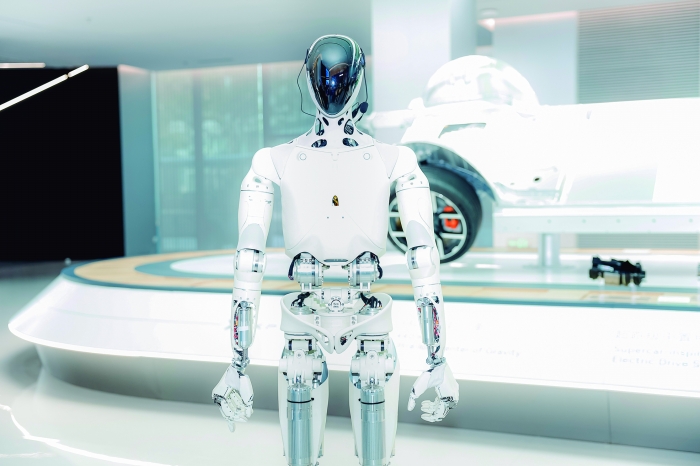
Core Insights - The Guangzhou International Auto Show is showcasing advancements in embodied intelligence, with companies like GAC Group and XPeng Motors presenting their latest humanoid robots [3][4][7] - The automotive industry is increasingly integrating embodied intelligence, with traditional manufacturers exploring this new field to create growth opportunities [3][10] - The demand for humanoid robots is expected to rise, with projections indicating that global annual production could reach 50 million units by 2050, generating significant revenue [9][10] Company Highlights - XPeng Motors unveiled its new humanoid robot, IRON, which features a highly human-like design and advanced capabilities, including 22 degrees of freedom in its hands and a total computational power of 2250 TOPS [7][8] - GAC Group's GoMate Mini robot is designed for practical applications, featuring 27 degrees of freedom and the ability to switch between different mobility modes, with a goal to achieve commercial viability by 2025 [4][6] - Both XPeng and GAC are focusing on the commercialization of humanoid robots, with XPeng planning to mass-produce IRON by the end of 2026 and GAC aiming for a robot industry chain value exceeding 10 billion yuan by 2030 [6][8] Industry Trends - The integration of embodied intelligence in the automotive sector is seen as a natural progression due to the similarities in technology and supply chains between electric vehicles and humanoid robots [10][11] - Major automotive companies, including Tesla, are heavily investing in humanoid robotics, with Tesla's Optimus robot expected to reach an annual production of 50,000 units by 2026 [9][10] - The market for humanoid robots is projected to be a $20 trillion opportunity, with significant growth anticipated as technology matures and production scales up [11]



港股重大调整!12月8日生效
Shang Hai Zheng Quan Bao· 2025-11-21 14:31
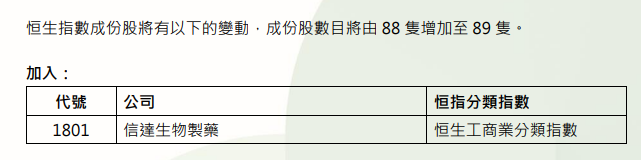
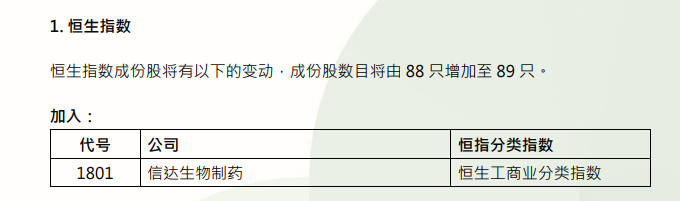
11月21日,恒生指数公司公布今年第三季度恒生指数系列季度检讨结果,所有变动将于2025年12月8日 起生效。 结果显示,信达生物获纳入恒生指数,成分股数目将由88只增加至89只。 | 代號 | 公司 | 恒指分類指數 | | --- | --- | --- | | 1801 | 信達生物製藥 | 恒生工商業分類指數 | 中国宏桥、信达生物、百胜中国获纳入恒生国企指数,新奥能源、海底捞、新东方-S则被剔除。 | 代號 | 公司 | | --- | --- | | 1378 | 中國宏橋集團有限公司 | | 1801 | 信建生物製藥 | | 9987 | 百勝中國控股有限公司 | 富卫集团、禾赛-W、奥克斯电气、极智嘉-W、银诺医药-B、奇瑞汽车获纳入恒生综合指数。 | 代號 | | | --- | --- | | 9973 | 奇瑞汽車股份有限公司 - H 股 | | 代號 | 公司 | | --- | --- | | 1828 | 富衛集團有限公司 | | 2525 | 禾賽科技 - W | | 2580 | 奥克斯電氣有限公司 | | 2590 | 北京極智嘉科技股份有限公司 - W - H 股 | | ...
【联合发布】一周新车快讯(2025年11月15日-11月21日)
乘联分会· 2025-11-21 13:56
Core Insights - The article provides a detailed overview of upcoming vehicle models from various manufacturers, including their specifications, market segments, and launch dates. Group 1: Manufacturer and Model Overview - Beijing Benz will launch the Mercedes-Benz C-Class on November 14, 2025, in the B NB segment with a price range of 338,300 to 384,100 CNY [12]. - Geely Auto is set to release the Geely Bin Yue L on November 15, 2025, in the AO SUV segment, priced at 97,800 CNY [20]. - Chery Auto will introduce the Chery Fengyun A9L on November 15, 2025, in the C NB segment, with prices ranging from 181,900 to 236,900 CNY [28]. - GAC Aion will launch the Aion i60 on November 16, 2025, in the A SUV segment, with prices between 109,800 and 135,800 CNY [36]. - NIO will release the NIO ES6 on November 17, 2025, in the B SUV segment, priced at 349,800 CNY [44]. Group 2: Technical Specifications - The Mercedes-Benz C-Class features a 2.0T engine with a power output of 125 kW and torque of 250 Nm [12]. - The Geely Bin Yue L is equipped with a 1.5T engine, producing 133 kW and 290 Nm of torque [20]. - The Chery Fengyun A9L offers a 1.5T plug-in hybrid engine with a total power output of 115 kW from the engine and 160 kW from the electric motor [28]. - The Aion i60 has a 1.5L range extender engine with a power output of 74 kW and an electric motor producing 180 kW [36]. - The NIO ES6 features a pure electric powertrain with a total output of 360 kW and torque of 700 Nm [44]. Group 3: Market Segmentation and Launch Dates - The article categorizes vehicles into various segments such as B NB, AO SUV, C NB, and A SUV, indicating a diverse range of offerings from manufacturers [2][4]. - The launch dates for these models are strategically planned between November 14 and November 21, 2025, showcasing a concentrated effort to capture market interest during this period [2][4][7].



恒指三季度季检结果出炉!信达生物染蓝 成份股增加至89只
Zhi Tong Cai Jing· 2025-11-21 10:35
Group 1 - Hang Seng Index will include Innovent Biologics (01801), increasing the number of constituent stocks from 88 to 89 [1][4] - Hang Seng China Enterprises Index will include China Hongqiao (01378), Innovent Biologics, and Yum China (09987), while New Energy (02688) and New Oriental-S (09901) will be removed, maintaining a total of 50 constituent stocks [3][5] - Hang Seng Technology Index will include Leapmotor (09863), while ASMPT (00522) will be removed, keeping the number of constituent stocks at 30 [7][9] Group 2 - Hang Seng Composite Index will include FWD Group (01828), Hesai Technology-W (02525), Aux Group (02580), Geekplus Technology-W (02590), Yino Pharma (02591), and Chery Automobile (09973), increasing the number of constituent stocks from 503 to 509 [10][11][12]
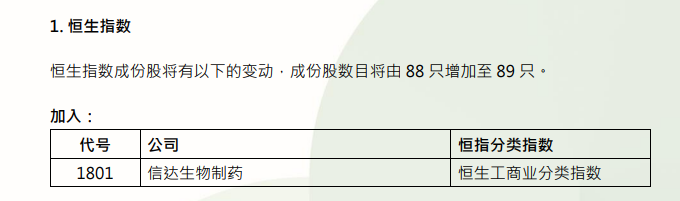
恒指三季度季检结果出炉!信达生物(01801)染蓝 成份股增加至89只
智通财经网· 2025-11-21 10:21
Group 1: Hang Seng Index - Xinda Biopharmaceutical (01801) will be included in the Hang Seng Index constituent stocks, increasing the number of constituents from 88 to 89 [1][2]. Group 2: Hang Seng China Enterprises Index - China Hongqiao (01378), Xinda Biopharmaceutical (01801), and Yum China (09987) will be added to the Hang Seng China Enterprises Index, while New Energy (02688) and New Oriental Education (09901) will be removed, maintaining a total of 50 constituents [4][5]. Group 3: Hang Seng Technology Index - Leapmotor (09863) will be included in the Hang Seng Technology Index, while ASMPT (00522) will be removed, keeping the number of constituents at 30 [7][8]. Group 4: Hang Seng Composite Index - FWD Group (01828), Hesai Technology (02525), Aux Group (02580), DeepGlint (02590), Yino Pharma (02591), and Chery Automobile (09973) will be added to the Hang Seng Composite Index, increasing the number of constituents from 503 to 509 [10][11].
日系“铁壁”被攻破,“中国车首次登顶印尼”
Guan Cha Zhe Wang· 2025-11-21 08:53
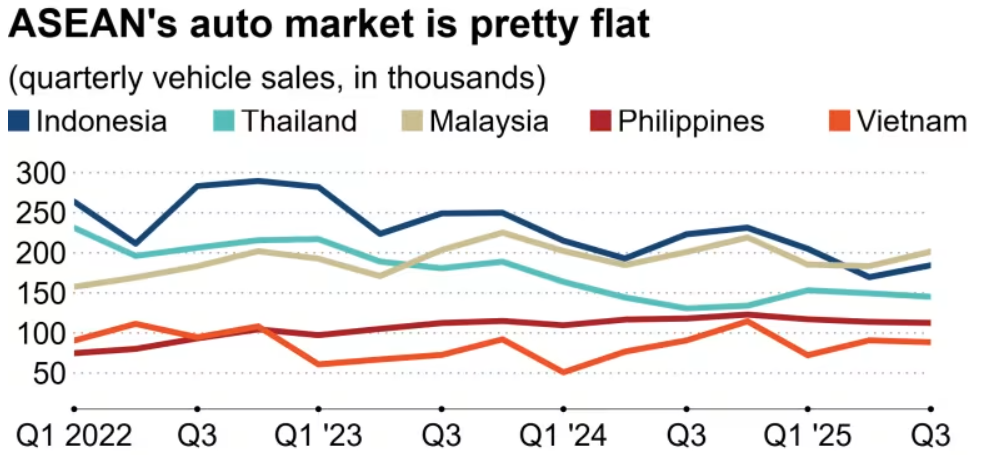
Core Insights - The long-standing dominance of Japanese automakers in Southeast Asia's automotive market is being challenged as demand shifts towards electric vehicles, with Chinese brands like BYD gaining significant traction [1][4] Group 1: Market Overview - In Q3 2023, total automotive sales in the five major Southeast Asian markets reached 731,900 units, a year-on-year decline of 4% but a quarter-on-quarter increase of 4% [4] - Indonesia's automotive sales fell by 17% year-on-year to 184,403 units, marking a 26% drop compared to two years ago, significantly impacting Japanese manufacturers who hold 90% market share [4] - Toyota remains the market leader in Indonesia with a 33.4% market share, but its Q3 sales dropped by 26%, while Daihatsu's sales fell by 24% [4] Group 2: Brand Performance - BYD's Atto 1 electric vehicle surpassed Toyota's Innova and Avanza in sales for the first time in October, with 9,396 units sold [4] - Astra International, Indonesia's largest automotive dealer, reported a 20% year-on-year decline in sales to 34,888 units, with market share dropping from 54% in September to 47% [4] - In Malaysia, automotive sales increased by 3% year-on-year to 201,588 units, supported by a 5.2% GDP growth [5] Group 3: Competitive Landscape - Chinese automakers are reshaping the Malaysian market, with Chery's sales reaching 25,631 units in the first ten months of the year, a 78.2% increase year-on-year, while BYD's electric vehicle sales grew by 56.5% [5] - Chery's growth began in Q3 2023, and it has surpassed Mitsubishi in sales for the first time in Q1 2024, and is on track to overtake Mazda in Q3 2024 [8] - The shift in consumer preference from sedans to SUVs is evident, with Chery's competitively priced models attracting buyers who previously considered Japanese sedans [8]

金融助力中国企业“走出去”报告
第一财经研究院· 2025-11-21 05:51
Investment Rating - The report indicates a positive investment outlook for Chinese enterprises going global, with a projected increase in foreign direct investment (FDI) to 1.16 trillion RMB in 2024, reflecting an 11.30% year-on-year growth [8]. Core Insights - Chinese enterprises are actively exploring new pathways for international expansion, adapting strategies in response to geopolitical challenges and evolving market conditions [4][8]. - The ASEAN region has emerged as a key destination for Chinese investment, with its share of China's outbound investment rising from 6.34% in 2014 to 17.88% in 2024 [8]. - The structure of China's outbound investment is shifting, with significant increases in the wholesale, retail, and manufacturing sectors, indicating a deeper integration into global value chains [8][52]. Summary by Sections Part A: Challenges and Pathways for Chinese Enterprises Going Global - The Chinese government is committed to high-quality outbound investment, emphasizing the importance of maintaining a stable international economic environment despite rising geopolitical tensions [18][19]. - The share of China's exports in global trade is projected to reach 14.64% in 2024, maintaining its position as the world's largest exporter [19][23]. - Chinese enterprises are increasingly focusing on the ASEAN region for investment, with a notable rise in direct investment since the implementation of the RCEP [44][52]. Part B: Financial Support for Outbound Expansion - Chinese financial institutions are enhancing their overseas presence, with major banks establishing branches in numerous countries to support outbound enterprises [9]. - There is a strong emphasis on integrating domestic and international resources, with banks providing cross-border credit and financing solutions for projects under the Belt and Road Initiative [9][11]. - Innovative financial products and services are being developed to support overseas investments, including specialized loans for infrastructure projects and comprehensive solutions for cross-border e-commerce [9][11]. Part C: Future Outlook and Recommendations - Recommendations include optimizing overseas network construction, enhancing multi-tiered financial service systems, and expanding the use of cross-border RMB [12][13]. - A comprehensive risk management system is suggested to help enterprises navigate geopolitical uncertainties and market volatility [12][13]. - Strengthening collaboration between financial institutions and industries is crucial for supporting enterprises in their global expansion efforts [12][13].



捷途汽车迈入“后李学用时代”
Jing Ji Guan Cha Wang· 2025-11-20 15:09
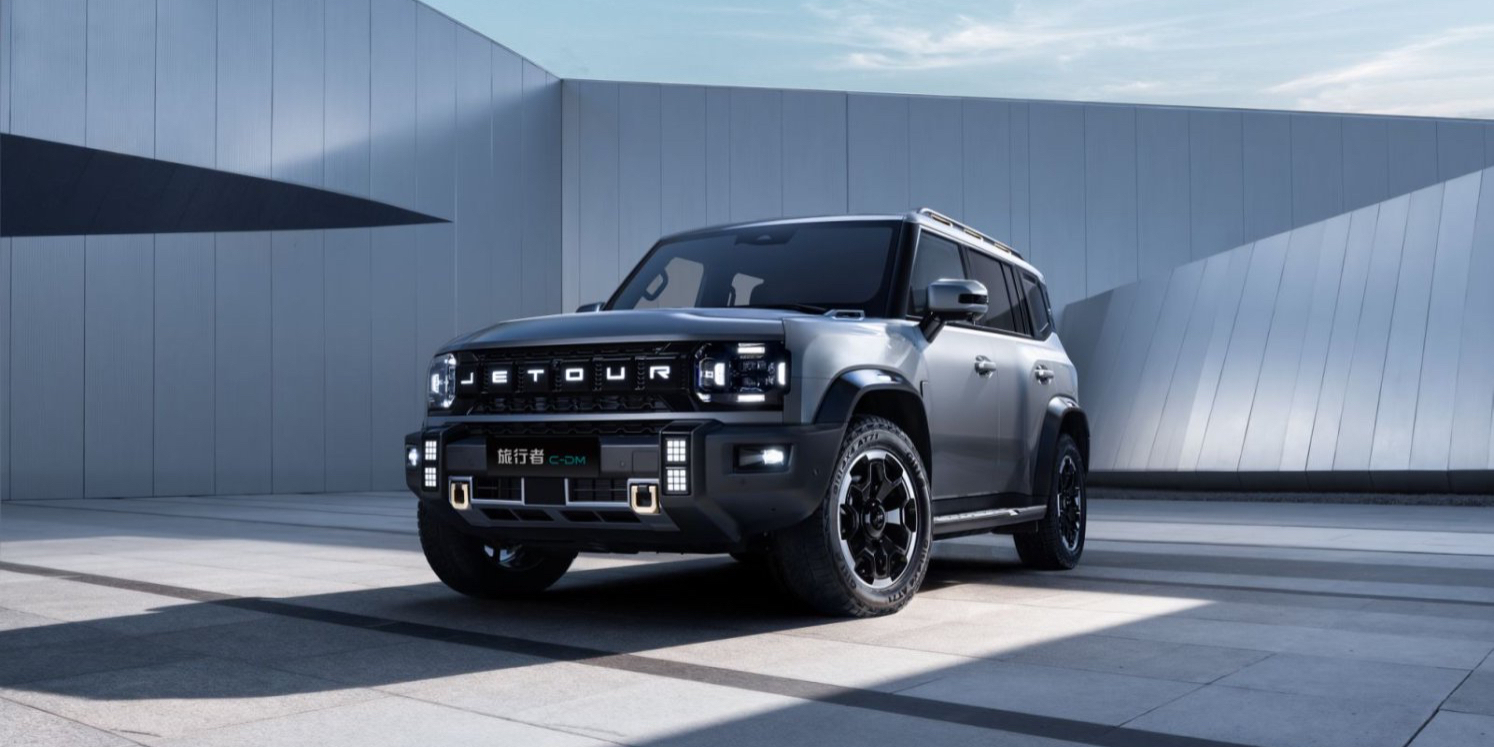
Core Viewpoint - The absence of Li Xueyong, a key figure in Jietu Auto, at the recent launch event reflects a strategic shift within Chery Group and the brand's development, indicating a transition towards a more mature operational model [4][6][8] Group 1: Li Xueyong's Role and Transition - Li Xueyong has played a crucial role in the rise of Jietu Auto, having been involved since its inception in 2018, focusing on a differentiated development strategy amid a challenging market [4][5] - His recent promotion to oversee multiple core brands within Chery signifies a shift from hands-on management of Jietu to a broader strategic role, impacting his direct involvement in daily operations [6][7] Group 2: Jietu Auto's Development and Strategy - Jietu Auto has rapidly become one of the fastest-growing brands in China's automotive market, achieving 2.046 million users globally within just seven years, making it the only Chinese brand to reach 2 million sales in such a short time [4][5] - The brand's marketing strategy has stabilized, focusing on the "Travel+" ecosystem, emphasizing user co-creation and community engagement, despite Li's absence at the event [7] - Jietu Auto has successfully addressed sales challenges but now faces the urgent need to enhance its new energy vehicle offerings and transition to a higher-end market, which will require more than just marketing capabilities [7][8]
王传福和李书福不约而同为海外市场站台
第一财经· 2025-11-20 03:51
2025.11. 20 本文字数:2133,阅读时长大约4分钟 作者 | 第一财经 肖逸思 今年10月,较少公开露面的比亚迪和吉利"掌门人"王传福和李书福,接连为自己的海外市场站台。 先是王传福出现在当月10日出现在比亚迪巴西工厂,随后李书福又现身马来西亚东盟峰会。 步入11月,两家公司又先后在第三季度财报投资者沟通会上,给明年的海外市场销量定下了一个高 速增长的目标。其中,吉利2026年预计海外销量增长50%~80%,整体规模将达到60万辆级别。而比 亚迪2026年海外销量规模预计将达到150万辆,同比增速预计和吉利相当。 比亚迪和吉利是国内汽车销量排在前二的两家头部车企。乘联分会数据显示,今年前10个月,比亚 迪国内零售销量累计近284万辆,吉利则为214万辆。过去,大众和通用两大品牌在国内零售销量最 高都在400余万辆,2024年,比亚迪的零售销量近372万辆,已经逼近历史巅峰数据。 明年国内市场竞争预期加剧 当下,中国汽车市场日趋白热化已经成为共识。但是,明年的车市竞争还增加了一项新的不确定性, 即自2026年1月1日起,新能源汽车将不再免征车辆购置税,而是开始减半征收。 随着新能源汽车补贴政策的进一 ...
