香港交易所

Search documents
安永:港股IPO市场迎来强劲复苏 IPO筹资额时隔四年再度突破2000亿港元
Zheng Quan Shi Bao Wang· 2025-11-27 07:39
Group 1 - The core viewpoint of the article highlights that the Hong Kong Stock Exchange (HKEX) is expected to achieve its second-highest IPO fundraising amount in nearly five years by 2025, only behind the peak in 2021 [1] - The report indicates that the fundraising amount is projected to exceed 200 billion HKD for the first time in four years, driven primarily by large IPO projects [1] - Mainland Chinese A-share listed companies are identified as a significant force behind the growth in fundraising scale within the Hong Kong market [1]

安永:料香港今年逾100宗IPO 集资2800亿港元
智通财经网· 2025-11-27 07:27
Group 1 - The core viewpoint of the report indicates that the IPO activities in mainland China and Hong Kong are experiencing growth, with A-shares and the Hong Kong market accounting for 16% and 33% of the global total in terms of IPO numbers and fundraising amounts respectively [1] - Hong Kong Stock Exchange ranked first globally with a fundraising amount of $36 billion for the year, marking a significant achievement in the IPO market [1] - The global IPO market shows signs of improvement, with the number of IPOs remaining stable and fundraising amounts on the rise, while Chinese companies occupy five spots in the top ten global IPOs, an increase from 2024 [1] Group 2 - The Hong Kong IPO market saw a strong recovery in 2025, with a total fundraising amount of HKD 280 billion, representing a substantial year-on-year increase of 218%, and surpassing the HKD 200 billion mark for the first time in four years [2] - Over 100 new stocks were listed in the Hong Kong market, reflecting a 43% increase from the previous year, indicating a significant rise in market activity [2] - Large IPOs have been a key factor in the resurgence of the Hong Kong stock market, with the top ten IPOs collectively raising HKD 154.7 billion, accounting for over half of the total annual amount, and showing an average financing scale increase of 137% compared to last year [2]
倒计时1天!港股市场将迎来近5年首只指数期货
Mei Ri Jing Ji Xin Wen· 2025-11-27 06:48
Core Viewpoint - The Hong Kong Stock Exchange has announced the launch of the Hang Seng Biotechnology Index Futures, set to begin trading on November 28, marking the first new stock index futures in the Hong Kong market in five years since the introduction of the Hang Seng Tech Index Futures in 2020 [1] Group 1: Industry Development - Biotechnology is described as "the fastest-growing and most dynamic sector" currently [1] - The introduction of index futures indicates official recognition of the biotechnology sector, which is expected to attract more market attention and capital [1] Group 2: Market Impact - The new index futures will provide risk management tools, allowing institutions to hedge their positions [1] - The launch of index futures is anticipated to enhance market liquidity, pricing efficiency, and risk management capabilities, driving the biotechnology sector towards a more mature, stable, and internationally influential phase [1]
中国及香港股票策略-2026 年展望:主题、风险、政策灵活性及 2026 年一季度首选标的-China & HK Equity Strategy_ 2026 Outlook_ Themes, risks, policy optionality and preferred picks for 1Q26
2025-11-27 02:17
Summary of Key Points from the Conference Call Industry Overview - The report focuses on the **China & Hong Kong equity market** with a specific outlook for **2026** and investment strategies for **1Q26** [2][5][10]. Core Insights and Arguments - **Constructive Stance**: The report maintains a positive outlook on MXCN/CSI300, predicting a further rally in 2026 with targets set at **100** for MXCN, **5,200** for CSI300, and **16,000** for MXHK, reflecting growth rates of **15%**, **15%**, and **9%** year-on-year respectively [2][7][8][9]. - **Investment Themes**: Four key investment themes for 2026 are highlighted: 1. **Anti-involution**: Expected to accelerate post-March NPC, improving margins and return on equity (ROE) [5][6]. 2. **AI Infrastructure Growth**: Anticipated growth in global AI infrastructure capex will benefit localization plays in China [5][6]. 3. **Global Macro Support**: Positive macroeconomic conditions, including easing fiscal and monetary policies in developed markets, are expected to boost overseas sales [5][6]. 4. **K-shaped Recovery**: Consumption recovery is expected to favor food & beverage and premium luxury sectors, while mid-tier consumption may suffer [5][6]. Risks Identified - **Geopolitical Tensions**: Ongoing tensions between the US and China, particularly ahead of the US mid-term elections, pose risks to market stability [5][6]. - **Earnings Consensus Risks**: The report notes a potential decline in consensus EPS growth for MXCN from approximately **15%** to **9%** due to intense competition in quick commerce platforms [5][6]. - **Property Market Concerns**: Reports of softening luxury sales and price declines in mainland China may trigger policy changes, including relaxation of home purchase restrictions in prime districts [5][6]. Sector Recommendations - **Overweight (OW)**: Communication Services, IT, Materials, and Staples sectors are recommended for investment [6][11][12]. - **Underweight (UW)**: Energy and Utilities sectors are advised against [6][11][12]. - **Top Picks for 1Q26**: Notable stocks include Baidu, NetEase, Midea, MIXUE, PDD, Pop Mart, Trip.com, Tingyi, Futu, Innovent, CATL, and COLI [6][13][15]. Valuation and Earnings Insights - **Valuation Normalization**: Since September 2024, MXCN/CSI300 has shown a return of **29%/30%** in USD terms, indicating a recovery from previous valuation discounts [20][22]. - **Earnings Growth**: The report highlights a broadening recovery in earnings across various sectors, despite weak headline EPS growth at the index level [42][44]. Additional Important Points - **EPS Revision Trends**: The breadth of EPS revisions has improved significantly, indicating a potential for recovery in earnings [58][59]. - **Market Under-Ownership**: The report emphasizes that China equity remains under-owned both domestically and internationally, suggesting potential for increased allocation [5][6]. This summary encapsulates the key insights and recommendations from the conference call, providing a comprehensive overview of the current state and future outlook of the China & Hong Kong equity markets.
智通ADR统计 | 11月27日
智通财经网· 2025-11-26 22:25
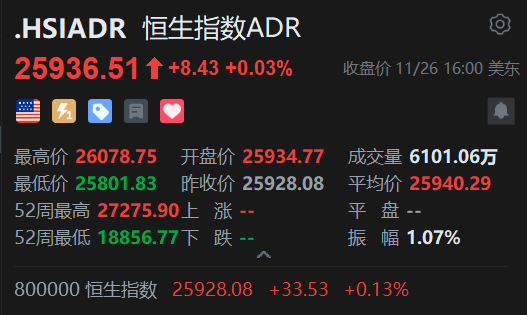
Market Overview - The Hang Seng Index (HSI) closed at 25,936.51, up by 8.43 points or 0.03% on November 26 [1] - The index reached a high of 26,078.75 and a low of 25,801.83 during the trading session, with a trading volume of 61.01 million shares [1] Stock Performance - Major blue-chip stocks showed mixed performance, with HSBC Holdings closing at HKD 109.799, up by 2.04% compared to the Hong Kong close [2] - Tencent Holdings closed at HKD 614.101, down by 0.87% compared to the Hong Kong close [2] Individual Stock Movements - Tencent Holdings (00700) reported a price of HKD 619.500, down by HKD 5.500 or 0.88%, with an ADR price of USD 614.101, reflecting a decrease of 0.87% [3] - Alibaba Group (09988) saw a decline of HKD 3.000 or 1.90%, with a latest price of HKD 154.800 and an ADR price of USD 153.233, down by 1.01% [3] - HSBC Holdings (00005) increased by HKD 0.800 or 0.75%, with a latest price of HKD 107.600 and an ADR price of USD 109.799, up by 2.04% [3] - AIA Group (01299) rose by HKD 1.450 or 1.83%, with a latest price of HKD 80.700 and an ADR price of USD 81.128, up by 0.53% [3] - Meituan (03690) increased significantly by HKD 5.550 or 5.65%, while other stocks like Baidu (09888) and Kuaishou (01024) experienced declines of 2.05% and 2.83% respectively [3]






全球期货交易所综合排名首次发布 上期所跻身前列
Zhong Guo Zheng Quan Bao· 2025-11-26 20:20
Group 1 - The first comprehensive ranking of global futures exchanges was released by Fudan University, filling a gap in the field of quantitative assessment [1] - The ranking includes 16 influential futures exchanges, with the observation period from 2016 to 2025, showing CME, ICE, and HKEX as the top three [1] - The Shanghai Futures Exchange has made significant progress, ranking among the second tier of exchanges due to the rapid growth of China's commodity trade [1] Group 2 - The global commodity futures exchange industry has seen three notable trends: significant market growth, enhanced innovation capabilities, and increased challenges in risk management due to macroeconomic uncertainties [2] - The trading volume of global commodity futures and options has increased by over 60% in the past five years, with an annual compound growth rate exceeding 10% [2] - The Shanghai Futures Exchange has introduced innovative products, including the first domestic crude oil futures and the first shipping index futures, reflecting a focus on green and technological advancements [2] Group 3 - Building a world-class exchange is a systematic project that involves various factors beyond the exchange's development level, including the financial and economic systems [3] - A new comprehensive evaluation index system for exchanges has been developed, which is expected to evolve into a "Shanghai standard" for assessing exchange competitiveness [3] - The Shanghai Futures Exchange has made substantial progress in the steel futures sector, leading globally in trading volume and becoming a key pricing reference for steel trade [3]


全球首个期货交易所综合排名发布
Qi Huo Ri Bao Wang· 2025-11-26 17:14
Core Insights - The first comprehensive ranking of global futures exchanges was released by Fudan University, with CME, ICE, and HKEX taking the top three spots [1][2] - The ranking evaluates 16 influential futures exchanges based on a multi-dimensional assessment framework, covering aspects such as capacity, governance, and macro performance [2][4] Group 1: Market Trends - Significant growth in market size has been observed, with global futures and options trading volume increasing over 60% in the past five years, averaging a compound annual growth rate (CAGR) of over 10% [3] - The domestic futures and options trading volume in China has nearly doubled, with a CAGR of approximately 14% [3] - The innovation capability of exchanges is on the rise, focusing on new technologies and renewable energy, with notable product launches such as crude oil futures and shipping index futures [3] Group 2: Risk Management and Challenges - The macro environment's uncertainty poses greater challenges for exchanges' risk management capabilities, highlighted by geopolitical events affecting commodity supply chains [3] - Chinese futures exchanges have effectively utilized their regulatory framework to stabilize price fluctuations, providing reliable price signals to global clients [3][4] Group 3: Future Directions - The development of China's futures market has been significant, with commodity trading volume leading globally, laying a solid foundation for becoming a world-class futures exchange [4] - Recommendations for exchanges include launching more international products, simplifying participation processes for foreign investors, and promoting "Shanghai prices" in international markets to enhance global competitiveness [4]
2025赴港上市2.0:科技赋能与制度创新下的香港资本市场业务新范式
Sou Hu Cai Jing· 2025-11-26 08:38
Core Insights - The report discusses the new paradigm of Hong Kong's capital markets driven by technological empowerment and institutional innovation, focusing on the trends and regulations for mainland companies planning to list in Hong Kong by 2025 [1][24]. Listing Pathways - The report highlights the suitability of H-share direct listings and red-chip indirect listings, with a trend towards A-share to H-share conversions. It emphasizes the importance of compliance issues related to VIE structure dismantling, H-share "full circulation," and offshore trust applications [2][18]. - The new regulatory framework established in 2023 has simplified the H-share listing process and optimized the "full circulation" mechanism, providing a more efficient cross-border financing path for large state-owned and mature private enterprises [18][24]. Practical Issues - The report identifies key legal issues for companies planning to list in Hong Kong, including the design of equity incentives, tax planning, and information disclosure, which are critical for executives to manage effectively [2][20]. - The Hong Kong Stock Exchange has introduced initiatives like the "Tech Company Fast Track" to enhance the attractiveness of the market for technology firms, aiming to facilitate their listing processes [2][10]. Hot Industries - The report categorizes key industries such as hard technology, biomedicine, and new consumption, each facing unique compliance challenges. Hard tech companies must navigate intellectual property and export control issues, while biomedicine firms focus on data security and human genetic resource protection [2][22]. - New consumption enterprises face multiple compliance tests, including third-party payment regulations and store licensing management, while domestic chain enterprises must pay attention to franchise compliance and fund management [2][22]. Market Dynamics - By 2025, Hong Kong's capital market is projected to regain its position as the world's top fundraising destination, with over 90% of the companies being from mainland China, driven by institutional innovations that facilitate access to global capital [1][24]. - The report emphasizes that the new regulatory environment and the establishment of a comprehensive filing system mark a significant shift in the cross-border listing landscape, enhancing the market's appeal for innovative enterprises [24].

阿里巴巴三季度财报超预期催化行情,恒指港股通ETF(520960)有望受益
Xin Lang Cai Jing· 2025-11-26 02:55
Group 1 - The core viewpoint of the news highlights the positive performance of the Hong Kong stock market, particularly driven by the strong earnings report from Alibaba Group, which reported revenues of approximately 247.8 billion yuan for the second fiscal quarter of 2026, reflecting a 15% year-on-year growth after excluding the impact of divested businesses, surpassing market expectations [1] - The Hong Kong stock market is expected to reach new highs in the fourth quarter, supported by a dual logic of improving fundamentals and continuous enhancement of liquidity, as stated by Guotai Junan Securities [1] - The technology sector in Hong Kong is anticipated to benefit from the AI industry cycle, becoming a core theme for year-end market performance [1] Group 2 - As of November 25, 2025, the top ten weighted stocks in the HSISC index include Alibaba-W, HSBC Holdings, Tencent Holdings, and others, collectively accounting for 55.68% of the index [1] - The HSISC index has shown a 0.46% increase, with notable gains from stocks such as Meituan-W, which rose over 6%, and others like CSPC Pharmaceutical Group and Shenzhou International, which increased by over 3% [1] - The HSISC ETF (520960) closely tracks the HSISC index, with Alibaba-W being the largest weighted stock, focusing on scarce investment opportunities in the Hong Kong market [2]
人民币被踢出局?英美联手巩固美元霸权,却忘中国才是购买力关键
Sou Hu Cai Jing· 2025-11-26 02:46
Group 1 - The London Metal Exchange (LME) announced a suspension of all non-USD denominated metal options trading starting November 10, citing "insufficient liquidity and low trading volume," which contradicts the actual trading data showing significant activity in RMB-denominated copper trading [2] - The trading volume for RMB-denominated copper is projected to rise from 357,000 contracts in early 2024 to 482,000 contracts by mid-2025, indicating a robust market contrary to LME's claims [2] - The LME, while appearing to be a UK entity, is effectively controlled by the Hong Kong Stock Exchange, raising questions about the motivations behind the suspension of RMB trading [2] Group 2 - Concurrently, the U.S. is set to initiate a new round of quantitative easing in December, which will increase the supply of USD in the market, potentially impacting global commodity prices [4] - The G7 has formed a "critical minerals alliance" excluding China, indicating a strategic move to undermine China's influence in global metal pricing [4][10] - The U.S. aims to maintain its dollar hegemony by tying key mineral pricing to the USD, similar to its historical approach with oil [10] Group 3 - The G7 alliance's strategy may be flawed as the global market has shifted to a "buyer-dominated" model, where China, as the largest metal importer, holds significant leverage in pricing negotiations [12] - Despite the U.S. efforts to isolate the RMB, the internal divisions within the G7 and the low GDP growth in the U.S. suggest a weakening of traditional dollar dominance [14] - The suspension of RMB trading by LME may inadvertently accelerate the development of a more robust RMB trading system, particularly through the Shanghai Futures Exchange [16][23] Group 4 - The dual trading system is emerging, with the LME and Chicago Mercantile Exchange dominated by USD, while the Shanghai Futures Exchange represents the RMB pricing system [22] - The recent developments are seen as a catalyst for the RMB's rise in global metal pricing, providing an alternative that could lead to a more equitable market structure [25] - The upcoming BRICS meeting presents an opportunity for the RMB to gain support from resource-rich and consumption-heavy nations, further solidifying its position in global trade [20]