
南方航空

Search documents
新型航空燃料热浪来袭!碳减排最多达九成
Zheng Quan Shi Bao Wang· 2025-10-24 03:40
Core Insights - The global aviation industry is entering the "SAF era," driven by policy changes and increasing demand for sustainable aviation fuel (SAF) [1][2][5] - The SAF market is expected to grow significantly, with a projected supply-demand gap exceeding 26 million tons from 2030 to 2035, leading to a market size in the thousands of billions of yuan [1][2] - SAF can reduce carbon dioxide emissions by 69% to 90% compared to traditional fuels, making it a viable path for the aviation industry's decarbonization efforts [2][5] Industry Developments - The European Union has mandated that by 2030, 6% of fuel used in flights from its airports must be SAF, with a target of 70% by 2050 [2][3] - China's SAF consumption is projected to exceed 20,000 tons this year, with various initiatives and policies being implemented to support the industry [3][6] - Major Chinese airlines are beginning to incorporate SAF into their operations, with commitments to increase SAF usage significantly by 2030 [3][6] Market Dynamics - The price of SAF has surged, with recent figures exceeding $2,700 per ton, driven by regulatory requirements and rising raw material costs [4][10] - The competition for SAF production capacity is intensifying, with numerous companies launching projects to meet the growing demand [6][7] - The current collection of waste cooking oil in China is limited to about 5 million tons annually, which is insufficient to meet future SAF demand [8][9] Challenges and Opportunities - The high cost of SAF production remains a significant barrier to widespread adoption, with estimates suggesting that SAF could be 4.2 times more expensive than conventional jet fuel [9][10] - Companies are exploring diverse raw materials for SAF production to enhance supply and reduce costs, including non-food biomass and green hydrogen [8][9] - The industry is witnessing a shift in production locations, with potential growth in regions rich in agricultural waste and renewable resources [9]



南方航空跌2.10%,成交额9355.60万元,主力资金净流出398.67万元
Xin Lang Zheng Quan· 2025-10-24 01:59
Core Viewpoint - China Southern Airlines' stock price has shown a slight increase of 0.46% year-to-date, with notable gains over the past 5, 20, and 60 trading days, indicating a positive short-term trend in the market [2]. Financial Performance - For the first half of 2025, China Southern Airlines reported a revenue of 86.29 billion yuan, reflecting a year-on-year growth of 1.77%. However, the net profit attributable to shareholders was -1.53 billion yuan, a decrease of 24.84% compared to the previous year [2]. - The company has cumulatively distributed 6.629 billion yuan in dividends since its A-share listing, with no dividends paid in the last three years [3]. Stock Market Activity - As of October 24, the stock price of China Southern Airlines was 6.52 yuan per share, with a market capitalization of 118.15 billion yuan. The stock experienced a decline of 2.10% during the trading session [1]. - The trading volume was 93.56 million yuan, with a turnover rate of 0.11%. There was a net outflow of 3.99 million yuan in principal funds, with large orders accounting for 5.32% of purchases and 9.58% of sales [1]. Shareholder Structure - As of June 30, 2025, the number of shareholders for China Southern Airlines was 140,000, a decrease of 7.17% from the previous period. The average circulating shares per person remained at 0 shares [2]. - Among the top ten circulating shareholders, Hong Kong Central Clearing Limited held 582 million shares, a decrease of 2.65 million shares from the previous period. Meanwhile, Huatai-PB CSI 300 ETF and E Fund CSI 300 ETF increased their holdings [3].
暗中较劲的中美航权
Hu Xiu· 2025-10-24 01:51
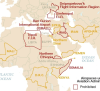
美国交通部则在其拟议的命令中表示:"(中国航班使用俄罗斯领空)已成为一个重要的竞争因素,对美国航空公司造成严重不 利影响,需尽可能消除美国和中国航空公司之间的竞争差距。" 早在2023年5月,俄罗斯领空问题就成为中美复航谈判的焦点,美方同意中国航空公司增加两国间航班数量,但前提是新航班不 得飞越俄罗斯。 2024年,中美达成协议,双方航空公司原则上共可运营每周100班定期客运航班,中方50班,美方50班。 截至目前,中方的六家航司早已把每周50个航班飞满,而美国航司尚未用满额度,采取了一种"软对抗"的方式。 飞过美国的朋友一般都清楚,北京、上海到美国西海岸城市(西雅图、旧金山、洛杉矶)的航线通常是走北太平洋,即日本→ 阿留申群岛,不太受俄罗斯关闭领空限制。 但飞美国东海岸城市(纽约、华盛顿、波士顿)则是向北经西伯利亚、北极和加拿大,这样的航线最短、最经济。 近日,美媒报道称特朗普政府拟提议禁止中国航空公司在往返美国的航班上飞越俄罗斯领空,认为这种做法使美国航空公司处 于不利地位。 众所周知,自2022年3月以来西方与俄罗斯便互关了领空,而中国航班仍可以使用俄罗斯领空,于是欧美航空公司就感到心理不 平衡,认为中 ...

中银晨会聚焦-20251024
Bank of China Securities· 2025-10-24 01:23
Key Points - The report highlights a selection of stocks for October, including companies such as China Southern Airlines (600029.SH) and Contemporary Amperex Technology Co., Ltd. (300750.SZ) [1] - The macroeconomic analysis indicates that China's foreign trade has shown strong resilience, leading to a record high in the current account surplus for the first half of the year, while the surplus as a percentage of GDP remains within internationally recognized reasonable limits [2][4] - The solid-state battery technology is identified as the next generation of power batteries for electric vehicles, with significant advantages in safety and energy density, supported by government policies [6][7] - The solid-state battery equipment market is projected to grow rapidly, with an estimated global market size of 4 billion yuan in 2024, and expected to reach 107.94 billion yuan by 2030 [7] - Shengquan Group is recognized as a leading synthetic resin enterprise in China, expanding into biomass chemicals and electronic chemicals, with a robust growth trajectory driven by increasing demand in downstream sectors [10][11] - The demand for electronic resins is expected to rise significantly due to the growth of AI servers and the ongoing domestic substitution of electronic resins [10][11] - The report notes that the global market for silicon-based anode materials is projected to reach 30 billion yuan by 2025, driven by the increasing demand for electric vehicles and energy storage [12] - Shengquan Group's proprietary biomass refining technology is highlighted for its ability to achieve high-value utilization of biomass, contributing to a complete industrial chain [13]




碳减排最多达九成 新型航空燃料直面高成本与低产能考验
Zheng Quan Shi Bao· 2025-10-23 17:15
Core Insights - The global aviation industry is entering the "SAF era," driven by policy initiatives and a significant expected increase in demand for Sustainable Aviation Fuel (SAF) [1][3][4] - The aviation sector is one of the hardest to decarbonize, with SAF being a viable alternative to traditional fuels, potentially reducing CO2 emissions by 69%-90% [2][3] - The European Union has set ambitious SAF blending targets, aiming for 2% by 2025, 6% by 2030, and 70% by 2050, which will significantly increase SAF demand [2][4] Industry Developments - China's SAF consumption is projected to exceed 20,000 tons this year, with various initiatives and policies being implemented to support the industry [3][5] - The establishment of the China Sustainable Aviation Fuel Industry Alliance and local government policies indicate a strong push towards SAF development [3][5] - Major airlines, including Cathay Pacific and China Eastern Airlines, are committing to increasing their SAF consumption as part of their ESG strategies [3][5] Market Dynamics - The price of SAF has surged, with European prices exceeding $2,700 per ton, driven by mandatory blending policies and rising raw material costs [4][9] - The competition for SAF production capacity is intensifying, with companies like Junheng Bio and Weili investing in large-scale SAF projects [5][6] - Current SAF production capacity in China is around 1 million tons, with expectations to double by 2026, although it remains insufficient to meet global demand [5][6] Raw Material and Cost Considerations - The primary feedstock for SAF production is waste cooking oil, with China's collection capacity limited to about 500,000 tons annually, which is insufficient for large-scale SAF production [6][8] - The average global cost of SAF is projected to be 4.2 times that of conventional jet fuel, raising concerns about its economic viability [8][9] - The high cost of SAF is a significant barrier to its adoption, with airlines facing pressure to balance sustainability goals with competitive pricing [9] Future Outlook - The diversification of raw materials for SAF production, including non-food biomass and green hydrogen, is expected to reshape the industry landscape [7][8] - The successful scaling of SAF production will depend on technological advancements and supportive government policies to lower costs and increase supply [9]
南航冬春航季每周在贵州计划执行航班量将突破700班次
Zhong Guo Jin Rong Xin Xi Wang· 2025-10-23 10:36
具体来看,南航贵州公司将继续高频运营贵阳至北京、上海、广州、深圳等干线航班,保障旅客出行需 求;贵阳至郑州航线加密至每日3班;新增贵阳至南通航线,每日1班;优化广州-贵阳-银川和贵阳-青 岛-哈尔滨航线时刻安排。 新华财经贵阳10月23日电(记者肖艳)记者从南航贵州公司获悉,南航贵州公司将于10月26日起执行冬 春季航班计划,新航季每周在贵州计划执行航班量将突破700班次,通过32条国内航线与全国29个重要 城市连接。 在支线航空布局方面,南航贵州公司将持续运营广州/北京大兴=遵义新舟、广州/深圳=遵义茅台、 广州=兴义等5条特色支线航线。 据介绍,在航线布局方面,南航坚持巩固主干航线与拓展航线增量并举的策略,强化贵州与长三角、中 原等核心经济区的空中纽带,支撑区域协同发展,加大贵州至华东、华南方向的运力投入。 编辑:刘润榕 ...
航空机场板块10月23日涨0.38%,深圳机场领涨,主力资金净流入3222.04万元
Zheng Xing Xing Ye Ri Bao· 2025-10-23 08:20
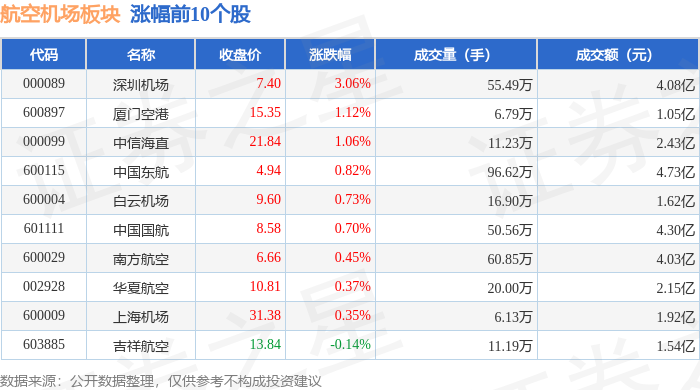
Market Overview - On October 23, the aviation and airport sector rose by 0.38% compared to the previous trading day, with Shenzhen Airport leading the gains [1] - The Shanghai Composite Index closed at 3922.41, up 0.22%, while the Shenzhen Component Index closed at 13025.45, also up 0.22% [1] Stock Performance - Shenzhen Airport (000089) closed at 7.40, up 3.06% with a trading volume of 554,900 shares and a turnover of 408 million yuan [1] - Xiamen Airport (600897) closed at 15.35, up 1.12% with a trading volume of 67,900 shares and a turnover of 105 million yuan [1] - China Eastern Airlines (600115) closed at 4.94, up 0.82% with a trading volume of 966,200 shares and a turnover of 473 million yuan [1] - China Southern Airlines (600029) closed at 6.66, up 0.45% with a trading volume of 608,500 shares and a turnover of 403 million yuan [1] Capital Flow - The aviation and airport sector saw a net inflow of 32.22 million yuan from institutional investors, while retail investors experienced a net inflow of 35.07 million yuan [2] - However, speculative funds recorded a net outflow of 67.29 million yuan [2] Individual Stock Capital Flow - China Southern Airlines (600029) had a net inflow of 69.47 million yuan from institutional investors, while it faced a net outflow of 34.49 million yuan from speculative funds [3] - China Eastern Airlines (600115) saw a net inflow of 39.42 million yuan from institutional investors, with a net outflow of 3.79 million yuan from speculative funds [3] - Shenzhen Airport (000089) experienced a net outflow of 11.13 million yuan from institutional investors, but had a net inflow of 5.62 million yuan from retail investors [3]




防御投资首选,交通运输ETF(159666)下跌0.19%
Sou Hu Cai Jing· 2025-10-23 06:30
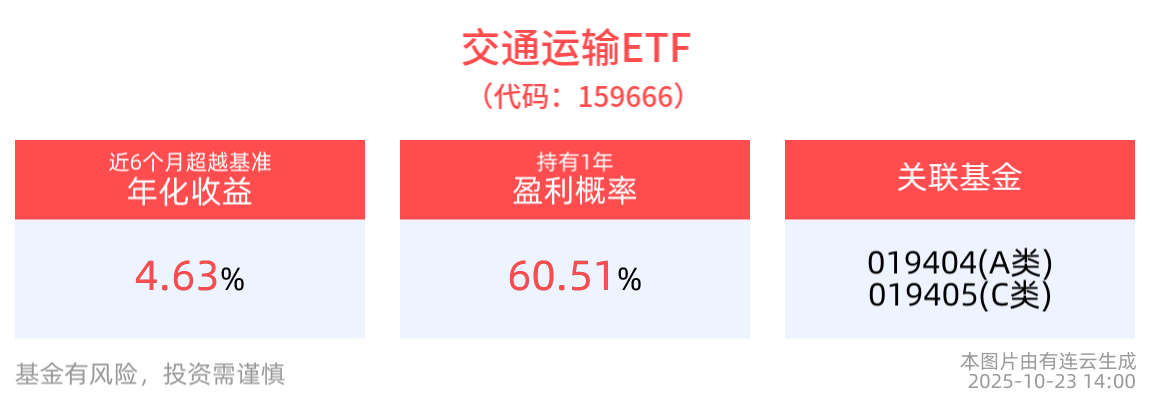
Core Insights - The Transportation ETF (159666) has experienced a slight decline of 0.29% as of October 23, 2025, with a latest price of 1.02 yuan, while it has seen a cumulative increase of 0.79% over the past week as of October 22, 2025 [2] Performance Summary - The Transportation ETF has achieved a net value increase of 20.35% over the past two years [2] - The highest single-month return since inception was 15.82%, with the longest consecutive months of increase being 4 months and the maximum increase during that period being 11.93% [2] - The average monthly return during the rising months is 3.16%, with a total annual profit percentage of 100.00% and a historical one-year profit probability of 60.51% [2] - Over the last six months, the ETF has outperformed its benchmark with an annualized excess return of 4.63% [2] Risk and Drawdown - The maximum drawdown over the past six months was 4.93%, with a relative benchmark drawdown of 0.04% [2] Fee Structure - The management fee for the Transportation ETF is 0.50%, and the custody fee is 0.10% [2] Tracking Accuracy - The tracking error for the Transportation ETF over the past month was 0.015% [2] Index Composition - The Transportation ETF closely tracks the CSI All Share Transportation Index, which reflects the overall performance of various industry companies within the index [3] - The index is categorized into 11 primary industries, 35 secondary industries, over 90 tertiary industries, and more than 200 quaternary industries [3] Top Holdings - The top holdings in the Transportation ETF include SF Holding (10.25% weight, -0.90% change), Beijing-Shanghai High-Speed Railway (9.99% weight, 0.00% change), and COSCO Shipping Holdings (8.27% weight, -0.13% change) [5]
飞鹤,急速打响市场保卫战丨消费参考
2 1 Shi Ji Jing Ji Bao Dao· 2025-10-23 02:24
Core Viewpoint - Under market pressure, China Feihe is taking various measures to stabilize its position, including launching new products that replicate the nutritional ecology of breast milk [1][2]. Company Performance - Feihe's revenue for the first half of the year decreased by 9.36% year-on-year to 9.151 billion yuan, with sales pressure attributed to increased competition and a deliberate reduction in milk powder channel inventory [3]. - The revenue breakdown shows that ultra-high-end, high-end, regular, and adult milk powder segments generated revenues of 6.19 billion, 1.69 billion, 330 million, and 290 million yuan, respectively, with declines of 13%, 14%, 3% growth, and 4% decline year-on-year [3]. Market Dynamics - The infant formula market is experiencing intensified competition, with leading brands like Yili, Nutricia, and FrieslandCampina expanding, while mid-tier brands like a2 are also showing strong growth potential [3][7]. - Feihe has maintained its position as the top seller in the infant formula market for six consecutive years, but the growth momentum in the market appears weak, with a projected decline in newborn numbers due to a significant drop in marriage registrations [4][5]. Membership and Tools - Feihe's "Star Mom Club" membership has surpassed 85 million, and the company plans to offer a free developmental self-assessment tool tailored to Chinese babies through this platform [2].

有酒店商家单品爆卖10万件 一大批新兴目的地火热亮相
Mei Ri Shang Bao· 2025-10-22 22:54
Core Insights - The "Double 11" shopping festival this year saw significant sales growth for various travel brands, with many achieving transaction volumes exceeding 100 million yuan within the first 24 hours [1] - Emerging travel destinations gained popularity, with domestic locations like Xinjiang and Guizhou recording over 500% growth in sales compared to last year, while international destinations like Denmark and Finland saw over 1000% growth [2] - New travel products debuted successfully during the festival, with several first-time participants achieving impressive sales figures [3] Group 1: Sales Performance - Major brands such as Marriott International, Chime Long Tourist Resort, and All Nippon Airways reported transaction volumes surpassing 100 million yuan [1] - Nearly 300 merchants saw their sales double compared to last year, indicating a robust market response [1] - Outbound travel products performed exceptionally well, with destinations like Singapore and Italy exceeding last year's total sales figures within the first day [1] Group 2: Consumer Preferences - Family-friendly travel services remained a top choice among consumers, with products like "KAIYuan 999 National 18 Store Exchange" and "Marriott Group 370+ Store 3-Night Exchange" selling over 100,000 and 60,000 units respectively [1] - There is a growing trend towards unique and high-quality travel experiences, as evidenced by the success of niche products like the "Aurora Tour" and "New Zealand Boutique Small Group Tour" [3] Group 3: Market Trends - The festival highlighted a shift towards lesser-known destinations, with regions in China and Southeast Asia experiencing significant sales growth [2] - The introduction of innovative travel products, such as multi-city car rental services in Japan, reflects a trend towards more diverse travel options [2][3] - The confidence among new merchants entering the market indicates a positive outlook for future sales and product offerings [3]