易方达

Search documents
大盘放量走高,超百股涨停,A500ETF易方达(159361)、沪深300ETF易方达(510310)助力布局核心资产
Sou Hu Cai Jing· 2025-12-22 11:42
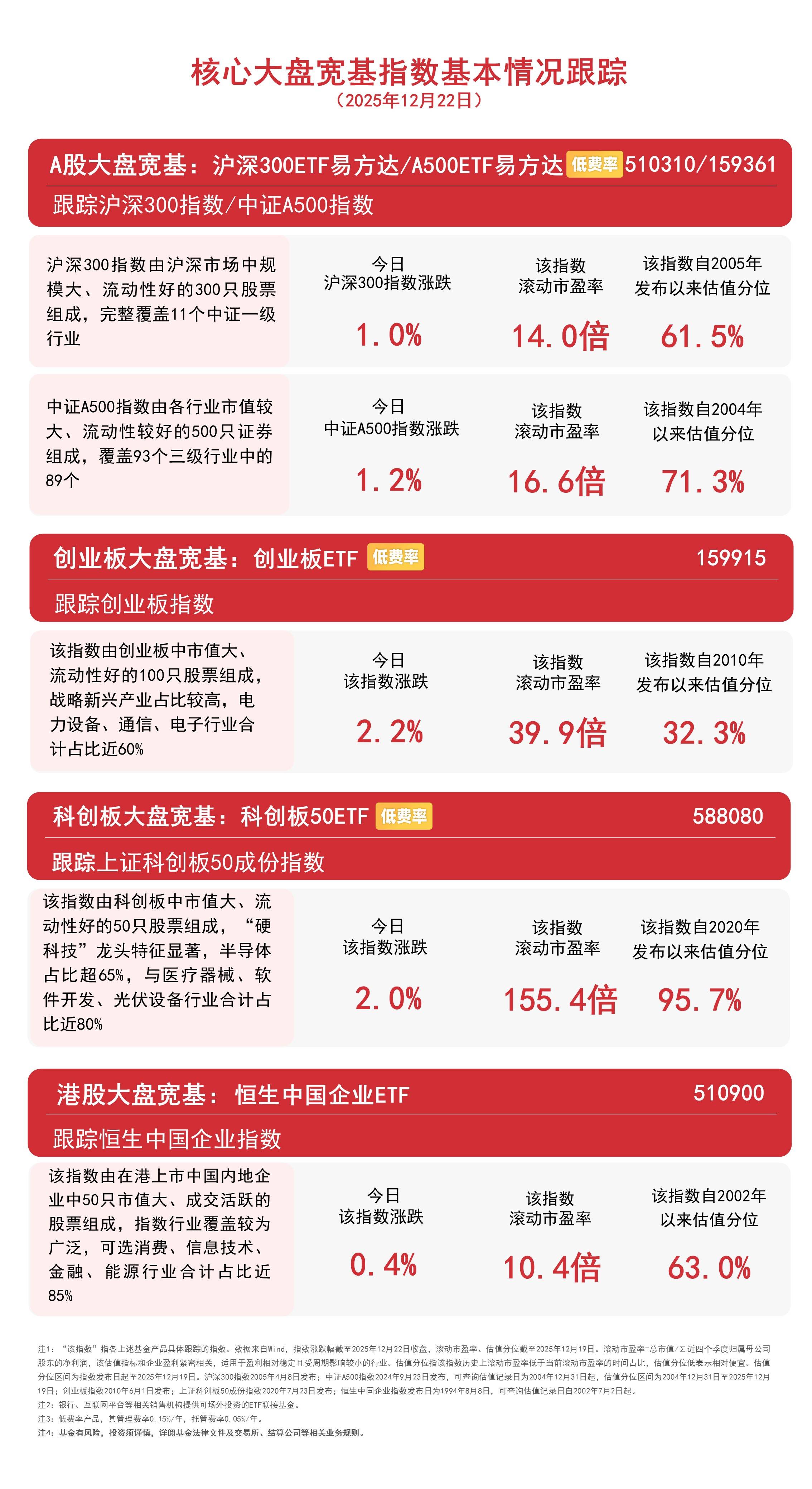
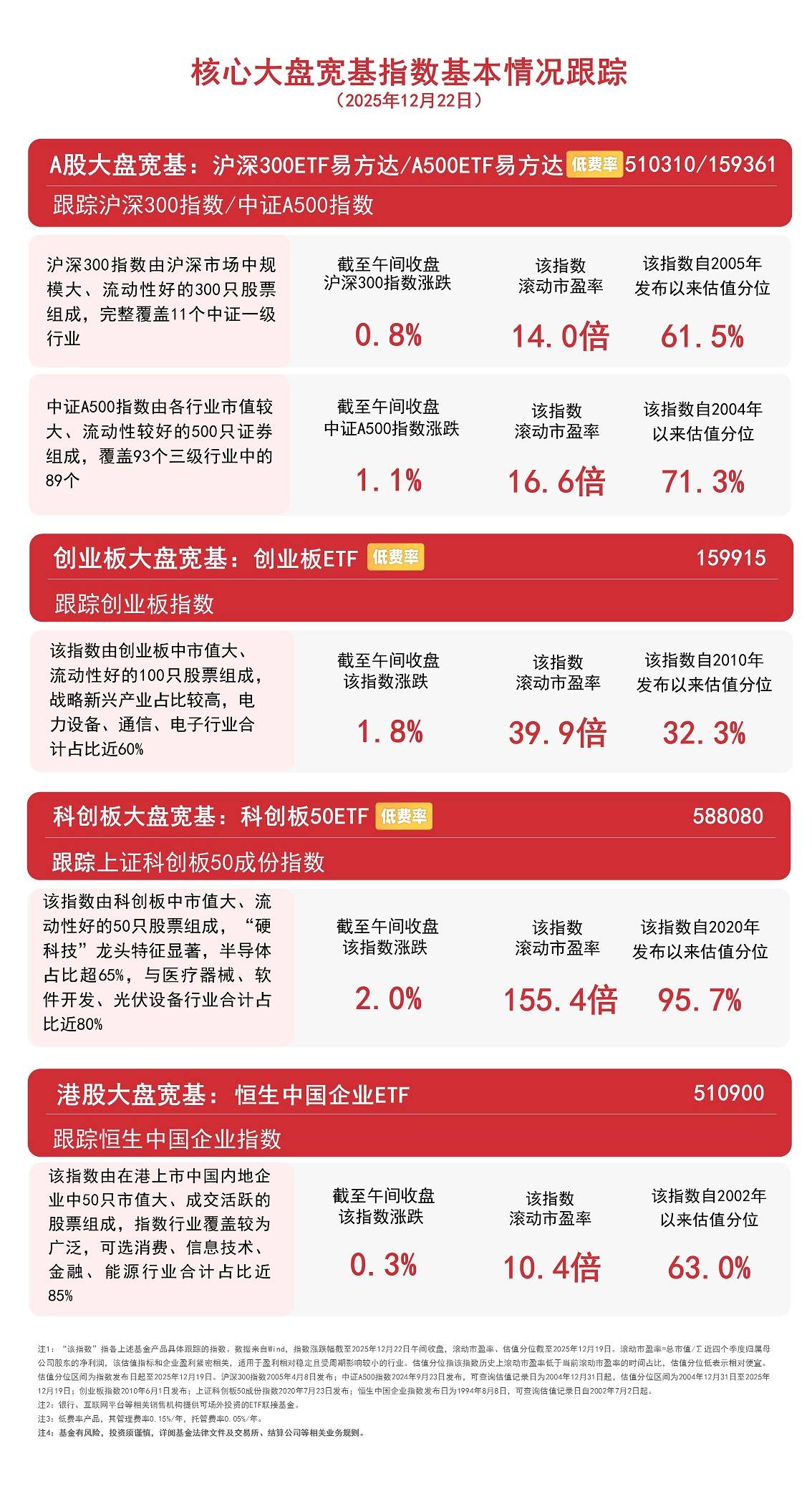
Market Overview - The A-share market opened high and continued to rise, with all three major indices increasing collectively. The total market turnover reached nearly 1.9 trillion yuan, an increase of over 130 billion yuan compared to the previous trading day. More than 2,900 stocks rose, with over 100 stocks hitting the daily limit up [1] - The Hainan Free Trade Zone, precious metals, and computing hardware sectors saw the largest gains, while the pharmaceutical retail, film and television, education, and banking sectors experienced declines [1] - By the close, the CSI A500 index rose by 1.2%, the CSI 300 index increased by 1%, the ChiNext index climbed by 2.2%, the STAR Market 50 index went up by 2%, and the Hang Seng China Enterprises Index gained 0.4% [1] Index Composition - The ChiNext index consists of 100 stocks with large market capitalization and good liquidity, with a high proportion of strategic emerging industries. The power equipment, communication, and electronics sectors account for nearly 60% of the index [4] - The STAR Market 50 index is composed of 50 stocks from the STAR Market with large market capitalization and good liquidity, prominently featuring "hard technology" leaders. The semiconductor sector accounts for over 65%, while the combined share of medical devices, software development, and photovoltaic equipment industries is around 80% [4]

A500ETF易方达(159361)成交再次放量,单日净申购超15亿份
Sou Hu Cai Jing· 2025-12-22 11:36
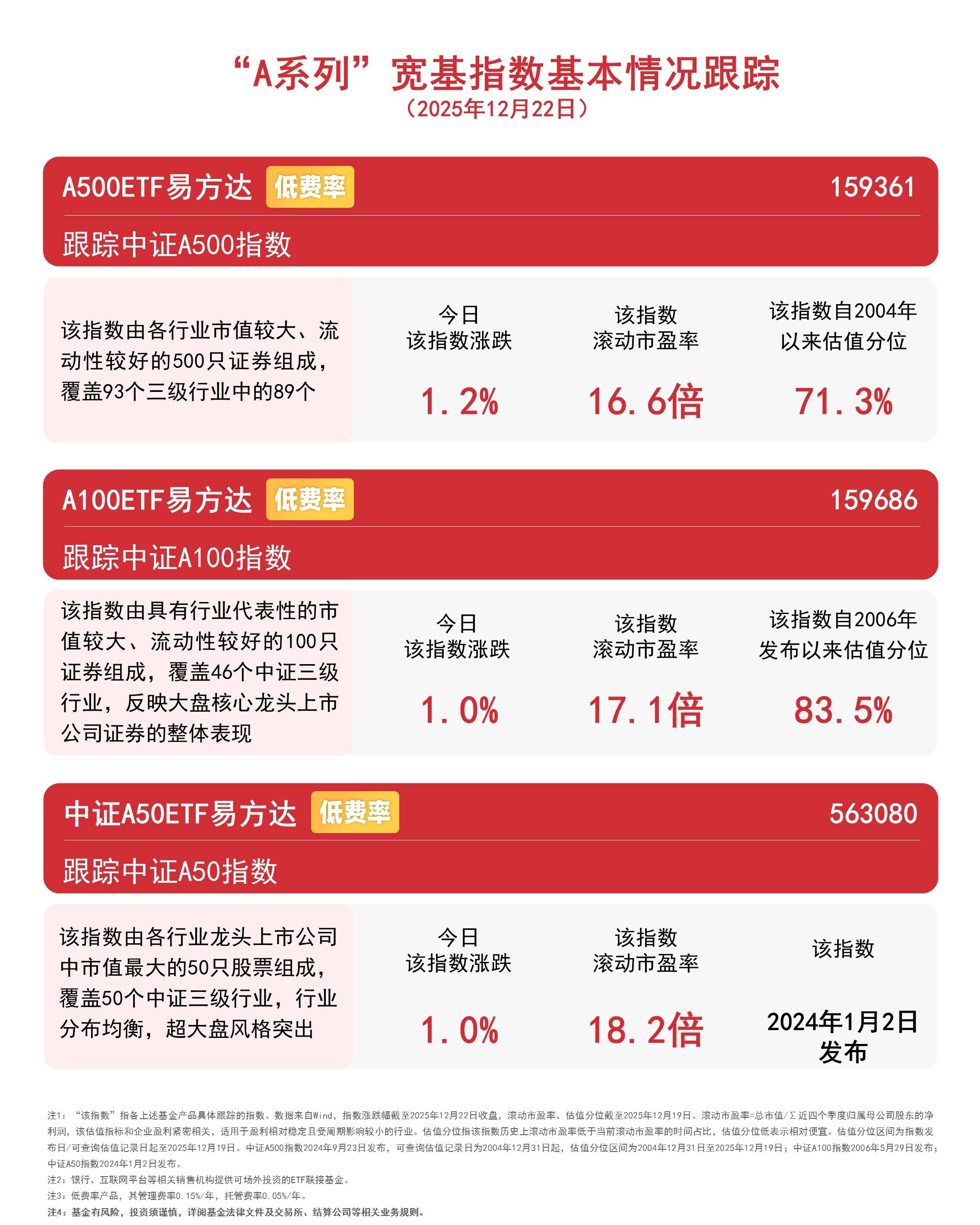
Group 1 - The core viewpoint of the article highlights the positive performance of the Chinese stock market, with the CSI A500 index rising by 1.2%, and both the CSI A100 and A50 indices increasing by 1% [1] - The A500 ETF from E Fund (159361) saw a trading volume exceeding 7.5 billion yuan, indicating high market attention and significant net subscriptions of over 1.5 billion units [1] - Huaxi Securities notes that the recent interest rate changes by the Federal Reserve and the Bank of Japan have alleviated concerns about arbitrage trading reversals, suggesting a favorable environment for foreign capital inflow and increased insurance fund investments [1] Group 2 - The recent large-scale net subscriptions in stock ETFs and the significant trading volume in multiple broad-based ETFs indicate a trend of incremental capital favoring opportunistic buying at lower prices [1]
ETF 日报 2025.12.22-20251222
Da Lian Shang Pin Jiao Yi Suo· 2025-12-22 09:33
Market Overview - On December 22, 2025, the Shanghai Composite Index rose 0.69% to close at 3917.36 points, the Shenzhen Component Index rose 1.47% to close at 13332.73 points, and the ChiNext Index rose 2.23% to close at 3191.98 points. The trading volume of A-shares in the two markets was 1882.4 billion yuan. The top-performing sectors were communication (4.28%), comprehensive (2.63%), and electronics (2.62%), while the bottom-performing sectors were media (-0.61%), banking (-0.52%), and beauty care (-0.45%) [2][6] Stock ETF - The top-traded stock ETFs on this day were Huatai-PineBridge CSI A500 ETF, which rose 1.22% with a discount rate of 1.28%; ChinaAMC CSI A500 ETF, which rose 1.03% with a discount rate of 1.20%; and Guotai CSI A500 ETF, which rose 1.03% with a discount rate of 1.16%. The top ten stock ETFs by trading volume are also listed in the report, including information such as price, change rate, tracking index, and discount rate [3][7][8] Bond ETF - The top-traded bond ETFs were Haifutong CSI Short-term Financing Bond ETF, which remained unchanged with a discount rate of -0.01%; China Merchants CSI AAA Science and Technology Innovation Corporate Bond ETF, which rose 0.06% with a discount rate of -0.18%; and Penghua Shanghai Stock Exchange AAA Science and Technology Innovation Bond ETF, which rose 0.03% with a discount rate of -0.18%. The top five bond ETFs by trading volume are also detailed [4][9][10] Gold ETF - Gold AU9999 rose 1.77% and Shanghai Gold rose 1.96%. The top-traded gold ETFs were Huaan Gold ETF, which rose 2.13% with a discount rate of 2.01%; Boshi Gold ETF, which rose 2.01% with a discount rate of 1.92%; and E Fund Gold ETF, which rose 2.01% with a discount rate of 1.91%. The top five gold ETFs by trading volume are presented [12][13] Commodity Futures ETF - Dacheng Nonferrous Metals Futures ETF rose 0.83% with a discount rate of 1.38%; Jianxin Yisheng Zhengzhou Commodity Exchange Energy and Chemical Futures ETF rose 1.65% with a discount rate of 1.81%; and ChinaAMC Feed Soybean Meal Futures ETF fell 0.10% with a discount rate of 3.06%. Information on these commodity futures ETFs is provided [15][16] Cross-border ETF - The previous trading day, the Dow Jones Industrial Average rose 0.38%, the Nasdaq Composite rose 1.31%, the S&P 500 rose 0.88%, and the German DAX rose 0.37%. On this day, the Hang Seng Index rose 0.43% and the Hang Seng China Enterprises Index rose 0.43%. The top-traded cross-border ETFs were E Fund CSI Hong Kong Securities Investment Theme ETF, which fell 0.10% with a discount rate of -0.79%; Huatai-PineBridge CSI KRX China-South Korea Semiconductor ETF, which rose 3.57% with a discount rate of 6.06%; and GF CSI Hong Kong Innovative Drug ETF, which fell 1.18% with a discount rate of -1.53%. The top five cross-border ETFs by trading volume are shown [18][19] Money ETF - The top-traded money ETFs on this day were Yin Hua Day Profit ETF, Hua Bao Add Benefit ETF, and Money ETF. The top three money ETFs by trading volume are listed [20][21]
ETF周报(20251215-20251219)-20251222
Mai Gao Zheng Quan· 2025-12-22 09:00
Market Overview - The performance of major indices during the sample period shows that SGE Gold 9999, CSI 2000, and S&P 500 had returns of 1.24%, 0.30%, and 0.10% respectively, ranking them at the top [1] - In terms of industry performance, retail trade, non-bank financials, and beauty care sectors led with returns of 6.66%, 2.90%, and 2.87% respectively, while electronics, power equipment, and machinery sectors lagged with returns of -3.28%, -3.12%, and -1.56% [1][15] ETF Product Overview Market Performance - Commodity ETFs had the best average performance with a weighted average return of 0.92%, while QDII ETFs had the worst performance with a return of -2.01% [19] - CSI 2000 and CSI 500 ETFs performed well with weighted average returns of 0.63% and 0.06% respectively, while STAR Market related ETFs had poor performance with returns of -2.55% and -2.48% [19] Fund Flow - Broad-based ETFs saw the highest net inflow of 406.15 billion, while money market ETFs experienced the largest net outflow of -19.43 billion [2][25] - From an industry perspective, technology sector ETFs had the highest net inflow of 100.54 billion, while traditional manufacturing sector ETFs had the lowest net inflow of -29.55 billion [27] Trading Volume - Broad-based ETFs experienced the highest increase in average daily trading volume, with a change rate of 20.12%, while QDII ETFs saw a decrease of -7.34% [31][33] - Financial real estate sector ETFs had the highest increase in average daily trading volume change rate at 15.85%, while the biopharmaceutical sector saw a decrease of -7.10% [37]
人形机器人“火力全开”,指数盘中涨超2%获资金共振,机器人ETF易方达(159530)盘中净申购达2400万份
Mei Ri Jing Ji Xin Wen· 2025-12-22 07:00
Group 1 - The humanoid robot sector experienced significant gains, with the National Robot Industry Index rising by 2.1%, and notable stocks such as Zhaowei Electric and Sanfeng Intelligent seeing increases of over 9% and 4% respectively [1] - The introduction of the G1 humanoid robot by Yushu Technology during Wang Leehom's concert in Chengdu marked the world's first robot concert stage, attracting considerable attention and social media buzz, particularly after being shared by Tesla CEO Elon Musk [1] - IDC forecasts that the shipment of commercial humanoid robots in China will reach approximately 5,000 units by 2025, growing to nearly 60,000 units by 2030, with a compound annual growth rate exceeding 95% [1] Group 2 - The National Robot Industry Index has adjusted its components to include five companies from the robot parts supply chain, such as Sanhua Intelligent Control and Lingyi Zhizao, increasing the proportion of humanoid robots and positioning the index to benefit from future industry trends [1] - The E Fund Robot ETF (159530) has surpassed 12 billion yuan in size, ranking first among related index products, and offers good liquidity for investors looking to invest in core humanoid robot industry targets [2]

科创板50指数半日涨近2%,科创板50ETF(588080)近10个交易日“吸金”16.5亿元
Mei Ri Jing Ji Xin Wen· 2025-12-22 06:41
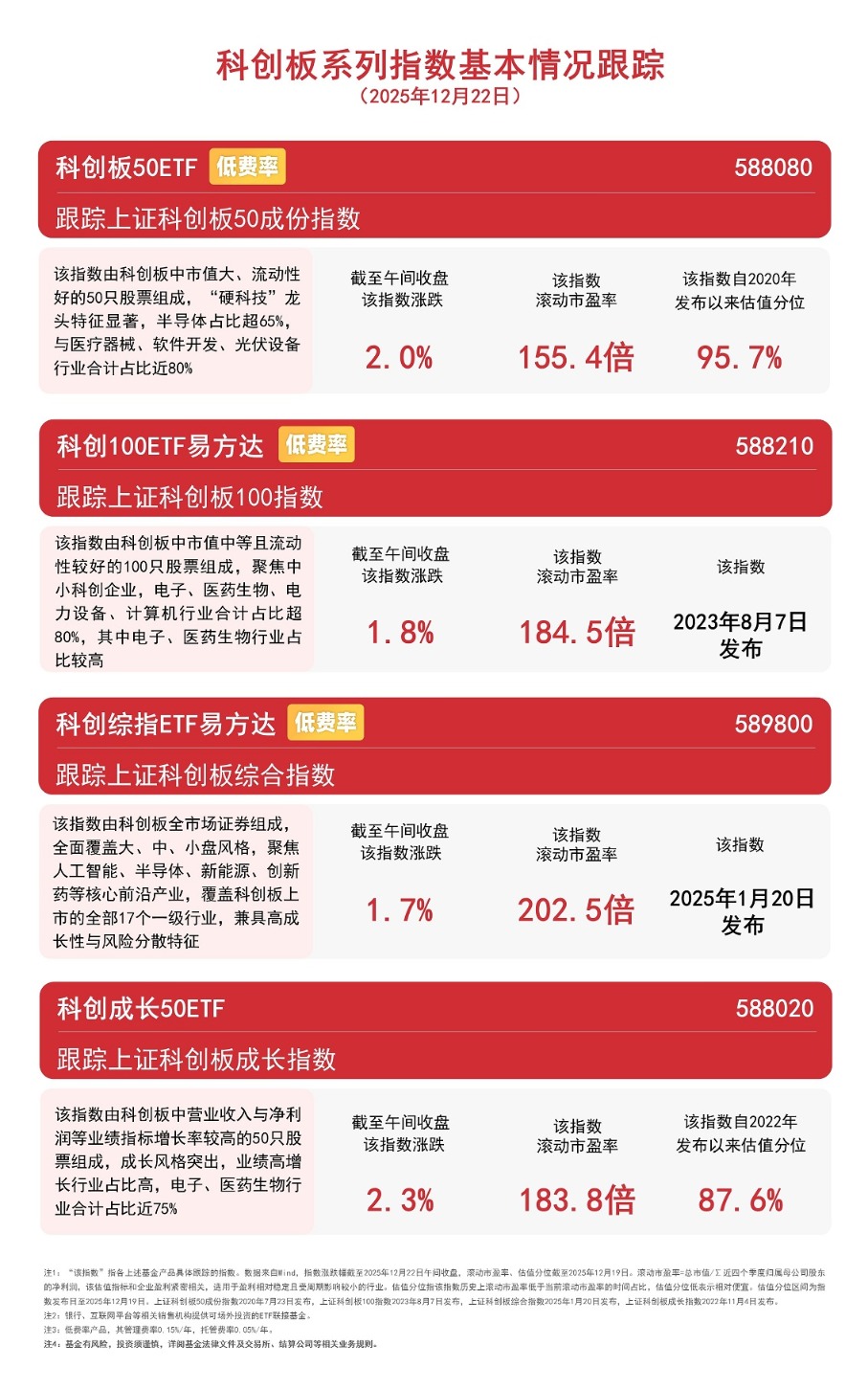
Core Viewpoint - The article discusses various ETFs tracking the STAR Market indices, highlighting their focus on high-growth sectors such as technology and healthcare, and their respective performance metrics since inception. Group 1: STAR Market ETFs - The STAR Market 50 ETF tracks the STAR Market 50 Index, composed of 50 large-cap and liquid stocks, with over 65% in semiconductors and nearly 80% in sectors like medical devices and software development [2] - The STAR Market 100 ETF tracks the STAR Market 100 Index, focusing on 100 mid-cap stocks, with over 80% in electronics, pharmaceuticals, and electrical equipment, and a notable 1.8% increase in its performance [2] - The STAR Market Comprehensive Index ETF covers all securities in the STAR Market, focusing on core industries such as AI, semiconductors, and new energy, with a performance increase of 1.7% [2] Group 2: Performance Metrics - The rolling price-to-earnings (P/E) ratio for the STAR Market 50 ETF is 155.4 times, with a valuation percentile of 95.7% since its launch in 2020 [2] - The rolling P/E ratio for the STAR Market 100 ETF is 184.5 times, reflecting a high valuation since its inception on August 7, 2023 [2] - The rolling P/E ratio for the STAR Market Comprehensive Index ETF is 202.5 times, indicating a strong valuation since its launch on January 20, 2025 [2] Group 3: Growth Focus - The STAR Growth 50 ETF tracks the STAR Growth Index, consisting of 50 stocks with high growth rates in revenue and net profit, with a significant focus on electronics and pharmaceuticals, which account for 23% of the index [2]
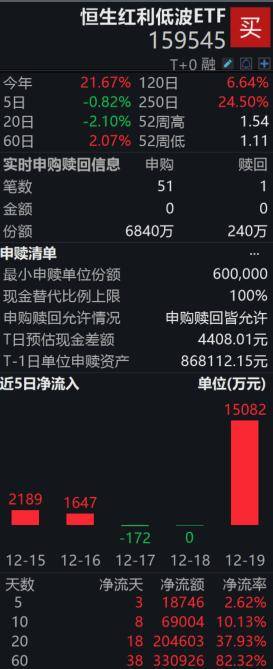
资金加码港股红利资产,恒生红利低波ETF(159545)盘中净申购6600万份,近20日“吸金”超20亿
Sou Hu Cai Jing· 2025-12-22 06:04
Core Viewpoint - The Hang Seng High Dividend Low Volatility Index (HSHYLV.HI) has shown a slight decline of 0.23%, with notable movements in key stocks, indicating a mixed performance in the market [1] Group 1: Market Performance - Key stocks such as Shougang Resources, Yancoal Australia, and Yanzhou Coal Mining experienced declines of 0.7%, 0.4%, and 0.6% respectively, while companies like VTech and Hang Seng Bank saw slight increases of 0.7% and 0.1% [1] - The index's performance reflects a broader trend in the market, with certain sectors like shipping and healthcare showing positive movements, including China Merchants Port up by 1.4% and COSCO Shipping Ports up by 2.6% [1] Group 2: Fund Inflows - The Hang Seng High Dividend Low Volatility ETF (159545) has attracted significant capital, with net inflows exceeding 690 million in the last 10 days and over 2 billion in the last 20 days [1] - Over the past 60 days, the fund has seen net inflows of more than 3.3 billion, indicating strong investor interest in dividend-focused assets [1] Group 3: Fund Structure and Strategy - The fund is designed to evaluate its excess return against the benchmark index quarterly, with a distribution mechanism that enhances cash yield stability for investors [3] - The EasyOne Dividend Index series, which includes the Hang Seng High Dividend Low Volatility ETF, aims to provide monthly dividends, catering to investors' cash flow needs [4]
沪指涨0.64%再次站上3900点,关注A500ETF易方达(159361)、沪深300ETF易方达(510310)投资价值
Sou Hu Cai Jing· 2025-12-22 05:06
Group 1 - The A-share market showed strong performance with all three major indices rising, with the Shanghai Composite Index increasing by 0.64% to surpass 3900 points, and nearly 3500 stocks in the market gaining [1] - The active sectors included Hainan, storage chips, and precious metals, while the pharmaceutical and film sectors experienced adjustments [1] - The Hong Kong stock market exhibited mixed performance, with semiconductor stocks leading gains, while automotive, robotics, and software sectors also saw significant increases, and the pharmaceutical and high-dividend sectors weakened [1] Group 2 - The CSI A500 index rose by 1.1%, the CSI 300 index increased by 0.8%, the ChiNext index climbed by 1.8%, and the STAR Market 50 index surged by 2.0% by midday [1] - The Hang Seng China Enterprises Index saw a modest increase of 0.3% [1] Group 3 - The STAR Market 50 ETF tracks the STAR Market 50 Index, which consists of 50 stocks with large market capitalization and good liquidity, predominantly in the semiconductor sector, accounting for over 65% [4] - The rolling price-to-earnings ratio of the STAR Market 50 Index is 155.4 times, with a valuation percentile of 95.7% since its inception in 2020 [4] Group 4 - The Hang Seng China Enterprises ETF tracks the Hang Seng China Enterprises Index, which includes 50 large-cap and actively traded stocks listed in Hong Kong, covering a wide range of industries [5] - The index's sector distribution includes consumer discretionary, information technology, finance, and energy, which together account for nearly 85% [5] - The rolling price-to-earnings ratio of the Hang Seng China Enterprises Index is 10.4 times, with a valuation percentile of 63.0% since its inception in 2002 [5]
从资本占用到长期持有:调整风险因子或为红利低波打开显著增量空间?
Sou Hu Cai Jing· 2025-12-22 03:27
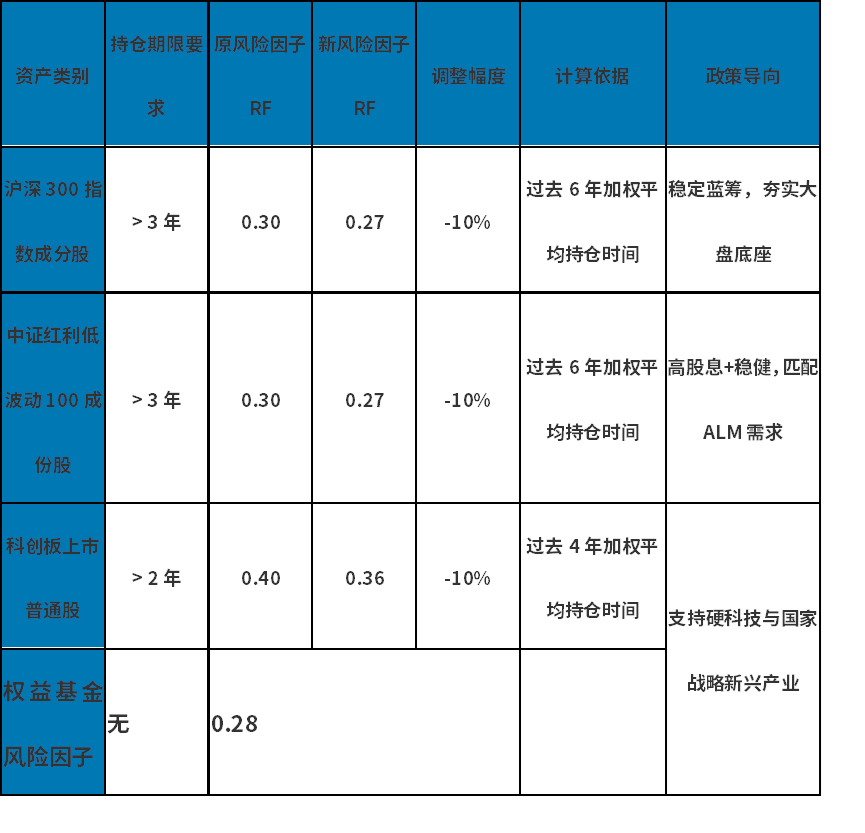
Core Viewpoint - The recent regulatory change to lower the risk factor for insurance companies investing in the stock market is expected to increase the available capital for investments, particularly benefiting dividend-paying and low-volatility assets [1][4]. Group 1: Understanding the Risk Factor Adjustment - The risk factor is a key constraint for insurance companies, determining the minimum capital they must hold against their investments. A lower risk factor means less capital is required for the same investment, thus improving capital efficiency [2][3]. - The new regulation reduces the risk factor from 0.30 to 0.27, a 10% decrease, which directly lowers the capital cost for equity investments [4]. Group 2: Implications for Dividend and Low-Volatility Assets - The inclusion of the CSI Dividend Low Volatility 100 index in the favorable risk factor category indicates a clear policy direction to encourage investment in stable, high-dividend assets [5]. - Insurance companies, facing challenges in traditional fixed-income returns, are likely to seek out high-quality assets with stable cash flows, making dividend-paying stocks more attractive [5]. Group 3: Comparison with Previous Adjustments - The current macroeconomic environment is more favorable compared to the previous risk factor adjustment in 2023, which occurred during a period of aggressive interest rate hikes by the Federal Reserve. This time, the anticipated easing of rates and clearer policy direction may enhance the effectiveness of the new regulation [6]. Group 4: Summary of Potential Market Impact - The adjustment in the risk factor is expected to release significant incremental capital, directing investments towards high-quality, long-term assets like dividend-paying stocks. Monitoring insurance capital allocation may provide valuable insights for investors in a volatile market [8].
黄金白银基金2025年领涨商品市场,2026年还能买买买吗?
Mei Ri Jing Ji Xin Wen· 2025-12-22 03:25
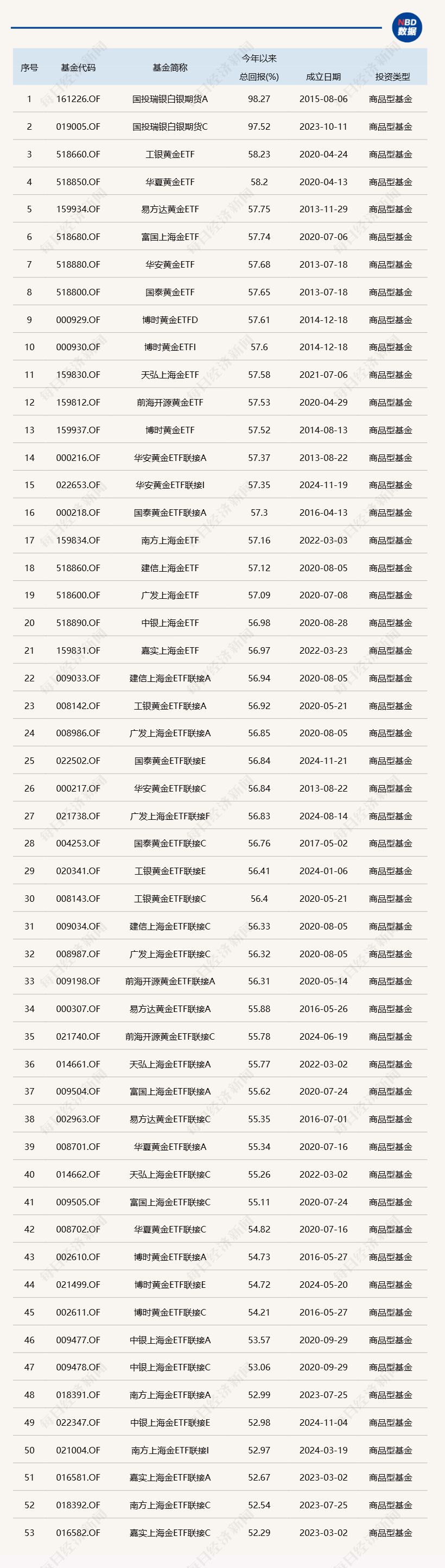
Core Viewpoint - The global financial market in 2025 experienced increased volatility due to geopolitical tensions and monetary policy adjustments, leading to a mixed performance in the commodity market, with gold and silver-related funds emerging as standout performers, some achieving nearly double returns [1][8]. Group 1: Commodity Fund Performance - As of December 19, 2025, commodity funds displayed a stark contrast, with most products yielding positive returns, particularly in the gold and silver sectors, where over 50 funds achieved annual returns exceeding 50% [1][8]. - Silver-related funds showed exceptional performance, with the Guotou Ruijin Silver Futures A and C shares returning 98.27% and 97.52% respectively, making them the "dark horse" products of the year [1][9]. Group 2: Market Trends and Predictions - Looking ahead to 2026, market analysts maintain a positive outlook on gold, while also considering investment opportunities in silver, copper, and other industrial metals [5][14]. - The Ant Group's research team emphasizes a cautious yet optimistic stance on gold, suggesting that while the market may react sensitively to negative factors, underlying demand will support buying [5][14]. - Citic Prudential's fund manager believes that gold remains a more attractive investment compared to silver and industrial metals due to its strong financial attributes and independence from economic cycles [5][14]. Group 3: Investment Strategies - Analysts recommend a diversified investment approach, advising against heavy concentration in a single commodity sector, with a suggested allocation of commodity funds not exceeding 10% of an overall portfolio [7][15]. - The Ant Group's team advocates for a "core and satellite" strategy, where core holdings focus on stable assets like gold and industrial metals, while satellite holdings can capture short-term opportunities in energy metals and oil [16][17].