大全能源

Search documents
2025年光伏上市公司业绩持续承压
中国能源报· 2026-01-26 13:28
Core Viewpoint - The photovoltaic industry is currently experiencing a cyclical downturn, with companies facing significant operational pressures, but there are signs of improvement such as narrowing losses and recovering gross margins [3][4][12]. Group 1: Industry Performance - As of the latest disclosures, the photovoltaic sector remains at the bottom of the cycle, with most companies reporting losses, including major players like TCL Zhonghuan, Trina Solar, and LONGi Green Energy, with expected losses ranging from tens to hundreds of billions [3][5]. - The China Photovoltaic Industry Association reported a 16.9% year-on-year decline in revenue for the main industry chain in the first three quarters of 2025, while gross margin improved to 3.64%, reaching 5.61% in Q3 [3][4]. Group 2: Losses and Variability - Despite widespread losses, there is a notable divergence in the extent of losses among companies. For instance, LONGi Green Energy's expected loss of 60 to 65 billion is a significant reduction from the previous year's loss of 85.92 billion [6]. - Some companies, like Daqo New Energy, are also showing signs of resilience with losses narrowing by 52.17% to 63.21% year-on-year [6]. Group 3: Market Dynamics - The industry is facing a severe imbalance between supply and demand, exacerbated by concentrated capacity release, leading to aggressive price competition and declining product prices [8]. - Key raw material costs, such as silicon and silver paste, have risen sharply in the second half of 2025, but this cost increase has not been effectively passed down to downstream products, further squeezing profit margins [8]. Group 4: Strategic Responses - Companies are adopting various strategies to navigate the downturn, focusing on technological innovation, global expansion, and business collaboration [10]. - R&D and innovation are seen as critical for overcoming challenges, with companies like LONGi Green Energy and Trina Solar investing in advanced technologies and exploring new market applications [10]. - The integration of energy storage solutions alongside photovoltaic manufacturing is emerging as a new competitive focus, with companies like JinkoSolar and Trina Solar emphasizing the growth of their storage businesses [10]. Group 5: Future Outlook - Industry leaders believe that the current downturn does not signify a decline but rather a necessary adjustment towards high-quality development in anticipation of future demand surges [12].

“太空光伏”引爆涨停潮
Di Yi Cai Jing Zi Xun· 2026-01-25 12:13
2026.01.25 本文字数:2377,阅读时长大约4分钟 资本市场炒作太空光伏概念一片欢腾,与光伏企业2025年业绩预告大面积且深度亏损的情形形成鲜明对 比。根据统计,在已发布预告的32家光伏上市公司中,23家预计出现亏损(包括续亏、首亏),占比逾 七成。 光伏主产业链(硅料、组件、电池、硅片)的亏损明显加剧,主要由于各环节低迷的终端需求、产能阶 段性过剩、产品价格上行受阻等多重因素。 在净利润预亏金额同比扩大的名单中,一体化龙头通威股份预计2025年净利润亏损区间达90亿元至100 亿元,上年同期亏损70.39亿元,它也是目前唯一一家预亏金额上限达到百亿规模的光伏企业。 亏损规模激增的光伏制造商还有天合光能、钧达股份,预亏上限均较上年同期扩大100%及以上。天合 光能预计亏损65亿元至75亿元,上年同期亏损34.43亿元,该公司表示组件价格承压,叠加硅料、银浆 等关键原材料涨价,使得组件业务盈利能力下滑,同时计提资产减值准备也对业绩有一定影响。 同为组件环节的晶科能源预计业绩首亏,亏损约59亿元至69亿元。对于业绩亏损的原因,晶科能源也提 到了2025年光伏组件价格整体处于低位,以及计提资产减值准备对业 ...
“太空光伏”引爆涨停潮
第一财经· 2026-01-25 12:07
Core Viewpoint - The photovoltaic (PV) sector in A-shares has seen a significant surge, with multiple stocks experiencing a 20% increase, driven by Elon Musk's endorsement of space photovoltaics at the Davos Forum. However, the industry faces a harsh reality of prolonged losses, overcapacity, and persistent price pressures, with major companies expected to report substantial losses in 2025 [3][4][5]. Group 1: Industry Performance and Financial Outlook - A total of 32 listed PV companies have issued profit warnings, with 23 companies, over 70%, expected to incur losses in 2025 [5]. - Major players like Tongwei Co. are projected to face losses between 9 billion to 10 billion yuan, a significant increase from the previous year's loss of 7.04 billion yuan, marking it as the only company with a projected loss exceeding 10 billion yuan [5][6]. - Trina Solar and JinkoSolar are also expected to report substantial losses, with Trina Solar's losses estimated at 6.5 billion to 7.5 billion yuan, up from 3.44 billion yuan the previous year [5][6]. Group 2: Market Dynamics and Challenges - The PV industry is grappling with a dual weakness in supply and demand, leading to significant price declines across the supply chain, including silicon materials, cells, and modules [8][9]. - The rapid expansion of manufacturing capacity in recent years has coincided with a slowdown in global demand, resulting in severe supply-demand imbalances [9]. - The cost of key raw materials, particularly silver, has surged, further straining the profitability of PV companies. Silver prices have increased by over 118% since October of the previous year, significantly impacting production costs [9][10]. Group 3: Future Industry Prospects - The path to recovery for the PV industry hinges on supply-side reforms, including capacity utilization improvements and the elimination of outdated production capabilities [10]. - The industry must address the current overcapacity and restore a healthy balance between supply and demand to improve product pricing and overall profitability [10].




连年巨亏 光伏业如何逃出“血海”
经济观察报· 2026-01-25 10:54
Core Viewpoint - The photovoltaic industry is undergoing a brutal survival elimination race and a deep restructuring of the industrial pattern, with the next phase expected to be redefined after this intense reshuffle [2][4]. Group 1: Industry Performance and Losses - In 2025, major companies in the photovoltaic sector are expected to report significant losses, with JinkoSolar forecasting a net loss of 5.9 billion to 6.9 billion yuan, Trina Solar predicting a loss of 6.5 billion to 7.5 billion yuan, and Tongwei expecting a loss of 9 billion to 10 billion yuan [2][6]. - The total expected losses from leading companies amount to hundreds of billions, indicating that the photovoltaic industry is still mired in a loss-making situation [2][5]. - The industry has shifted from a phase of rapid expansion to a deep adjustment period, with companies generally operating at a loss to maintain operations, severely squeezing overall profitability [7][12]. Group 2: Causes of the Crisis - The root cause of the current industry crisis is attributed to aggressive expansion in the past, leading to severe structural oversupply and intense price competition [3][6]. - The prices of key materials such as silicon have plummeted from 300,000 yuan per ton in 2022 to around 55,000 yuan per ton, while silver prices have nearly doubled in recent months, further exacerbating the challenges faced by companies [4][10]. Group 3: Strategic Responses and Industry Restructuring - In response to the crisis, leading companies are turning to mergers and acquisitions to strengthen competitiveness or are extending into related fields such as energy storage and hydrogen energy to seek strategic breakthroughs [4][12]. - TCL Zhonghuan announced plans to invest in a new energy technology company to enhance its integrated strategy and expand battery and module production capacity [12]. - The industry is experiencing a "淘汰赛" (elimination race), with smaller companies likely to exit the market or seek mergers as the competitive landscape narrows [13][14]. Group 4: Future Outlook and Recovery Potential - Companies like Tongwei have seen some operational profitability in the latter half of 2025, but overall losses are expected to continue due to declining sales prices and rising raw material costs [9][10]. - The recovery of profitability is contingent on the overall price recovery across the supply chain and the expansion of photovoltaic application scenarios, which could provide significant growth opportunities [9][10]. - The photovoltaic industry is witnessing a recent increase in component prices, with some manufacturers raising prices by 0.04 to 0.15 yuan per watt, indicating a potential shift in market dynamics [18][19].

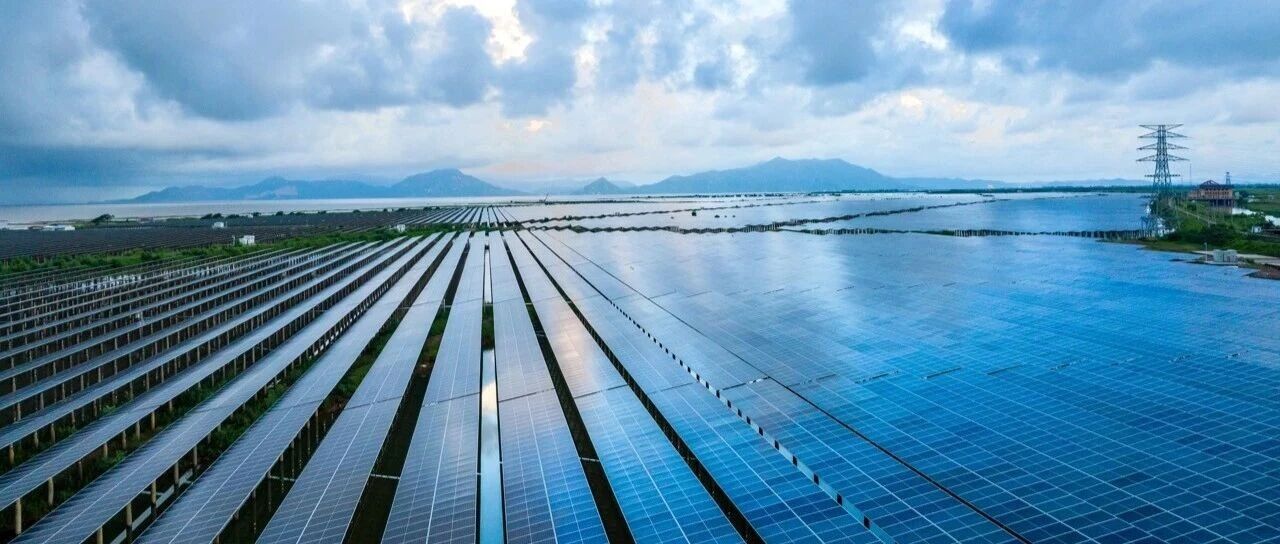
“太空光伏”引爆涨停潮,概念炒作难掩行业供需双弱
Di Yi Cai Jing· 2026-01-25 09:44
Core Viewpoint - The A-share photovoltaic sector has experienced a significant surge, with multiple stocks hitting a 20% limit-up, driven by Elon Musk's endorsement of space photovoltaics at the Davos Forum. However, the industry faces a harsh reality of prolonged losses, overcapacity, and persistent price pressure, with major companies expected to report substantial losses in 2025 [1][2]. Group 1: Industry Performance - The photovoltaic industry has seen widespread losses, with 23 out of 32 listed companies expected to report losses in 2025, accounting for over 70% of the sample [2]. - Major players like Tongwei Co. anticipate a net loss of 90 to 100 billion yuan in 2025, up from a loss of 70.39 billion yuan the previous year, marking it as the only company with a projected loss exceeding 100 billion yuan [2]. - Trina Solar and JinkoSolar are also expected to report significant losses, with Trina Solar projecting a loss of 65 to 75 billion yuan, and JinkoSolar estimating a loss of 59 to 69 billion yuan [2][3]. Group 2: Market Dynamics - The photovoltaic supply chain is experiencing intensified losses due to weak terminal demand, overcapacity, and stagnant product prices, which are the main contributors to the industry's financial struggles [2][3]. - Despite some companies like Daqo Energy and Longi Green Energy reducing their losses, the overall trend remains negative, with Daqo Energy expecting a loss of 14.18 to 17.18 billion yuan, a reduction of 52.17% to 63.21% year-on-year [3]. - The industry is facing a dual challenge of weak supply and demand, with overcapacity leading to low prices, which is the primary cause of losses [4][5]. Group 3: Cost Pressures - The rapid increase in raw material prices, particularly silver, has significantly impacted production costs, with silver prices rising over 118% since October of the previous year [6][7]. - The cost of silver paste, a critical material in photovoltaic technology, has surged, further straining the profitability of companies in the sector [6][7]. - Companies are exploring cost-reduction strategies, including substituting silver with copper and aluminum, but the impact of these innovations on profitability remains limited [7]. Group 4: Future Outlook - The industry is expected to undergo structural reforms characterized by capacity utilization improvements, elimination of outdated capacity, and potential mergers and acquisitions, which are essential for recovery [7]. - A return to a healthy supply-demand balance and a restoration of product prices to reasonable levels are crucial for the fundamental improvement of companies' profitability [7].

商业航天引爆太空光伏需求!科创50ETF(588000)午后翻红,光伏股集体大涨,晶科能源涨停,天合光能涨超14%!
Mei Ri Jing Ji Xin Wen· 2026-01-23 06:50
Group 1 - The A-share market experienced fluctuations on January 23, with the Sci-Tech 50 ETF (588000) rebounding in the afternoon, showing a gain of 0.43% and a trading volume exceeding 3.5 billion yuan, indicating a significant increase in trading activity [1] - Solar energy stocks surged, with JinkoSolar hitting the daily limit, Trina Solar rising by 14.92%, GuoBo Electronics increasing by 13.83%, and Canadian Solar up by 10.51%. Other companies like ZhongKong Technology and Daqo New Energy also saw gains exceeding 7% [1] - Trina Solar announced a price increase for its distributed photovoltaic standard components by 0.03 yuan/W, with the new price range set at 0.88-0.92 yuan/W. This marks the third price adjustment since 2026, with an overall increase of 0.06 yuan/W in less than a month [1] Group 2 - The outlook for the solar industry is optimistic, with brokerage reports indicating that the application for 200,000 satellites in China is accelerating the entire commercial space industry chain, leading to a surge in demand for space-based photovoltaics [1] - The planned constellation of thousands of satellites is expected to exponentially increase the demand for photovoltaic cells, while the complexity of satellite equipment is driving up the energy supply requirements per satellite [1] - Technological advancements are pushing the photovoltaic cell industry towards low-cost HJT and perovskite tandem routes, driven by commercialization [1] Group 3 - The Sci-Tech 50 ETF (588000) tracks the Sci-Tech 50 Index, with over 70% of its holdings in the electronics sector, aligning well with the current development trends in artificial intelligence and robotics [2] - The ETF also covers multiple sub-sectors, including medical devices, software development, and photovoltaic equipment, indicating a high content of hard technology [2] - Investors optimistic about the long-term development prospects of China's hard technology are encouraged to continue monitoring this ETF [2]


科创新能源ETF(588830)涨超8.2%,固态电池在太空领域具备发展潜力
Xin Lang Cai Jing· 2026-01-23 06:28
Group 1: Solid-State Battery Development in Space - Solid-state batteries have significant potential in the space sector, with global agencies accelerating their development and validation, aiming for practical application by 2028 [1] - NASA initiated its solid-state battery project, SABERS, in 2021, utilizing a sulfide-based all-solid-state system with an energy density of 500-550 Wh/kg and a discharge rate of 10C, capable of operating in temperatures ranging from -80℃ to +80℃ [1] - The solid-state battery sent to the ISS in 2022 completed over 500 cycles with only a 5% capacity degradation, exceeding expectations [1] - The natural adaptability of solid-state batteries to extreme conditions in space, such as vacuum, temperature variations, and high radiation, makes them a safer and more efficient option compared to liquid batteries [1] - The potential market for solid-state batteries in space applications is substantial, with estimates suggesting a market size exceeding 500 billion for 1 million satellites, alongside applications in computing power storage, deep space exploration, and lunar bases [1] Group 2: Performance of New Energy Indices and ETFs - As of January 23, 2026, the Shanghai Stock Exchange Sci-Tech Innovation Board New Energy Index (000692) surged by 7.66%, with significant gains from constituent stocks such as Laplace (+20.01%), JinkoSolar (+20.00%), and Aotwei (+20.00%) [2] - The New Energy ETF (588830) closely tracks the performance of the New Energy Index and reported an increase of 8.27%, marking its third consecutive rise [2] - The top ten weighted stocks in the New Energy Index as of December 31, 2025, include JinkoSolar, Atlass, and Trina Solar, collectively accounting for 46.84% of the index [2] - The primary sectors represented in the index are photovoltaic equipment (45.83%), batteries (42.46%), and wind power equipment (5.73%) [2]
科创新能源ETF(588830)昨日收涨1.61%,光伏反内卷持续推进
Xin Lang Cai Jing· 2026-01-23 01:36
Group 1 - The core viewpoint of the news is that the Chinese government is pushing for a shift in the photovoltaic industry from "price competition" to "innovation-driven" competition to combat "involution" [1][2] - The National Energy Administration highlighted that the root cause of "involution" in the photovoltaic industry is the shift from competing on technology and innovation to competing on price and scale [1] - A recent procurement by Huadian for 8GW of high-efficiency modules showed that 75% of the components met the high-efficiency standard (conversion efficiency ≥ 23.8%), indicating that only leading companies can meet these requirements [1] Group 2 - Changjiang Electric Power New Energy noted that the recent statements from the State Administration for Market Regulation and Huadian's large-scale procurement of high-efficiency components suggest that self-discipline in the photovoltaic industry will continue to advance [2] - The basic expectations for traditional photovoltaic have weakened previously, but recent developments have restored these expectations, solidifying the bottom of both the fundamental and financial aspects [2] - The trend in the photovoltaic market will need to be monitored closely, especially around mid-year, as demand expectations shift [2] Group 3 - The Science and Innovation New Energy ETF closely tracks the Shanghai Stock Exchange Science and Technology Innovation Board New Energy Index, which includes 50 large-cap stocks in the photovoltaic, wind power, and new energy vehicle sectors [3] - As of December 31, 2025, the top ten weighted stocks in the index include JinkoSolar, First Solar, Trina Solar, and others, accounting for 46.84% of the total index weight [3] Group 4 - The Science and Innovation New Energy ETF (588830), the ChiNext New Energy ETF (159261), and the Photovoltaic ETF (159863) are mentioned as key investment vehicles in the sector [4]
光伏龙头企业“亏损潮”延续,专家:2026年三四月份有望迎来拐点
Hua Xia Shi Bao· 2026-01-22 09:35
Core Viewpoint - The photovoltaic industry is experiencing significant losses across all major segments, with a call for recovery and improvement in profitability by 2026, focusing on asset management and pricing power [2][11]. Group 1: Industry Performance - The photovoltaic sector is in a "dark moment," with all major segments, including silicon materials, wafers, cells, and modules, reporting losses [2]. - The overall performance of the industry is characterized by high inventory and weak demand, despite some signs of recovery in silicon material prices [3]. - The integrated companies face significant pressure, with a notable decline in profitability due to rising costs of key materials like silver paste [3][6]. Group 2: Company-Specific Insights - Daqo New Energy forecasts a net loss of 1 to 1.3 billion yuan for 2025, but with a reduced loss margin of 52.17% to 63.21% year-on-year due to improved operational efficiency [3]. - Longi Green Energy expects a net loss of 6 to 6.5 billion yuan, a reduction of over 2 billion yuan compared to the previous year, driven by increased production efficiency [5]. - Junda Co. anticipates a net loss of 1.5 to 1.2 billion yuan, significantly higher than the previous year's loss of 590 million yuan, citing supply-demand imbalance and price transmission issues [4]. Group 3: Component and Equipment Sector - Companies focusing on Bifacial (BC) modules, such as Aiko Solar, are seeing a significant reduction in losses, with expected losses narrowing from 5.319 billion yuan to between 1.9 billion and 1.2 billion yuan [5]. - The equipment sector, represented by Aotai Technology, is also facing declines, with expected revenue dropping by 26.71% to 30.50% year-on-year [8]. - Silver paste manufacturer Dike Co. is projected to shift from profit to loss, with expected losses of 200 to 300 million yuan due to rising silver prices [9]. Group 4: Future Outlook - The industry is still in a phase of "deleveraging and capacity reduction," but there are signs of recovery in upstream segments, with discussions about potential profitability improvements in 2026 [11][12]. - Aiko Solar reports that its ABC module sales volume is expected to double, indicating a positive trend despite overall losses [12]. - Analysts predict that the industry may see a shift from supply-demand pricing to cost-based pricing by early 2026, potentially improving profit margins significantly [12].




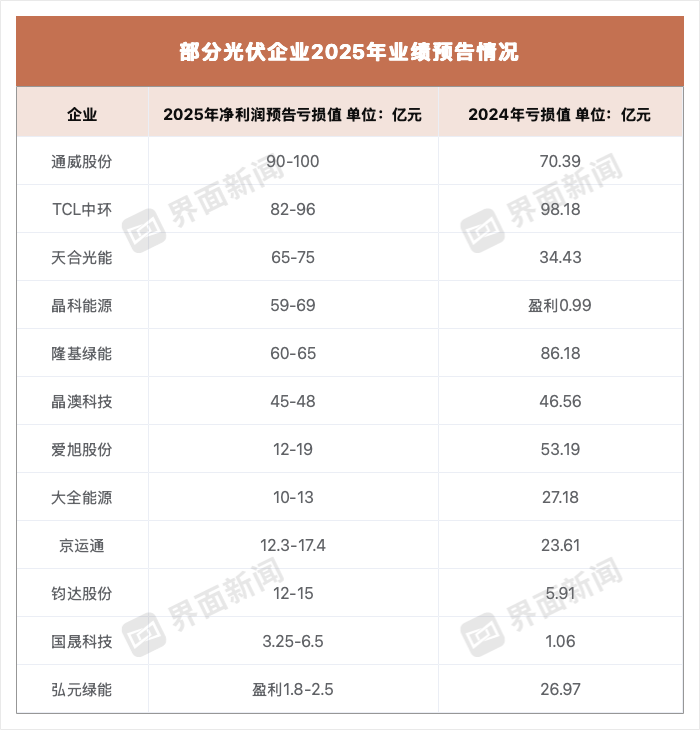
行业寒冬叠加银价暴击,12家光伏龙头集体“失血”超500亿
Xin Lang Cai Jing· 2026-01-22 08:03
Core Viewpoint - The photovoltaic industry continues to face significant challenges, with major companies reporting substantial losses, totaling over 500 billion yuan, except for Hongyuan Green Energy, which is the only profitable entity among the analyzed firms [1][2]. Group 1: Financial Performance - Among 12 major photovoltaic companies, only Hongyuan Green Energy reported a profit, while the others collectively faced losses exceeding 500 billion yuan [1]. - Tongwei Co. is projected to incur the largest loss in 2025, estimated between 90-100 billion yuan, followed by TCL Zhonghuan and Trina Solar, with losses of 82-96 billion yuan and 65-75 billion yuan, respectively [2]. - JinkoSolar is expected to report a loss of 59-69 billion yuan for the previous year, while it anticipates a slight profit in 2024 [6][8]. Group 2: Cost Pressures - The rising prices of silver and silicon materials have significantly increased production costs for photovoltaic companies, with silver paste becoming a major cost component, accounting for approximately 17% of module costs [3][5]. - Silver prices have surged over 230% since the beginning of 2025, contributing to the financial strain on companies like Longi Green Energy and Trina Solar [5]. Group 3: Company Strategies and Developments - Longi Green Energy and TCL Zhonghuan have shown the most significant reduction in losses among leading firms, with Longi reducing its losses by nearly 20 billion yuan due to improved production yields and the development of alternative materials [10]. - Hongyuan Green Energy has successfully turned a profit, projecting a net profit of 1.8-2.5 billion yuan for 2025, attributed to its vertically integrated supply chain strategy [14][15]. - JinkoSolar and Trina Solar have both highlighted advancements in their energy storage businesses, indicating a potential area for growth despite current losses [8].