强生

Search documents
京产汽车每3辆就有1辆来自顺义
Bei Jing Ri Bao Ke Hu Duan· 2025-10-10 22:34
Core Insights - Shunyi District has become a significant hub for high-end manufacturing, particularly in the fields of new energy vehicles, aerospace, third-generation semiconductors, intelligent equipment, and healthcare, achieving an average industrial output growth of 8.2% annually since the 14th Five-Year Plan [1][2] High-End Manufacturing Development - The new energy vehicle sector in Shunyi has attracted major companies such as Li Auto, Beijing Hyundai, and Mercedes-Benz, with a total production of 1.65 million vehicles and an output value of 336 billion yuan, growing at an average rate of 13% [2] - In aerospace, Shunyi hosts over 20 key enterprises and has seen an average industrial output growth of 15%, particularly in aircraft maintenance, contributing 14 billion yuan to the national output [2] - The pharmaceutical trade sector has seen significant growth, with major companies like Sinopharm and Merck, and a trade scale exceeding 100 billion yuan, accounting for nearly one-third of the national total [3] Open Development Platforms - Shunyi has over 950 foreign-funded enterprises and is developing three major open development platforms, including the Capital Airport Economic Zone, which generated over 350 billion yuan in revenue last year, marking a 53% increase since 2020 [4] - The Tianzhu Comprehensive Bonded Zone ranks highly among national bonded zones, while the Sino-German Industrial Park has attracted over 120 German enterprises [4] Social Investment and Employment - The district allocates over 85% of its fiscal spending to social welfare, with significant investments in education and healthcare, including the addition of 11,000 preschool and 20,000 primary school seats [6] - Shunyi has created 170,000 new jobs over the past five years and has been recognized as a "fully employed district" for 13 consecutive years [6]
维立志博康小强:不卷PD-1,领跑肿瘤免疫治疗2.0 | 进击的创新药企
经济观察报· 2025-10-10 12:25
Core Viewpoint - The article discusses the innovative strategies and advancements of Weilizhibo, a Chinese biopharmaceutical company focused on cancer immunotherapy, particularly in developing next-generation therapies that address limitations of existing PD-(L)1 treatments [4][5][6]. Group 1: Company Overview - Weilizhibo has 14 candidate innovative drugs, with 4 in the top three of global clinical progress, aiming to become first-in-class drugs [6][7]. - The company was founded by Kang Xiaoqiang and Lai Shoupeng in 2012, focusing on cancer immunotherapy after extensive research in the U.S. [8][9]. Group 2: Market Context - The global market for innovative drugs is rapidly evolving, with significant investment interest, particularly in the field of cancer immunotherapy [4]. - The PD-(L)1 inhibitors have shown a response rate of only about 20%, indicating a substantial unmet need in cancer treatment [6][10]. Group 3: Strategic Focus - Weilizhibo aims to address cancers that do not respond to PD-(L)1 therapies, focusing on alternative immune checkpoint inhibitors like LAG-3 and 4-1BB [10][11]. - The company has developed three core technology platforms: IO2.0, TCE, and ADC, which are expected to define the future of oncology [11][12]. Group 4: Clinical Progress - The PD-L1/4-1BB dual antibody (LBL-024) is currently in Phase III clinical trials and has shown promising results, with an objective response rate of 75% in a recent study [12][19]. - Weilizhibo's GPRC5D/CD3 dual antibody has completed Phase II trials and received orphan drug designation from the FDA, indicating its potential in treating multiple myeloma [19][20]. Group 5: Financial Strategy - Weilizhibo has successfully completed multiple funding rounds, raising a total of 1.084 billion yuan, with a significant increase in valuation from 40 million yuan in 2015 to 3.1 billion yuan in 2024 [15][16]. - The company strategically increased its IPO fundraising target to 189 million USD due to favorable market conditions, resulting in a successful listing on the Hong Kong Stock Exchange [16][17]. Group 6: Future Outlook - The company plans to expand its indications from rare cancers to larger cancer types, with a goal of submitting a biological license application by Q3 2026 [20][21]. - Weilizhibo intends to adopt a light-asset strategy for commercialization, collaborating with CDMOs for production while considering establishing its own facilities in the future [21][22].


维立志博康小强:不卷PD-1,领跑肿瘤免疫治疗2.0 | 进击的创新药企
Jing Ji Guan Cha Wang· 2025-10-10 08:58
Core Insights - The article discusses the rise of innovative drug companies in China, particularly in the field of cancer immunotherapy, as they shift from following trends to pioneering original research and development [2] Company Overview - Leads Biolabs, a Chinese company focused on tumor immunotherapy, is currently in clinical stages and aims to address diseases that existing PD-(L)1 therapies cannot treat [3][5] - The company has 14 candidate innovative drugs, with 4 in the top three of global clinical progress, potentially becoming first-in-class drugs [5] Market Context - The PD-(L)1 target has become highly competitive, with 20 approved monoclonal antibodies in China, yet the response rate for PD-(L)1 monotherapy is only about 20%, leaving a significant portion of patients without effective treatment [4][10] - The global sales of the PD-1 drug "K" reached approximately $32.056 billion in 2024, highlighting the lucrative nature of immunotherapy [3] Strategic Focus - The company has chosen to focus on LAG-3 and other targets instead of PD-(L)1, aiming to develop unique therapies that can address the limitations of existing treatments [10][11] - The company has established three core technology platforms: IO2.0 (4-1BB), TCE (CD3), and ADC (antibody-drug conjugates), which are expected to define the future of oncology [10][16] Clinical Development - The PD-L1/4-1BB dual antibody (code LBL-024) is currently in Phase III clinical trials in China, showing promising results with a 75% objective response rate and a 92.3% disease control rate in a recent study [11][12] - The company plans to submit a biological product license application to the Chinese regulatory authority in Q3 2026, with conditional approval expected by Q2 2027 [17] Financing and IPO - Leads Biolabs has completed 8 rounds of financing, raising a total of 1.084 billion yuan, with a significant increase in valuation from 40 million yuan in 2015 to 3.1 billion yuan in 2024 [13][14] - The company went public in July 2025, initially aiming to raise $100 million but increasing the target to $189 million due to market conditions, achieving a record subscription rate on its first trading day [15] Future Outlook - The company aims to expand its indications from rare cancers to larger cancer types, with plans to target 8 indications this year and 10 next year [17] - The commercialization strategy involves a light asset approach, collaborating with CDMOs for production while considering establishing its own manufacturing base in the future [18]

道指标普续收新高,科技板块走弱纳指回落,中概股多数收低
Feng Huang Wang· 2025-10-03 23:21
Market Performance - On October 3rd, U.S. stock indices showed mixed results, with the Dow Jones and S&P 500 reaching new highs, closing at 46,758.28 (+0.51%) and 6,715.79 (+0.01%) respectively, while the Nasdaq Composite fell to 22,780.51 (-0.28%) [1][2] - Among the 30 Dow components, 22 stocks rose, with notable gains from UnitedHealth, Travelers, Caterpillar, Johnson & Johnson, Goldman Sachs, and Visa, all increasing by over 1% [2] - The Russell 2000 index also hit a record high, rising 0.72% on the day and 1.72% for the week [2] Economic Indicators - The U.S. Senate rejected a bipartisan temporary funding bill, leading to a government shutdown, which halted nearly all economic activities and delayed the release of the September non-farm payroll report [4] - Market expectations for a 25 basis point rate cut by the Federal Reserve in October are nearly 95%, as indicated by the CME FedWatch Tool [4] Company News - Berkshire Hathaway has amended its corporate bylaws to separate the roles of Chairman and CEO [10] - Tesla has commenced sales of its Cybertruck in Qatar, following earlier operations in Saudi Arabia [11] - A Chevron refinery in El Segundo, California, experienced a sudden explosion, affecting over 16% of the state's refining capacity and supplying a significant portion of fuel to Southern California [12] Sector Performance - The coal sector saw significant gains, with Peabody Energy rising by 9.18%, while cryptocurrency mining companies also performed well, with Bitdeer Technologies up 10.28% [7] - Solid-state and lithium battery-related stocks mostly rose, with Plug Power increasing by 34.63% and American Lithium by 31.78% [8] Chinese Stocks - The Nasdaq Golden Dragon China Index fell by 1.15%, but gained 2.58% over the week, with most popular Chinese stocks declining, including a 4.16% drop for Global Data and a 3.99% drop for Li Auto [9]




重磅非农就业缺席,三大美股指仍齐创新高,ISM数据打压科技股,原油全周重挫
Sou Hu Cai Jing· 2025-10-03 16:03
Group 1 - The U.S. stock market indices reached new highs, with the S&P 500 set to achieve its longest winning streak since late July, driven by strong performances in the tech sector and AI investments [1][9] - Hitachi announced a memorandum of understanding with OpenAI to collaborate on AI infrastructure, resulting in a 10.3% increase in Hitachi's stock price [1] - Nvidia's stock initially rose nearly 0.8% but later experienced a slight decline following the release of the ISM services index, which fell to 50, marking a new low since 2020 [1][9] Group 2 - Pharmaceutical stocks rebounded, with Johnson & Johnson's rating upgraded to "outperform" by Wells Fargo, leading to a rise of over 2% in its stock price [2] - The healthcare and utilities sectors saw gains of at least 1%, contributing to the overall rise in the S&P 500 [2] - The California governor's office reported a fire at Chevron's El Segundo refinery, impacting oil prices, which rose over 1% but are expected to see significant weekly declines [2] Group 3 - The Stoxx Europe 600 index rose by 0.4%, reaching a historical high, driven by optimism regarding the Federal Reserve's interest rate cuts and strong inflows into the AI sector [5][8] - European steel stocks outperformed the market following an upgrade in ratings due to news of the EU's plan to increase steel import tariffs to 50% [6] Group 4 - Copper prices surged to a yearly high of $10,577 per ton, driven by supply concerns following a significant accident at Freeport-McMoRan's Grasberg copper mine in Indonesia [12]
全球AI创新赋能标杆!联想(00992)入选《快公司》“创新者最佳工作场所”百强榜
智通财经网· 2025-10-03 11:41
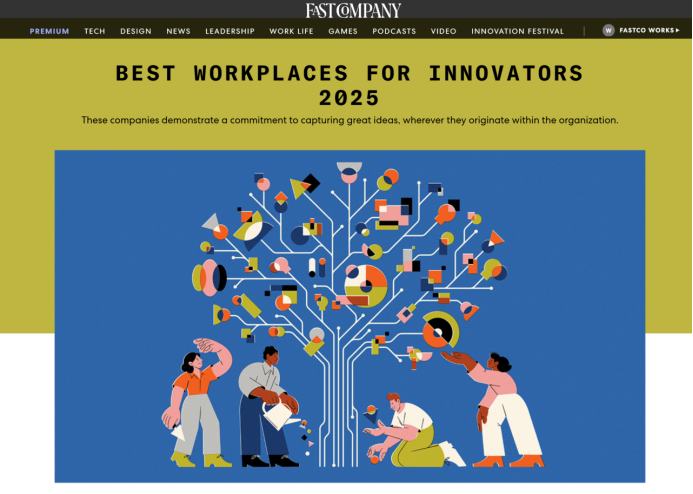
Core Insights - Lenovo Group has been recognized in the "Best Workplaces for Innovators" list by Fast Company for the second consecutive year, highlighting its advancements in AI technology and employee empowerment [1][3] - Lenovo has been selected as a benchmark enterprise for AI innovation, joining the ranks of renowned companies like Adobe, IBM, and Johnson & Johnson [1] Group 1: Recognition and Awards - The "Best Workplaces for Innovators" list includes 100 exemplary organizations from nearly 1,000 participating companies across various sectors such as entertainment, biotech, and healthcare [3] - The evaluation process involved comprehensive assessments by Fast Company editors and a professional review panel to ensure the authority and fairness of the selection [3] Group 2: Innovation and R&D - Lenovo's continuous investment in R&D is a key factor in its recognition, with 18 global R&D centers and 4 AI innovation centers established to support technological breakthroughs [3][4] - The company has increased its R&D expenditure by 13% year-on-year, with 25% of its employees engaged in R&D or innovation-related work [4] Group 3: Product Development and Culture - Lenovo launched the world's first rollable screen AI PC, ThinkBook Plus Gen 6, showcasing its innovative culture that encourages cross-department collaboration and bold experimentation [4] - The company emphasizes an inclusive workplace culture and actively engages in public welfare projects, aligning with its vision of "Smarter Technology for All" [4][5] Group 4: Leadership and Vision - Lenovo's leadership believes that innovation is embedded in the company's culture, empowering teams to break boundaries and focus on customer-centric breakthroughs [5] - Fast Company’s editor-in-chief noted that the companies on the list demonstrate that innovation is a deliberate choice achieved by empowering every employee [5]

巴菲特会「卖飞」比亚迪么?
36氪· 2025-09-30 09:40
Core Viewpoint - Buffett's decision to sell BYD shares serves as a valuation warning but does not signify the end of BYD's long-term growth potential [3][37]. Group 1: Buffett's Selling Behavior - Buffett's exit from BYD after 17 years raises questions about his ability to "escape the peak" in investment [4]. - An analysis of 24 stocks sold by Berkshire Hathaway since 2006 shows that 13 of them experienced varying degrees of decline within a year after Buffett's exit [6]. - The most significant declines were seen in PetroChina, ConocoPhillips, and Wells Fargo, with drops of -70%, -30%, and -25% respectively [6][7]. Group 2: Long-term Performance of Sold Stocks - Over a longer period of five years, the number of stocks that continued to decline after Buffett's exit reduced to around six [8]. - For instance, Fannie Mae's stock fell over 100% before its bankruptcy, while UPS saw a decline of over 40% [8][9]. Group 3: BYD's Market Position and Challenges - BYD was a pioneer in the domestic electric vehicle market, benefiting from a significant first-mover advantage during the early stages of the industry [39]. - However, by 2022, the electric vehicle market shifted from growth to intense competition, leading to challenges for BYD, including sales pressure and profit margin compression due to price wars [44]. - The company's valuation had significantly deviated from historical averages, prompting Buffett's decision to sell [45]. Group 4: Future Outlook for BYD - Despite the short-term volatility following Buffett's exit, BYD's stock recorded a 28% gain since Buffett's initial sale in August 2022 [48]. - The company maintains a strong market position with a mature vehicle platform and self-research capabilities in core components, suggesting a favorable long-term outlook [51]. - Buffett's exit is viewed as a tactical adjustment rather than a complete rejection of BYD's future potential, indicating that the risks associated with the stock may have been largely mitigated [53].
华润双鹤药业股份有限公司关于全资子公司华润双鹤利民药业(济南)有限公司波生坦分散片获得药品注册证书的公告
Shang Hai Zheng Quan Bao· 2025-09-29 23:07
Core Viewpoint - The company announced that its wholly-owned subsidiary, Huaren Shuanghe Limin Pharmaceutical (Jinan) Co., Ltd., has received a drug registration certificate for Bosentan dispersible tablets from the National Medical Products Administration (NMPA) [1][2]. Group 1: Drug Registration and Development - The drug Bosentan dispersible tablets are indicated for pulmonary arterial hypertension (PAH) in pediatric patients aged 3 years and older, as well as for adult patients classified as WHO functional class II to IV [1][2]. - The development of this generic drug began in 2022, with the application for marketing authorization submitted on June 14, 2024, and approval granted on September 23, 2025 [2]. Group 2: Market Situation - Bosentan dispersible tablets were developed by Actelion Pharmaceuticals Ltd and were approved for sale in the EU in 2009 under the brand name "Tracleer." The drug was imported into China in September 2019 under the brand name "Quankeli" [3]. - In 2024, the global sales of Bosentan dispersible tablets reached approximately $35.9 million, with "Tracleer" accounting for about $31.3 million of that total [3]. - In the Chinese market, the total sales of Bosentan dispersible tablets were approximately 2.126 million yuan in 2024, with Johnson & Johnson holding a 100% market share [3]. Group 3: Impact on the Company - The acquisition of the drug registration certificate is expected to enhance the company's product line and market competitiveness, while also providing valuable experience for future product development [4].

特朗普宣布将对专利及品牌药品加征100%关税,对国内药企影响几何?
财联社· 2025-09-26 07:06
Core Viewpoint - The article discusses the announcement by President Trump regarding a new round of high tariffs on various imported products, particularly focusing on the pharmaceutical industry, which will see a 100% tariff on patented and branded drugs starting October 1, 2023, significantly higher than the previous 15% agreement with Europe [1][2]. Group 1: Tariff Details and Market Reaction - The new tariffs include a 50% tariff on kitchen cabinets and bathroom sinks, a 30% tariff on imported furniture, and a 100% tariff on patented and branded drugs, with exemptions for companies that have manufacturing facilities "under construction" in the U.S. [1][2] - Following the announcement, the innovation drug index and various biotech ETFs saw declines of over 1%, with specific companies like Huahai Pharmaceutical and Baiyue Shenzhou experiencing stock price drops [2][3]. Group 2: Company Responses and Strategies - Many domestic pharmaceutical companies are assessing the impact of the new tariffs, with some indicating that their production capabilities in the U.S. may mitigate the effects. For instance, Huahai Pharmaceutical is evaluating whether its facilities meet the criteria for exemption [4][5]. - Major U.S. pharmaceutical companies like Johnson & Johnson and Eli Lilly have already invested significantly in expanding their domestic production capabilities, with Johnson & Johnson planning to invest approximately $20 billion in North Carolina and Eli Lilly announcing a $270 billion investment for new factories [3][4]. Group 3: Expert Opinions and Future Outlook - Industry experts suggest that the 100% tariff is politically motivated and may not significantly impact domestic innovative drug companies, as many already have manufacturing in the U.S. and the majority of their sales are through partnerships with multinational corporations [6][7]. - The anticipated implementation of a global drug pricing model by the U.S. government could further influence drug pricing and market dynamics, but experts believe that the overall impact on the domestic pharmaceutical industry will be limited [6][7].




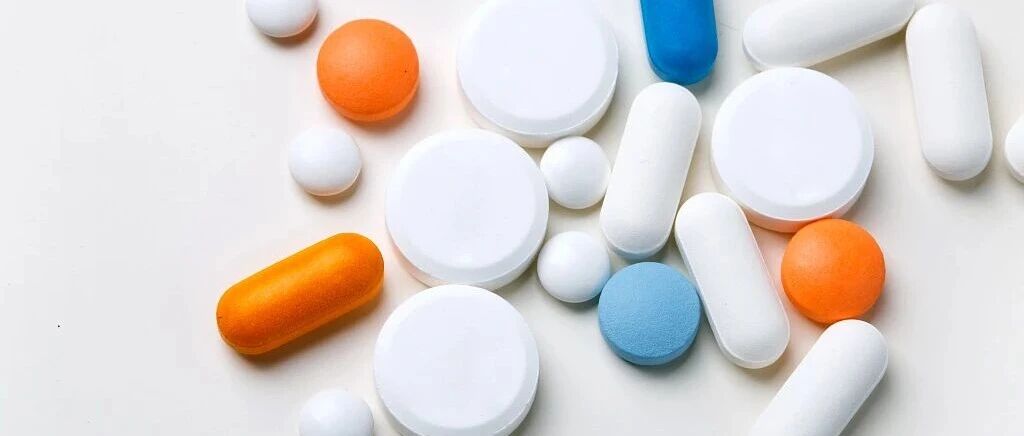
突发“黑天鹅”!刚刚,医药板块集体大跌!
天天基金网· 2025-09-26 05:13
Group 1 - The article discusses the new tariffs announced by President Trump on various imported products, including a 25% tariff on heavy trucks, 50% on kitchen cabinets, 30% on furniture, and 100% on patented and branded drugs starting from October 1, 2025, unless companies build manufacturing plants in the U.S. [3][8][10] - The pharmaceutical sector in the Asia-Pacific market experienced a decline following the announcement, with the A-share pharmaceutical and biotechnology sector also showing a downward trend [4][6][10] - Specific indices related to weight-loss drugs, innovative drugs, and CROs saw significant declines, with the weight-loss drug index dropping by 1.56% and the innovative drug index by 1.48% [5][6] Group 2 - Individual stocks such as Sunflower and Aosaikang saw substantial declines, with Sunflower dropping over 12% and Aosaikang down by 9% [6][7] - The Hong Kong biotechnology index opened nearly 2% lower and continued to decline, with companies like MicroPort Medical and WuXi Biologics showing notable drops [7][10] - The article highlights that the high tariffs could increase costs and disrupt the drug supply chain, potentially putting patients at risk [9][10] Group 3 - The article mentions that major pharmaceutical companies like Johnson & Johnson and GlaxoSmithKline have announced plans to increase investments in the U.S. in response to the tariffs, with Johnson & Johnson planning to invest $55 billion [10] - The long-term implications of Trump's tariff policy could lead to higher drug costs for patients, as the high production costs in the U.S. may offset any benefits from the tariffs [10]