
森马服饰

Search documents
“2025校服领军品牌”等榜单发布
Sou Hu Wang· 2025-12-22 06:24
Core Viewpoint - The "2025 (5th) Clothing Tender Procurement Evaluation Promotion Activity" aims to standardize the clothing tender procurement order and promote industry development, coinciding with the 25th anniversary of the implementation of the "People's Republic of China Tendering and Bidding Law" [1] Group 1: Evaluation and Rankings - The evaluation utilized a comprehensive assessment method, considering factors such as registered capital, years of operation, operational premises, human resources, total bid amounts and project counts over the past three years, honors, technological innovation, management system certification, and information technology [3] - The "2025 Leading Brands in School Uniforms" list includes companies such as Haier Home Group Co., Ltd., Zhejiang Semir Garment Co., Ltd., and Jiangsu Tiger Leopard Group Co., Ltd. [3] - The "2025 Top Ten School Uniform Brands" list features Haier Home Group Co., Ltd., Zhejiang Semir Garment Co., Ltd., and Jiangsu Paixun Garment Co., Ltd. [3] Group 2: Customized Services for Suppliers - Eight personalized service menus were introduced for clothing tender suppliers, including certification services, inclusion in procurement directories, news interview services, 3D (VR) exhibition services, and promotional services on WeChat [4][5] - The services aim to enhance the visibility and credibility of suppliers, providing them with opportunities for training and networking within the public procurement sector [5] Group 3: Background of the Organizing Body - China Procurement and Bidding Network was established in 2000 to support the implementation of the "People's Republic of China Tendering and Bidding Law" and to regulate the public procurement market [6] - The platform has significant influence in the domestic bidding and public procurement fields, with over 40 million data entries published annually and more than 180,000 registered members [6]



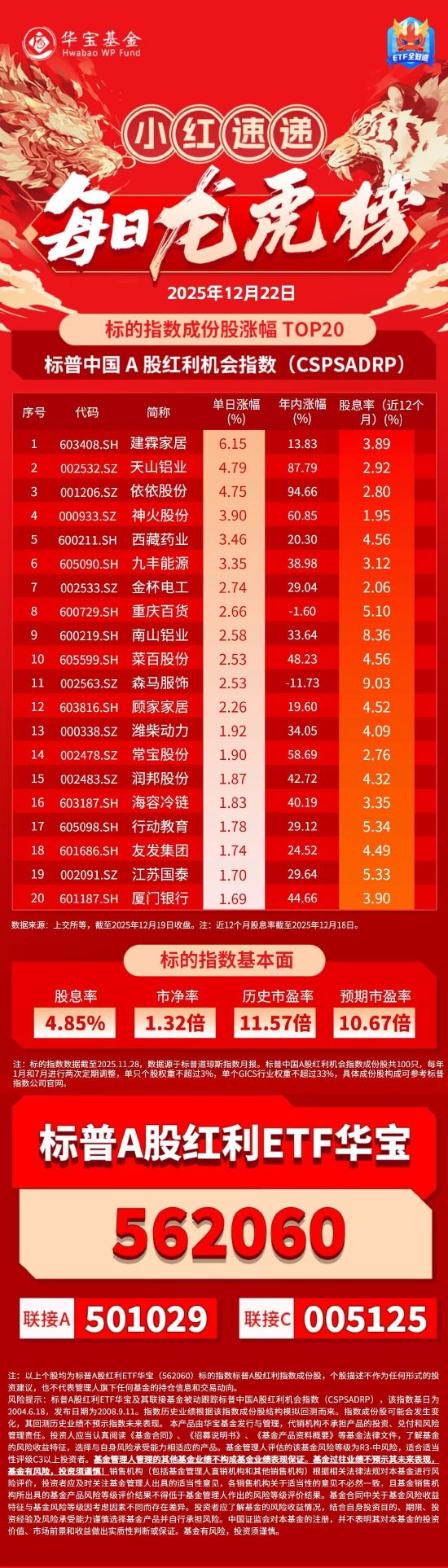
小红日报 | 建霖家居涨超6%,小盘红利相对占优!标普A股红利ETF华宝(562060)标的指数收涨0.63%三连阳
Xin Lang Cai Jing· 2025-12-22 01:58
Core Viewpoint - The article provides insights into the performance of the constituents of the S&P China A-Share Dividend Opportunity Index, highlighting the top-performing stocks based on daily and year-to-date gains, as well as their dividend yields. Group 1: Stock Performance - The top stock by daily gain is Jianlin Home (建霖家居) with a daily increase of 6.15% and a year-to-date increase of 13.83% with a dividend yield of 3.89% [6] - Tianshan Aluminum (天山铝业) shows a significant year-to-date increase of 87.79% with a daily gain of 4.79% and a dividend yield of 2.92% [6] - Yiyi Co. (依依股份) has a year-to-date increase of 94.66% with a daily gain of 4.75% and a dividend yield of 2.80% [6] Group 2: Dividend Yields - The article lists several companies with notable dividend yields, including Nanshan Aluminum (南山铝业) at 8.36% and Semir Apparel (森马服饰) at 9.03% [6] - Other companies with competitive dividend yields include Jiangsu Guotai (江苏国泰) at 5.33% and Xiamen Bank (厦门银行) at 3.90% [6] - The overall dividend yield for the index is reported at 4.85% [2]


被退货逼疯的女装店家,选择了超长预售期
经济观察报· 2025-12-20 03:15
Core Viewpoint - The clothing industry is facing a decline, prompting merchants to control production through pre-sales as a strategy to "exchange time for survival space" [1][7]. Group 1: Pre-sale Dynamics - Pre-sale is defined as the sale of products before they officially enter the market, a practice that has evolved since its introduction by platforms like Taobao in 2012 [5]. - In 2024, major platforms like Taobao and JD.com announced the cancellation of pre-sales during the "618" shopping festival, but reintroduced them during "Double 11," indicating a fluctuating reliance on this sales model [5]. - Merchants like "DuoDuo" utilize pre-sales to manage inventory effectively, often only producing a fraction of the total orders based on expected return rates [6][11]. Group 2: Consumer Experience and Challenges - Consumers have expressed frustration with pre-sales, citing issues such as indefinite shipping times, order cancellations, and quality concerns [4][18]. - A survey indicated that 78% of respondents believe pre-sale periods are lengthening, with 80% stating that extended pre-sales diminish their shopping experience [18]. - The average return rate for some merchants has escalated, with "A Jie" reporting an increase from 50% to 80% in return rates, largely attributed to consumer behavior changes [15]. Group 3: Production and Supply Chain Implications - The overall scale of the clothing industry is shrinking, with significant declines in revenue and profit reported by major companies [7]. - Manufacturers face challenges with production timelines, as frequent changes in orders and styles lead to increased costs and inefficiencies [20][22]. - The shift towards smaller order quantities has resulted in higher production costs, complicating the supply chain for manufacturers [22]. Group 4: Regulatory and Market Trends - New regulations from platforms aim to shorten pre-sale periods to improve consumer experience, yet complexities in the industry mean that not all products can be treated the same [24]. - Some merchants are exploiting category misclassifications to extend pre-sale periods, indicating a potential loophole in the regulatory framework [25]. - Experts suggest that while pre-sales can lead to inefficiencies, they also represent a shift towards demand-driven production, which could be beneficial if managed properly [25].

预售围城
Jing Ji Guan Cha Bao· 2025-12-20 01:35
Core Viewpoint - The article discusses the growing trend of pre-sale in the fashion industry, highlighting consumer frustrations and the operational challenges faced by merchants due to extended pre-sale periods and high return rates [1][6][23]. Group 1: Consumer Experience - Consumers are increasingly frustrated with pre-sale items that take too long to ship, leading to cancellations and dissatisfaction with product quality [1][2][3]. - A survey of approximately 30 consumers revealed various issues with pre-sale purchases, including unpredictable shipping times and receiving incorrect or low-quality items [3][4]. - A significant percentage of consumers (78%) believe that pre-sale periods are lengthening, and 80% feel that extended pre-sale negatively impacts their shopping experience [16][21]. Group 2: Merchant Strategies - Merchants like "DuoDuo" utilize pre-sale as a strategy to manage inventory and cash flow, often only producing a fraction of the orders to mitigate risks associated with high return rates [4][12][16]. - The average return rate for some merchants has increased significantly, with one brand reporting a rise from 50% to 80% in returns, indicating a shift in consumer behavior towards trying multiple items before returning [13][14]. - Larger brands have different pre-sale strategies, often using it as a means to gauge demand before committing to production, while smaller merchants rely on pre-sale to manage cash flow and inventory [14][15][22]. Group 3: Industry Trends - The overall scale of the clothing industry is declining, with significant drops in revenue and production reported by major companies [5][6]. - Pre-sale has become a necessary tactic for survival in a challenging market, allowing merchants to "trade time for survival space" amidst declining sales [6][23]. - The article notes that the pre-sale model in the fashion industry resembles early real estate pre-sale practices, suggesting potential for market bubbles and the need for regulatory oversight [23][24]. Group 4: Operational Challenges - Manufacturers face increased complexity and costs due to frequent changes in production lines and the need to adapt to varying order sizes, which complicates the production process [17][20]. - The time required for production has increased, with manufacturers reporting longer wait times for orders due to the need for adjustments in production lines [17][19]. - The handling of returns adds additional operational costs for merchants, as each returned item requires inspection and potential refurbishment before resale [21][22].
森马服饰:提升公司资源的利用效能
Zheng Quan Ri Bao Wang· 2025-12-19 15:41
证券日报网讯12月19日,森马服饰(002563)在互动平台回答投资者提问时表示,公司会结合业务发展 实际需要,进行审慎管理和动态优化,提升公司资源的利用效能。 ...
森马服饰涨2.17%,成交额1.49亿元,主力资金净流入856.15万元
Xin Lang Cai Jing· 2025-12-19 05:45
Core Viewpoint - Semir Apparel's stock price has shown fluctuations, with a recent increase of 2.17% despite a year-to-date decline of 13.19% [1] Group 1: Stock Performance - As of December 19, Semir Apparel's stock price reached 5.66 CNY per share, with a trading volume of 1.49 billion CNY and a market capitalization of 15.249 billion CNY [1] - The stock has experienced a 3.28% increase over the last five trading days, a 2.75% decrease over the last 20 days, and a 3.66% increase over the last 60 days [1] Group 2: Financial Performance - For the period from January to September 2025, Semir Apparel reported a revenue of 9.844 billion CNY, representing a year-on-year growth of 4.74%, while the net profit attributable to shareholders was 537 million CNY, a decrease of 28.90% year-on-year [2] - Cumulative cash dividends since the company's A-share listing amount to 12.585 billion CNY, with 2.694 billion CNY distributed over the last three years [3] Group 3: Shareholder Information - As of September 30, 2025, the number of shareholders increased by 20.28% to 49,900, while the average circulating shares per person decreased by 16.86% to 44,299 shares [2] - The seventh largest circulating shareholder, Hong Kong Central Clearing Limited, held 87.3554 million shares, a decrease of 84.364 million shares compared to the previous period [3] Group 4: Business Overview - Semir Apparel, established on February 5, 2002, and listed on March 11, 2011, specializes in apparel design, outsourcing production, marketing, and distribution, with a product focus on Semir brand casual wear and Balabala brand children's clothing [1] - The company's revenue composition includes 70.15% from children's clothing, 28.02% from casual wear, and 1.83% from other categories [1] - Semir Apparel operates within the textile and apparel industry, specifically in non-sports clothing, and is associated with various concepts such as digital economy and cross-border e-commerce [1]
森马服饰:截至目前公司未收到股东增持计划
Zheng Quan Ri Bao Wang· 2025-12-18 07:11
证券日报网讯12月17日,森马服饰(002563)在互动平台回答投资者提问时表示,截至目前,公司未收 到股东增持计划。 ...
服饰行业周度市场观察-20251217
Ai Rui Zi Xun· 2025-12-17 08:38
Investment Rating - The report does not explicitly provide an investment rating for the industry Core Insights - The luxury goods market in China has passed its "crisis peak," with a projected global growth of 5% by 2026, driven by consumer confidence recovery and high-net-worth individuals [2] - The children's clothing market is experiencing accelerated concentration, with leading brands driving industry upgrades, while traditional brands face challenges [2][5] - The global eyewear market is expected to exceed $330 billion by 2030, with significant growth driven by aging populations and increased awareness of eye health [4] - The domestic lingerie industry shows signs of weak recovery and strong differentiation, with varying performance among major players [5] - The children's clothing market is projected to reach 473.8 billion yuan by 2025, attracting multiple entrants due to high margins [2][5] Industry Environment - The luxury goods market is forecasted to grow 5% globally by 2026, with China expected to grow 4% [2] - The children's clothing market is shifting towards a "consumption dividend," with Z-generation parents prioritizing brand, technology, and sustainability [2] - The global eyewear market is projected to reach $335.9 billion by 2030, with an annual growth rate of 8.6% [4] - The domestic lingerie market is characterized by weak recovery and strong differentiation among brands [5] - The children's clothing market concentration is increasing, with the top 10 brands expected to reach a 31% market share by 2025 [5] Top Brand Dynamics - Decathlon is attempting to reshape its brand image by collaborating with a French space agency to launch a space suit, aiming to shift consumer perception from "affordable" to "high-end" [8] - The brand "Yishijifeng" has rapidly risen in the apparel e-commerce sector, leveraging self-media IP advantages to achieve significant sales [9] - The brand "Aonrun" reported a 24.9% increase in net sales in Q3 2025, focusing on high-end markets and channel expansion [9] - Hema has begun selling luxury goods to enhance its platform's appeal and drive associated consumption [11] - Kering Group plans to establish a new investment department to focus on emerging brands and reduce reliance on Gucci [11] - The brand "Dai'anfen" is exiting the Chinese market due to failure to adapt to changing consumer preferences and market dynamics [12] - The outdoor brand "Bershka" is applying for a Hong Kong IPO, showcasing significant revenue growth and high gross margins [14]
渤海证券研究所晨会纪要(2025.12.16)-20251216
BOHAI SECURITIES· 2025-12-16 00:29
Core Insights - The report emphasizes that domestic demand will dominate and set the economic tone for the coming year, with a short-term focus on improvements in the export chain [2] Industry News - The Central Economic Work Conference was held in Beijing, highlighting the importance of domestic demand [2] - A notification on strengthening the collaboration between commerce and finance to boost consumption was officially released [2] Important Company Announcements - Jian Sheng Group announced an investment of 818 million yuan in capacity construction in Egypt [2] - Ribo Fashion plans to acquire 71% of Indile's shares for 1.42 billion yuan through a combination of issuing shares and cash payment [2] Market Review - From December 8 to December 12, the light industry manufacturing sector underperformed the CSI 300 index by 0.96 percentage points, with a decline of 1.04% compared to the CSI 300's decline of 0.08% [2] - During the same period, the textile and apparel sector lagged behind the CSI 300 index by 2.49 percentage points, with a decline of 2.57% [2] Weekly Strategy - The Central Economic Work Conference emphasized the need to build a strong domestic market as a primary task for economic work next year. Policies for replacing old products in sectors like automobiles, home appliances, and home furnishings are expected to continue [2] - The real estate market will be stabilized with city-specific measures to control inventory and encourage the purchase of existing homes for affordable housing [2] - Approximately 100 cities, including Hangzhou and Wuhan, have increased housing purchase subsidies this year, indicating a less pessimistic outlook for the real estate sector [2] Recommendations - The report maintains a "neutral" rating for the light industry manufacturing and textile apparel sectors, while suggesting to continue monitoring companies with strong overseas capacity and brand pricing power [3] - Companies such as Oppein Home (603833), Sophia (002572), Pathfinder (300005), Semir Apparel (002563), Guibao Pet (301498), and Zhongchong Co. (002891) are rated as "overweight" [3]
纺织服装行业 2026 年度投资策略:破晓见曦,制造先明
Changjiang Securities· 2025-12-15 11:16
Group 1 - The report indicates that the manufacturing sector is expected to stabilize, with overseas retail remaining robust and inventory levels in the industry and brand sectors returning to health. A shift in inventory cycles is anticipated, which could lead to either proactive replenishment or passive destocking phases, depending on demand changes [4][7][8] - Domestic retail sales have shown signs of recovery since August, supported by favorable policies such as tariff reductions and measures to boost domestic demand. This trend is expected to continue into next year, increasing the likelihood of a transition to proactive replenishment or passive destocking phases [4][9] - The report suggests focusing on high-elasticity profit recovery stocks in the A-share market, while emphasizing the need for certainty in brand retail, particularly in the Hong Kong market where short-term pressures persist [4][10] Group 2 - The analysis reveals that the textile and apparel industry has slightly underperformed the broader market this year, with the textile manufacturing index rising by 13.3% compared to a 5.3% increase in the brand apparel index as of December 12, 2025 [23][32] - The report highlights that the retail sector has shown steady recovery, with a year-on-year increase of 6.3% in retail sales for clothing and textiles in October 2025, although export figures have been weak, reflecting a decline of 9.1% in textile exports [21][23] - The report emphasizes the importance of understanding the inventory cycle and the potential for significant catalysts in head sports manufacturing orders and stock prices as demand shifts [7][8][9]