
浙商证券

Search documents
资本市场双向开放全面深化,券商基本面持续向好
Shanxi Securities· 2025-11-14 06:54
Investment Rating - The report maintains an investment rating of "Leading the Market - A" for the non-bank financial industry, indicating an expected performance exceeding the benchmark index by more than 10% [4][29]. Core Insights - The capital market is undergoing comprehensive deepening of dual openness, with the China Securities Regulatory Commission (CSRC) emphasizing risk prevention, strong regulation, and promoting high-quality development [4][7]. - The fundamentals of brokerage firms are improving, with significant year-on-year and quarter-on-quarter performance improvements noted in the first three quarters of 2025 [4][7]. - The report suggests that some brokerage firms may explore overseas business growth through both external and internal development strategies, leveraging competitive advantages for steady performance growth [4][7]. Market Performance and Scale - During the period from November 3 to November 7, major indices rose, with the Shanghai Composite Index increasing by 1.08%, the CSI 300 by 0.82%, and the ChiNext Index by 0.65% [5][9]. - The average daily trading volume in A-shares was 2.01 trillion yuan, reflecting a 13.46% decrease compared to the previous period [5][11]. Credit Business - As of November 7, the market had 2,969.12 million pledged shares, accounting for 3.63% of the total share capital, with a margin trading balance of 2.49 trillion yuan, showing a 0.29% increase [15][17]. Fund Issuance - In October 2025, new fund issuance totaled 804.86 billion units, with 136 funds launched, marking a 30.54% decrease from the previous period [15][17]. Investment Banking Business - In October 2025, the equity underwriting scale reached 574.44 billion yuan, with IPO amounts at 128.69 billion yuan and refinancing amounts at 445.75 billion yuan [15][17]. Bond Market - The China Bond Total Price Index decreased by 1.76% since the beginning of the year, while the yield on 10-year government bonds was 1.81%, up by 20.62 basis points [15][17]. Regulatory Policies and Industry Dynamics - The CSRC and the Ministry of Finance announced the "Securities Settlement Risk Fund Management Measures," which adjust the collection scope and payment ratios for risk funds, enhancing the inclusivity of the rules [21][24].
亿纬锂能股价跌5.1%,浙商证券资管旗下1只基金重仓,持有2.27万股浮亏损失10.12万元
Xin Lang Cai Jing· 2025-11-14 06:04
Group 1 - The core point of the news is that EVE Energy Co., Ltd. experienced a 5.1% drop in stock price, trading at 82.91 yuan per share, with a total market capitalization of 169.61 billion yuan as of the report date [1] - EVE Energy's main business includes the research, production, and sales of consumer batteries (including lithium primary batteries, small lithium-ion batteries, and ternary cylindrical batteries) and power batteries (including electric vehicle batteries and energy storage batteries) [1] - The revenue composition of EVE Energy is as follows: power batteries account for 45.26%, energy storage batteries 36.56%, consumer batteries 18.03%, and others 0.16% [1] Group 2 - From the perspective of fund holdings, a fund under Zheshang Securities Asset Management has EVE Energy as its fifth-largest holding, with 22,700 shares, representing 3.99% of the fund's net value [2] - The fund, Zheshang Huijin Transformation Growth (000935), has a total scale of 51.79 million yuan and has achieved a return of 44.4% this year, ranking 1557 out of 8140 in its category [2] - The fund manager, Ma Binbo, has been in position for 7 years and 325 days, with the best fund return during his tenure being 78.16% and the worst being -43.63% [3]

A股重要信号,至少6家券商上调两融规模
2 1 Shi Ji Jing Ji Bao Dao· 2025-11-14 05:25
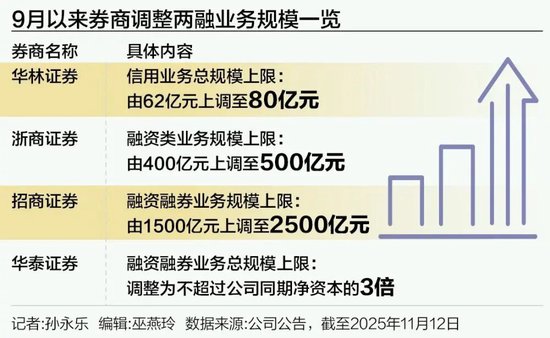
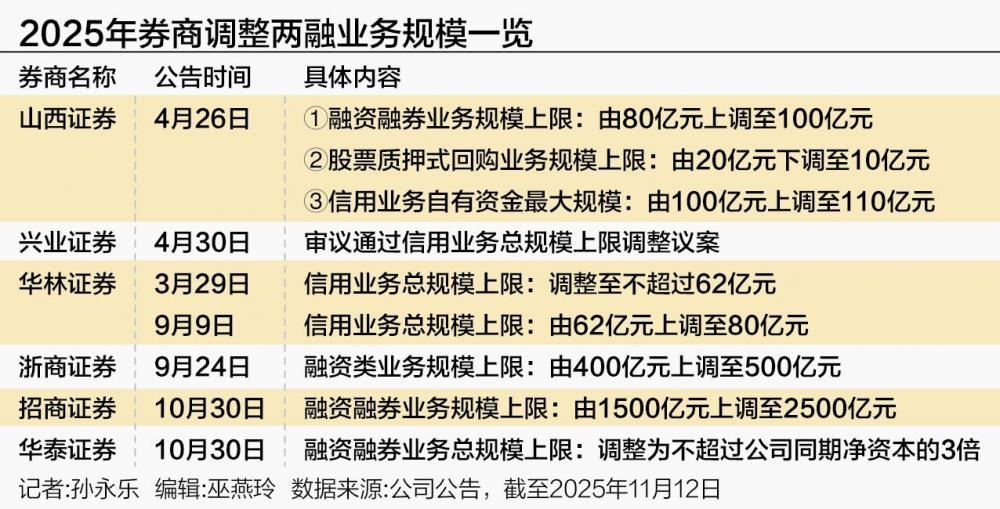
记者丨孙永乐 21世纪经济报道记者观察到,面对A股市场信用交易需求的持续旺盛,券商正积极把握业务机遇,纷纷 扩容两融业务规模。 10月底,两家头部券商几乎同步官宣上调两融业务额度,招商证券将两融业务规模上限从1500亿元大幅 提升至2500亿元,华泰证券最新两融总规模上限则定格在约2865亿元。 据记者不完全统计,截至目前,年内已有至少6家证券公司宣布上调两融及相关融资类业务规模上限, 包括华林证券、山西证券、兴业证券、浙商证券。 业内人士认为,10月两融新开户数据环比回落,主要是因为国庆长假压缩开户窗口,叠加节后市场波动 引发观望情绪。但需看到这是短期扰动,非趋势逆转。投资者信心修复与政策暖意仍在,两融需求长期 向好。当前市场杠杆水平更趋稳健,券商在业务扩张中仍坚守风控底线。 编辑丨巫燕玲 近日,A股10月融资融券新开户数据出炉。中证数据有限责任公司(简称"中证数据")最新数据显示, 10月份市场新开融资融券账户13.02万户,环比9月的20.54万户出现明显回落。 截至10月末,市场融资融券账户总数已达1539.88万户,同时,融资融券余额继续攀升,已经从年初的 不足1.9万亿元增长至2.49万亿元。 同 ...



A股重要信号,至少6家券商上调两融规模
21世纪经济报道· 2025-11-14 05:21
Core Viewpoint - The A-share market experienced a significant decline in new financing and securities lending accounts in October, with 130,200 new accounts opened, a decrease of 36.61% compared to September's 205,400 accounts. Despite this, the total number of financing and securities lending accounts reached 15.39 million, and the balance of financing and securities lending increased to 2.49 trillion yuan, indicating a robust long-term demand for credit trading in the market [1][4][8]. Summary by Sections New Account Openings - In October, the number of new financing and securities lending accounts fell to 130,200, down from 205,400 in September, marking a 36.61% decrease. This decline is attributed to the National Day holiday and market volatility, which compressed the time available for investors to open accounts [3][4][6]. - The total number of financing and securities lending accounts reached 15.39 million by the end of October, with 96 securities companies and 11,600 business outlets engaged in these activities [4]. Market Dynamics - The financing and securities lending balance has risen from less than 1.9 trillion yuan at the beginning of the year to 2.49 trillion yuan, reflecting a strong demand for credit trading [1][8]. - The market sentiment has shown volatility, impacting both ordinary trading and credit trading accounts, with a noticeable decrease in new account openings for both categories in October [4][6]. Brokerages' Response - Major brokerages are actively expanding their financing and securities lending business. For instance, China Merchants Securities raised its business limit from 150 billion yuan to 250 billion yuan, while Huatai Securities set its limit at approximately 286.5 billion yuan [2][8][9]. - At least six securities companies have announced increases in their financing and securities lending business limits this year, including Huatai Securities, China Merchants Securities, and others [7][9]. Future Outlook - Industry experts predict that the demand for financing and securities lending will remain strong in the long term, despite short-term fluctuations. The current market leverage level is stabilizing, and brokerages are maintaining risk control while expanding their business [1][10].
泰和科技:接受浙商证券等投资者调研
Mei Ri Jing Ji Xin Wen· 2025-11-14 04:23
Group 1 - The core viewpoint of the article highlights that Taihe Technology (SZ 300801) will hold an investor meeting on November 4, 2025, where the chairman and chief engineer will address investor inquiries [1] - For the year 2024, the revenue composition of Taihe Technology is as follows: water treatment industry accounts for 86.17%, chlor-alkali industry accounts for 13.42%, and others account for 0.41% [1]

双乐股份向不特定对象发行可转债申请审核状态变更为提交注册
Zheng Quan Shi Bao Wang· 2025-11-14 01:36
Group 1 - The core point of the article is that Shuangle Co., Ltd. (301036) has changed the status of its application for issuing convertible bonds to "submitted for registration" [1] - The company plans to issue convertible bonds to unspecified objects, with an expected fundraising amount of 800 million yuan [1] - The underwriting institution for this issuance is Zheshang Securities Co., Ltd. (601878) [1]
“75”后钱文海正式出任浙商证券董事长
Sou Hu Cai Jing· 2025-11-14 01:35
Core Viewpoint - The leadership transition at Zheshang Securities marks a strategic shift aimed at enhancing the company's competitive position in the industry, with new chairman Qian Wenhai set to lead the firm towards ambitious growth targets by 2030 [1][3][6]. Leadership Transition - Former chairman Wu Chenggen retired after nearly 20 years, during which he transformed Zheshang Securities from a struggling local broker into a mid-sized firm ranked around 20th nationally [1][3]. - Qian Wenhai, who joined Zheshang Securities in 2023, has been pivotal in the acquisition of Guodu Securities and will oversee the strategic integration of both firms [1][5]. Financial Performance - For the first three quarters of 2025, Zheshang Securities reported revenues of 6.789 billion yuan, a year-on-year increase of 66.73%, ranking 18th in the industry [2][6]. - The net profit attributable to shareholders reached 1.892 billion yuan, up 49.57% year-on-year, with an industry ranking of 20 [2][6]. Business Growth and Strategy - The company aims to double its core indicators by the end of 2030, aspiring to enter the top 15 firms in the industry [1][6][7]. - Key business segments showed significant growth, with investment income soaring by 609.88% to 2.442 billion yuan, while brokerage fees increased by 59.57% to 2.325 billion yuan [6][7]. Competitive Landscape - Zheshang Securities has been consistently outperforming its local competitor, Caitong Securities, in revenue, although it has lagged slightly in net profit [7]. - The merger with Guodu Securities is expected to enhance Zheshang's capital strength and total asset scale, facilitating a more competitive position in the market [7]. Strategic Objectives - The company has outlined three core tasks: integrating Guodu Securities, achieving the "mid-to-large broker" goal, and solidifying compliance and risk management foundations [7][8]. - Plans include optimizing internal control systems and enhancing operational efficiency through technology, particularly in risk management and customer service [8].
年内6家券商上调两融规模 最高提额千亿元
2 1 Shi Ji Jing Ji Bao Dao· 2025-11-13 23:05
Core Viewpoint - The A-share market has seen a significant decline in new financing and securities lending accounts in October, with a total of 130,200 new accounts opened, down 36.61% from September's 205,400 accounts, attributed to the National Day holiday and market volatility [4][6]. Group 1: Market Data - As of the end of October, the total number of financing and securities lending accounts reached 15.39 million, with the balance of financing and securities lending increasing from less than 1.9 trillion yuan at the beginning of the year to 2.49 trillion yuan [2][5]. - The financing and securities lending balance has set a new historical record, surpassing 2.5 trillion yuan for the first time on October 29 [7][10]. Group 2: Brokerages' Response - Major brokerages are actively expanding their financing and securities lending business, with at least six firms announcing increases in their business limits this year, including China Merchants Securities and Huatai Securities [3][11]. - China Merchants Securities raised its financing and securities lending limit from 150 billion yuan to 250 billion yuan, while Huatai Securities set its limit at approximately 286.5 billion yuan [3][10]. Group 3: Investor Behavior - The decline in new account openings in October is seen as a normal adjustment following two months of high growth, with market sentiment and investor entry timing affecting both regular and credit trading accounts [5][6]. - The market's volatility and reduced trading days due to the holiday have contributed to a decrease in investor willingness to enter the market, despite a temporary rise in the Shanghai Composite Index [6][9].
基建蓄力消费加码 年末经济韧性足
Zheng Quan Shi Bao· 2025-11-13 17:48
Economic Resilience - China's economy is expected to maintain resilience towards the end of the year, despite export growth facing temporary pressure due to weak external demand and high base effects [1] - Infrastructure investment is gaining momentum as local governments actively push project construction and allocate new funds [1] Infrastructure Investment - Major construction projects are entering a "sprint phase," with significant projects like the Dalian Changhai Bridge receiving 790 million yuan in new policy financing support [2] - Various regions, including Jiangsu and Guangxi, are holding mobilization meetings to accelerate major project construction, emphasizing the need for rapid project advancement [2] - A total of 500 billion yuan in new policy financing tools has been quickly allocated in October, which is expected to improve fixed asset investment and boost local investment willingness [2] Construction Activity Indicators - The "excavator index," a leading indicator for infrastructure construction, showed a recovery in October, with excavator sales increasing by 7.77% year-on-year [3] - However, high-frequency data for November indicates a general decline in demand for construction materials like rebar and cement [3] Export Challenges - The Shanghai Export Container Freight Index fell by 3.6%, reflecting weak external demand and the impact of base effects from last year's export surge [4] - The forecast for North American import growth is low, with an expected annual growth rate of only 1.6% from 2025 to 2026, the lowest among global regions [4] - Despite easing trade tensions between China and the U.S., the export growth may be supported by China's direct investment in Africa and Latin America [4] Consumer Market Activity - The recent "Double 11" shopping festival has energized year-end consumption efforts, with the Ministry of Commerce launching a nationwide consumption promotion campaign [5] - Local governments are implementing various promotional activities, including consumption vouchers and trade-in policies, to stimulate consumer spending [6] - The winter tourism and ice-snow economy are gaining traction, with significant increases in related content and planned distribution of consumption vouchers in regions like Jilin [6]
债市专题研究:日本股债回顾与启示
ZHESHANG SECURITIES· 2025-11-13 10:36
Group 1: Report's Investment Rating - No investment rating information for the industry is provided in the report. Group 2: Core Views of the Report - After the Japanese bond yield broke below 2%, it remained in a long - term low - level oscillation. The weak economic reality restricted the upward movement of the yield, but there were still significant obstacles to further decline. The Japanese stock market, on the other hand, experienced a long - bull market due to factors such as positive macro - economic expectations, improved corporate micro - profitability, and the support from the Bank of Japan [1]. Group 3: Summary Based on the Directory 1. Japan's Stock and Bond Review and Insights ➢ Japanese Bonds: Long - term Oscillation after Breaking below 2% - **1990 - 2018 Phases**: From 1990 to 1998, the 10 - year Japanese bond yield was in a downward period, dropping from over 8% to 0.77%. From 1999 to 2008, it was in an oscillation period, fluctuating around a 1.5% central level. From 2008 to 2018, under continuous and substantial monetary policy easing, the yield steadily declined and remained in a low - level oscillation. Since 2018, as Japanese monetary policy gradually normalized, the bond's elasticity increased, and the yield moved from a long - term zero - interest state to positive interest [10]. - **1998 - 1999**: Fiscal adjustment and the Asian financial crisis led to a significant deterioration of the Japanese economy. The Bank of Japan cut interest rates, causing the 10 - year Japanese bond yield to break below 2% in October 1997 and reach a low of 0.77% in October 1998. Subsequently, due to the imbalance between the supply and demand of national bonds (the government's large - scale fiscal expansion increased bond issuance, while the main buyer, the Ministry of Finance's Fund Management Bureau, suspended bond purchases), the yield quickly rebounded to 2.43% [13][14][19]. - **2002 - 2003**: The Japanese government adopted fiscal austerity while the central bank implemented loose monetary policies. The 10 - year Japanese bond yield started a new downward trend in February 2002 and reached a low of 0.43% in June 2003. After 2002, the global economic recovery improved Japan's economic outlook, and the yield rebounded. The sell - off by commercial banks using the VAR model accelerated the bond market's adjustment, with the yield rising by nearly 120BP from June to September 2003 [20][22][23]. ➢ Japanese Stocks: Long - Bull Trend after 2013 - After hitting a historical high in 1989, the Japanese stock market entered a long - term correction. In 2013, it started a new long - bull market, reaching a new high in February 2024. As of the end of October 2025, the Nikkei 225 index was at 52,411.34 points, a cumulative increase of 512.27% compared to the beginning of 2012 [28]. - Abenomics was an important catalyst for the rise of the Japanese stock market. In 2013, the Abe cabinet launched a 20.2 - trillion - yen economic stimulus package, the Bank of Japan introduced the QQE policy, and the government launched the "Japan Revitalization Strategy". Multiple factors such as positive macro - economic expectations, the development of high - tech industries, and the support from the central bank led to a double - whammy of improved corporate profitability and valuation, driving the long - bull market [31][32].