邮储银行

Search documents
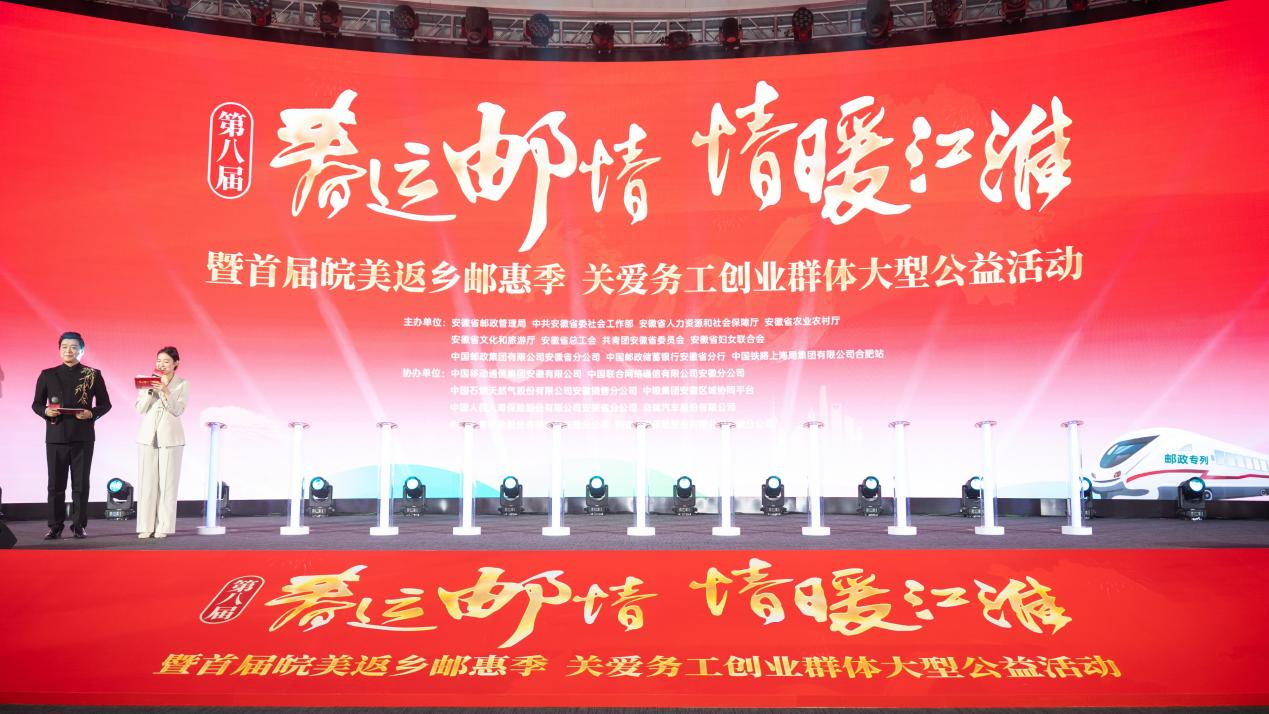
第八届“春运邮情 情暖江淮”暨首届“皖美返乡邮惠季”在合肥温情启动
Xin Lang Cai Jing· 2026-01-10 11:13
Core Viewpoint - The "Spring Transportation Postal Love, Warm Jianghuai" event aims to provide comprehensive services for migrant workers and entrepreneurs during their return home, aligning with national policies to stabilize employment, promote consumption, and benefit people's livelihoods [1][3]. Group 1: Event Overview - The event is jointly organized by China Post Group Co., Ltd. Anhui Branch and various local government departments and organizations, marking its eighth consecutive year since its inception in 2018 [3]. - Over the years, the initiative has provided more than 58,300 return tickets and operated over 30 special trains, serving over 10 million migrant workers [3]. Group 2: Service Offerings - This year's theme, "Anhui Beautiful Return Postal Benefit Season," focuses on addressing the urgent needs of migrant workers and offers services throughout their return journey, including travel, consumption, cultural tourism, and entrepreneurship [3]. - Specific services include special train services and fuel discounts for travel, online and offline group purchases with consumption subsidies, unique cultural tourism routes, and employment consultation stations with dedicated entrepreneurial loan products [3]. Group 3: Community Engagement - The event featured the appointment of renowned Huangmei opera artist Han Zaifen as a public welfare ambassador, emphasizing the responsibility to support migrant workers [5]. - A special segment was dedicated to presenting return tickets to representatives of migrant workers, highlighting the emotional significance of these tickets as a warm gift from their hometowns [5]. Group 4: Future Directions - The event will continue until March 2026, with plans to transition from event-based services to more regular and systematic support for the community [5]. - Anhui Post aims to enhance its role in public welfare and local development, contributing to the broader goals of modernizing Anhui [6].

险资持续“扫货”银行股 后续增持空间依然看好
Zhong Guo Jing Ying Bao· 2026-01-10 09:35
Core Viewpoint - Recently, Ping An Life has announced increased holdings in Agricultural Bank and China Merchants Bank H-shares, reflecting a broader trend among insurance companies to invest in bank stocks, particularly H-shares, due to their attractive dividend yields and valuation discounts [1][2]. Group 1: Investment Activities - Ping An Life announced that it has increased its stake in China Merchants Bank H-shares to 20% as of December 31, 2025, with a book value of 43.956 billion yuan, representing 0.78% of total assets [1]. - Similarly, Ping An Life has increased its stake in Agricultural Bank H-shares to 20% as of December 30, 2025, with a book value of 32.428 billion yuan, accounting for 0.58% of total assets [1]. - Multiple life insurance companies, including Ping An Life, have been actively acquiring shares in various banks, particularly H-share listed banks, throughout 2025 [1]. Group 2: Reasons for Increased Investment - The increase in insurance capital allocation to bank stocks, especially H-shares, is driven by favorable policies encouraging long-term capital market entry and the stable nature of bank stocks, which offer high dividends [2]. - The current low interest rate environment and "asset shortage" have highlighted the advantages of bank stocks as high-dividend, low-volatility investments, making them attractive to insurance funds [2]. - H-shares of banks are generally priced at a 15%-30% discount compared to their A-share counterparts, enhancing their appeal due to higher post-tax dividend yields [2][3]. Group 3: Impact of Increased Holdings - The rising shareholding of insurance funds in banks is expected to influence corporate governance and business strategies, promoting more sustainable dividend policies and enhancing governance structures [4]. - Insurance funds are likely to push for more rigid and tiered dividend policies, potentially increasing the average cash dividend payout ratio by 3-5 percentage points [4][5]. - The collaboration between insurance companies and banks is anticipated to deepen, leading to optimized financial services and improved operational efficiencies [5]. Group 4: Future Outlook - Analysts predict that there remains significant room for insurance capital to increase its holdings in banks, driven by ongoing regulatory encouragement and the need for asset allocation [5]. - The focus of insurance capital is expected to shift towards banks with clear dividend returns and strong asset quality, with H-shares likely remaining a primary target due to their cost-effectiveness [5].
当数字人民币开始计息
Jing Ji Guan Cha Bao· 2026-01-10 07:17
Core Viewpoint - The digital renminbi (e-CNY) will start accruing interest on wallet balances as of January 1, 2026, marking a significant shift from a cash-like payment tool to a deposit currency model, which aligns with economic growth and financial intermediation mechanisms [1][2][3] Digital Renminbi Transition - The People's Bank of China (PBOC) will implement a new measurement framework and management system for digital renminbi on January 1, 2026, transitioning from a cash-type model to a deposit currency model [2] - Major state-owned banks will begin to pay interest on digital renminbi wallet balances at the same rate as regular savings accounts [2] Systemic Upgrade - The ability to earn interest signifies a systemic upgrade, transforming digital renminbi from a mere tool to a comprehensive monetary system, responding to global trends in digital currencies [3][4] - The PBOC aims to redefine how money exists, circulates, and is governed, moving towards a more sustainable and operationally integrated digital currency [3][4] Cross-Border Payment Enhancements - The PBOC is focusing on enhancing cross-border payment systems, including expanding the use of the renminbi in international transactions and improving the efficiency of cross-border financial flows [5][6] - The digital renminbi is expected to become a core engine for cross-border payments, facilitating smoother transactions and reducing costs for businesses [5][6] Infrastructure Development - Recent policies indicate a strategic alignment between digital renminbi development and cross-border payment infrastructure, aiming for a cohesive system that supports both domestic and international financial activities [7][8] - The revised rules for the renminbi cross-border payment system will enhance governance and scalability, ensuring a robust framework for financial transactions [8][9] Future Implications - The transition to a deposit currency model is anticipated to significantly increase liquidity within the banking system and encourage more financial services around digital renminbi [13][14] - The internationalization of the renminbi will depend on clear rules, risk management, and compliance, which are essential for building trust among global financial institutions [14][15] Conclusion - The digital renminbi's evolution into a deposit currency represents a fundamental shift in China's monetary policy, with implications for both domestic financial stability and international currency dynamics [1][3][14]





多家银行开年首期大额存单主打短期 个别利率跌破1%
Zheng Quan Ri Bao· 2026-01-09 16:40
Core Viewpoint - The current trend in the large-denomination certificate of deposit (CD) market is characterized by a significant shift towards short-term products and a decline in interest rates, with many banks focusing on one-year or shorter maturities while three-year CDs see a sharp reduction in issuance and five-year products nearly disappearing [1][2][3][4] Group 1: Market Trends - Over 40 banks have announced the issuance of the first batch of large-denomination CDs for 2026, with a notable emphasis on short-term products [1] - The issuance of three-year large-denomination CDs has drastically decreased, and five-year products are almost non-existent [2][3] - Interest rates for large-denomination CDs are on a downward trend, with most three-year products yielding less than 2% and one-year rates generally below 1.5%, with some short-term CDs dropping to around 1% [2][3] Group 2: Specific Product Examples - Jinxiang Rural Commercial Bank issued its first large-denomination CD for 2026 with rates of 1.2% for three months, 1.5% for one year, 1.55% for two years, and 1.75% for three years [2] - Yunnan Tengchong Rural Commercial Bank launched a three-month large-denomination CD with a rate of only 0.95% [2] - Guangdong Longchuan Rural Commercial Bank's first large-denomination CD for 2026 includes rates of 1.15% for six months, 1.3% for one year, and 1.35% for two years [2] Group 3: Factors Influencing Trends - The dual trend of short-term focus and declining interest rates in the large-denomination CD market is primarily driven by banks' need to reduce long-term high-cost liabilities due to ongoing pressure on net interest margins [3][4] - The overall net interest margin for commercial banks was reported at a historical low of 1.42% as of the end of Q3 2025, prompting banks to minimize or cease issuing high-cost long-term deposits [4] - Experts predict that the low interest rate environment for large-denomination CDs will likely become the norm in 2026, influenced by continued accommodative monetary policy and persistent downward pressure on asset yields [4]
鏖战零售AUM 开年银行资产提升活动密集上线
Mei Ri Jing Ji Xin Wen· 2026-01-09 15:19
Group 1 - Major banks, including ICBC and ABC, have launched asset enhancement activities to increase retail AUM (Assets Under Management) and customer loyalty [1][4] - The activities involve rewards for customers who increase their average financial assets over a specified period, with minimum thresholds set for participation [1][2] - Various banks have different criteria for what constitutes financial assets, including deposits, wealth management, funds, insurance, and government bonds [1][3] Group 2 - The asset enhancement activities are seen as effective short-term tactics to stimulate AUM growth, particularly in attracting dormant customers and short-term funds [4] - Retail banking has faced challenges due to declining interest rates and regulatory changes affecting fee income, prompting banks to focus on increasing AUM to boost revenue [5] - As of Q3 2023, several A-share banks reported significant growth in retail AUM, with Postal Savings Bank reaching 17.89 trillion yuan, an increase of over 7% year-on-year [5]
邮储银行大宗交易成交50.00万股 成交额271.00万元
Zheng Quan Shi Bao Wang· 2026-01-09 14:34
Group 1 - Postal Savings Bank executed a block trade on January 9, with a transaction volume of 500,000 shares and a transaction amount of 2.71 million yuan, at a price of 5.42 yuan per share [1] - The buyer of the block trade was Guotai Junan Securities Co., Ltd. headquarters, while the seller was Industrial Securities Co., Ltd. Fuzhou Chaoyang Road Securities Business Department [1] - In the last three months, the stock has seen a total of 12 block trades, with a cumulative transaction amount of 48.01 million yuan [2] Group 2 - On January 9, Postal Savings Bank's closing price was 5.42 yuan, reflecting an increase of 0.18%, with a daily turnover rate of 0.23% and a total transaction amount of 827 million yuan [2] - The stock experienced a net outflow of 65.10 million yuan in main funds for the day, and over the past five days, the stock has declined by 0.55% with a total net outflow of 188 million yuan [2] - The latest margin financing balance for the stock is 1.01 billion yuan, which has decreased by 28.42 million yuan over the past five days, representing a decline of 2.73% [2]

42家A股银行全部撤销监事会
2 1 Shi Ji Jing Ji Bao Dao· 2026-01-09 12:09
记者丨郭聪聪 编辑丨周炎炎 作为中国商业银行公司治理的"标配",运行近三十年的监事会制度,正在全行业范围内悄然谢幕。 自2024年新《公司法》及相关监管配套文件相继落地以来,从工行、农行等国有大行,到各地城商行、农商行,纷纷加入调整行列,陆续宣布不再设立监事 会。 据21世纪经济报道记者统计,截至2026年初,42家A股上市银行全部公开宣布撤销监事会,另有不少中小银行正推进相关计划,原监事会的监督职能已整体 移交至董事会下设的审计委员会。 这一变革的背后,既是银行机构顶层管理框架的重塑,更是金融机构治理效能的深度优化。这场治理调整为何发生?全新的监督机制能否扛起内部监督的重 任?银行业公司治理改革又将走向怎样的新征程? 监事会制度设立三十年 银行监事会制度的设立与退出,几乎贯穿了中国银行业市场化改革与现代公司治理建设的全过程。这一制度的建立,深植于中国银行业改革与国有金融机构 监督的特定历史背景之中。 1995年《商业银行法》首次明确要求国有独资商业银行设立监事会,旨在强化国有资产监督。随后近三十年间,一系列规章指引相继出台,逐步细化了监事 会的职责、构成与运行机制,使其成为与董事会、高级管理层并称的"三长" ...

银行短期大额存单利率进入0字头
2 1 Shi Ji Jing Ji Bao Dao· 2026-01-09 11:46
Core Viewpoint - Major state-owned banks in China have launched new large-denomination time deposit products in early 2026, but short-term product interest rates have generally entered the "0" range, indicating a downward trend in deposit rates across the banking sector [1][2]. Group 1: State-Owned Banks - The annual interest rates for 1-month and 3-month large-denomination time deposits from major state-owned banks such as Bank of China, Agricultural Bank of China, Industrial and Commercial Bank of China, and China Construction Bank are all at 0.9%, with a minimum deposit requirement of 200,000 yuan [1]. - Some products from these banks have interest rates lower than those of regular fixed-term deposits of the same duration [1]. - Since December 2025, these banks have collectively removed 5-year large-denomination time deposits, with available products now generally limited to 3 years or less, and interest rates ranging from 1.10% to 1.55% [1]. Group 2: Other Banks - In contrast to state-owned banks, some joint-stock banks, city commercial banks, and rural commercial banks are still offering short-term large-denomination time deposits with interest rates above 1%. For instance, Citic Bank's 1-month large-denomination time deposit has an interest rate of 1.1% [1]. - Tianjin Bank's first 3-month large-denomination time deposit for 2026 has an interest rate of 1.15%, while Liu'an Rural Commercial Bank offers a similar product at 1.1% [1]. - However, smaller banks are also experiencing downward pressure on short-term interest rates, with some entering the "0" range, such as Yunnan Tengchong Rural Commercial Bank, which has set a 3-month deposit rate at 0.95% [2]. Group 3: Market Analysis - Industry experts suggest that the recent interest rate adjustments are closely related to banks' ongoing efforts to manage net interest margins and reduce funding costs [2]. - The current market environment indicates that the downward trend in deposit rates may continue [2].

银行短期大额存单利率进入0字头
21世纪经济报道· 2026-01-09 11:41
Group 1 - Major state-owned banks have launched new large-denomination time deposit products, but short-term product interest rates have generally entered the "0" range, with rates for 1-month and 3-month deposits at 0.9% [1] - Compared to state-owned banks, some joint-stock banks and city commercial banks still offer short-term large-denomination time deposits with interest rates above 1%, such as CITIC Bank's 1.1% for a 1-month deposit [1] - The interest rates for large-denomination time deposits from state-owned banks have been reduced, with the current rates for products with a term of 3 years or less ranging from 1.10% to 1.55% [1] Group 2 - Smaller banks are also experiencing downward pressure on short-term interest rates, with some entering the "0" range, as seen with Yunnan Tengchong Rural Commercial Bank offering a 0.95% rate for a 3-month deposit [2] - The adjustment in interest rates is closely related to banks' ongoing efforts to manage net interest margins and reduce funding costs, indicating a potential continuation of the downward trend in deposit rates in the current market environment [2]

42家A股银行全部撤销监事会
21世纪经济报道· 2026-01-09 11:06
Core Viewpoint - The supervisory board system, a standard for corporate governance in Chinese commercial banks for nearly three decades, is quietly coming to an end across the industry as banks transition to a new governance structure under the revised Company Law effective in 2024 [1][4]. Group 1: Background and Historical Context - The establishment and subsequent exit of the supervisory board system reflect the entire process of market-oriented reform and modern corporate governance in China's banking sector, rooted in the historical context of state-owned financial institution supervision [2]. - The supervisory board was first mandated by the 1995 Commercial Banking Law to enhance the oversight of state assets, evolving over nearly thirty years into a distinctive "dual-layer" governance structure alongside the board of directors and senior management [2]. Group 2: Legislative Changes and Implementation - The new Company Law effective in July 2024 allows banks to establish an audit committee under the board of directors instead of maintaining a supervisory board, providing legal space for diverse governance models [4]. - Following the implementation of this law, major state-owned banks, including ICBC, ABC, and others, completed amendments to their articles of association by September 2025, officially abolishing the supervisory board [5]. Group 3: Trends and Observations - By January 1, 2026, all 42 A-share listed banks had publicly announced the abolition of their supervisory boards, with many smaller banks also advancing similar plans [5][6]. - The exit of the supervisory board is seen as a trend driven by both regulatory changes and the inherent challenges faced by the supervisory board in its long-term practice [8]. Group 4: Challenges and Future Directions - The transition to an audit committee assumes greater responsibility for oversight, with experts noting both opportunities and challenges in this new structure [12]. - The audit committee is expected to enhance its supervisory role, but its effectiveness will depend on clear regulations regarding member selection and independence [13]. - The banking industry is exploring various strategies to optimize the audit committee's functioning, including clarifying responsibilities and ensuring a diverse and professional member composition [14].