DeepSeek

Search documents
Gemini 3 Pro刷新ScienceQA SOTA|xbench快报
红杉汇· 2025-11-20 03:38
Core Insights - Google has officially launched its latest foundational model, Gemini 3, which shows significant improvements in deep reasoning, multimodal understanding, and agent programming capabilities [1] - Gemini 3 Pro achieved a new state-of-the-art (SOTA) score of 71.6 on the xbench-ScienceQA leaderboard, surpassing Grok-4 and demonstrating faster response times and lower costs [1][3] Performance Metrics - Gemini 3 Pro scored an average of 71.6 with a BoN of 85, while Grok-4 scored 65.6, indicating a 6-point lead over the second-place model [5] - The average response time for Gemini 3 Pro is 48.62 seconds, significantly faster than Grok-4's 227.24 seconds and GPT-5.1's 149.91 seconds [6] - Cost analysis shows that running the ScienceQA tasks with Gemini 3 Pro costs only $3, compared to $32 for GPT-5.1, making it substantially more economical [6] Technological Advancements - Gemini 3 introduces a cognitive architecture that shifts from reactive to cautious reasoning, utilizing a "Deep Think" mode that allows for multiple reasoning pathways and self-verification [8] - The model employs a sparse MoE architecture, activating only a small subset of its vast parameters during computation, which enhances efficiency while maintaining performance [8] Developer Tools and Features - The introduction of "Vibe Coding" allows Gemini 3 to align code generation with developer intent, functioning as an autonomous agent capable of executing complex tasks within an IDE [9] - Gemini 3 Pro integrates with Google’s Antigravity platform, enabling developers to automate workflows that involve reading web pages, executing commands, and generating code seamlessly [10] Multimodal Capabilities - Gemini 3 adopts a native multimodal architecture, allowing it to process text, code, images, video, and audio using a unified world model, enhancing its perception and interaction capabilities [11] - The model can generate dynamic, interactive user interfaces in real-time based on user intent, marking a shift from static outputs to interactive experiences [12] Hardware Infrastructure - Gemini 3 is trained on Google’s proprietary TPU (Tensor Processing Unit), designed for high-bandwidth and parallel computing, facilitating efficient training and cost management [13]



中国VC没有合伙人?20年血泪史揭示三大真相
3 6 Ke· 2025-11-19 23:28
Core Insights - The ultimate dream for many Chinese venture capitalists (VCs) is independence rather than partnership, indicating a systemic failure of the Chinese partnership model [1][3][4] - The article discusses three major truths about the Chinese VC industry over the past 20 years: the dilemma of partnerships, the evolution of buyback clauses, and the disillusionment with post-investment support [1][21] Group 1: Partnership Dilemma - There is a prevailing belief that true partners do not exist in Chinese VC, with most firms having a single decision-maker despite the title of "partner" [3][4] - The dominance of strong individuals in the industry leads to a lack of collaborative decision-making, as seen in the experiences of early adopters of the partnership model [5][6] - Many young partners find that achieving the title of "partner" does not equate to commensurate financial rewards or decision-making power [6][7] Group 2: Buyback Clause Evolution - The concept of "buyback clauses" has become a significant topic in the VC landscape, highlighted by a public dispute involving prominent figures in 2023 [9][10] - The history of buyback clauses in China shows their transition from a protective measure to a tool that can question the essence of venture capital [11][12] - Regulatory changes have redefined buyback clauses, categorizing them as liabilities rather than equity, which alters their impact on investment agreements [12] Group 3: Disillusionment with Post-Investment Support - Post-investment support was once viewed as a core competitive advantage for VCs, but this perception has shifted dramatically since 2022 [13][17] - The development of post-investment services peaked around 2021, with many firms investing heavily in dedicated teams, but this trend reversed as market conditions worsened [14][16] - The once-promising post-investment support has now been recognized as a cost center rather than a value-adding component of the investment process [17] Group 4: Consumer Investment Trends - The consumer sector has been a focal point for VC investments, with notable successes and failures illustrating the volatility of this market [18][19] - The rise and fall of companies like Bubble Mart and Yuanqi Forest exemplify the rapid changes in consumer sentiment and investment viability [19] Group 5: Future Prospects in Technology Investment - Despite challenges in the consumer sector, technology investments are emerging as a new area of hope, with companies like DeepSeek and Yuzhu Technology gaining attention [20] - These cases suggest that China still has the potential to produce world-class technology firms, prompting a reevaluation of investment strategies in uncertain market conditions [20] Group 6: The Path Forward - The evolution of the Chinese VC industry reflects a journey from failed partnership models to a search for a unique organizational innovation that fits the local context [21]

中国银河证券:传媒互联网子行业10月表现分化 AI应用生态构建进行时
智通财经网· 2025-11-19 02:23
Core Insights - The Chinese film and gaming market experienced a decline in revenue year-on-year due to high base effects, while the advertising market showed stable growth with significant investment in telecommunications and other sectors. The AI field is rapidly advancing, shifting from technical competition to ecosystem building and scenario penetration [1]. Film Industry - The film supply remains stable, but the overall box office revenue saw a year-on-year decline. In October 2025, the national box office reached 2.612 billion yuan (including service fees), a decrease of 27.94% year-on-year and 1.88% month-on-month. The film "The Volunteers: Blood and Peace" led the monthly box office with 525 million yuan, accounting for 22.4% of the total [2]. Gaming Industry - The gaming market experienced a slight year-on-year decline due to high base effects. In September 2025, the actual sales revenue of the domestic gaming market was 29.679 billion yuan, down 2.13% year-on-year. Self-developed games generated 1.621 billion USD in overseas revenue, a decrease of 4.82%. Mobile game revenue was 21.488 billion yuan, down 2.31%, while client games performed well with a revenue of 7.009 billion yuan, up 25.49%. Tencent's games dominated the iOS revenue chart in China [3]. Advertising Market - The overall advertising market showed stable growth, with a year-on-year increase of 3.5% in spending from January to September 2025. In September alone, advertising spending rose by 12.7% year-on-year and 0.7% month-on-month. Notable increases in advertising spending were observed in telecommunications, personal care, entertainment, and IT sectors, with year-on-year increases of 78.9%, 42.1%, 38.9%, and 22.2% respectively. Conversely, the pharmaceutical, alcoholic beverages, and cosmetics sectors saw declines of -17.4%, -12.7%, and -4.8% respectively [4]. AI Industry - The iteration of large models is accelerating, promoting the practical application of technology and ecosystem building. Companies like OpenAI and Google are advancing multimodal and secure applications. OpenAI released Sora2 and ChatGPT Atlas, while Google launched Veo3.1 integrated into the Gemini ecosystem, showcasing systematic development in generative AI. In China, DeepSeek introduced DeepSeek-OCR, reflecting trends in model lightweighting and multimodal integration. The AI industry is transitioning from competition in model capabilities to ecosystem building and scenario penetration, with applications expected to accelerate in education, creativity, development, and security [5]. Investment Recommendations - With the continuous iteration of foundational large model capabilities, AI applications are beginning to show a solid technological foundation for development. The ongoing exploration of AI across various industries is expected to bring transformative impacts. Companies to watch include Tencent Holdings, Alibaba, Kuaishou-W, Zhiwei Buy, and Kunlun Wanwei. The gaming market is expected to maintain high levels of prosperity, with several companies launching new products, making companies like Bilibili-W, Giant Network, G-bits, Perfect World, and 37 Interactive Entertainment worth monitoring [6].


凯文·凯利最新演讲:这个能力,下一个10年最具竞争力
创业邦· 2025-11-18 10:39
Core Viewpoints - The importance of preparing for the future rather than predicting it in an era of uncertainty [7] - AI is seen as a complement to human capabilities, enhancing efficiency and creativity rather than replacing jobs [20] - The future will be shaped by those who can collaborate with AI, rather than those who resist it [8] AI and Uncertainty - There are three key uncertainties regarding AI: the possibility of achieving general artificial intelligence, the direction of AI computing (centralized vs. decentralized), and the impact of AI on employment [10][14][16] - Current investments are heavily focused on exploring general intelligence, but the future may consist of various specialized AI systems rather than a single general system [11][13] - The trend towards edge computing is emerging, with a significant portion of computing already occurring at the edge, which offers advantages in speed, privacy, and energy efficiency [14][15] AI's Role in Employment and Industry - AI is not leading to mass unemployment but is instead enhancing productivity, with studies showing an average efficiency increase of about 25% for employees using AI [17][19] - The introduction of AI changes the nature of work, allowing humans to focus on more creative and judgment-based tasks while AI handles repetitive ones [20][41] - AI's role is to augment human capabilities rather than replace them, leading to a reorganization of job structures rather than job losses [43] Future Directions of AI - Future AI innovations will focus on four key areas: symbolic reasoning, spatial intelligence, emotional intelligence, and intelligent agents [22] - Symbolic reasoning will reintroduce structured intelligence to enhance AI's understanding and reasoning capabilities [22][23] - Spatial intelligence will enable AI to interact with and understand the real world, moving beyond text-based learning [24][27] - Emotional intelligence will allow AI to recognize and respond to human emotions, fostering deeper human-AI interactions [29][30] - Intelligent agents will evolve from mere tools to partners capable of executing tasks and collaborating with other agents [30][31] The Concept of "Cool China" - "Cool China" refers to a nation that attracts others through creativity and charm rather than force, with potential to lead in innovation and cultural influence [60][61] - China has the opportunity to produce world-class products and technologies, enhancing its global standing [62] - Cultural output will play a significant role in shaping China's soft power, allowing it to resonate with global audiences [63] - The development of attractive cities that blend technology and culture will further enhance China's appeal [64] Challenges and Responsibilities - The rise of an AI-driven society will bring challenges related to privacy, data usage, and the balance between personalization and individual rights [66][68] - AI has the potential to create a more just and efficient society, particularly in areas like social governance and resource distribution [69] - The realization of "Cool China" depends on a commitment to innovation, openness, and responsibility, shaping a respected and admired global presence [71]

微博自研VibeThinker开源模型:15亿参数超越千亿级对手,训练成本仅7800美元
Xin Lang Ke Ji· 2025-11-17 11:40
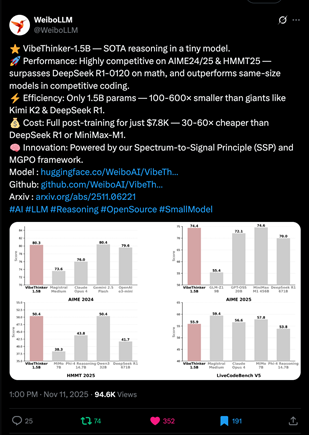
Core Insights - Weibo AI has introduced its self-developed open-source large model, VibeThinker, which has only 1.5 billion parameters but outperformed models with hundreds of times more parameters in benchmark tests [1][2][3] - The training cost for VibeThinker is only $7,800, significantly lower than competitors, indicating a shift from a "scale competition" to an "efficiency revolution" in the AI industry [1][5][6] Model Performance - VibeThinker achieved impressive results in high-difficulty mathematical tests, surpassing models like DeepSeek-R1 with 671 billion parameters and MiniMax-M1 with 456 billion parameters [2][3] - The model's performance in LiveCodeBench v6 matched or exceeded that of larger models, demonstrating the potential of smaller models in complex reasoning tasks [3] Cost Efficiency - The total training cost for VibeThinker was approximately $7,800, which is 30 to 60 times more cost-effective than other models that require hundreds of thousands of dollars for similar performance [6][7] - This cost advantage allows smaller companies and research institutions to participate in AI innovation, promoting a more inclusive AI research environment [7][8] Application and Ecosystem - Weibo is actively integrating AI technology across various business scenarios, launching features like Weibo Smart Search and AI Interaction Accounts to enhance user experience [8][9] - The development of VibeThinker marks a new phase in Weibo's AI strategy, focusing on leveraging unique data assets to create a model that better understands public sentiment and social needs [9][10] Future Prospects - VibeThinker is expected to drive the growth of Weibo's AI applications, enhancing user experience and potentially creating a new "social super-ecosystem" that combines social attributes with intelligent services [10][11] - The technological advancements of VibeThinker are anticipated to significantly reduce the operational costs of AI applications on the Weibo platform, allowing for scalable AI capabilities without excessive resource burdens [11]

美国AI基础设施投资系列一:美国AI基础设施投资是否过热?AIdc投资端与需求端的节奏错配风险
Haitong Securities International· 2025-11-17 09:49
Investment Rating - The report indicates a cautious outlook on the AI infrastructure investment in the U.S., suggesting a potential mismatch between investment pace and demand [2][20]. Core Insights - Since 2025, the U.S. AI infrastructure has entered a phase of "ultra-high-speed expansion + high-leverage support," with major companies raising approximately USD 93 billion, surpassing the total of the previous three years [2][20]. - The capital expenditure on AI data centers is being revised upward, but the revenue and cash flow from the end market have not yet aligned with this accelerated investment pace, indicating a potential risk of over-investment [2][20]. - The report emphasizes that while the long-term demand for AI as a general-purpose technology is likely to absorb most infrastructure investments, the timing of this demand realization is critical [15][23]. Summary by Sections 1) **Funding Side: Transition from High Profitability to High Capex** - Major tech companies have significantly increased their bond market financing, raising about USD 93 billion since 2025, which is expected to lead to over USD 5 trillion in cumulative capital expenditure on AI-related data centers over the next decade [4][20]. - The shift in funding structure indicates a move from "high profitability + low leverage" to "high Capex + high leverage," with debt financing becoming more prevalent [4][20]. 2) **Short-term Outlook (1-2 years)** - The market shows tolerance for high capital expenditure and rapid leveraging, characterized by front-loaded funding and Capex, while revenue and cash flow lag behind [5][21]. - Early investments are seen as beneficial for securing scarce resources and competitive advantages [5][21]. 3) **Medium-term Outlook (3-5 years)** - If the rollout of high-ARPU scenarios is slower than expected, the earlier intensive investments may lead to pressure on balance sheets, with risks of valuation repricing and asset price corrections [6][22]. - The report warns of potential structural pressures on profitability due to increased price competition and underutilization of resources [6][22]. 4) **Long-term Outlook (5-10 years and beyond)** - The demand for AI is expected to gradually absorb most infrastructure investments, but the mismatch in investment and demand realization could lead to a concentration of returns among a few participants who effectively match investment with demand [7][23]. - The report highlights the importance of companies being able to convert heavy investments into high utilization and stable cash flows to maintain market share and pricing power [7][23]. 5) **Demand Side: Competitive Landscape and Pricing Pressure** - The competitive landscape is characterized by converging differences among AI models, leading to increased price competition and pressure on profit margins [10][11]. - The emergence of low-cost, high-performance models is expected to further compress pricing power for mainstream closed-source models, impacting the overall revenue growth in the AI infrastructure sector [10][11]. 6) **Investment Strategy: Transition from AI Beta to Structural Alpha** - The report suggests that the investment logic in AI-related assets should shift from merely betting on "AI Beta" to focusing on the matching of investment and demand, utilization rates, pricing power, and quality of free cash flow [17]. - The ability to navigate the credit and capital expenditure cycles will be crucial for companies to achieve sustainable returns in the long term [17].




阿里 “千问” 项目官宣,“超级新势力” 全面来袭!科创人工智能ETF华夏(589010) 午后震荡企稳,AI持仓结构分化凸显
Xin Lang Cai Jing· 2025-11-17 06:53
Group 1 - The core viewpoint of the news highlights the ongoing developments in the AI sector, particularly the performance of the Sci-Tech Innovation Artificial Intelligence ETF (589010), which is experiencing slight fluctuations and a weak consolidation pattern in the short term [1] - The ETF's component stocks show a mixed performance, with 17 stocks rising and 12 falling, indicating a clear differentiation within the sector [1] - Alibaba has officially launched its "Qianwen" project, aiming to penetrate the AI to C market, providing a free personal AI assistant that can interact with users and assist in various life scenarios [1] Group 2 - Open-source securities indicate that the chaotic competition phase in the AI industry has ended, transitioning to a competitive landscape dominated by a few strong players [2] - The development of large model technology has moved beyond the initial "hundred model war" phase, entering a period focused on core technological breakthroughs and commercial value verification [2] - The domestic large model teams are differentiating into major players such as Alibaba, ByteDance, DeepSeek, Jiyue Xingchen, and Zhipu, while the overseas market is led by OpenAI, Google, Anthropic, X.AI, and Meta [2]
在全球最大的科技峰会现场,他们用DeepSeek养出迷你“独角兽”
虎嗅APP· 2025-11-15 09:17
Core Insights - The article discusses the emergence of new AI startups at the Web Summit, highlighting the potential for innovation in various countries beyond traditional tech hubs like Silicon Valley and Beijing [2][3][7]. Group 1: AI Startup Landscape - The Web Summit has become a platform for showcasing AI startups from diverse regions, including Brazil, Turkey, and Poland, which are skipping traditional SaaS models to enter the AI-native era [5][8]. - Many startups are focusing on niche problems within their local markets, demonstrating a trend where AI applications are tailored to specific user needs [5][9]. - The rise of AI is evident in sectors like sales and programming, with AI agents becoming increasingly specialized and integrated into business processes [5][28]. Group 2: Global AI Adoption - Smaller countries are leveraging AI to revitalize their economies, with examples like Lovable in Sweden achieving rapid growth and user adoption [7][8]. - The article notes that many startups are self-funded and not as reliant on external financing, indicating a different approach to growth compared to their counterparts in the US and China [5][9]. - AI is reshaping organizational structures, with many startups operating with minimal full-time staff and relying on freelance talent [17][19]. Group 3: Innovative Applications - Several startups are developing unique AI applications, such as Hablla in Brazil, which utilizes WhatsApp for personalized marketing, and Lyway in South Korea, focusing on AI-driven language testing [14][15]. - The article highlights the importance of product understanding and user engagement in the AI space, as seen with companies like Headway, which has successfully gamified learning experiences [24][25]. - AI applications are increasingly being designed to address specific industry needs, such as manufacturing and sales, showcasing the versatility of AI technology [28].

梁文锋代表DeepSeek,他代表梁文锋
量子位· 2025-11-15 02:08
Core Viewpoint - The article discusses the emergence of "Hangzhou Six Little Dragons" at the World Internet Conference in Wuzhen, highlighting the presence of key figures in AI and technology, particularly focusing on DeepSeek and its representative, Chen Deli, who expressed both optimism and concerns about the future impact of AI on society [1][3][41]. Group 1: DeepSeek and Its Representation - DeepSeek's founder Liang Wenfeng did not attend the conference; instead, researcher Chen Deli represented the company, marking a significant public appearance for DeepSeek [3][6][41]. - Chen Deli, who joined DeepSeek in 2023, has been involved in critical research areas such as language models and alignment mechanisms, contributing to several important publications [18][22][20]. - The article notes that Chen Deli's presence at the conference has made him the second public representative of DeepSeek after Liang Wenfeng, emphasizing his role as a spokesperson for the company's views on AI [41][42]. Group 2: AI Perspectives - Chen Deli expressed a mixed outlook on AI, stating that while there is a "honeymoon period" between humans and AI over the next three to five years, there are significant long-term concerns about AI potentially replacing most jobs in society [8][9]. - He highlighted that the current AI revolution differs fundamentally from previous industrial revolutions, as AI is beginning to possess its own "intelligence," which could surpass human capabilities in certain areas [10][11]. - The potential for AI to disrupt existing social order and economic structures is a major concern, with Chen suggesting that technology companies may need to act as "guardians" to mitigate negative impacts [12][13]. Group 3: Value Alignment in AI - During his presentation, Chen Deli introduced the concept of "value alignment decoupling," proposing that core values should be unified while allowing users to customize diverse values, ensuring safety and adaptability to societal diversity [25][24]. - This approach aims to address the rigidity of traditional large models, which often embed fixed values that do not reflect the complexity of human society [24][25]. - The idea of "harmony in diversity" encapsulates this new perspective on AI value alignment, suggesting a more flexible and user-centric approach to AI development [26][25].

Alibaba Looks To Future With ChatGPT Inspired App And Tokenization
Forbes· 2025-11-14 12:30
Core Insights - Alibaba Group Holding is redesigning its flagship mobile AI app to resemble OpenAI's ChatGPT, aiming to enhance its competitive position against major Asian rivals [2][4] - The app will be renamed Qwen and will integrate more agent-style capabilities to facilitate shopping across Alibaba's services [3][6] - The long-term goal is to develop Qwen into a fully capable AI agent, with plans for an international version and significant internal resources allocated for the redesign [5][9] E-commerce Integration - Alibaba is leveraging its traditional strength in e-commerce to attract users to the revamped Qwen app, especially as the e-commerce landscape shifts towards AI-driven models [6][7] - The app will initially remain free, with potential for future monetization as the user base grows [7] Payment Infrastructure - Alibaba is overhauling cross-border payment systems within its $35 billion e-commerce ecosystem, focusing on tokenization to enhance global settlement processes [8][9] - A new payment network utilizing a tokenized, stablecoin-like system for international B2B transactions is expected to launch by the end of the year [9] AI Growth and Performance - Alibaba has reported significant growth in AI-related offerings, with its cloud business becoming the fastest-growing division [10]