台积电

Search documents
iPhone 17三款传涨价5% Pro 款起售价将突破1,000美元
Jing Ji Ri Bao· 2025-08-03 23:20
Core Insights - The introduction of equivalent tariffs by the U.S. is expected to increase the cost of products imported from other countries, leading to a projected price increase of nearly 5% for the upcoming iPhone 17 series, with the Pro model's starting price expected to exceed $1,000 for the first time [1][2] - Jefferies analysts estimate that the iPhone 17 series, including Pro, Pro Max, and Air models, will see a price increase of $50 compared to the iPhone 16 series, which translates to a 4% to 5% increase [1] - Apple's shift of iPhone production from China to India has incurred additional costs, and despite not being officially included in the tariff range, the price increase for iPhones seems inevitable [1] Group 1 - Apple's CEO Tim Cook confirmed that tariff expenses reached $800 million last quarter, with a warning that costs could rise to $1.1 billion if current policies remain unchanged [2] - The 25% tariff on iPhones produced in India, combined with the inability of Indian production to meet demand, necessitates continued reliance on Chinese factories, which adds to the cost pressures [2] - Concerns have been raised regarding the impact of early purchases by U.S. consumers on iPhone sales, as many bought devices in anticipation of price increases due to tariffs, potentially affecting the sales of the iPhone 17 series [2]

台积电消费应用接单转淡 第4季营收恐无法再创高
Jing Ji Ri Bao· 2025-08-03 23:20
Group 1 - The core viewpoint indicates that the impact of U.S. tariffs is leading to a conservative consumer outlook for the second half of the year, with expectations that demand for terminal products like PCs and smartphones during the year-end holiday season may not meet expectations [1] - TSMC's orders related to consumer applications are weakening, and there are concerns that TSMC's revenue in Q4 may decline from the historical high in Q3, marking the first time in nearly a decade that Q4 performance may not exceed Q3 [1] - Approximately 40% of TSMC's terminal applications are in the consumer sector, which is being affected by tariffs and economic changes, leading to a slowdown in growth for the peak season in Q4, although it is still expected to outperform the same period last year [1] Group 2 - TSMC's revenue in the first half of the year increased by about 40% year-on-year, with Q4 revenue estimated to be between $31.8 billion and $33 billion, averaging $32.4 billion, indicating a quarter-on-quarter decline despite being better than the same period last year [2] - The estimated decline in Q4 revenue is projected to be in the high single to mid-double digit percentage range compared to Q3 [2]
台积电美国投资扩厂 加速度
Jing Ji Ri Bao· 2025-08-03 23:20
Core Viewpoint - TSMC (2330) is expected to face a decline in revenue in Q4 compared to Q3 for the first time in nearly a decade, despite actively pursuing growth opportunities in the U.S. semiconductor market [1][2] Group 1: Revenue and Production Outlook - TSMC anticipates that Q4 revenue in New Taiwan Dollars and U.S. Dollars may not surpass Q3 levels, marking a significant seasonal decline [1] - The first wafer fab in Arizona is set to begin mass production using 4nm technology in Q4 2024, achieving yield rates comparable to those in Taiwan [1] - The second wafer fab, utilizing 3nm technology, has been completed, with strong interest from advanced process customers, prompting TSMC to accelerate production timelines [1] Group 2: Investment and Expansion Plans - TSMC has committed to investing a total of $165 billion in advanced semiconductor manufacturing in the U.S., including six wafer fabs, two advanced packaging facilities, and a major R&D center [1][2] - Approximately 30% of the advanced process capacity below 2nm is expected to be produced in Arizona, supporting major U.S. clients such as Apple, NVIDIA, AMD, Qualcomm, and Broadcom [1] - The fourth wafer fab in Arizona will utilize N2 and A16 process technologies, with the fifth and sixth fabs planned to adopt even more advanced technologies, contingent on customer demand [2]
台积电2纳米厂,新进展
半导体行业观察· 2025-08-03 03:17
Core Viewpoint - TSMC is advancing its 2nm production capabilities with the installation of equipment at its second factory (P2) in Kaohsiung, while the first factory (P1) has recently achieved mass production, indicating a strong commitment to expanding its advanced process technology despite significant investments in the U.S. [2][4] Group 1: Production Milestones - TSMC's P1 factory in Kaohsiung has reached a monthly production capacity of 10,000 wafers, with plans for P1 and P2 to collectively achieve a monthly capacity of 35,000 wafers by the end of the year [2] - The P2 factory has begun equipment installation and is expected to enter trial production within 3-4 months, following a rapid construction phase [2] Group 2: Market Impact and Financials - TSMC's 2nm process, utilizing nanosheet architecture, has reportedly achieved a trial production yield of 65%, surpassing competitors like Intel and Samsung [4] - The company anticipates that its 2nm technology will drive approximately $2.5 trillion (around NT$75 trillion) in global terminal product value over the next five years [4] - TSMC's supplier, Shengyang Semiconductor, has increased its capital expenditure to NT$79.04 billion to accelerate capacity expansion, raising its monthly production target from 800,000 to 850,000 wafers this year and to 1.2 million wafers by 2026 [4] Group 3: Stock Performance and External Factors - TSMC's stock price fell by NT$20 to NT$1,140, resulting in a market capitalization drop below NT$30 trillion, influenced by the announcement of a 20% tariff on Taiwan by the U.S. [4]

台积电,史上新高
半导体芯闻· 2025-08-01 10:30
Group 1 - The price gap between TSMC's American Depositary Receipts (ADRs) and its stocks listed in Taipei has surged to the highest level in 16 years, raising concerns about a potential overheat in the AI boom [2][3] - In July, TSMC's ADRs traded at a 24% premium compared to its Taipei-listed stocks, up from 17% in April and 7.4% over the past decade, indicating a significant increase in demand from U.S. market participants [2] - The increase in premium is attributed to TSMC's critical role in the global AI supply chain and the limited supply of ADRs, making conversion operations difficult [2] Group 2 - Since the release of ChatGPT in 2022, TSMC's ADRs have risen over 190%, while its Taipei-listed stocks have increased by less than 140%, with foreign ownership in the latter reaching nearly 74% [3] - Market observers suggest that the widening price gap signals caution, indicating a potential bubble in the U.S. market for popular tech companies' ADRs [3]
台股收跌0.46%
Xin Lang Cai Jing· 2025-08-01 05:51
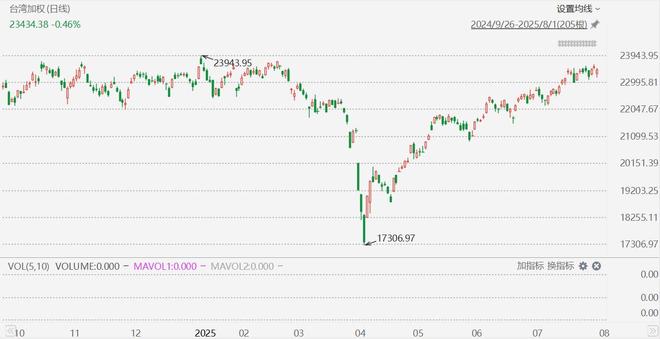
来源:格隆汇APP 格隆汇8月1日|台湾加权指数收盘下跌108.14点,跌幅0.46%,报23434.38点。台积电(2330.TW)收跌 1.72%,报1140元新台币。 ...
台股收涨0.34%
Xin Lang Cai Jing· 2025-07-31 05:53
来源:格隆汇APP 格隆汇7月31日丨台湾加权指数收盘上涨80.8点,涨幅0.34%,报23542.52点。台积电(2330.TW)收涨 0.43%,报1160元新台币。 ...
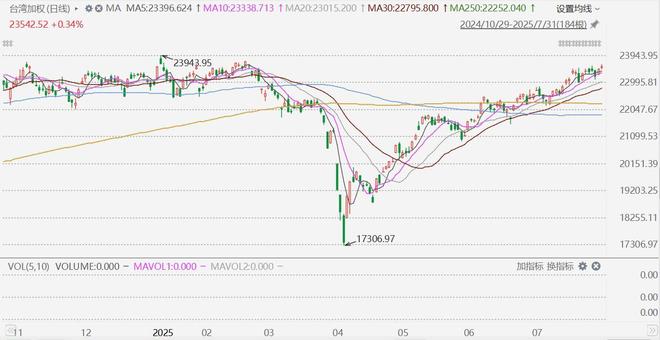
台湾证交所加权股价指数收涨0.3%,至23,542.52点,至2月24日以来最高收盘水平。台积电上涨0.4%。
news flash· 2025-07-31 05:42
台湾证交所加权股价指数收涨0.3%,至23,542.52点,至2月24日以来最高收盘水平。台积电上涨0.4%。 ...
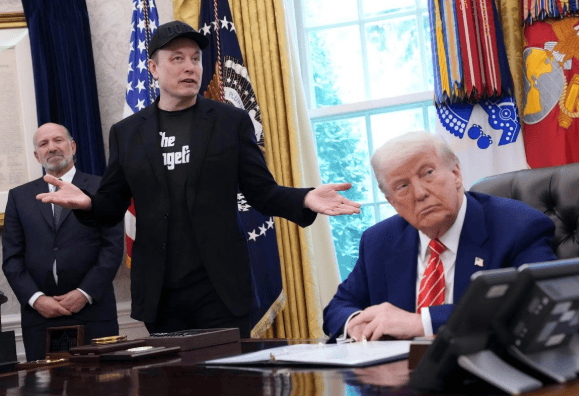
三星与特斯拉签千亿大单,马斯克发声,特朗普开始讨好,商人总是唯利是图
Sou Hu Cai Jing· 2025-07-31 03:32
Core Insights - Samsung Electronics' stock surged by 5.54% following a significant contract with Tesla worth 22.8 trillion KRW (approximately 118.3 billion RMB) for chip manufacturing, marking a pivotal moment for the company in the competitive semiconductor market [1][3] - The contract is expected to account for 7.6% of Samsung's revenue in 2024 and is seen as a crucial opportunity for the company to recover from recent struggles in the foundry market, where it has lost market share to TSMC [1][3] - Elon Musk's personal involvement in overseeing production efficiency highlights the strategic importance of AI chips for Tesla's future ambitions, including autonomous driving and robotics [5][8] Company and Industry Summary - The contract with Tesla is set to last until the end of 2033, with Samsung initially producing A14/AI4 chips, while the next-generation AI6 chips will be manufactured at a new facility in Texas [1][3] - TSMC currently dominates the foundry market with a 67.6% share, while Samsung's share has decreased from 8.1% to 7.7%, indicating a challenging environment for Samsung in securing major clients [3] - The Texas facility has faced delays, originally scheduled for completion in April 2023 but now pushed back to October 2023, with rumors suggesting it could be delayed until 2027 [3] - Analysts predict that this contract could increase Samsung's foundry sales by 10% and attract additional partnerships with other chip design companies [3][9] - Musk's plans for a $12 billion debt financing for chip procurement and data center construction further emphasize the critical role of hardware supply in Tesla's growth strategy [5][9] - The evolving political landscape, particularly Trump's changing stance towards Musk and Tesla, reflects the intertwined nature of business interests and government relations in the tech and automotive sectors [8][9]
凌晨重磅!罕见反对!美股跳水,黄金暴跌!
中国基金报· 2025-07-31 00:21
Core Viewpoint - The Federal Reserve decided to maintain the benchmark interest rate unchanged, with notable internal dissent among board members, marking the first time since 1993 that multiple members voted against the decision [2][4]. Group 1: Federal Reserve Decision - The Federal Open Market Committee voted 9-2 to keep the federal funds rate target range at 4.25% to 4.5%, marking the fifth consecutive meeting without a rate change since January [4]. - Board members Michelle Bowman and Christopher Waller opposed the decision, advocating for an immediate rate cut, highlighting significant internal disagreement [4]. Group 2: Market Reactions - Following the announcement, U.S. stock indices experienced a sharp decline, with the Dow Jones Industrial Average falling by 0.38%, the S&P 500 down by 0.12%, while the Nasdaq Composite rose by 0.15% [5][6]. - The closing figures for the indices were: Dow Jones at 44,461.28, Nasdaq at 21,129.67, and S&P 500 at 6,362.90 [7]. Group 3: Economic Outlook - Federal Reserve Chairman Jerome Powell stated that no decisions have been made regarding the September meeting, emphasizing the need to evaluate the latest economic data and trade policy impacts [10]. - The market's expectations for a rate cut in September decreased, with the probability of a 25 basis point cut dropping from 64% to 46% [10]. Group 4: Economic Indicators - Powell noted that while the U.S. economy remains generally robust, recent data indicates a slowdown in economic activity, primarily due to reduced consumer spending [13][14]. - Inflation rates have significantly decreased since mid-2022 but remain slightly above the long-term target of 2%, with the overall Personal Consumption Expenditures (PCE) price index rising by 2.5% over the past 12 months [14]. Group 5: Gold Market Impact - The decision by the Federal Reserve and Powell's comments led to a significant drop in gold prices, which fell by over 1.5% [15][16]. Group 6: Microsoft Performance - Microsoft reported better-than-expected earnings and revenue, with a market capitalization surpassing $4 trillion, making it the second company to achieve this milestone after Nvidia [18][21]. - For the fourth fiscal quarter, Microsoft’s revenue increased by 18% year-over-year to $64.7 billion, marking the fastest growth in over three years [23]. - Azure revenue grew by 39% in the fourth quarter, exceeding analyst expectations, with projections for Azure and other cloud services to exceed $75 billion in fiscal year 2025, a 34% increase from the previous fiscal year [23].