Arm Holdings plc

Search documents
华虹公司筹划收购华力微,寒武纪近40亿定增方案获上交所通过
Mei Ri Jing Ji Xin Wen· 2025-08-18 01:32
Group 1 - The Shanghai stock market shows positive performance with the Shanghai Composite Index rising by 0.83% to 3696.77 points, the Shenzhen Component Index increasing by 1.60% to 11634.67 points, and the ChiNext Index up by 2.61% to 2534.22 points [1] - The overnight US market had mixed results, with the Dow Jones Industrial Average up by 0.08%, while the S&P 500 and Nasdaq Composite fell by 0.29% and 0.40% respectively [1] - The Philadelphia Semiconductor Index dropped by 2.26%, with notable declines in major semiconductor stocks such as Micron Technology down by 3.53% and Applied Materials down by 14.07% [1] Group 2 - Huahong Semiconductor announced plans to acquire controlling interest in Shanghai Huali Microelectronics through a combination of share issuance and cash payment to resolve IPO-related competition issues [2] - Shanghai Bayi Shikong's KrF resin has completed multiple client certifications and is set to begin trial production at its high-end photoresist resin production line [2] - Cambricon, a leading domestic AI chip company, has received approval for its nearly 4 billion yuan targeted issuance plan, marking significant support for its future technology development and market expansion [2] Group 3 - The Sci-Tech Innovation Semiconductor ETF (588170) tracks the Shanghai Stock Exchange Sci-Tech Innovation Board Semiconductor Materials and Equipment Theme Index, focusing on semiconductor equipment (59%) and materials (25%) [3] - The Semiconductor Materials ETF (562590) and its linked funds also emphasize semiconductor equipment (59%) and materials (24%), highlighting the importance of the semiconductor upstream sector [3] - The semiconductor materials and equipment industry is crucial for domestic substitution, characterized by low domestic replacement rates and high potential for growth, benefiting from the expansion of semiconductor demand driven by the AI revolution [3]


真“亲儿子”!英伟达9成持仓押注Coreweave
美股IPO· 2025-08-15 13:25
Core Viewpoint - Nvidia has heavily invested in AI cloud computing, with 91.36% of its public holdings concentrated in CoreWeave, totaling $3.96 billion [1][3][4] Group 1: Investment Strategy - Nvidia's investment strategy includes a diversified portfolio in AI-related companies, with significant stakes in Arm, Applied Digital, Nebius, and Recursion Pharmaceuticals [3][8] - CoreWeave is positioned as a key asset in Nvidia's portfolio, reflecting confidence in AI infrastructure [6][10] Group 2: CoreWeave's Performance - CoreWeave reported Q2 revenue of $1.2 billion, a year-over-year increase of over 300%, although its stock price recently dropped nearly 21% due to lower-than-expected revenue growth and increased capital expenditure plans [4][11] - Analysts predict CoreWeave's revenue could grow by 127% next year, potentially reaching $11 billion, highlighting strong demand for AI computing [6] Group 3: Challenges and Market Dynamics - CoreWeave faces challenges, including over $11 billion in total debt and cash consumption during network expansion, alongside a significant stock unlock event that may pressure its share price [10][11] - The upcoming stock unlock will test market enthusiasm for AI infrastructure, as approximately 84% of Class A shares will be released, primarily held by insiders and Nvidia [4][11]


英伟达Q2持仓曝光:9成仓位豪赌CoreWeave
Hua Er Jie Jian Wen· 2025-08-15 12:57
Core Insights - Nvidia has heavily invested in CoreWeave, allocating 91.36% of its public holdings, amounting to $3.96 billion, indicating a strong belief in AI cloud computing services [1][2] - CoreWeave's revenue for Q2 reached $1.2 billion, showing a year-over-year growth of over 300%, although its stock price recently dropped nearly 21% due to lower-than-expected revenue growth and increased capital expenditure plans [1][4] - The company is facing a significant unlock of approximately 84% of Class A shares, which may lead to market volatility [1][4] Investment Diversification - Besides CoreWeave, Nvidia holds stakes in several other AI-related companies, including Arm (4.11%), Applied Digital (1.79%), Nebius (1.52%), and Recursion Pharmaceuticals (0.90%) [3] - Arm is expanding its energy-efficient architecture into data centers, while Applied Digital focuses on high-performance computing infrastructure [3] - Recursion Pharmaceuticals applies machine learning in drug discovery, showcasing Nvidia's interest in AI-driven healthcare [3] Challenges Facing CoreWeave - CoreWeave is burdened with over $11 billion in total debt and is consuming cash while expanding its network [4] - Despite these challenges, the company has a strong customer base, with major tech firms like Microsoft and Meta increasing their capital expenditure forecasts [4] - CoreWeave has secured a $4 billion four-year expansion agreement with OpenAI and announced a $9 billion stock acquisition of Core Scientific [4]
英伟达(NVDA.US)Q2持仓:91%仓位重仓“亲儿子”CoreWeave(CRWV.US) 持仓市值暴增至43亿美元
智通财经网· 2025-08-15 08:12
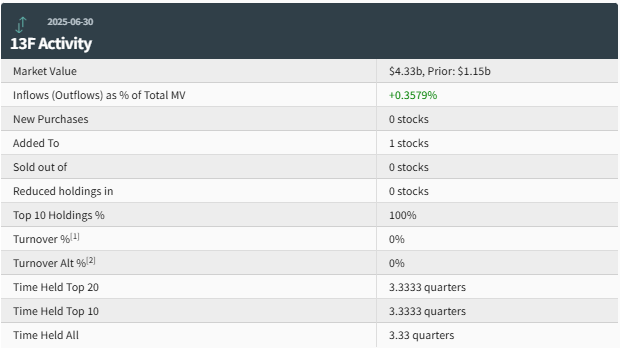
Core Viewpoint - CoreWeave continues to receive significant support from Nvidia, with Nvidia's Q2 holdings in CoreWeave increasing to $4.33 billion from $1.15 billion in the previous quarter, indicating a strong commitment to the cloud AI infrastructure provider [1][2]. Holdings Summary - Nvidia's total market value of holdings in CoreWeave reached approximately $3.96 billion, representing 91.36% of its investment portfolio, with a slight increase of 0.39% in the number of shares held [2][5]. - CoreWeave has seen a cumulative stock price increase of about 318% since its NASDAQ listing in March, although it has recently experienced a decline due to increased losses and lower-than-expected guidance [3]. - A significant portion of CoreWeave's A-class shares, approximately 84%, will be unlocked soon, primarily held by insiders, including the CEO and Nvidia [3]. - Other notable holdings in Nvidia's portfolio include Arm with a market value of approximately $178 million (10.25% of the portfolio) and Applied Digital with a market value of about $77.7 million (3.78% of the portfolio) [3][4].

华尔街对冲基金13F报告:押注大型科技股,联合健康成热门标的
Feng Huang Wang· 2025-08-15 07:54
Group 1: Hedge Fund Investment Trends - Major hedge funds like Bridgewater, Tiger Global, and Discovery Capital increased investments in large tech companies in Q2 due to unprecedented growth in the AI sector [1][2] - These funds reduced exposure to aerospace, defense, consumer, and retail sectors, indicating a strategic shift towards technology [1] Group 2: Performance of Tech Stocks - Tech stocks have rebounded significantly, with the S&P 500 index rising 10% this year, largely driven by large tech companies that account for nearly one-third of the index's total market capitalization [2] - Bridgewater's investment in Nvidia increased over twofold, holding 7.23 million shares by the end of June, with a total investment of $1.14 billion [2] Group 3: Specific Fund Activities - Discovery Capital nearly doubled its stake in Meta and established a new position in CoreWeave, betting on sustained demand in the AI sector [3] - Tiger Global increased its holdings in several "Big Seven" companies, including Amazon and Nvidia, with Amazon shares reaching a total value of $2.34 billion [5] - Coatue Management built new positions in ARM Holdings and Oracle, investing approximately $750 million and $843 million respectively, focusing on AI-related business [6] Group 4: UnitedHealth Group Interest - UnitedHealth Group emerged as a popular investment target, with significant investments from Berkshire Hathaway and other hedge funds despite a 46% drop in its stock price this year due to rising costs and other challenges [8]



麻省理工大学:《通往通用人工智能之路》的研究报告
欧米伽未来研究所2025· 2025-08-15 06:45
Core Viewpoint - The report emphasizes the rapid evolution of Artificial General Intelligence (AGI) and the significant challenges that lie ahead in achieving models that can match or surpass human intelligence [2][9]. Summary by Sections AGI Definition and Timeline - The report defines AGI and notes that the timeline for its realization has dramatically shortened, with predictions dropping from an average of 80 years to just 5 years by the end of 2024 [3][4]. - Industry leaders, such as Dario Amodei and Sam Altman, express optimism about the emergence of powerful AI by 2026, highlighting its potential to revolutionize society [3]. Current AI Limitations - Despite advancements, current AI models struggle with tasks that humans can solve in minutes, indicating a significant gap in adaptability and intelligence [2][4]. - The report cites that pure large language models scored 0% on certain benchmarks designed to test adaptability, showcasing the limitations of current AI compared to human intelligence [4][5]. Computational Requirements - Achieving AGI is expected to require immense computational power, potentially exceeding 10^16 teraflops, with training demands increasing rapidly [5][6]. - The report highlights that the doubling time for AI training requirements has decreased from 21 months to 5.7 months since the advent of deep learning [5]. Need for Efficient Computing Architectures - The report stresses that merely increasing computational power is unsustainable; instead, there is a need for more efficient, distributed computing architectures that optimize speed, latency, bandwidth, and energy consumption [6][7]. - Heterogeneous computing is proposed as a viable path to balance and scale AI development [6][7]. The Role of Ideas and Innovation - The report argues that the true bottleneck in achieving AGI lies not just in computation but in innovative ideas and approaches [7][8]. - Experts suggest that a new architectural breakthrough may be necessary, similar to how the Transformer architecture transformed generative AI [8]. Comprehensive Approach to AGI - The path to AGI may require a collaborative effort across the industry to create a unified ecosystem, integrating advancements in hardware, software, and a deeper understanding of intelligence [8][9]. - The ongoing debate about the nature and definition of AGI will drive progress in the field, encouraging a broader perspective on intelligence beyond human achievements [8][9].

沙特主权财富基金PIF Q2持仓:买入礼来(LLY.US)等医药股看涨期权 清仓Meta(META.US)
智通财经网· 2025-08-15 02:33
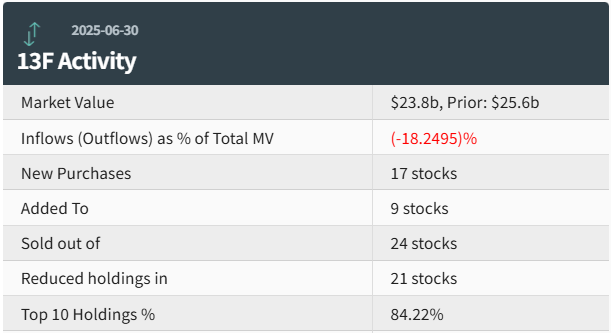
Core Insights - The Saudi Public Investment Fund (PIF) reported a total market value of $23.8 billion for its U.S. stock holdings as of June 30, 2025, down from $25.6 billion in the previous quarter, representing a 7% decrease [1][2] - PIF added 17 new stocks, increased holdings in 9 stocks, reduced holdings in 21 stocks, and completely sold out of 24 stocks during the second quarter [1][2] Holdings Overview - The top five holdings include Uber (UBER.US) with approximately 72.8 million shares valued at $6.8 billion, representing 28.54% of the portfolio; Electronic Arts (EA.US) with about 24.8 million shares valued at $4 billion, accounting for 16.64%; Lucid (LCID.US) with around 1.77 billion shares valued at $3.7 billion, making up 15.69%; Take-Two Interactive (TTWO.US) with about 11.4 million shares valued at $2.8 billion, representing 11.64%; and Arm call options (ARM.US) with approximately 8.97 million shares valued at $1.5 billion, constituting 6.09% of the portfolio [3][4][5] Changes in Holdings - The top five purchases by percentage change in the portfolio were Arm call options, Lilly call options (LLY.US), UnitedHealth call options (UNH.US), Vertex Pharmaceuticals call options (VRTX.US), and Mastercard call options (MA.US) [6][7] - The top five sales by percentage change in the portfolio included Salesforce call options (CRM.US), Starbucks call options (SBUX.US), Meta (META.US), Microsoft call options (MSFT.US), and Linde call options (LIN.US) [6][7] Additional Insights - The top ten holdings accounted for 84.22% of the total market value of PIF's U.S. stock portfolio [1][2] - PIF's significant sell-offs included major companies such as Visa (V.US), Shopify (SHOP.US), Sea (SE.US), PayPal (PYPL.US), Meta (META.US), and FedEx (FDX.US) [5]




CDNS Stock Gains 25% in a Year: Stay Invested or Book Profits?
ZACKS· 2025-08-14 16:06
Core Insights - Cadence Design Systems (CDNS) stock has increased by 24.6% over the past year, outperforming the Computer-Software industry (up 23.1%), the broader Computer and Technology sector (up 24.2%), and the S&P 500 composite (up 17.5%) [1] - The company has seen a 4.6% rise since July 28, following a better-than-expected second-quarter performance, with the stock closing at $349.12, below its 52-week high of $376.45 [2] Growth Drivers - AI is significantly transforming semiconductor and system design, with Cadence being well-integrated into this shift. Key growth drivers include 5G, hyperscale computing, and autonomous vehicles [3] - The rapid adoption of Generative AI, Agentic AI, and Physical AI is leading to increased computing needs and semiconductor innovation, benefiting Cadence. The company collaborates with industry leaders like Qualcomm and NVIDIA on next-generation AI designs [4] - Rising R&D spending by customers focused on AI-driven automation is expected to benefit Cadence. The company is unifying its capabilities across various domains to capture opportunities from the ongoing AI supercycle [5] Financial Performance - Cadence's ratable software model, strong backlog, and high recurring revenue mix provide resilience amid macroeconomic volatility [6] - Core EDA revenues grew by 16% year over year in the second quarter, driven by demand from AI and hyperscale clients. The company launched Cerebrus AI Studio, which offers significant improvements in chip design efficiency [9] - The IP business saw a 25% year-over-year revenue increase in the second quarter, supported by a broadening silicon solutions portfolio and rising demand in AI and HPC [10] - Management has upgraded its revenue outlook for 2025 to a range of $5.21-$5.27 billion, with non-GAAP EPS expected between $6.85 and $6.95 [12] Cash Flow and Shareholder Returns - As of June 30, 2025, Cadence had cash and cash equivalents of $2.823 billion, with operating cash flow of $378 million and free cash flow of $334 million. The company repurchased shares worth $175 million in the second quarter and plans to execute $200 million in repurchases in the third quarter [13] Competitive Landscape - The company faces headwinds from global macroeconomic conditions and competition in the EDA/AI space, particularly from Keysight Technologies and Synopsys, which recently acquired ANSYS [15] - Cadence generates a significant portion of its revenues from international markets, with 47% of revenues coming from the U.S. in 2024. Adverse foreign currency exchange rates could impact revenue growth [16] - Cadence stock is trading at a premium, with a forward 12-month Price/Earnings ratio of 46.83X compared to the industry's 35.12X [17] Conclusion - Cadence's strong fundamentals, robust AI-driven demand, and resilient recurring revenue model position it well for long-term growth, despite macro uncertainties and competitive pressures [18]


桥水二季度增持英伟达等科技股,清仓中概股
Xin Lang Cai Jing· 2025-08-14 15:15
Core Insights - Bridgewater significantly increased its investments in major U.S. tech companies during Q2 2023, particularly in Nvidia, which saw a 154% increase in shares held [1][2] - The fund's strategy included both substantial increases in holdings of certain companies and a complete exit from others, particularly in the Chinese stock market [2][3] Group 1: Increased Holdings - Bridgewater added nearly 4.39 million shares of Nvidia, bringing total holdings to 7.23 million shares, making it the third-largest position at 4.61% of the portfolio [1] - Microsoft was another key focus, with an increase of approximately 905,600 shares, totaling 1.72 million shares, a 111.9% increase, elevating its position to sixth at 3.44% [1] - Alphabet (Google's parent company) saw an increase of nearly 2.56 million shares, totaling 5.6 million shares, an 84.1% increase, raising its holding percentage from 2.18% to 3.98% [1] - Meta's shares increased by approximately 89.6%, from 426,000 shares to 807,000 shares, making it the seventh-largest holding [1] Group 2: New Investments - Bridgewater initiated a position in chip design company Arm with nearly 474,000 shares, representing 0.31% of the total portfolio [3] - The fund also entered positions in Intuit (approximately 59,000 shares), EQT (787,000 shares), Lyft (approximately 2.48 million shares), and Ulta Beauty (over 58,000 shares), although these new holdings represent a small portion of the overall investment [3] Group 3: Reduced Holdings - The fund reduced its stake in Amazon by approximately 795,500 shares, a 6% decrease, bringing its holding to 1.10% and making it the 20th largest position [2] - AMD shares were reduced by 408,900 shares, lowering its holding percentage to 1.0% [2] - Bridgewater completely exited its positions in Alibaba, Baidu, and JD.com, having previously increased its stake in Alibaba significantly in Q1 2023 [2] Group 4: ETF Holdings - SPDR S&P 500 ETF remains Bridgewater's largest holding, despite a reduction of 732,000 shares, a decline of approximately 21.9% [3] - The second-largest holding is iShares Core S&P 500 ETF, which saw an increase of nearly 6.2% to approximately 2.31 million shares [3] - Nvidia ranks third in holdings, followed by a decrease in the emerging markets ETF (IEMG) by 9.4% [3]
桥水二季度大举增持英伟达,加仓谷歌、微软、Meta,清仓阿里等中概
华尔街见闻· 2025-08-14 10:46
Core Viewpoint - Bridgewater Associates, one of the largest hedge funds globally, significantly increased its investments in major U.S. tech companies during the second quarter of this year, particularly in Nvidia, which is now its third-largest holding [1][3]. Summary by Sections Investment Increases - Bridgewater raised its stake in Nvidia by nearly 4.39 million shares, bringing its total to 7.23 million shares, a 154% increase from the previous quarter, making up 4.61% of its total portfolio [3][7]. - Microsoft saw a 111.9% increase in shares, with an additional 905,620 shares added, totaling 1.72 million shares, now representing 3.44% of the portfolio [3][7]. - Alphabet was increased by approximately 2.56 million shares, totaling 5.60 million shares, an 84.1% rise, now accounting for 3.98% of the portfolio [3][7]. - Meta's shares increased by over 38,146 shares to 807,073 shares, marking an 89.6% increase, now 2.40% of the portfolio [4][7]. - Uber's shares surged by 314,000, a 531% increase, now making up 1.41% of the portfolio [5][7]. - Johnson & Johnson's shares increased by over 199,000, a 667.8% rise, now 1.41% of the portfolio [6][7]. Investment Reductions - Bridgewater reduced its Amazon holdings by approximately 795,500 shares, a 6% decrease, now 1.10% of the portfolio [8][9]. - AMD shares were reduced by about 408,860 shares, a decrease of 18.89% [11]. - PayPal saw a reduction of nearly 447,790 shares, a drop of over 12% [10]. - The fund completely exited its positions in Alibaba, Baidu, and JD.com, which were previously increased in the first quarter [12][13]. New Investments - Bridgewater initiated a position in Arm with nearly 474,000 shares, representing 0.31% of the total portfolio [14]. - New positions were also taken in Intuit, EQT, Lyft, and Ulta Beauty, with each holding a small percentage of the overall portfolio [14]. Major Holdings - The SPDR S&P 500 ETF remains Bridgewater's largest holding, despite a reduction of 731,882 shares, now accounting for 6.51% of the portfolio [15][18]. - The iShares Core S&P 500 ETF increased by nearly 6.2% to approximately 2.31 million shares, now 5.78% of the portfolio [17][18]. - The second to tenth largest holdings include Nvidia, Alphabet, Microsoft, Meta, Salesforce, Booking Holdings, and GE Vernova, with various changes in share counts and percentages [17][18].