吉利汽车

Search documents
股票市场概览:资讯日报:美国非农就业创造一年最大增长-20260212
Guoxin Securities Hongkong· 2026-02-12 03:48
Employment Data - In January 2026, the U.S. non-farm payrolls increased by 130,000, significantly exceeding the market expectation of 55,000[9] - The unemployment rate fell to 4.3%, lower than the anticipated 4.4%[9] - Job growth was heavily concentrated in the healthcare sector, which added 124,000 jobs, approximately double the average monthly increase for 2025[9] Market Performance - On February 11, 2026, major indices in the U.S. experienced slight declines after an initial boost from the employment data[9] - The S&P 500 index closed at 6,941, with a year-to-date increase of 1.40%[3] - The Nasdaq index closed at 23,066, showing a year-to-date decline of 0.76%[3] Sector Highlights - Gold stocks performed well, with Zijin Mining International rising over 9% and Lingbao Gold increasing by more than 7%[9] - Automotive stocks collectively strengthened, with Li Auto and Geely both rising over 2% due to the continuation of the vehicle trade-in policy[9] - Cement and building materials stocks surged, with China National Building Material increasing by over 11%[9] Technology Stocks - Major tech stocks showed mixed results, with Nvidia up 0.80% and Micron Technology soaring 9.94%, while Microsoft and Google fell by 2.15% and 2.39%, respectively[9]
多家主流车企公布2026年销量目标,最高增速达67.5% 中安在线-新能源汽车
Mei Ri Jing Ji Xin Wen· 2026-02-12 02:56
Group 1 - In 2026, traditional automotive groups are focusing on steady growth strategies, emphasizing the deepening transformation of their new energy businesses and expansion into overseas markets [1] - Major traditional automakers have set growth targets of 10% to 15% for 2026, with new energy vehicles being a key driver for sales increases [2] - Geely aims for a sales target of 3.45 million units in 2026, a 14% increase from 2025, with a significant focus on new energy vehicle sales reaching 2.22 million units, a 32% increase [2] - Changan plans to sell 3.3 million units in 2026, a 13.3% increase, with new energy vehicle sales targeted at 1.4 million units, a 26.2% increase [2] - Chery Group targets 3.2 million units for 2026, a 14.03% increase, with a strong emphasis on new energy vehicles, which accounted for over 90% of new products launched [3] - Dongfeng Group also sets a target of 3.25 million units for 2026, with 1.7 million in new energy vehicles and 600,000 for exports [3] - Great Wall Motors adopts a more cautious approach, setting a target of at least 1.8 million units for 2026, indicating a need for transformation in its new energy business [4] Group 2 - New energy vehicle startups and tech companies are setting aggressive sales targets for 2026, with some aiming for growth rates as high as 67.5% [5] - Leap Motor aims for a sales target of 1 million units in 2026, representing a 67.5% increase from 2025, following a strong growth of 103% in 2025 [5] - Xiaomi plans to deliver 550,000 vehicles in 2026, a 34% increase, with plans to launch four new models to enhance its product matrix [5] - NIO targets a sales growth rate of 40% to 50% for 2026, estimating sales between 456,000 and 489,000 units, supported by new model launches [5] - The overall market for passenger vehicles in China is expected to see a slight growth of 1% in 2026, with a projected retail volume of approximately 24 million units [6] - The competition in the domestic automotive market is expected to intensify, leading to a more challenging environment for all automakers [6]
面板收入暴涨150%,被苹果抛弃的Micro LED,终于被「AI眼镜」救活了
3 6 Ke· 2026-02-12 02:51
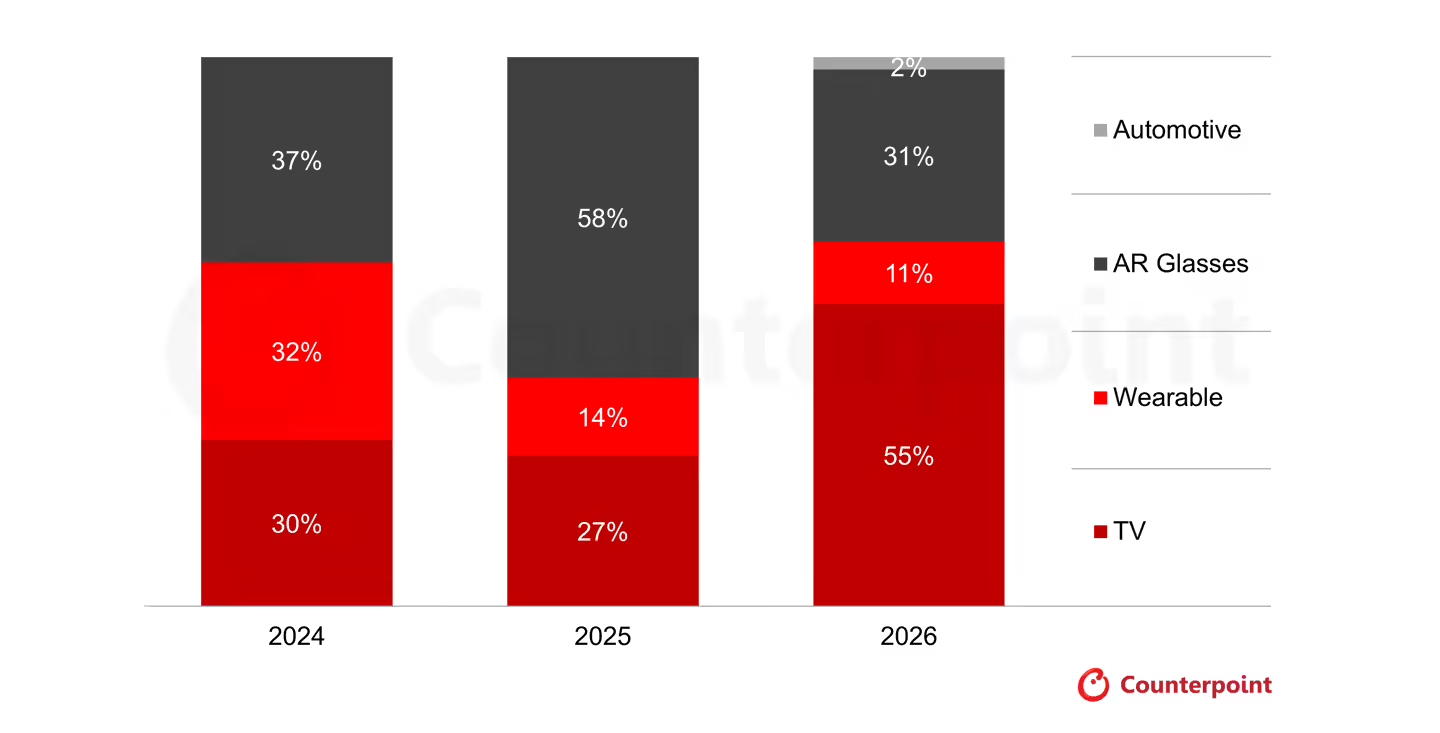
Core Insights - Apple has abandoned its long-term investment in Micro LED technology due to challenges in mass production, but recent developments indicate a resurgence in the Micro LED market driven by the explosive growth of AR smart glasses, with a reported revenue increase of 150% year-over-year [1][20]. Group 1: Market Trends - The AI smart glasses market is rapidly expanding, with most current models featuring AI capabilities, benefiting the Micro LED industry [3]. - Major brands are launching AI glasses in 2025, with a notable trend of using Micro LED technology, indicating its status as a standard for high-end smart glasses [4][21]. Group 2: Product Highlights - The Thunder X3 Pro, set to launch in May 2025, features dual full-color Micro LED technology, achieving an eye brightness of 3500 nits and peak brightness of 6000 nits, targeting the high-end market with a price near 10,000 yuan [4]. - Lenovo's AI glasses V1 utilize a monochrome Micro LED solution with a peak brightness of 2000 nits, priced at 3999 yuan, showcasing a more affordable option [6]. Group 3: Technical Advantages - Micro LED technology is distinguished from traditional LED screens, as it consists of tiny micro-displays that project images through optical systems, making it suitable for compact devices like AI glasses [10]. - Micro LED is seen as the next-generation display technology following Mini LED, offering significant brightness advantages crucial for outdoor use [11]. Group 4: Competitive Landscape - JBD, a key player in the Micro LED space, supplies micro-displays and optical modules for many AI glasses, indicating its strong market position and technological edge [21][25]. - JBD's micro-displays have high pixel density and brightness, making them ideal for AR applications, and the company has attracted investments from major firms like Alibaba and BYD [25]. Group 5: Future Outlook - The Micro LED technology is expected to find broader applications beyond AI glasses, potentially impacting sectors like smart automotive and robotics, suggesting a promising growth trajectory for JBD and the Micro LED market [25].

1月车市燃油车销量“抬头”多款车型价格降幅高于30%
Mei Ri Jing Ji Xin Wen· 2026-02-12 02:35
Core Viewpoint - The domestic automotive market is witnessing a shift as fuel vehicles are increasingly adopting intelligent features to compete with electric vehicles, driven by consumer demand for smart driving capabilities and the rising market share of electric vehicles [1][5]. Group 1: Market Trends - Consumers are showing a preference for fuel vehicles equipped with advanced intelligent configurations, leading to a notable change in purchasing behavior [1]. - The new Honda Fit, dubbed the "people's supercar," sold out its initial 3,000 units within 20 days, indicating a strong demand for competitively priced fuel vehicles [2]. - Many fuel vehicle models have seen price reductions of 30% to 40%, with some luxury models experiencing even greater discounts [2][3]. Group 2: Sales Performance - In January, fuel vehicle sales showed significant growth, with SAIC Group selling 242,000 units, a year-on-year increase of 19.19% [6]. - Geely's fuel vehicle sales reached 134,400 units in January, with over 100,000 units coming from the "Chinese Star" series [6]. - GAC Toyota also reported positive sales growth in January, with the Camry model achieving a 17% year-on-year increase [6]. Group 3: Strategic Initiatives - The "Oil-Electricity Co-Intelligence" strategy has been adopted by major automakers, aiming to enhance the competitiveness of fuel vehicles by integrating smart technologies [5][6]. - Companies like FAW-Volkswagen plan to launch multiple new models equipped with intelligent cockpit and driving assistance systems by 2026, showcasing the potential for fuel vehicles to be equally intelligent [6][7]. - The top five brands in the fuel vehicle market have increased their market share from 29% in 2020 to 37% in 2025, indicating a strengthening of leading brands in the sector [7].


2026格局与趋势丨(下):汽车制造商痛失定价权
3 6 Ke· 2026-02-12 01:52
Core Insights - Tesla is shifting its production focus from Model S and Model X to the Optimus robot, indicating a broader industry trend towards innovation and transformation amidst profit challenges [1] - The automotive industry is facing a profit crisis, with a projected profit margin of only 4.1% in 2025, significantly lower than the 5.9% margin of downstream industries [4][6] - The price war initiated by Tesla has spread across the entire automotive market, leading to a decline in revenue and profit margins for many manufacturers [6][8] Industry Challenges - The automotive sector is experiencing a "spiral of death" in profits due to five core factors: intense price competition, rising costs, imbalanced profit distribution, overcapacity, and the pains of electrification [3] - In December 2025, the industry's profit margin fell to a historic low of 1.8%, with revenues declining by 0.8% while costs increased by 0.8%, creating a "scissors gap" [6][8] - The overall capacity utilization rate for the automotive industry is projected to be 73.2% in 2025, below the healthy threshold of 75%, with some joint ventures operating at only 40-60% [8][9] Financial Performance - The automotive industry's revenue is expected to reach approximately 11.18 trillion yuan in 2025, reflecting a year-on-year growth of 7.1% [4] - The cost of production is anticipated to rise by 8.1% in 2025, leading to a decrease in per vehicle revenue by 1.6 million yuan and continuous pressure on gross profit margins [8] - The average profit margin for automotive dealers is projected to be around 4.1%, with over 58% of dealers expected to incur losses in 2025 [10][12] Supply Chain Dynamics - The supply chain is experiencing a bifurcation, with suppliers showing moderate improvement while dealers face significant losses [12] - The dominance of battery manufacturers like CATL is evident, as they captured 76.9% of the net profits in the industry, with CATL alone accounting for 68.1% [27][29] - The shift in value from traditional automotive manufacturers to technology and battery suppliers is reshaping the industry's profit landscape [14][27] Future Outlook - The automotive industry is expected to face ongoing challenges from rising costs in chips and materials, with potential cost increases of 4,000 to 7,000 yuan per vehicle due to supply chain pressures [35] - The transition towards electric and smart vehicles is creating a competitive environment where traditional manufacturers are losing pricing power to tech companies and battery suppliers [21][29] - The long-term outlook suggests that while battery suppliers currently hold significant power, this may shift as competition intensifies and manufacturers seek to reduce dependency on external suppliers [33]


中汽协:绝大多数重点车企已把账期压缩至60天内,一些车企要求供应商下调价格
Xin Jing Bao· 2026-02-12 01:41
Core Insights - The China Automotive Industry Association (CAAM) released a report indicating that most key automotive companies have reduced their payment terms to within 60 days, with an average payment term of approximately 54 days, which is a reduction of about 10 days compared to the same period last year [1] - All surveyed companies are committed to fulfilling their payment term promises, with many establishing special task forces and implementing institutional documents to ensure compliance [2] - By June 2025, 17 automotive companies, including GAC, Dongfeng, FAW, Geely, and BYD, have pledged to standardize supplier payment terms to within 60 days [3] Payment Terms and Practices - The average payment term for key automotive companies is around 54 days, with four companies having terms below 50 days [1] - All 15 surveyed companies utilize cash or bank acceptance bills for payments, with five companies having a cash payment ratio exceeding 50% and two companies exceeding 70% [1] - 17 key companies have set a maximum payment term of 60 days from the acceptance of goods, with 14 companies offering additional preferential policies for small and medium-sized enterprises (SMEs) [1] Process Optimization - Many companies have optimized their financial processes and improved information systems to facilitate automatic payments, reducing delays caused by manual operations [2] - Some companies have changed the starting point for payment terms from the billing date to the date of delivery acceptance, and increased the frequency of settlements from monthly to bi-weekly [2] - Several companies are preparing special funds exceeding 10 billion to improve payment terms for suppliers [2] Challenges and Issues - Despite the improvements, some companies still face issues in supplier payment practices, such as varying starting points for payment terms and management inconsistencies leading to extended payment periods [2] - A few companies have pressured suppliers to lower product prices or accept unreasonable terms under the guise of shortened payment terms [2]
港股开盘:恒指跌0.2%、科指跌0.47%,AI应用及芯片股走高,锂电池概念股活跃,科网股普遍回调
Jin Rong Jie· 2026-02-12 01:33
Market Overview - The Hong Kong stock market opened slightly lower, with the Hang Seng Index down 0.2% at 27,210.56 points, the Hang Seng Tech Index down 0.47% at 5,474.25 points, and the National Enterprises Index down 0.19% at 9,250.27 points [1] - Major tech stocks mostly opened lower, with Alibaba down 1.37%, Tencent down 2.01%, and Meituan down 2.48%, while AI application stocks showed strength, with Zhihui up 8.77% and MINIMAX-WP up 5.65% [1] Company Performance - NetEase reported strong performance, with a net revenue of approximately 112.63 billion yuan, a year-on-year increase of 6.96%, and a net profit of approximately 33.76 billion yuan, up 13.68% [2] - NetEase Cloud Music saw a significant profit increase of 75.4%, with a revenue of 7.76 billion yuan and a profit of 2.75 billion yuan, confirming a turning point in performance [2] Industry Trends - The hard technology and manufacturing sectors showed signs of recovery, with Qiu Tai Technology reporting a 22.8% year-on-year increase in camera module sales and an 18.4% increase in fingerprint recognition module sales, driven by demand in IoT and smart automotive sectors [3] - The renewable energy sector also saw growth, with China Resources Power reporting a 28.4% year-on-year increase in electricity sales, and solar power sales soaring by 72.3% [3] Biopharmaceutical Sector - The biopharmaceutical sector experienced significant positive developments, with Rebio Biotech announcing a global exclusive licensing agreement worth up to 4.4 billion USD, leading to a substantial increase in stock price [4] - Heng Rui Pharmaceutical's product was included in a breakthrough therapy list, with projected global sales exceeding 6.5 billion USD in 2024 [4] Capital Market Activity - Industrial capital is actively engaging in buybacks to stabilize the market, with Geely Automobile repurchasing shares worth approximately 20.30 million HKD and other companies like Kingsoft and Bai Rong Cloud also participating in buybacks [5] - Huili Group is expected to see a profit increase of over 20 times in 2025, indicating a strong performance reversal [5] Institutional Insights - There is a divergence in institutional views regarding market fluctuations, with some suggesting that the recent pullback is a liquidity shock, while others believe that valuation recovery is nearly complete [6] - Specific sectors like AI computing and surgical robots are highlighted for potential growth, with expectations for high performance in 2025 and 2026 [6]

历史性时刻!出口乘用车中新能源占比首次超一半
Di Yi Cai Jing· 2026-02-12 01:03
Group 1 - In January 2026, China's automobile exports reached 681,000 units, marking a year-on-year increase of 44.9% [1] - Passenger car exports accounted for 589,000 units, with a year-on-year growth of 48.9%, while commercial vehicle exports were 93,000 units, up 23.6% [1] - The export of new energy vehicles (NEVs) significantly contributed to this growth, with 302,000 units exported, representing a year-on-year increase of 100% [1] Group 2 - The structure of NEV exports showed that pure electric vehicle exports were 202,000 units, doubling year-on-year, while plug-in hybrid vehicle exports reached 99,000 units, up 97.3% [1] - The shift in the export landscape indicates a historic change, with NEVs now dominating over traditional fuel vehicles in terms of export volume [1] - The report from the China Passenger Car Association highlighted that plug-in hybrid vehicles are becoming a new growth point for exports, particularly in the pickup segment [2] Group 3 - Among the top ten automobile exporters in January, nine companies reported positive growth, with Chery leading at 119,000 units, followed by BYD (100,000 units) and SAIC (97,000 units) [3] - The overall export volume for Chinese automobiles is projected to reach 8.32 million units in 2025, reflecting a year-on-year increase of 30% [3] - The growth is attributed to enhanced overseas market presence and brand investment by Chinese automakers, alongside improvements in the domestic supply chain [3] Group 4 - Recent trends indicate strong performance in automobile exports to regions such as Central and South America, Southeast Asia, and the Middle East, with expectations for continued growth as international market conditions stabilize [4]
新成绩!曹操出行Robotaxi规模达百辆,商业化潜能加速释放
Zhong Guo Zheng Quan Bao· 2026-02-12 00:49
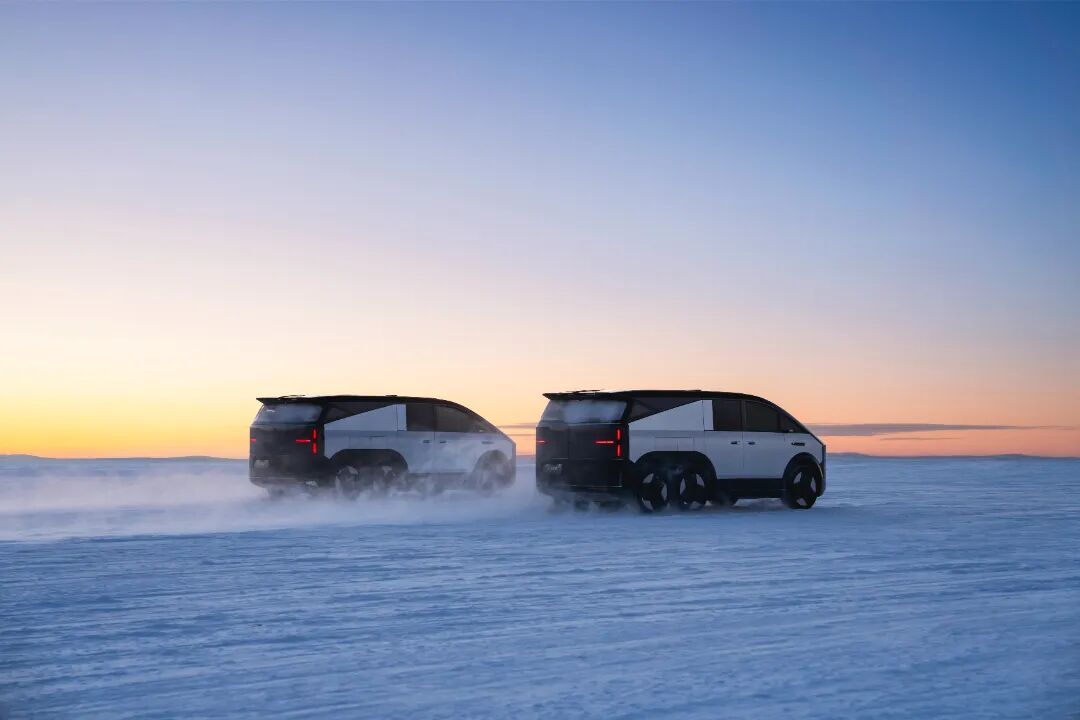
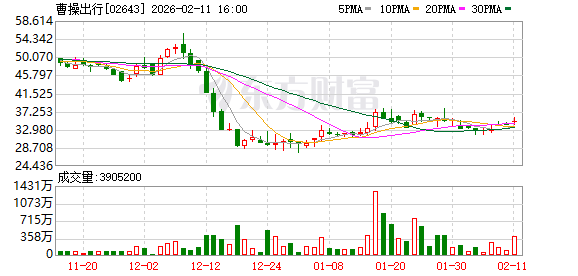
Core Insights - Cao Cao Mobility has reached a significant milestone with the deployment of 100 Robotaxis in Hangzhou, marking the critical start of the Robotaxi 2.0 phase, which aims for unmanned, large-scale, and commercial operations [2][3] - The company plans to continue investing and expanding its market presence both domestically and internationally, leveraging its advanced Robotaxi development model and the support from Geely Holding Group [2][3] Group 1: Robotaxi Development Strategy - Cao Cao Mobility has outlined a clear "three-step" strategy for Robotaxi, transitioning from initial technology validation and small-scale testing to mixed operations of human and unmanned driving, ultimately leading to fully customized Robotaxi commercial operations globally [3] - The company has implemented a "green intelligent passage island" in Hangzhou, enhancing the automation capabilities of Robotaxi operations with features like automatic battery swapping, cleaning, scheduling, and settlement [3][6] Group 2: International Expansion and Collaborations - The company is actively pursuing international collaborations, having signed a memorandum of understanding with the Abu Dhabi Investment Office to establish a local office and promote autonomous driving and green travel technology trials [4] - Cao Cao Mobility's ride-hailing services have expanded to cover 42 countries and regions globally, with recent strategic acquisitions enhancing its product matrix and creating a one-stop platform for travel and business services [9] Group 3: Financial Performance and Growth Potential - In the first half of 2025, Cao Cao Mobility reported significant growth in key financial metrics, with revenue reaching 9.456 billion yuan, a 53.5% year-on-year increase, and a net cash flow from operating activities of 325 million yuan, up 164.6% [10] - The company aims to deploy 100,000 fully customized Robotaxi vehicles by 2030, with projected revenues of 20.67 billion yuan, 26.24 billion yuan, and 32.37 billion yuan for the years 2025 to 2027, respectively [10]
海豹05:新款纯电续航210km,大哥说买完车就准备去辞职
车fans· 2026-02-12 00:29
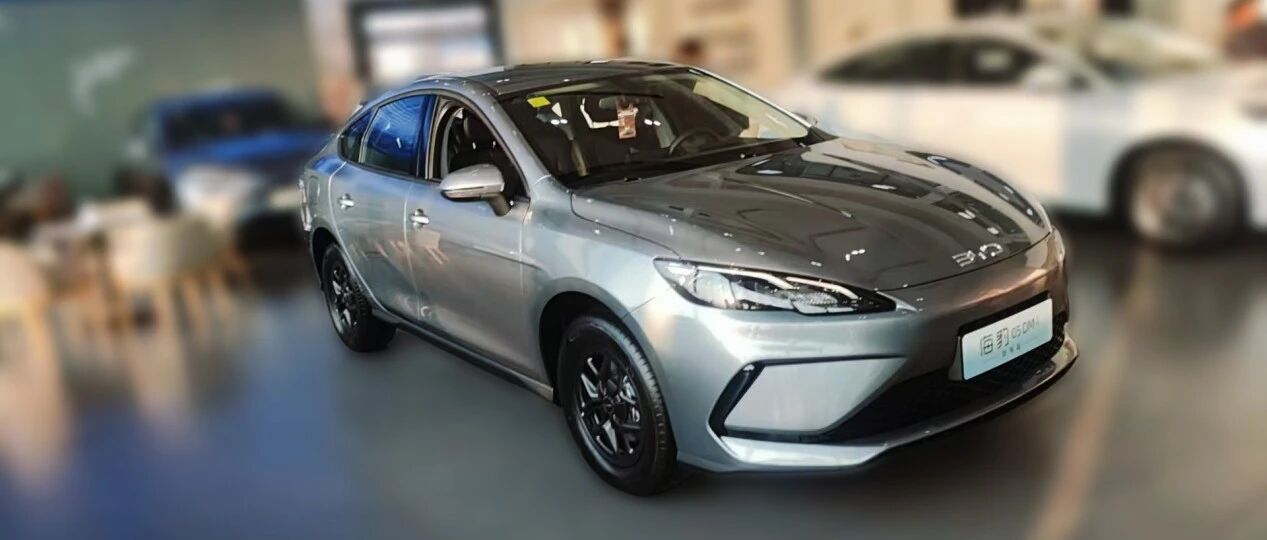
Core Viewpoint - The article discusses the launch and market positioning of the BYD Sea Lion 05, highlighting its competitive pricing and features, particularly the 210 km range version, while also addressing market challenges and customer perceptions [1][4][20]. Group 1: Product Launch and Pricing - The Sea Lion 05 was launched on January 18, with two models priced at 89,800 yuan and 99,800 yuan, respectively, and no current discounts available [2][4]. - The new model primarily features an extended range of 210 km, with no significant changes to other specifications, and lacks a formal launch event [8][15]. - The sales strategy is closely tied to the popularity of the Qin model, with customers expressing concerns about potential price drops in the future [10][19]. Group 2: Customer Insights and Market Competition - Customers often compare the Sea Lion 05 with the Qin and models from Geely, with Geely being a significant competitor due to its quality and design [10][12]. - There is a perception among customers that the current economic climate may lead to further price reductions, impacting their purchasing decisions [8][10]. - A customer shared that using the Sea Lion 05 for ride-hailing could provide a better work-life balance, indicating a shift in consumer behavior towards flexibility in work [12][13]. Group 3: Financing and Purchase Timing - Financing options include a two-year interest-free loan from Agricultural Bank, which is appealing to customers given the vehicle's lower price point [17][18]. - The article suggests that now is a good time for customers in need of a vehicle to make a purchase, especially considering the current market conditions [19]. - The sales team believes that the Sea Lion 05 offers strong value for daily commuting and ride-hailing, despite challenges in the broader market [20].